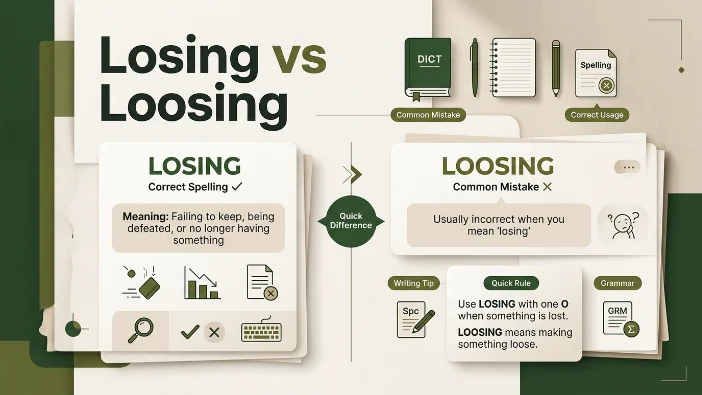
Quick Answer
Losing (spelled with one “o”) is the correct spelling when referring to misplacing something, failing to win, or experiencing a loss. Loosing (spelled with two “o”s) means releasing, setting free, or making something less tight, but it is rarely used in modern English. Most people actually mean “losing” when they type “loosing.”
Have you ever typed Losing vs Loosing? You’re definitely not alone. This spelling confusion trips up countless English writers, from students rushing through assignments to professionals drafting important emails. The problem is that both words look similar and sound almost identical in casual speech, yet they carry completely different meanings.
The truth is that “loosing” appears so infrequently in everyday writing that many grammar resources barely mention it. Yet the misspelling persists because of a simple misunderstanding about how English spelling rules work with verbs ending in “e.” By the time you finish this guide, you’ll never second-guess which spelling to use again. We’ll explore not just the difference between these words but also the grammar patterns that explain why “losing” is almost always the word you need.
What’s the Difference Between Losing and Loosing?
At its core, the difference between these two words comes down to one simple fact: “losing” is a common word you’ll use frequently, while “loosing” is an uncommon word you’ll rarely need. Here’s what each word actually means:
Losing is the present participle of the verb “to lose.” It means failing to keep something, misplacing an object, being defeated in a competition, or experiencing a reduction in quality or quantity.
Loosing is the present participle of the verb “to loose.” It means releasing something from restraint, making something less tight, or setting something free. Think of “loosing arrows from a bow” or “loosing a knot.”
| Aspect | Losing | Loosing |
|---|---|---|
| Meaning | Failing to keep; misplacing; being defeated | Releasing; setting free; making less tight |
| Part of Speech | Verb (present participle) | Verb (present participle) |
| Refers To | Loss, defeat, misplacement | Release, freedom, relaxation |
| Typical Usage | “I’m losing my keys again.” | “She’s loosing the ropes from the dock.” |
| Example | “The team is losing the game.” | “The archer is loosing an arrow.” |
| Common Confusion | Often misspelled as “loosing” | Rarely used in modern English |
Here’s what you really need to remember: “loosing” is almost never the word you want. In professional writing, academic papers, and daily communication, you’ll use “losing” hundreds of times for every single instance of “loosing.” The only time you genuinely need “loosing” is when you’re talking about physically releasing or untying something.
Is “Losing” a Grammar, Vocabulary, or Usage Issue?
This confusion involves grammar, vocabulary, and usage, but the main problem is understanding that “losing” and “loosing” are different words with different meanings. Many writers focus only on spelling, but the real difference comes from knowing which verb they are using and what they want to express.
Grammar Classification
Both “losing” and “loosing” are present participle forms of verbs. They can be used with helping verbs to create continuous tenses or function as descriptive words in certain contexts.
“Losing” comes from the verb “lose,” while “loosing” comes from the verb “loose.” The spelling rules are similar because both words drop the final e before adding “-ing.” However, the grammar pattern is not the reason people confuse them. The real issue is that the two verbs have completely different meanings.
Vocabulary Difference
The biggest difference between “losing” and “loosing” is vocabulary, not grammar. They come from different root words and are not interchangeable.
“Losing” means failing to keep something, no longer having something, or experiencing defeat. For example, someone can lose a game, lose money, or lose an opportunity.
“Loosing” means releasing, setting free, or letting something go. For example, an archer may loose an arrow, or someone may loose an animal from captivity.
Because the meanings are unrelated, replacing one with the other can completely change the message.
Usage Difference
In everyday English, “losing” is extremely common. You will see it in conversations, news reports, workplace communication, sports discussions, and academic writing.
“Loosing,” on the other hand, is rarely used in modern English. It mainly appears in specific situations involving release or freedom, such as historical writing, archery, sailing, or technical descriptions. Most English speakers may go months without needing to use it.
Formal and Business English
In professional writing, “losing” is the correct choice when discussing problems, failures, missed opportunities, or declines.
Examples:
- The company is losing customers.
- The team is losing valuable time.
Using “loosing” in these situations would confuse readers because it suggests releasing something rather than experiencing a loss.
The word “loosing” may appear in rare technical contexts, such as describing the release of equipment or a physical object, but these situations are uncommon in business communication.
Academic Writing
Academic writing requires precise word choice. When discussing financial losses, research outcomes, competition, or reduced performance, “losing” is the correct term.
“Loosing” may only appear in specialized historical or scientific discussions where the meaning involves releasing something. For most academic subjects, writers will never need to use it.
Everyday Conversation
In normal conversation, people almost always use “losing.” You will hear phrases like:
- I’m losing my keys.
- Our team is losing the match.
- She is losing interest.
The word “loosing” often sounds unusual or old-fashioned to modern speakers, which is one reason many people misremember the spelling and accidentally add an extra o to “losing.”
Practical Takeaway
The confusion between “losing” and “loosing” is mainly a vocabulary and usage issue with a spelling challenge attached. Once you understand that losing means no longer having something and loosing means releasing something, choosing the correct spelling becomes much easier.
Losing: The Word You Actually Need Most Often
Let’s begin with “losing” because it is the word you will use far more frequently in everyday English. Understanding its meaning, patterns, and common contexts makes it easier to see why adding an extra “o” creates such a common spelling mistake.
Meaning and Pronunciation
“Losing” (pronounced LOO zing) means failing to win, misplacing something, experiencing a decline, or no longer having something you previously had. It comes from the verb “lose,” which has the irregular past tense “lost.” This unusual pattern is one reason many learners find the spelling confusing.
Examples:
- Losing a game
- Losing your keys
- Losing confidence
- Losing money
Part of Speech
“Losing” is the present participle form of the verb “lose.” Depending on the sentence, it can work in different ways.
Main verb in continuous tenses:
- I am losing my patience.
An adjective:
- The losing team accepted the result.
Gerund functioning as a noun:
- Losing is never easy.
Common Collocations
These common word combinations will help you use “losing” naturally:
- Losing weight
- Losing money
- Losing time
- Losing hope
- Losing your mind
- Losing track of something
- Losing control
- Losing face
Typical Sentence Patterns
Subject + am/is/are + losing + object
Example:
- She is losing her keys again.
Subject + keep + losing + object
Example:
- I keep losing my phone.
Subject + risk + losing + object
Example:
- They risk losing their investment.
Workplace Example
In professional communication, “losing” is commonly used to describe declining results, missed opportunities, or reduced performance.
Example:
“The marketing department has been losing market share for three consecutive quarters. Our competitors are gaining ground while we are losing momentum.”
Academic Example
In educational contexts, “losing” often describes a decline in knowledge, skills, focus, or opportunities.
Example:
“Students who skip foundational courses may find themselves losing the background knowledge needed for advanced coursework.”
Technology Example
In technology writing, “losing” often describes connection problems, missing information, or system failures.
Example:
“The application keeps losing connection to the server, causing data packets to drop during peak traffic periods.”
Email Example
In professional emails, “losing” can describe frustration or ongoing problems.
Example:
“I am losing patience with this software issue. Could you please escalate the ticket to your technical team?”
Daily Conversation Example
In everyday speech, “losing” appears constantly.
Example:
“I am losing my voice after that concert.”
This type of personal usage is one of the most common ways native speakers use the word.
Common Learner Mistake
A frequent mistake is treating “lose” like a regular verb and writing “losed” instead of “lost.” Confusion with “loosing” makes the problem even more common.
Remember this pattern:
Lose → Losing → Lost
Mini Recap
“Losing” is the word you will need in most situations. Use it when talking about defeat, misplacing something, reducing something, or no longer having something. If you are not describing the act of releasing or setting something free, “losing” is almost certainly the correct choice.
Loosing: The Word You Rarely Need
“Loosing” is the word that creates most of the confusion because it looks very similar to “losing” but has a completely different meaning. Although it is a correct English word, it appears much less often in modern writing and conversation.
Meaning and Pronunciation
“Loosing” (pronounced LOO sing) means releasing, setting free, or making something no longer restricted. It comes from the verb “loose,” which means free, untied, or not firmly attached.
Examples:
- Loosing an arrow
- Loosing a rope
- Loosing an animal from a cage
Unlike “losing,” which is connected to loss, “loosing” is connected to freedom and release.
Part of Speech
“Loosing” is the present participle form of the verb “loose.” Like “losing,” it can function as a verb form, adjective, or gerund depending on the sentence.
Example:
- The sailor is loosing the rope.
- Loosing the restraints required careful handling.
Common Collocations
Because the word is uncommon, its collocations are more specialized:
- Loosing arrows
- Loosing ropes
- Loosing knots
- Loosing animals
- Loosing cargo restraints
- Loosing a grip
- Loosing a flood
Typical Sentence Patterns
Subject + is/are + loosing + object
Example:
- The sailors are loosing the ship from the dock.
Subject + loosed + object + at + target
Example:
- The archer loosed an arrow toward the target.
Workplace Example
In workplace writing, “loosing” only appears in specific physical contexts.
Example:
“Before transporting the equipment, the workers began loosing the securing straps.”
This refers to physically releasing something, not losing something.
Academic Example
In academic or scientific writing, “loosing” may appear when discussing the release of objects, animals, or materials.
Example:
“The researchers carefully loosed the specimens from their containers before observation.”
Technology Example
In technical contexts, “loosing” may occasionally appear as a metaphor for removing restrictions or constraints.
Example:
“The system works by loosing certain restrictions to allow more flexible data analysis.”
However, this usage is uncommon.
Email Example
Professional emails may use “loosing” only when discussing literal release.
Example:
“Please confirm that the safety locks are being loosed before the maintenance procedure begins.”
Daily Conversation Example
The most common everyday use would involve physically releasing or untying something.
Example:
“Can you help me with loosing this tight knot?”
Even here, many speakers would simply say “loosening” instead.
Common Learner Mistake
The biggest mistake is using “loosing” when the intended meaning is “losing.” Many writers add the extra “o” because they associate the word with “loose.”
A helpful reminder:
Mini Recap
“Loosing” is a valid but uncommon word used for releasing, freeing, or making something less restricted. It is not a replacement for “losing.” When you are unsure, ask yourself whether something is being lost or released. That simple distinction will usually guide you to the correct spelling.
When NOT to Use Each Word
Knowing when “losing” and “loosing” are incorrect is just as important as understanding their meanings. Since the two words look and sound similar, writers often choose the wrong one based on spelling rather than meaning. The easiest way to avoid mistakes is to focus on whether something is being lost or released.
Common Mistakes with “Losing”
Using “Losing” When You Mean “Loosing”
Why it happens:
Many writers remember that both words are real but forget that they describe completely different actions. The similar spelling makes it easy to mix them up.
Correct choice:
Use “losing” when something is disappearing, decreasing, being missed, or no longer being kept.
Memory tip:
If you are not physically setting something free, “losing” is usually the word you need.
Writing “Loosing” When Talking About Sports
Why it happens:
The double o spelling can look more natural because English has many words with repeated vowels. Some writers assume the same pattern applies here.
Correct choice:
Use “losing” when describing a defeat in a competition.
Example:
The team is losing the match.
Memory tip:
A losing team did not release anything. It simply failed to win.
Using “Loosing” in Emotional Situations
Why it happens:
Common phrases like “losing patience” and “losing control” are heard frequently, but the pronunciation can make the spelling confusing.
Correct choice:
Use “losing” for emotions, abilities, confidence, patience, and control.
Examples:
She is losing confidence.
I am losing patience.
Memory tip:
These things are not being released. They are gradually decreasing.
Using “Loosing” for Abstract Ideas
Why it happens:
Some writers think a longer spelling looks stronger or more appropriate for serious situations. However, spelling does not change the meaning.
Correct choice:
Use “losing” for abstract ideas such as losing hope, losing interest, losing trust, or losing motivation.
Memory tip:
If the meaning involves reduction or absence rather than release, choose “losing.”
Common Mistakes with “Loosing”
Using “Loosing” Instead of “Releasing”
Why it happens:
Some writers believe “loosing” sounds more formal or advanced. In modern English, that is usually not true.
Correct choice:
In most situations, words like “releasing,” “freeing,” or “letting go” are clearer.
Example:
Better:
The company is releasing a new product.
Not:
The company is loosing a new product.
Memory tip:
Reserve “loosing” for situations involving actual freedom or release.
Using “Loosing” in Everyday Writing
Why it happens:
After learning that “loosing” is a real word, some writers try to use it more often than necessary.
Correct choice:
Most everyday sentences require “losing,” not “loosing.”
Examples:
I am losing my keys.
She is losing interest.
Memory tip:
If nothing is being physically released, you probably do not need “loosing.”
Confusing “Loosing” With “Loosening”
Why it happens:
The words “loose,” “loosing,” and “loosening” all relate to the idea of something becoming less restricted, which creates confusion.
Correct choice:
Loosening means making something less tight gradually.
Example:
He is loosening the knot.
Loosing means releasing something completely.
Example:
The archer is loosing an arrow.
Memory tip:
Loosening is a gradual adjustment. Loosing is a complete release.
Quick Rule to Avoid Mistakes
Ask yourself one simple question:
Am I losing something, or am I releasing something?
If something is disappearing, declining, or no longer available, use “losing.”
If something is being freed, untied, or released, use “loosing.”
Common Mistakes Table
| Correct Sentence | Incorrect Sentence | Explanation |
|---|---|---|
| “I keep losing my car keys.” | “I keep loosing my car keys.” | You’re misplacing keys, not releasing them from restraint. |
| “The team is losing the championship.” | “The team is loosing the championship.” | Sports involve defeat, not release. |
| “She’s losing weight on her new diet.” | “She’s loosing weight on her new diet.” | Weight reduction isn’t release from physical restraints. |
| “I’m losing interest in the project.” | “I’m loosing interest in the project.” | Interest isn’t something you release; it’s something you lose. |
| “The archer is loosing an arrow.” | “The archer is losing an arrow.” | The archer releases the arrow deliberately, not misplaces it. |
| “The sailors are loosing the ship.” | “The sailors are losing the ship.” | They’re releasing from the dock, not misplacing the vessel. |
| “The company is losing money.” | “The company is loosing money.” | Financial loss isn’t release from restraint. |
| “I’m losing track of time.” | “I’m loosing track of time.” | You’re misplacing your sense of time, not untying it. |
Quick Decision Guide
| If you mean… | Use… | Example |
|---|---|---|
| Defeat in a competition | Losing | “We’re losing the game.” |
| Misplacing something | Losing | “I’m losing my keys.” |
| Experiencing reduction | Losing | “She’s losing money.” |
| Physical release from restraint | Loosing | “He’s loosing the ropes.” |
| Setting something free | Loosing | “They’re loosing the animals.” |
The 10-Second Rule: If you can replace “losing/loosing” with “releasing” and it makes sense, use “loosing.” If you can replace it with “failing to keep” and it makes sense, use “losing.” For everything else, use “losing.”
Real-World Examples
These practical situations show how the words appear in authentic contexts, helping you internalize the correct usage.
Office Communication
“I’ve noticed the project is losing momentum because key stakeholders aren’t responding to emails. The client is losing confidence in our timeline. We need to address this before we lose the contract.” In professional settings, “losing” appears repeatedly to describe business challenges.
Business Email
“During the quarterly review, we identified that the marketing department has been losing $50,000 monthly to wasted ad spend. We’re also losing customer trust because of inconsistent messaging. I’m concerned that we’re losing competitive advantage.” This demonstrates how “losing” clusters in business communication about setbacks.
Academic Setting
“Students who procrastinate often find themselves losing the critical thinking skills required for advanced analysis. The data shows they’re losing academic confidence. Additionally, they risk losing scholarships because of declining grades.” Educational contexts use “losing” for skill degradation and missed opportunities.
Customer Support
“I’ve been losing service connectivity all morning. The representative suggested I check my router, but I keep losing the connection anyway. I’m losing patience with this situation.” Technology support conversations frequently involve “losing” connections and patience.
Technology
“The new software update has been losing sync with the server every hour. Users are losing access to shared files. We’re losing productivity because of these technical issues.” Technical documentation regularly uses “losing” for functionality problems.
Artificial Intelligence
“The language model appears to be losing context in longer conversations. It’s losing track of previous user inputs and generating irrelevant responses. Developers are losing confidence in the system’s ability to handle extended dialogues.” AI discussions use “losing” for performance degradation.
Daily Conversation
“I feel like I’m losing my mind trying to find parking downtown. I’m losing track of how many blocks I’ve driven. And now I’m losing my appetite entirely.” Personal, casual contexts demonstrate “losing” in emotional and physical situations.
Losing and Loosing in Modern Technology
The rise of digital communication, artificial intelligence, and virtual tools has introduced new contexts where the losing/loosing confusion becomes particularly relevant.
Artificial Intelligence: In AI development, “losing” appears frequently to describe performance issues: “The neural network is losing accuracy over time.” “Models lose relevance without regular retraining.” Developers discuss losing data quality, losing model efficacy, and losing competitive advantage. “Loosing” appears rarely, perhaps in metaphors about “loosing the constraints” of an algorithm.
Virtual Assistants: Voice recognition systems often expose the losing/loosing problem. Users dictate “I’m losing my keys” and the system must distinguish this from “loosing.” The misspelling appears constantly in search queries and voice-to-text errors.
Chatbots: When training chatbots on human language, developers must account for common spelling errors. A well-designed chatbot recognizes that a user asking about “loosing access” actually means “losing access” and responds accordingly.
Software: In user interface design, error messages frequently use “losing” constructions: “You’re losing unsaved changes.” “System losing connection.” “File losing original quality.” The prevalence of these phrases in software means users encounter “losing” constantly, yet many still misspell it.
Business Tools: Project management software, CRM systems, and analytics platforms all use “losing” terminology: “Losing leads,” “Losing data,” “Losing productivity.” The digital workplace has normalized “losing” in ways that make the word feel familiar but don’t necessarily help users remember the spelling.
Word Origin: The History Behind the Confusion
Understanding where these words come from helps explain why English learners struggle with them and why the spelling difference matters.
Lose comes from the Old English word “losian,” which meant to perish, be destroyed, or become lost. It’s related to the Old English “leosan,” which appeared in religious texts describing spiritual loss. The word has always meant a negative outcome something valuable slipping away. Its irregular past tense “lost” reflects its ancient origins, as many Old English verbs formed irregular past tenses. The spelling with a single “o” has been consistent for centuries, making the modern misspelling with two “o”s particularly puzzling to linguists.
Loose entered English from Old Norse “lauss,” meaning free, released, or not bound. This Scandinavian influence reflects the Viking settlements in England during the medieval period. Unlike “lose,” “loose” followed a regular verb pattern, forming “loosed” as its past tense. The double “o” spelling has always distinguished it from “lose,” reinforcing that these are separate words with separate histories.
The confusion between them likely intensified when the “se” endings merged in pronunciation. Both words now sound similar in rapid speech, leading to spelling errors among people who learned English primarily through listening rather than reading.
Expert Insight: The Spelling Logic You Need
The most effective way to remember the difference between “losing” and “loosing” isn’t memorizing dictionary definitions it’s understanding the logic of English spelling. Here’s the pattern that makes everything clear.
When we add “-ing” to verbs ending in a silent “e,” we usually drop that “e”: “make” becomes “making,” “write” becomes “writing,” “lose” becomes “losing.” The silent “e” disappears to make room for the “-ing” ending.
But “loose” doesn’t end in a silent “e” it ends in a pronounced “e.” The “se” in “loose” makes a distinct sound, even if it’s subtle. When we add “-ing” to “loose,” we drop the final “e” to get “loosing.”
Here’s where most people go wrong: they mistake “lose” for having the same vowel pattern as “loose.” They know that words like “goose” become “geese” (though the spelling changes irregularly) and assume “lose” follows a similar pattern. But “lose” is irregular it doesn’t double its vowel when changing form.
The memory trick that finally works for students is this: “O” for “Oh no, I lost something.” The single “o” in “losing” represents the regret of loss. You don’t need a second “o” because you’re not making anything more loose you’re just losing. When you’re literally setting something free, that’s when the double “o” of “loose” applies.
Error Prevention Checklist
- Always use “losing” when:
- Discussing defeat in games or sports
- Misplacing physical objects
- Experiencing reduction in weight, money, or quality
- Expressing emotional states like patience or hope
- Describing lost opportunities or advantages
- Always use “loosing” only when:
- Physically releasing something from restraint
- Setting something free from bondage
- Untying knots or loosening bonds
- Releasing arrows or projectiles
- Describing literal freedom from physical constraint
- Never confuse them if:
- You can’t physically see the release happening
- You’re discussing abstract concepts or emotions
- You’re writing in a business or professional context
- You’re unsure which word fits choose “losing”
✓ Quick memory tip: If you’re not literally untying or setting free, you’re losing. One “o” for ordinary situations. Two “o”s only for physical release. Remember: “losing” is what happens when you lose something; “loosing” is what archers do with arrows.
Related Grammar Confusions Worth Learning
These commonly confused word pairs follow similar patterns and will strengthen your overall writing precision:
- Affect vs Effect Understanding the verb/noun distinction helps with academic and professional writing
- Farther vs Further Knowing the physical vs metaphorical distance improves clarity
- Lie vs Lay This transitive/intransitive distinction frequently appears in grammar tests
- Who vs Whom Understanding object vs subject pronouns elevates formal writing
- Its vs It’s This possessive vs contraction error is among the most common grammar mistakes
- Your vs You’re Another possessive vs contraction pair that confuses even native speakers
- Then vs Than The time vs comparison distinction is essential for clear communication
- To vs Too vs Two Understanding these homophones prevents basic errors
- There vs Their vs They’re This trio regularly appears in professional editing lists
- Principal vs Principle The “school administrator vs rule” distinction helps in educational contexts
Each of these pairs involves either spelling confusion, meaning confusion, or both. Mastering them alongside “losing vs loosing” will noticeably improve your writing accuracy.
FAQs
Is “Loosing” Actually a Real Word?
Yes, “loosing” is a real English word, but it does not mean the same thing as “losing.” It is the present participle of the verb “to loose,” which means to release, set free, or let something go. Although the word is grammatically correct, it is uncommon in modern English. Today, most writers prefer words like “releasing” or “freeing.” In everyday writing, “loosing” is far more likely to be an accidental misspelling of “losing.”
Why Do So Many People Write “Loosing” Instead of “Losing”?
Many writers confuse “loosing” with “losing” because the words sound similar in casual speech. Another reason is that English often uses double vowels in common words, leading some people to assume “losing” should also contain two o letters. The familiar spelling of “loose” can also influence this mistake, even though the two words have different meanings and uses.
When Should I Use “Loosing” in Professional Writing?
In most professional writing, you should avoid using “loosing.” Instead, choose clearer alternatives such as “releasing,” “freeing,” or “untying.” The word “loosing” is mainly appropriate in specialized contexts, such as historical writing about archery, technical descriptions of release mechanisms, or discussions of setting animals or people free. For everyday business, academic, and workplace writing, “losing” or another more precise verb is usually the better choice.
How Can I Remember the Spelling Difference?
A simple memory trick is to think, “One O for ‘Oh no, I lost something.'” The single o in “losing” can remind you of the feeling of losing something important. On the other hand, “loose” already has two o letters because it describes something that is not tight or securely fastened. Keeping this distinction in mind makes it easier to choose the correct spelling.
Does “Loosing” Have the Same Meaning as “Loosening”?
No. “Loosing” and “loosening” describe different actions. “Loosening” means making something less tight or less firm, such as loosening a screw or loosening a knot. “Loosing,” however, means completely releasing or setting something free, such as loosing an arrow or loosing a captive. Understanding this difference helps you use each word accurately in the right context.
Conclusion
The battle between “losing” and “loosing” is one of the most avoidable mistakes in English writing. Once you understand that “losing” describes defeat, misplacement, and reduction while “loosing” specifically means physical release or setting free the choice becomes obvious. The key is recognizing that you’ll almost never need “loosing” in everyday writing, so when in doubt, choose “losing.
Remember the memory trick that finally clicks for most writers: “O” for “Oh no, I lost something.” One “o” for losing. Two “o”s for setting something loose. And here’s the practical rule you can carry with you forever: if you’re not physically untying, releasing, or setting free, you’re losing not loosing. Keep that distinction in mind, and you’ll never make this error again.
6 thoughts on “Losing vs Loosing | How One Extra “O” Changes the Entire Meaning In 2026”