Quick Answer
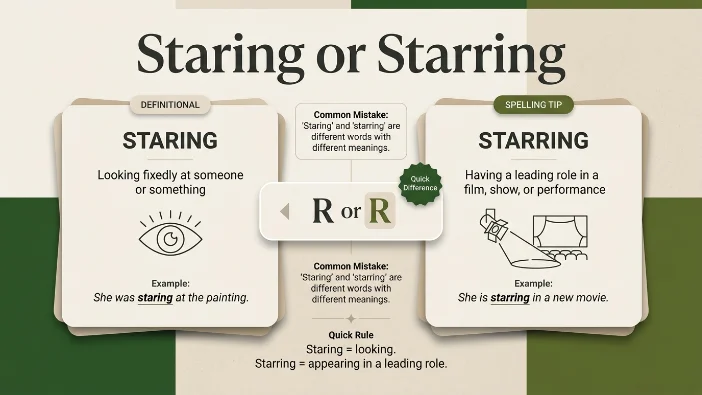
The difference between staring and starring is simple: staring means looking intently at something or someone, while starring means featuring a leading performer in a movie, play, or show. Remember that staring has one ‘r’ for looking, and starring has two ‘r’s for a leading role. Both are spelled correctly, so spell-check won’t catch the error .
You are writing an important email and want to say a new movie features your favorite actor. But suddenly, you pause. Is it staring or starring? This moment of hesitation is incredibly common. The words look almost identical, and because both are legitimate English terms, your spell-checker will completely miss the mistake . This is a classic English usage pitfall that can undermine your professionalism and confuse your readers.
Understanding this distinction goes beyond avoiding red squiggly lines; it’s about ensuring your writing conveys the precise image you intend. One word puts a person on a stage under the spotlight, while the other puts them on the spot. This guide will explain the clear difference between staring and starring, provide you with memorable rules, and offer practical examples to ensure you never mix them up again, whether you’re writing an academic paper, a business email, or a social media post.
What’s the Difference Between Staring and Starring?
The core difference lies in the action they describe: one is a visual action, and the other is a professional role. Staring is about what you do with your eyes; starring is about who is the main attraction in a performance .
Meaning of Both Words
Staring is the present participle of the verb “to stare.” It means to look at someone or something for a long time, often with wide-open eyes. This look can be driven by curiosity, shock, fear, or even rudeness . It’s an action anyone can do at any time.
Starring is the present participle of the verb “to star.” In the context of entertainment, it means to be the main performer or lead actor in a film, play, or television show . It can also function as an adjective to describe a leading role or a production that features a specific actor .
Core Difference
The core difference is simple: staring involves your eyes and focus; starring involves your profession and a performance. When you are “staring,” you are a spectator. When you are “starring,” you are the person on stage being watched.
Part of Speech Comparison Table
| Feature | Staring | Starring |
|---|---|---|
| Meaning | Looking fixedly and intensely at something or someone. | To be the main performer or lead actor in a production. |
| Part of Speech | Verb (present participle) or Adjective. | Verb (present participle) or Adjective. |
| What It Refers To | An act of looking, a gaze. | A role in a movie, play, or show. |
| Typical Context | Daily life, social interaction, descriptions of behavior. | Entertainment, film credits, theater, performances. |
| Common Confusion | Often confused with gazing (a softer, admiring look). | Often confused with featuring (which can be a supporting role). |
In short, if you’re describing a look, you need staring. If you’re describing who’s on the marquee, you need starring. This seemingly small difference between one ‘r’ and two can completely change the meaning of your sentence.
Is Staring vs. Starring a Grammar, Vocabulary, or Usage Issue?
This is primarily a usage and vocabulary issue rather than a deep grammatical one. Both words are grammatically correct and function as verbs and adjectives. The problem is that their spelling is almost identical, leading writers to select the wrong one based on a lack of knowledge of their distinct meanings.
- Vocabulary: The definitions are completely different. “Staring” relates to vision, while “starring” relates to performing.
- Usage: The context dictates which word is appropriate. Using one in the place of the other is a semantic error—it makes the sentence nonsensical even though the grammar is fine.
- Formal vs. Informal: Neither word is inherently more formal than the other, though “staring” is more common in everyday conversation and “starring” is frequently used in professional reviews, movie posters, and entertainment journalism.
The only real “grammar” rule involved is the spelling rule for adding “-ing” to a verb. For “stare,” you drop the silent ‘e’. For “star,” which ends with a single vowel before a single consonant, you double the final consonant (star + r + ing). But even understanding this rule, the choice ultimately comes down to knowing which word to use when .
Understanding “Staring”: A Deep Dive
Staring (pronounced /ˈstɛɹ.ɪŋ/) is the action of looking at something or someone for a prolonged period, often with a fixed and intense gaze . This act can be neutral, but it often carries social connotations, ranging from surprise and admiration to confrontation or rudeness . It’s about the physical act of looking.
Definition and Examples
The definition is simple: to look fixedly and without blinking at someone or something for a long time . This look is often noticeable and can make the person being looked at feel uncomfortable.
Workplace Example
- “The manager was staring at the quarterly report, trying to find the discrepancy.”
Academic Example
- “Throughout the lecture, he was staring blankly out the window, lost in thought about the upcoming exam.”
Technology Example
- “Her cat is obsessed with staring at the cursor moving across the computer screen.”
Email Example
- “I apologize for not hearing your question earlier; I was completely staring at my screen trying to solve the system error.”
Daily Conversation Example
- “Why are you staring at me like that? Is there something on my face?”
A Learner’s Mistake
- ❌ Incorrect: “The movie was so beautiful, I just sat there starring at the screen.”
- ✅ Correct: “The movie was so beautiful, I just sat there staring at the screen.” The action is looking at the screen, not performing on it.
Understanding “Starring”: A Deep Dive
Starring (pronounced /ˈstɑː.rɪŋ/) is the action of being the main actor or performer in a production . It’s a professional designation that puts you at the center of a performance. It comes from the noun “star,” which refers to a famous and prominent performer.
Definition and Examples
When an actor is “starring,” they are in a leading role. A movie or show “starring” a certain actor means that performer is its main draw and the focus of the story .
Workplace Example
- “Our company’s promotional video will be starring a well-known actor to attract more attention.”
Academic Example
- “For our final project, we produced a short play starring students from the drama department.”
Technology Example
- “The new action game is starring a former professional basketball player as the main character.”
Email Example
- “We are thrilled to announce our new campaign, starring our very own team of developers in the lead roles.”
Daily Conversation Example
- “Did you see that new Netflix show starring the actress from that classic 90s film?”
A Learner’s Mistake
- ❌ Incorrect: “Who is staring in the next Marvel movie?”
- ✅ Correct: “Who is starring in the next Marvel movie?” The question is about who is playing the lead role.
When Not to Use Each Word
Writers commonly choose the wrong word in several situations, often because they are thinking of a film but describing a person’s reaction to it. Here’s where to be careful:
- When describing someone looking at a movie poster: Mistake: “She was starring at the movie poster.” Correct: “She was staring at the movie poster.” Her eyes are on the poster, not her name in the credits.
- When talking about your favorite actor: Mistake: “I can’t wait to see him staring in the new film.” Correct: “I can’t wait to see him starring in the new film.” The actor is taking a leading role.
- When you look at a celebrity in public: Mistake: “I couldn’t stop starring at the famous actor.” Correct: “I couldn’t stop staring at the famous actor.” You are looking at them.
- When writing a film review: Mistake: “A hilarious comedy staring John Mulaney.” Correct: “A hilarious comedy starring John Mulaney.” The review is about the actor’s performance in the film.
- When you’re watching a performance: Mistake: “I was starring at the stage for the entire show.” Correct: “I was staring at the stage for the entire show.” The focus is on the act of watching the performance.
- When discussing the role itself: Mistake: “She earned a staring role in the school play.” Correct: “She earned a starring role in the school play.” The role is that of a lead performer.
Common Mistakes Table
| Correct Sentence | Incorrect Sentence | Explanation |
|---|---|---|
| He was staring blankly at the whiteboard. | He was starring blankly at the whiteboard. | The action is looking at the board; it has nothing to do with performing. |
| The movie is starring two incredible actors. | The movie is staring two incredible actors. | The movie is featuring actors in leading roles, not looking at them. |
| The children were staring at the magician. | The children were starring at the magician. | The children are watching the magician, not performing beside him. |
| Who is starring in the Broadway production? | Who is staring in the Broadway production? | The question is about who is in the lead acting role, not who is looking. |
| I caught him staring at me across the room. | I caught him starring at me across the room. | He was looking at me, not acting on a stage. |
| The new series, starring a famous comedian, is hilarious. | The new series, staring a famous comedian, is hilarious. | The series features the comedian as a lead actor. |
Decision Box
If you mean “looking”, always use staring (one ‘r’).
If you mean “performing as a lead”, always use starring (two ‘r’s).
Real-World Examples
- Office Communication: “Our project manager was staring intently at the data, looking for a way to improve our Q4 results.”
- Business Email: “We are excited to announce our upcoming webinar, starring our CEO, David Miller.”
- School or University: “The professor couldn’t help but feel nervous with all those eyes staring at him during his lecture.”
- Customer Support: “The customer support team noticed the agent was staring at the blinking error message in confusion.”
- Technology: “This new tech demo is a short film starring a digital avatar powered by our latest AI.”
- Artificial Intelligence: “The AI generated a fictional poster for a film starring a robot as the world’s first AI president.”
- Daily Conversation: “We were all just staring at the menu, completely unable to decide what to order.”
Staring and Starring in Modern Technology
The terms have become increasingly relevant with the rise of visual technology and digital content. Staring describes how users often interact with technology—people spend hours staring at their phones, computer screens, or televisions. It’s used to describe the passive or focused act of consuming digital information . Conversely, starring is central to the language of media and content creation. Every streaming platform, YouTube video, and social media short promotes its content by highlighting who is starring in it. The word is crucial for marketing and describing the cast of digital entertainment .
Word Origin
- Staring comes from the Old English word starian, meaning “to be rigid” or “to gaze.” The root word stare carried the sense of looking with wide-open eyes because of wonder or fear . The core meaning of a fixed, intense look has remained largely unchanged for centuries.
- Starring comes from the English word star, which derives from the Old English steorra. The first use of “star” to mean a lead performer is recorded in the 1820s. The verb “to star” was formed from this, and its present participle, starring, became the standard way to describe actors in leading roles .
Expert Insight
One of the most common errors I see in professional writing is the misuse of these two words. It’s a simple slip, yet it can significantly undermine your credibility. If you can fix just one “spell-check won’t catch it” mistake today, make it this one. The key is to create a mental trigger. I often tell my students that when you see a movie poster, you are starring at it. By tying the physical action of looking with the double “r” of the word itself, you can effectively break the habit of confusion and ensure your writing is clear, professional, and precise.
Error Prevention Checklist
- □ Always use “staring” when you are describing the action of someone looking fixedly at a person or object.
- □ Always use “starring” when you are describing the lead actor or main performer in a production.
- □ Never confuse them if you are writing about a performance or describing a reaction to one. Ask yourself: Is this a visual action or a professional role?
- □ Quick Memory Tip: An actor gets two ‘r’s because they require two things: talent and a role. A person looking just needs one ‘r’ for their one pair of eyes. Or, more simply: starRING has two R’s, just like a lead actor (star) needs two Rs to be at the center.
Related Grammar Confusions
Learning about staring and starring is a great step toward mastering other tricky English words. Here are some related comparisons worth exploring:
- Complement vs. Compliment: One means to complete, the other means to praise.
- Elicit vs. Illicit: One means to draw out, the other means unlawful.
- Imminent vs. Eminent: One means about to happen, the other means distinguished.
- Principal vs. Principle: One is a person or a main thing, the other is a rule or belief.
- Stationary vs. Stationery: One means not moving, the other means writing supplies.
- Your vs. You’re: One shows possession, the other is a contraction for “you are.”
- There, Their, They’re: One is a location, one is possessive, one is a contraction.
- Its vs. It’s: One is possessive, one is a contraction for “it is.”
- Affect vs. Effect: One is usually a verb, the other is usually a noun.
- Accept vs. Except: One means to receive, the other means to exclude.
FAQs
What is the main difference between staring and starring?
The main difference is that staring means to look at something or someone intently and for a long time. In contrast, starring means featuring a performer in a leading or principal role in a film, play, or television show .
Why is my spell-check not catching the error?
Spell-check will not catch the error because both “staring” and “starring” are correctly spelled English words. Spell-check only identifies words that are not in its dictionary; it cannot understand the context of your sentence to determine if you used the right word .
Is it “starring role” or “staring role”?
The correct phrase is “starring role.” This refers to the main or lead part in a performance. Using “staring role” would be incorrect, as it would mean a “role of looking” .
How can I easily remember the difference?
A simple way to remember is to connect the number of ‘r’s in the word to its meaning. Starring (two ‘r’s) is for a star or a lead actor. Staring (one ‘r’) is for looking. You can also remember the phrase, “An actor needs two ‘r’s for the starring role” .
Can “staring” and “starring” be used in the same sentence?
Yes. A common example is, “She was staring at the poster for the movie starring her favorite actor.” This sentence perfectly illustrates both words: “staring” for the act of looking and “starring” for the actor’s role .
Conclusion
Mastering the difference between staring and starring is a small but crucial step in polishing your English writing. While one misspelling might seem trivial, consistently using the correct word demonstrates attention to detail and a strong command of language. We’ve seen that staring is the act of looking, often intensely, while starring is about holding the lead role in a performance.
The one practical rule to remember is: if there’s a spotlight, it’s starring; if there’s an action, it’s staring. When you think of a leading actor, remember they need two ‘r’s to be a star. When you think of a focused look, remember one ‘r’ for your eyes. By using the “Quick Answer” as your mental shortcut and applying the “Error Prevention Checklist,” you can be confident in your choice every time.
Read More Related Articles:
- Usage vs Useage | Stop Making This Spelling Mistake in Your Writing In 2026
- Losing vs Loosing | How One Extra “O” Changes the Entire Meaning In 2026
- Successfully or Succesfully | Easy Trick to Remember the Correct Spelling Forever In 2026

Zoe Chambers works as a content writer at synoseek.com, contributing thoughtful pieces on everyday subjects and ideas. She writes in a simple, grounded way, often drawing from real-world experiences. Her focus is on keeping content natural, clear and easy for readers to connect with.
1 thought on “Staring or Starring | Grammar Guide to Never Confusing Them Again In 2026”