Quick Answer:
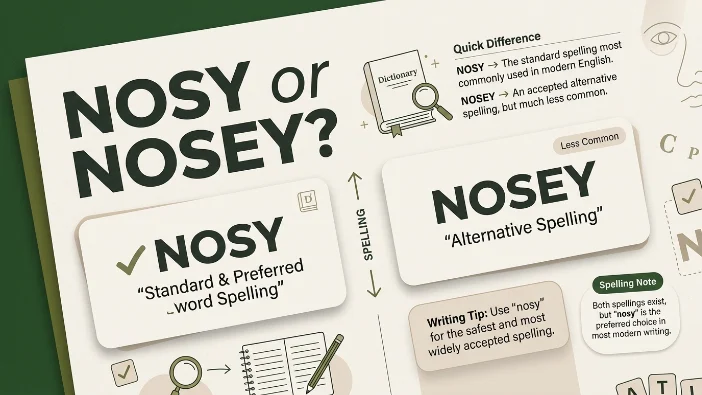
Nosy is the correct and preferred spelling in modern English, especially in American writing, dictionaries, and formal contexts. Nosey is an accepted variant spelling, more common in British and Australian English, but it’s used far less often. If you’re unsure which one to use, choose nosy it’s the safer, more widely accepted choice.
Is it nosy or nosey? Both spellings are correct, but nosy is the more common version, especially in American English. The word describes someone who is overly interested in other people’s private affairs or personal matters.
While nosey is also an accepted spelling, it is less frequently used. Understanding the difference between nosy or nosey can help you choose the spelling that best fits your audience and writing style.
Why This Tiny Word Trips Up So Many Writers
You’re describing your neighbor who always peeks through the curtains when a delivery truck pulls up, and you pause halfway through typing the sentence. Is it nosy or nosey? Both look reasonable. Both sound identical when spoken out loud. And if you search online, you’ll find plenty of examples of each one being used, which makes the confusion even worse.
Here’s the short version of what’s going on: this isn’t really a case of two different words with two different meanings, like affect and effect. It’s a case of one word with two spellings. That distinction matters, because it changes how you should think about the “rule.” You’re not choosing between two concepts you’re choosing between two accepted forms of the same concept, and one of those forms has become the standard almost everywhere in the world.
Getting this wrong won’t usually cause a total breakdown in communication. People will understand what you mean either way. But in professional writing, academic papers, or anything that goes through a spell checker or an editor, using the less common spelling can make your writing look inconsistent or slightly outdated. That’s reason enough to nail it down once and for all.
By the end of this guide, you’ll know exactly when each spelling is appropriate, why the confusion exists in the first place, and how to make sure you never second-guess yourself again.
Nosy or Nosey: What’s the Difference?
The direct answer is that there’s no difference in meaning only a difference in spelling convention and regional preference. Both words describe someone who is overly curious about other people’s private business, often in an intrusive or unwelcome way.
Nosy is built the same way English typically forms adjectives from nouns ending in a silent or non-syllabic vowel pattern you take the noun nose, drop nothing, and simply add -y. That’s the pattern followed by words like icy (from ice) and lazy, which don’t insert an extra letter before the suffix. Nosey adds an extra e before the -y, which is less standard but not wrong it’s simply an older or regional variant that has stuck around in some forms of English.
Here’s a table that lays out the practical differences:
| Feature | Nosy | Nosey |
|---|---|---|
| Meaning | Overly curious about others’ affairs | Overly curious about others’ affairs |
| Part of Speech | Adjective | Adjective |
| Refers To | A personality trait or behavior | Same trait or behavior |
| Typical Usage | American English, formal and business writing, dictionaries | British/Australian English, casual or older texts |
| Common Confusion | Assumed to be a separate or “wrong” word | Assumed to be a modern misspelling |
So when you strip away the confusion, the recap is simple: both spellings mean the same thing, both describe the same kind of behavior, and neither one is grammatically incorrect. The real question isn’t “which one is right” it’s “which one fits the audience and style guide you’re writing for.
Is Nosy vs Nosey a Grammar, Vocabulary, or Spelling Issue?
This is a spelling issue, not a grammar or vocabulary issue. Grammar deals with sentence structure word order, tense, agreement between subject and verb. Vocabulary deals with meaning and word choice. Spelling deals with how a word is written down, and that’s exactly where nosy and nosey diverge.
Because both forms carry the same definition and function identically as adjectives, they’re fully interchangeable in terms of meaning. You could swap one for the other in any sentence and the reader would understand you perfectly. What changes is how the word looks on the page, and that has more to do with regional convention than any rule of English grammar.
In formal English think business reports, academic essays, journalism, or anything submitted for publication nosy is the expected spelling almost everywhere, including in British style guides that increasingly favor it. In everyday conversation or informal writing, especially in the UK, nosey still shows up regularly and won’t raise many eyebrows.
The practical takeaway: if you’re writing something formal or if you’re unsure of your audience’s location, default to nosy. It’s the version dictionaries list as the primary entry, and it’s the spelling spell-checkers are least likely to flag.
A Closer Look at “Nosy”
Meaning: Showing too much curiosity about other people’s personal matters, often in a way that feels intrusive or unwelcome.
Part of Speech: Adjective.
Common Collocations: nosy neighbor, nosy coworker, nosy questions, don’t be nosy, a bit nosy.
Typical Sentence Patterns: Nosy usually appears right before a noun (a nosy neighbor) or after a linking verb like be or seem (she seemed nosy).
Workplace Example: “I don’t mean to be nosy, but did HR say anything about the new schedule?
Academic Example: In a psychology paper discussing social behavior, a researcher might write, “Participants who scored higher on nosy tendencies were more likely to ask personal questions during the interview.”
Technology Example: “Some smart home devices have been criticized for being a little too nosy, collecting more data than users realize.”
Email Example: “Sorry if this feels like a nosy question, but is the project on track for Friday?”
Daily Conversation Example: “My grandmother is so nosy she knows everyone’s business on the street before they do.”
One Learner Mistake: Non-native speakers sometimes confuse nosy with nosey and assume one is a typo. Since both appear in dictionaries, neither is technically wrong, but learners often don’t realize nosy is the far more commonly accepted form in international and American English.
Mini Recap: Nosy is the standard spelling used in American English and most global business writing. It’s the safest choice when you’re not sure which version to pick.
A Closer Look at “Nosey”
Meaning: Identical to nosy describing excessive or intrusive curiosity about others’ private affairs.
Part of Speech: Adjective.
Common Collocations: nosey parker (a British idiom for an overly curious person), nosey neighbour, bit of a nosey person.
Typical Sentence Patterns: Like nosy, it appears before nouns or after linking verbs, with identical grammar rules.
Workplace Example: “He’s always being a bit nosey about what everyone earns.”
Academic Example: A British university essay on social etiquette might note, “Victorian literature often portrayed the nosey neighbour as a comic figure meant to highlight social gossip.”
Technology Example: In British tech journalism, you might read, “Critics called the app a nosey piece of software that tracked far more than it needed to.”
Email Example: “Feel free to say no, but I’m being a bit nosey how did the interview go?
Daily Conversation Example: “Stop being so nosey and mind your own business!”
One Learner Mistake: Learners studying British English sometimes assume nosey is the only correct spelling because it’s what they encounter most in casual UK media, then get corrected when writing for international or American audiences.
Mini Recap: Nosey is a legitimate variant, most commonly seen in British and Australian informal writing, but it’s used far less than nosy worldwide, including increasingly within the UK itself.
When Not to Use Each Spelling
Formal American writing. If you’re writing a resume, a business proposal, or an academic paper for a US audience, avoid nosey. It reads as inconsistent with standard American spelling conventions, and most style guides will flag it during editing.
Anything run through automated grammar tools. Most spell-checkers default to nosy as the primary form. Using nosey can trigger unnecessary red squiggly lines, which slows down editing and can make your document look less polished at a glance.
International or mixed-audience content. When you’re writing for a global readership website copy, marketing content, help documentation nosy is the safer universal choice since it’s recognized everywhere without looking regionally specific.
Dictionary or definition-style writing. If you’re explaining vocabulary, defining terms, or writing educational material, lead with nosy since that’s the headword most dictionaries list first, with nosey noted as a variant.
British idiomatic phrases. The one place nosey genuinely has a stronger claim is inside the fixed idiom nosey parker, referring to a habitually curious person. Swapping in nosy parker is technically fine too, but nosey parker is the traditional and far more recognized form of the phrase.
Casual British conversation or dialogue. If you’re writing dialogue for a British character, or texting a friend in the UK, nosey fits naturally and won’t look out of place.
Children’s books or informal blogs with a British audience. Nosey has a slightly softer, more playful feel in casual British contexts, which is why you’ll still spot it in storybooks and light-hearted articles.
The pattern to remember: nosy is your default, everywhere-safe option. Nosey is your regional, informal option useful, but situational.
Common Mistakes Table
| Correct Sentence | Incorrect Sentence | Explanation |
|---|---|---|
| “My neighbor is so nosy about my mail.” | “My neighbor is so nosie about my mail.” | Nosie isn’t a recognized spelling of either variant. |
| “Don’t be nosey about her salary.” | “Don’t be noesy about her salary.” | Letters are out of order; this isn’t a valid form. |
| “He asked a nosy question during the meeting.” | “He asked a nosy’s question during the meeting.” | Adding an apostrophe turns the adjective into an incorrect possessive form. |
| “She’s a bit of a nosey parker.” | “She’s a bit of a nosy-parker with a hyphen.” | The idiom is traditionally written as two words, without a hyphen. |
| “They were nosy about the new hire’s background.” | “They were nosying about the new hire’s background.” | Nosying isn’t a standard verb form; the adjective doesn’t conjugate that way. |
Quick Decision Box
If you’re writing for a general, professional, or American audience, use Nosy.
If you’re writing casually for a British or Australian audience, or using the idiom nosey parker, Nosey works fine too.
When in doubt, go with nosy it’s the version recognized as standard nearly everywhere.
Real World Examples
Office Communication: A team lead messages a colleague, “Sorry to be nosy, but did the client mention pricing on the call?” The word softens what could otherwise feel like an intrusive question.
Business Email: An HR representative writes, “I know this might sound nosy, but we need to confirm your emergency contact details are current.” Here, nosy is used almost apologetically, which is a common and natural pattern in workplace writing.
School or University: A professor jokes with students, “I’m not trying to be nosy, but I noticed three of you cited the same obscure source coincidence?” The lighthearted tone shows how the word works well in casual academic banter.
Customer Support: A support agent might type, “I don’t mean to pry or seem nosy, but could you tell me what device you’re using so I can troubleshoot faster?” This shows the word functioning as a polite hedge before asking a personal question.
Technology: A tech reviewer writes, “This fitness app got called out for being nosy it wanted access to contacts, location, and even your microphone.” The word captures public concern about overreaching data collection in a relatable way.
Artificial Intelligence: A journalist covering AI privacy concerns might write, “Some users worry that voice assistants are a little too nosy, always listening for a wake word.” This example shows how the word has naturally extended into conversations about modern technology and privacy.
Daily Conversation: Two friends catching up might say, “Okay, nosy question are you two back together or not?” This shows the casual, almost affectionate use of the word between people who know each other well.
Nosy in Modern Technology
The word nosy has found a surprisingly comfortable home in conversations about modern technology, and that’s worth understanding if you write about tech, privacy, or digital products.
Artificial Intelligence: When people discuss AI tools that collect more personal data than expected, nosy often becomes shorthand for “invasive.” A chatbot that remembers too much personal detail, or an AI assistant that asks probing follow-up questions, might get described as nosy in casual tech reviews.
Virtual Assistants: Devices like smart speakers are frequently described using this word because they’re always listening for a trigger phrase. Users joke about their “nosy” smart speaker picking up on background conversations.
Voice Assistants: Similar to virtual assistants, voice-activated tools raise privacy questions that naturally invite this vocabulary. Writers use nosy to describe the uneasy feeling of being overheard by software.
Chatbots: Customer service bots that ask for more personal information than necessary before you’ve even asked your question get labeled nosy in user reviews and complaint threads.
Software: Apps requesting broad permissions, like access to your photos or contacts for features that don’t need them, are commonly described as nosy by tech journalists and everyday users alike.
Business Tools: Workplace monitoring software, especially tools that track keystrokes or screen activity, often gets this label from employees who feel their privacy is being tested.
In every one of these cases, nosy not nosey is overwhelmingly the spelling used in tech journalism, product reviews, and everyday commentary, reinforcing just how dominant it has become as the standard form.
Where the Word Comes From
The word traces back to the noun nose, combined with the suffix -y, which English uses to turn nouns into descriptive adjectives the same pattern behind words like sunny from sun or hairy from hair. The imagery is simple and vivid: someone metaphorically “sticking their nose” into matters that aren’t theirs, much like the physical act of sniffing around for information.
The variant nosey, with its extra e, likely developed as writers tried to preserve the pronunciation of the long vowel sound in nose before adding the suffix, similar to how some writers spell homey instead of homy. Over time, dictionaries settled on nosy as the primary form, while nosey remained in circulation, particularly in British English, without ever being labeled incorrect.
Expert Insight
As a language instructor, I always tell students that variant spellings like this one aren’t really “mistakes waiting to happen” they’re proof that English is a living language shaped by regional habits and print history. The real skill isn’t memorizing a rigid rule; it’s learning to read your audience. If you’re writing for a global or American readership, lean on nosy out of habit, the same way you’d default to color over colour. But don’t panic if you see nosey in a British novel or a casual text from a UK friend that’s simply the language doing what it’s always done, adapting to where it’s spoken.
Error Prevention Checklist
- Always use Nosy when writing for American, international, or formal audiences.
- Use Nosey only in casual British or Australian contexts, or within the idiom nosey parker.
- Never confuse either spelling with made-up forms like nosie or noesy those aren’t recognized at all.
- Quick memory tip: Nosy matches the simple pattern of nose + y, just like icy or shiny. If you can spell those without an extra letter, you can spell nosy the same way.
Related Grammar Confusions Worth Learning
- Gray vs Grey another spelling variant split largely along American and British lines, useful for understanding regional spelling patterns in general.
- Judgment vs Judgement shows the same kind of extra-letter variation seen between nosy and nosey.
- Advisor vs Adviser two accepted spellings for the same professional role, similar in spirit to this comparison.
- Canceled vs Cancelled a classic American versus British doubling-of-consonants issue worth knowing for consistency.
- Toward vs Towards a small but common regional spelling difference that trips up many writers.
- Practice vs Practise in British English these are different parts of speech, unlike the nosy and nosey pair, making it a useful contrast to study.
- Curious vs Nosy worth learning because these words are related in meaning but carry very different connotations, one neutral and one slightly negative.
- Inquisitive vs Nosy helpful for understanding tone, since inquisitive sounds more polite than nosy in most contexts.
- Snoopy vs Nosy both describe similar behavior, but snoopy often implies sneakier, more secretive curiosity.
- Prying vs Nosy useful for expanding vocabulary around the same general idea of unwanted curiosity.
FAQs
Is “nosey” a real word?
Yes, nosey is a real and accepted spelling of nosy. However, it is much less common than nosy, particularly in modern American English. While both forms have the same meaning, nosy is generally the more widely recognized choice.
Which spelling do dictionaries prefer, “nosy” or “nosey”?
Most major dictionaries treat nosy as the primary spelling and nosey as a variant. Because nosy is more common across different types of writing, it is usually the safer choice for formal, academic, and professional contexts.
Is “nosy” British or American English?
Neither spelling belongs exclusively to one variety of English. Nosy is especially common in American English and is also widely used in British English. Nosey appears more often as a British variant but can also be found in other forms of English.
Can I use “nosy” and “nosey” interchangeably in an essay?
Since both spellings are accepted and mean the same thing, either can be used. However, it is best to choose one spelling and remain consistent throughout your essay. Nosy is generally the safer option because it is more widely used and recognized.
What does “nosey parker” mean?
Nosey Parker is an informal British expression for someone who is overly curious about other people’s private affairs or constantly wants to know their business. The phrase usually carries a mildly negative or teasing tone.
Why does spell check sometimes mark “nosey” as incorrect?
Some spell-check tools use American English as their default setting, where nosy is the more common spelling. As a result, nosey may occasionally be flagged or suggested for correction even though it is an accepted spelling variant.
Conclusion
At the end of the day, the choice between nosy and nosey comes down to consistency and audience rather than right versus wrong. Both spellings describe the exact same trait an unwelcome curiosity about someone else’s business and both are recognized in standard dictionaries.
If you remember one simple rule, make it this: nosy is the globally safe, dictionary-preferred spelling, while nosey is a regional, informal cousin best saved for casual British writing or the idiom nosey parker. Stick with nosy by default, and you’ll rarely, if ever, need to second-guess yourself again.
Read More Related Articles:
- Happened or Happend | Master the Correct Usage in Minutes In 2026
- Anual or Annual | Simple Grammar Guide For Error-Free Writing In 2026
- Successfully or Succesfully | Easy Trick to Remember the Correct Spelling Forever In 2026

Zoe Chambers works as a content writer at synoseek.com, contributing thoughtful pieces on everyday subjects and ideas. She writes in a simple, grounded way, often drawing from real-world experiences. Her focus is on keeping content natural, clear and easy for readers to connect with.
2 thoughts on “Nosy or Nosey | Surprisingly Common Spelling Confusion In 2026”