Quick Answer
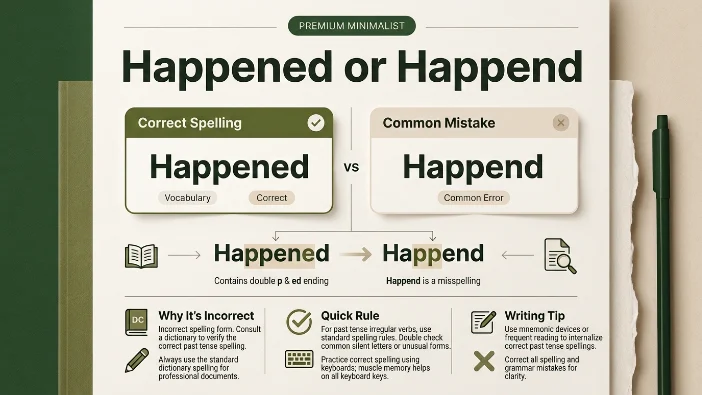
Happened is the only correct spelling. “Happend” is a common misspelling that occurs when writers drop the second ‘e’ in the past tense of “happen.” Always use “happened” to describe something that occurred in the past, whether in writing, business communication, or everyday conversation.
Few spelling mistakes create as much confusion as the difference between Happened or Happend. If you’ve ever typed “happend” into a document and watched your spellchecker underline it in red, you’re far from alone. This simple error trips up native English speakers and language learners alike, creating unnecessary communication issues that can undermine your writing credibility.
The confusion makes sense when you think about it. English spelling rules seem to contradict themselves constantly, and the way we pronounce “happened” doesn’t always match how we spell it. When you say the word aloud, the second ‘e’ sound often gets swallowed, making “happend” sound like a perfectly reasonable alternative. But here’s the truth: happend is never correct, while happened is the only proper spelling.
This guide will explain exactly why “happened” uses two ‘e’s, when and how to use it correctly, and how to remember the spelling so you never make this mistake again. By the end, you’ll have a complete understanding of this common word and the tools to use it confidently in any professional or personal context.
What’s the Difference Between Happened and Happend?
The short answer is that “happend” doesn’t exist. It’s simply a misspelling of “happened.”
Happened” is the past tense form of the verb “happen,” which means to take place, occur, or come about by chance. For example, you might say “the meeting happened yesterday” or “an accident happened on the highway.” The word functions as a verb and describes completed actions or events in the past.
Happend” has no meaning, no part of speech, and no legitimate use in the English language. It appears in writing only as an error, typically when someone types quickly or assumes that the past tense spelling should match the pronunciation more closely.
| Aspect | Happened | Happend |
|---|---|---|
| Meaning | Took place; occurred in the past | No meaning (misspelling) |
| Part of Speech | Verb (past tense) | Not a word |
| Refers To | Completed events, actions, or situations | Nothing |
| Typical Usage | Describing past occurrences | Incorrect spelling |
| Example | “The concert happened last night.” | “The concert happend last night.” ❌ |
| Common Confusion | Correct spelling, often mispronounced | Confusion from pronunciation |
The core difference is simple: one is correct, and one isn’t. When you write “happend,” you’ve made a spelling error that readers will notice. Professional editors, teachers, and employers all recognize this mistake, and it can make your writing appear careless.
Is “Happened” a Grammar, Vocabulary, or Usage Issue?
The confusion between “happened” and “happend” mainly comes from spelling, but understanding the grammar and usage behind the word makes the correct form easier to remember. Unlike some word pairs that have different meanings, this is not a choice between two valid English words. One spelling is correct, while the other is simply a mistake.
Grammar Classification
“Happened” is a grammatical spelling issue because it is the correct past tense and past participle form of the verb “happen.” English verbs follow specific patterns when forming the past tense, and “happen” becomes “happened” by adding “-ed” while keeping the complete base word.
Writing “happend” creates an incorrect verb form and affects grammatical accuracy.
Vocabulary Difference
This is not a vocabulary difference because “happend” is not a recognized English word. There are no two meanings to compare, and writers are not choosing between two acceptable options.
The correct form is always:
Happen → Happened
The incorrect form “happend” is only a spelling error.
Usage Difference
The meaning of “happened” stays the same across different situations. The surrounding context determines how the word is used, but the spelling does not change.
Examples:
- What happened?
- The accident happened at noon.
- Something unexpected happened during the meeting.
Whether you are writing casually, professionally, or academically, the correct spelling remains “happened.”
Formal, Business, and Academic Writing
Correct spelling becomes even more important in professional communication. A spelling mistake like “happend” may appear minor, but repeated errors can make writing look careless.
In business emails, reports, and academic papers, always use “happened” because accurate spelling helps maintain credibility and professionalism.
Practical Takeaway
Treat “happened” as a fixed spelling that works in every context. The second “e” is essential and should never be removed.
Understanding “Happened”: Complete Usage Guide
Meaning
“Happened” means to take place, occur, or come into existence. It can also describe something that affected or happened to a person, situation, or object.
Examples:
- The meeting happened yesterday.
- I don’t know what happened.
- Something strange happened on the way home.
Pronunciation
Happened is pronounced as:
/ˈhæp.ənd/
(HAP uhnd)
The second vowel sound is weak in normal speech, which is one reason some writers forget the extra “e” when spelling it.
Part of Speech
“Happened” is a verb form.
It works as:
- The past tense of happen
- The past participle form used with helping verbs
Examples:
- The event happened last night.
- It has happened before.
Common Collocations
These common phrases will help you use “happened” naturally:
- Something happened unexpectedly
- Nothing happened
- What happened next
- It happened that
- As it happened
- Happened to meet someone
- Happened to see something
- An accident happened
- An incident happened
- An event happened
- Happened by chance
Typical Sentence Patterns
Subject + happened + time/adverb
Examples:
- The meeting happened this morning.
- The accident happened suddenly.
It + happened + that + clause
Examples:
- It happened that I was already there.
- It happened that nobody was home.
Happened + to + verb
Examples:
- I happened to see her at the store.
- They happened to be in the same class.
Workplace Example
“The product launch happened without any technical issues because of the preparation work completed by the team last quarter.”
In workplace writing, “happened” commonly describes meetings, events, changes, or situations that took place.
Academic Example
“The Renaissance happened during a period of major cultural, political, and economic transformation in Europe.”
Academic writing often uses “happened” when explaining historical events or developments.
Technology Example
“The server failure happened at 3 AM, which triggered the automatic backup system.”
In technology contexts, the word often describes errors, updates, failures, or system events.
Email Example
“Dear Team, I wanted to confirm that the client meeting happened as scheduled this morning. The feedback was positive, and we have started working on the next phase.”
Daily Conversation Example
“When I asked about the trip, she explained everything that happened while I was away.”
Common Learner Mistake
Incorrect:
The concert happend at 8 PM.
Correct:
The concert happened at 8 PM.
Why:
The verb “happen” keeps its full spelling when adding “-ed.” The correct pattern is:
Happen + ed = Happened
Mini Recap
Use “happened” whenever you talk about past events, situations, or experiences. The spelling remains the same in every context, and the second “e” is always required.
Understanding “Happend”: Why This Misspelling Happens
Meaning
“Happend” has no meaning because it is not a correct English word.
It is simply a misspelling of “happened.”
Pronunciation
There is no standard pronunciation for “happend” because it is not an accepted word. However, some people may pronounce it the same way they pronounce “happened” because the spelling mistake usually comes from writing rather than speaking.
Why Does This Mistake Happen?
The most common reason is that the second “e” in “happened” is not strongly heard during normal speech. The word is often pronounced quickly, causing the middle vowel sound to become very weak.
This process is known as schwa reduction, where unstressed vowels become less noticeable in pronunciation.
Because writers do not clearly hear the extra “e,” they may accidentally remove it while spelling.
Common Situations Where Writers Make This Mistake
People often write “happend” because of:
- Typing quickly without proofreading
- Relying only on pronunciation
- Applying incorrect spelling patterns from other past tense verbs
- Mobile typing errors
- Limited spelling practice
- Writing while distracted
Why “Happend” Is Incorrect
The mistake happens because writers shorten the base word incorrectly.
The base verb is:
Happen
Not:
Happ
When adding “-ed,” keep the complete word:
Happen + ed = Happened
English spelling does not remove the final “en” before adding the ending.
How to Remember the Correct Spelling
Remember the word in three parts:
Hap + pen + ed
The spelling contains:
- Two p’s
- The original e from “happen”
- The extra e before d
Even though pronunciation compresses the sounds, the spelling keeps all the letters.
Final Reminder
Whenever you describe something that took place in the past, use “happened.” The spelling may feel longer than the pronunciation sounds, but that extra “e” is what makes the word correct.
When Not to Use Each Word
Understanding when to avoid “happend” and when “happened” is not appropriate helps prevent both spelling mistakes and tense errors. The key difference is simple: “happend” is never correct, while “happened” should only be used when referring to something that already took place.
When to Avoid “Happend”
The word “happend” does not exist in standard English. It is always an incorrect spelling of “happened,” regardless of the situation, audience, or type of writing.
Professional Writing
Why the mistake happens:
Writers often make this error when rushing through emails, reports, or workplace messages without reviewing the final version.
Correct word:
Use “happened.”
Example:
The meeting happened as planned.
Memory tip:
Professional communication represents your attention to detail, so always proofread important documents.
Academic Papers
Why the mistake happens:
Students and researchers may focus heavily on ideas and arguments while overlooking small spelling errors.
Correct word:
Use “happened.”
Example:
The discovery happened during the early stages of the experiment.
Memory tip:
Academic writing requires accuracy, and spelling mistakes can distract readers from your work.
Social Media Posts
Why the mistake happens:
Fast typing, casual writing habits, or incorrect autocorrect suggestions can lead to spelling mistakes.
Correct word:
Use “happened.”
Example:
I still can’t believe what happened yesterday.
Memory tip:
A quick review before posting can prevent simple errors from becoming public.
Text Messages
Why the mistake happens:
Mobile typing encourages speed, and writers sometimes skip checking words that sound correct.
Correct word:
Use “happened.”
Example:
What happened at the party?
Memory tip:
Even informal messages look clearer when common words are spelled correctly.
Resume or Cover Letter
Why the mistake happens:
Last minute editing can cause small spelling errors to remain in important career documents.
Correct word:
Use “happened.”
Memory tip:
A single spelling mistake can affect the professional impression you create.
Client Communications
Why the mistake happens:
Writers sometimes focus on delivering information quickly and ignore proofreading.
Correct word:
Use “happened.”
Example:
The issue happened during the system update.
Memory tip:
Clear and accurate writing helps maintain trust with clients and professional contacts.
When to Avoid “Happened”
Unlike “happend,” the word “happened” is a correct English word. You do not avoid it because of spelling. Instead, you avoid it when the sentence requires a different tense or form of the verb “happen.”
Present Tense Situations
Use the present form when describing something that occurs regularly or is happening now.
Incorrect:
Why does this keep happened to me?
Correct:
Why does this keep happening to me?
Future Situations
Use “happen” when talking about events that have not occurred yet.
Example:
The event will happen tomorrow.
Not:
The event will happened tomorrow.
Hypothetical Situations
Use “happened” correctly in conditional sentences when discussing imagined past situations.
Example:
If that happened, we would be prepared.
However, different conditional structures may require other forms depending on the meaning.
Noun Forms
When you need a noun instead of a verb, use “happening.”
Example:
We discussed the happening at the festival.
The word refers to an event or occurrence rather than describing an action.
Immediate Present Situations
Use the present participle “happening” when something is taking place right now.
Example:
I can see it happening right now.
Not:
I can see it happened right now.
Quick Rule to Remember
- Use “happened” only for completed past events.
- Use “happen” for future or general situations.
- Use “happening” for events occurring now.
- Never use “happend” because it is always a spelling mistake.
Common Mistakes Comparison Table
| Correct Sentence | Incorrect Sentence | Explanation |
|---|---|---|
| “The accident happened at midnight.” | “The accident happend at midnight.” | Dropping the ‘e’ creates a spelling error. Remember: happen + ed = happened. |
| “What happened to your project?” | “What happend to your project?” | The ‘e’ before ‘d’ is essential for correct spelling. |
| “Nothing happened during the meeting.” | “Nothing happend during the meeting.” | The word “happen” needs both its ‘e’ and the added ‘ed’. |
| “It happened that I knew the answer.” | “It happend that I knew the answer.” | The base word “happen” ends in ‘en’, so add ‘ed’ to make the past tense. |
| “The event happened exactly as planned.” | “The event happend exactly as planned.” | Never shorten “happened” by removing the second ‘e’. |
| “Have you heard what happened?” | “Have you heard what happend?” | The past participle always uses “happened,” never “happend.” |
Quick Decision Guide
You should use “happened” when:
- Describing anything that occurred in the past
- Using the past tense of “happen”
- Using the past participle of “happen”
- Writing in any context, formal or informal
- Speaking about completed events
- Asking “what happened?”
You should never use “happend” because:
- It isn’t a real word in English
- It will be marked as incorrect in any document
- It makes your writing look unprofessional
- It confuses readers
- Spellcheckers will flag it
Real-World Examples of Happened
Office Communication
“After the software update happened, we noticed a 40% improvement in loading times. The team celebrated when everything worked as expected.”
Why this works: The sentence describes a completed past event with clear results and context.
Business Email
“Dear Marcus, I’m writing to confirm that the board meeting happened at 10 AM as scheduled. The minutes have been distributed to all attendees for review.”
Why this works: The email confirms a past event that affects future actions.
School or University
“The chemistry experiment happened exactly according to our hypothesis. When we analyzed the results, the data supported our initial predictions.”
Why this works: Academic writing requires precise verb tenses, and “happened” provides clarity about when the experiment occurred.
Customer Support
“The system outage happened due to a power fluctuation, but our backup generator engaged immediately. We restored service within 15 minutes.”
Why this works: The explanation clearly identifies a past event and its consequences.
Technology Context
“The error happened when the user attempted to access the database without proper authentication. The security logs recorded the attempt automatically.”
Why this works: Technical documentation requires clear temporal markers that “happened” provides.
Artificial Intelligence
“The unexpected output happened when the model processed input outside its training parameters. We adjusted the boundary conditions to prevent recurrence.”
Why this works: AI professionals need precise language to describe system behavior.
Daily Conversation
“You’ll never believe what happened at the grocery store! I ran into my old high school teacher, and we talked for twenty minutes right there in the produce section.”
Why this works: Stories rely on past tense verbs, and “happened” is the standard way to introduce past events.
Happened in Modern Technology
The word “happened” appears frequently in modern technology contexts, particularly in documentation and error reporting.
Artificial Intelligence Systems: When AI models produce unexpected outputs, developers describe what “happened” during processing. This temporal clarity helps teams debug and improve systems. For example: “The classification error happened when the model encountered ambiguous data.”
Software Development: Bug reports always begin with what happened versus what should have happened. “The crash happened when the user clicked the upload button without selecting a file” provides essential context for fixing issues.
User Interfaces: Error messages often use “happened” to communicate with users. “Something happened while processing your request” is a common notification that reassures users the system detected an issue.
Virtual Assistants: Voice assistants respond to questions about past events using “happened.” “What happened on this date in history?” or “Tell me what happened with my package” are typical queries.
Data Analysis: Analysts describe patterns in past data using “happened” to explain trends. “The increase in traffic happened during the holiday shopping season” provides context for metrics.
Automatic Systems: When automation fails, documentation describes what happened during the process. “The backup failure happened due to insufficient storage space” helps administrators prevent future issues.
Why This Matters: Modern technology requires precise language to describe system behavior. Using the correct spelling “happened” instead of “happend” maintains professional credibility in technical documentation.
Word Origin and History
The verb “happen” entered English in the late 14th century from the Middle English word “happen,” which likely came from the Old English “gehæppan,” meaning “to happen by chance.” The root can be traced further back to the Proto-Germanic word “*haf-,” which meant “to hold” or “to seize.
The spelling “happened” reflects the regular pattern of adding -ed to English verbs. However, the pronunciation evolved differently from the spelling. Over centuries, the second ‘e’ in “happened” became unstressed and eventually nearly silent in many dialects. This linguistic shift where spellings become frozen while pronunciation changes created the conditions for the modern confusion.
In Middle English, the word appeared in various forms including “happenede” and “happed,” but standard spelling gradually settled on “happened” during the early modern period. The 18th century brought formalized spelling rules, and “happened” became the accepted standard.
Why History Matters: Understanding that “happened” has centuries of consistent spelling helps reinforce that “happend” isn’t a word. The spelling isn’t arbitrary; it follows established patterns that have been stable for hundreds of years.
Expert Insight
If I were teaching this concept to students, I’d focus on one core principle: the base word “happen” must stay intact when adding -ed.
English has many verbs where adding -ed doesn’t change the original word’s spelling. “Walk” becomes “walked,” “talk” becomes “talked.” “Happen” follows the same pattern. You don’t remove the ‘e’ from “happen” because it’s part of the word, not an extra letter you can discard.
The confusion arises because “happen” ends in a syllable that sounds like it could drop in speech. But writing is different from speaking. In writing, the second ‘e’ of “happened” creates the correct spelling, even if you don’t hear it clearly.
Try this memory trick: think of “happened” as “happen-ed.” The “-ed” part starts with a new ‘e’. So you have happen + ed = happened. If you wrote “happend,” you’d have “happ” + “ed,” which doesn’t correspond to any real verb. The word is “happen,” not “happ,” so you must keep the full word when adding the past tense ending.
Error Prevention Checklist
☑ Always use “happened” to describe past events and occurrences.
☑ Never use “happend” in any writing context it’s always incorrect.
☑ Remember the base word is “happen,” and you add “ed” to make the past tense.
☑ Think of the spelling as “happen-ed” to remember the extra ‘e’.
☑ Run spellcheck on all documents to catch this common error.
☑ Read your writing aloud when checking for errors pronunciation tricks won’t work.
Quick Memory Tip: “Happen has an ‘e’ at the end, so happened keeps that ‘e’ and adds another. Two ‘e’s in happened: one from happen, one from -ed.”
Related Grammar Confusions
Here are other common spelling and grammar mistakes worth learning about:
- “Receive” vs. “Recieve” – The “i before e except after c” rule creates frequent confusion.
- “Separate” vs. “Seperate” – Many writers struggle with the correct vowels in this common word.
- “Occurred” vs. “Occured” – Knowing when to double the ‘r’ in past tense verbs.
- “Definitely” vs. “Definately” – One of the most misspelled words in professional writing.
- “Embarrass” vs. “Embarass” – Double ‘r’ and double ‘s’ trip up many writers.
- “Privilege” vs. “Priviledge” – Common business and legal term often misspelled.
- “Unnecessary” vs. “Unneccessary” – Double consonants create confusion.
- “Accommodate” vs. “Acommodate” – Many forget the second ‘c’ or double ‘m’.
- “Millennium” vs. “Millenium” – Double ‘n’ confusion in time-related words.
- “Occasion” vs. “Occassion” – Whether to use one or two ‘s’ letters.
Understanding these common errors helps strengthen overall spelling and grammar skills.
FAQs
Is “happend” ever correct in any context?
No, “happend” is never correct. It is a misspelling of “happened” that should always be avoided. The word has no legitimate meaning or usage in English, regardless of context or audience.
Why do I see “happend” in some online comments?
You see “happend” online because people type quickly without proofreading. The misspelling appears in casual digital communication, but it remains an error. Always use “happened” for correct spelling.
How can I remember the spelling of “happened”?
Think of the base word “happen” and add “-ed” to create the past tense. The spelling “happend” would require removing the ‘e’ from “happen,” which doesn’t follow English spelling rules. Remember: happen + ed = happened.
Does spellcheck catch “happend” as an error?
Yes, most spellcheckers identify “happend” as incorrect and suggest “happened.” However, some casual writing tools or autocorrect features might not flag it, so always double-check your writing.
Is “happened” a regular or irregular verb?
“Happened” is a regular verb in terms of its spelling and conjugation. Adding “-ed” to the base form “happen” follows the standard pattern for regular verbs. The only potential confusion is the silent ‘e’ in pronunciation.
Can I use “happened” in a resume or formal document?
Absolutely. “Happened” is the correct past tense of “happen” and is appropriate for all professional contexts. Just ensure you spell it correctly to maintain a professional appearance.
What’s the difference between “happened” and “occurred”?
Both mean “took place,” but “happened” is more casual and common, while “occurred” is slightly more formal. Both use regular -ed endings. “Occurred” doubles the final ‘r’ before adding -ed, following a different rule entirely.
Why does “happened” have a silent ‘e’?
The ‘e’ isn’t entirely silent, but it becomes reduced in speech. When we say “happened” quickly, the second syllable’s vowel sound becomes very weak, almost disappearing. This pronunciation led to spelling errors when writers drop the ‘e’ they can’t hear clearly.
Is “happend” accepted in British English?
No, “happend” is not accepted in any standard English dialect, including British English. The correct spelling remains “happened” in all English-speaking countries.
How often do people make this mistake?
This is a common spelling error, particularly among non-native speakers and in casual writing. It appears frequently in online posts, text messages, and rushed professional communications.
Conclusion
The distinction between “happened” and “happend” isn’t really a distinction at all it’s a clear choice between correct and incorrect spelling. “Happened” serves as the proper past tense form of “happen,” appearing in every context from casual conversations to professional documents. Happend,” on the other hand, represents a common error that you should avoid completely.
Remember the simple rule: the base word is “happen,” and you add “-ed” to create the past tense, giving you “happened.” The extra ‘e’ matters it’s not optional, even if you can’t hear it clearly when you speak.
The next time you write about something that occurred yesterday, last week, or years ago, take a moment to ensure you’ve used “happened” correctly. Your readers will appreciate the professionalism, and your writing will communicate clearly and effectively.
One final practical rule: When in doubt, spell out “happen” first, then add “-ed.” You can’t go wrong with happen + ed = happened.
3 thoughts on “Happened or Happend | Master the Correct Usage in Minutes In 2026”