Quick Answer
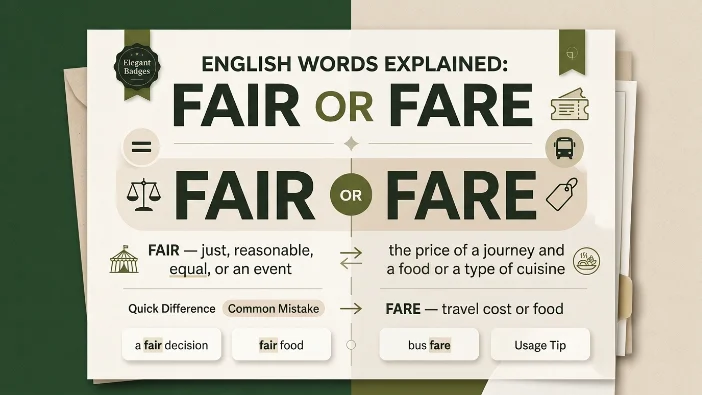
The difference between fair and fare comes down to meaning and usage. Fair is an adjective meaning just or impartial, and also describes complexion or weather. Fare is a noun for transportation payment or food provided. Choosing the correct word matters because using “fair” when you mean “fare” creates confusing, unprofessional writing.
You’re typing a quick email to your manager, and you want to say your coworker’s suggestion sounds reasonable. Do you write “that seems fair” or “that seems fare”? Then you remember you need to ask about the train ticket cost for next week’s business trip. Is it “train fair” or “train fare”? Suddenly, two simple words that sound exactly alike are tripping you up.
This confusion happens constantly. Fair and fare are homophones words that sound identical but carry completely different meanings. They don’t function the same way grammatically, and they belong in completely different contexts. Using one when you need the other can make your writing look careless, which matters whether you’re sending a professional email, writing academic work, or creating business content.
By the end of this guide, you’ll know exactly when to use each word, understand the reasoning behind every choice, and never second-guess yourself again.
Fair vs Fare: What’s the Actual Difference?
Let’s cut through the confusion immediately. The core difference between fair and fare is that fair is primarily an adjective describing something just, equitable, or pleasing to the eye, while fare is a noun referring to transportation charges or the food provided during travel.
These words share only one thing their pronunciation. Everything else about them is distinct, from their parts of speech to their origins to their everyday usage.
| Aspect | Fair | Fare |
|---|---|---|
| Meaning | Just, impartial, equitable; also light in complexion or mild in weather | Money paid for transportation; food and drink provided |
| Part of Speech | Adjective (mostly), occasionally noun | Noun (mostly), occasionally verb |
| Refers To | Treatment, judgment, appearance, weather conditions | Payment, travel, meals, food offerings |
| Typical Usage | “That’s not fair!” “She has fair skin.” “Fair weather” | “Bus fare” “Airfare” “The fare on the menu” |
| Example | The teacher gave all students a fair chance to answer. | The taxi fare from the airport was forty dollars. |
| Common Confusion | People write “fare” when describing just treatment because it sounds the same. | People write “fair” when discussing ticket prices because they rarely see “fare” written. |
Here’s the quick recap: if you’re talking about something being reasonable, just, or describing someone’s light complexion, you want fair. If you’re discussing the cost of a bus ticket, train ride, or plane trip, or talking about what’s being served for a meal, you want fare.
Is This a Grammar, Vocabulary, or Usage Issue?
Understanding the distinction between fair and fare involves vocabulary knowledge and usage awareness more than grammar rules. Neither word changes form based on tense or subject agreement, and they follow standard English patterns.
From a grammar perspective, these words function differently. Fair works as an adjective modifying nouns (“a fair decision”) or as an adverb in phrases like “play fair.” It can also appear as a noun in specific contexts, such as “the county fair.” Fare operates primarily as a noun (“the bus fare”) but sometimes as a verb meaning to get along or succeed, as in “he fared well in the competition.
Vocabulary-wise, these are completely separate words with different meanings, origins, and usage patterns. They aren’t synonyms, and they aren’t interchangeable in any context. Knowing which meaning fits your situation comes down to vocabulary knowledge, not grammar rules.
Usage determines the choice. Formal writing demands precision using fair when you mean fare will undermine your credibility. In business English, mixing these up in client communications suggests carelessness. Academic writing penalizes such errors. Everyday conversation gets by because spoken language doesn’t reveal the difference, but written communication requires accuracy.
The bottom line: both words are correct English. Your choice depends entirely on what you’re trying to say.
Understanding Fair
The word fair carries several related meanings, all stemming from the idea of something being just, pleasing, or appropriate.
Meaning and Pronunciation: Fair is pronounced exactly like fare “fair” rhymes with “hair.” The primary meaning involves justice and impartiality, but it also describes light skin or hair color and pleasant weather conditions.
Part of Speech: Mostly an adjective, sometimes a noun.
Common Collocations:
- Fair chance
- Fair deal
- Fair treatment
- Fair price
- Fair weather
- Fair skin
- Fair hair
- Fair trade
- Play fair
- Fair enough
Typical Sentence Patterns:
- It’s only fair that everyone gets equal time.
- She has fair complexion and blue eyes.
- The weather forecast promises fair skies tomorrow.
- The judge made a fair ruling based on the evidence.
- Is this a fair price for the service?
Workplace Example: The performance review process seemed fair because every employee received the same evaluation criteria. No one was singled out for harsh treatment or given special consideration.
Academic Example: The research study required fair participant selection procedures to ensure the results would be valid and unbiased. Any deviation from this standard would compromise the data.
Technology Example: The algorithm should produce fair outcomes across all demographic groups without privileging any particular category. Engineers tested the system specifically for fairness concerns before deployment.
Email Example: “I appreciate the proposal, and it seems like a fair arrangement for everyone involved. Let’s schedule time to discuss the details next week.”
Daily Conversation Example: “Come on, that’s not fair you had an extra two minutes to prepare your answer!” The friendly complaint drew laughter from the group.
One Learner Mistake: “The bus fair was too expensive” is incorrect. You’re discussing the cost of transportation, so you need “fare.”
Mini Recap: Remember fair whenever you’re thinking about justice, reasonableness, or describing something light and pleasant. If you can substitute “just,” “reasonable,” or “light,” use fair.
Understanding Fare
Fare is a more specialized word than fair, typically appearing in specific contexts related to travel and food.
Meaning and Pronunciation: Fare sounds identical to fair. The primary meaning refers to money paid for transportation on buses, trains, planes, boats, or taxis. The secondary meaning refers to food and drink provided, particularly in restaurants or on journeys.
Part of Speech: Primarily a noun, occasionally a verb meaning to manage or get along.
Common Collocations:
- Bus fare
- Train fare
- Airfare
- Taxi fare
- Standard fare
- Traditional fare
- Culinary fare
- Fared well
- Fared badly
- Half fare
Typical Sentence Patterns:
- The bus fare increased by fifty cents this month.
- Airfare during the holiday season is always expensive.
- The restaurant served traditional Italian fare.
- How did you fare on the exam?
- Old citizens receive a discounted fare.
Workplace Example: The company reimbursed employees for all travel expenses, including taxi fares and meal allowances. They submitted receipts for the airport shuttle fare separately from the hotel charges.
Academic Example: The study examined how rising transportation fares affect low-income communities’ access to employment opportunities. Researchers analyzed fare structures across seventeen metropolitan areas.
Technology Example: The ride-sharing app calculates the estimated fare before you confirm your trip, showing the breakdown between base fare, distance charges, and surge pricing. Users can compare this with the taxi meter fare.
Email Example: “Could you please confirm the train fare from Union Station to the conference venue? I want to submit my expense report accurately and include parking fees separately.”
Daily Conversation Example: “I can’t believe the movie theater popcorn fare now costs twelve dollars that’s more than the ticket itself!” They decided to eat before the show instead.
One Learner Mistake: “That seems like a fare price” is incorrect. You’re talking about reasonableness, so you need “fair.”
Mini Recap: Use fare when discussing transportation costs or food offerings. If you can replace the word with “ticket price,” “food,” or the verb “manage,” you’re on the right track.
When Not to Use Each Word
Writers choose the wrong word most often when they’re rushing, relying on how the word sounds rather than what it means, or when they haven’t seen the correct spelling in context enough times to build memory.
Here are the most common situations where writers make mistakes:
Situation 1: Discussing Just Treatment
You’re writing about workplace equality and mention “fair treatment.” Many writers accidentally use “fare treatment” because they’re focused on the sound. The mistake happens because they’ve never consciously noticed which spelling fits which context. The correct choice is always fair when discussing justice or impartiality.
Situation 2: Describing Ticket Prices
You’re calculating travel expenses and mention “plane fare.” Writers sometimes use “plane fair” because they assume the word relates to market fairness or reasonable pricing. But transportation costs are always fare in English, regardless of whether the price seems reasonable or not.
Situation 3: Complaining About Restaurant Food
You’re posting a review and mention the “restaurant fare.” Writers occasionally use “restaurant fair” because they associate the word with a county fair or fairgrounds event. But when discussing food offerings, fare is the correct choice.
Situation 4: Discussing Complexion
You’re describing someone’s appearance and mention their “fair skin.” Writers sometimes use “fare skin” in this context, which makes no sense you would never use fare to describe physical characteristics or coloring.
Situation 5: Talking About Weather
You’re planning an outdoor event and mention “fair weather.” The mistake here is using fare because you’re thinking about travel conditions or general circumstance. But fair is the standard word for pleasant, mild weather conditions.
Situation 6: Referring to Expos or Festivals
You’re discussing a “book fair” or “craft fair.” Writers might use “book fare” if they confuse the event with food offerings or paid admission. But public exhibitions and community events are always fair in this context.
Situation 7: Using Fare as a Verb
You’re writing about someone’s performance and mention “he fared well.” Writers sometimes use “he faired well,” which is a common mistake. The verb form is always fare, not fair.
Situation 8: Discussing Reasonable Pricing
You’re describing a “fair price” for a service. Writers might use “fare price” because of the association with payment. But the word fare refers to the price itself, not its reasonableness. When you’re commenting on whether something is reasonable or just, you need fair.
Common Mistakes Table
| Correct Sentence | Incorrect Sentence | Explanation |
|---|---|---|
| The train fare from Boston to New York is ninety dollars. | The train fair from Boston to New York is ninety dollars. | Transportation costs require fare. You’re talking about the money paid, not justice or appearance. |
| The judge made a fair decision based on all the evidence. | The judge made a fare decision based on all the evidence. | Judicial decisions are about justice and impartiality, so fair is correct. |
| The restaurant serves excellent traditional Italian fare. | The restaurant serves excellent traditional Italian fair. | Food offerings are fare. You’re discussing the menu, not an exhibition or weather. |
| She has fair hair and blue eyes. | She has fare hair and blue eyes. | Describing physical characteristics requires fair. |
| We’re expecting fair weather for the wedding ceremony. | We’re expecting fare weather for the wedding ceremony. | Weather conditions use fair when describing pleasant conditions. |
| The county fair has been running for over a hundred years. | The county fare has been running for over a hundred years. | Community events and exhibitions are fair, not fare. |
| He fared well in his new management role. | He faired well in his new management role. | The verb meaning to get along or manage is always fare. |
| I think her proposal sounds completely fair. | I think her proposal sounds completely fare. | When something seems just or reasonable, you want fair. |
Quick Decision Guide
- If you mean something is just, reasonable, or impartial → use FAIR
- If you mean transportation payment or food → use FARE
- If you’re describing someone’s light skin or hair → use FAIR
- If you’re talking about pleasant weather → use FAIR
- If you’re referring to an exhibition or community event → use FAIR
- If you mean the verb “to get along” → use FARE
Real-World Examples
Office Communication
“Let’s make sure the division of tasks is fair across the team. Everyone should have roughly the same workload, and the weekend coverage should rotate equally.”
Business Email
“Regarding the client visit: we need to confirm the taxi fare from the airport to our office, and I want to discuss the meal arrangements separately. Please note the restaurant fare options for the business lunch meeting.”
School or University
“The professor emphasized that all students deserve fair treatment during the grading process. She reminded everyone that she applies the same rubric to every submission without bias.”
Customer Support
“I understand your concern about the ticket fare increase. However, our pricing structure applies fairly to all passengers, and the fare you paid covers the full route with a guaranteed seat.”
Technology
“The ride-sharing app shows the estimated fare breakdown before you confirm your trip. If the fare seems unfair, you can cancel without penalty within the first two minutes.”
Artificial Intelligence
“The AI system must produce fair recommendations without demographic bias. The fare adjustment feature in the pricing algorithm automatically calculates route-based charges.”
Daily Conversation
“This restaurant’s fare is pretty basic just standard burgers and salads. But the portions are generous and the prices seem fair for downtown.”
Modern Technology Context
Artificial intelligence and voice assistants have made word choice more important than ever. Virtual assistants like Siri, Alexa, and Google Assistant process written and spoken queries, and they interpret homophones based on context.
When you speak to a voice assistant, it must decide whether you’re asking about a “fair price” or a “fare price.” The assistant analyzes surrounding words to make that determination. If you say “the bus fair was expensive,” the assistant might misunderstand because fair doesn’t fit that context.
In written AI interactions, such as composing email drafts or creating content with AI writing tools, correct word choice matters. AI models learn from patterns in text, and using the wrong word consistently reinforces errors.
Chatbots used for customer service often handle travel queries. The system must distinguish between “airport fare” (the cost) and “airport fair” (which might refer to an event or activity). Getting this wrong creates confusion and frustrates users.
Business tools that generate reports, proposals, or client communications need accurate vocabulary. Automated systems that misuse fair and fare reflect poorly on the organization using them.
Word Origin and History
Fair traces back to Old English fæger, meaning beautiful or pleasing. The word eventually expanded to include meanings of moral beauty, justice, and equity. By the 14th century, fair described neutral or light coloring, and by the 16th century, it referred to favorable weather conditions.
Fare comes from Old English faran, meaning to journey or travel. The noun form developed to mean the cost of travel. The verb meaning to get along or manage comes from the same root how you progress or advance on your journey.
These two words diverged from entirely different linguistic roots and have remained distinct for over a thousand years. Their identical pronunciation is coincidental but persistent.
Expert Insight
What confuses English learners most about fair and fare isn’t the meaning it’s the sound. Students hear both words long before they see them written, and their brains naturally connect the sound to whatever word they learned first. This creates a strong mental association that’s hard to break.
The solution isn’t memorizing dictionary definitions. It’s building context awareness training yourself to notice which situations require which word by reading extensively in context. Every time you read, pay attention to how these words appear. Over time, your brain builds the necessary connections.
Error Prevention Checklist
Always use FAIR when:
- Describing something just or equitable
- Talking about someone’s light complexion or hair color
- Describing pleasant weather conditions
- Referring to an exhibition or community event
- Saying something is reasonable or acceptable
Always use FARE when:
- Discussing transportation costs
- Referring to food and drink offerings
- Using the verb meaning to get along or manage
- Talking about paid passage on any vehicle
Never confuse them if:
- The sentence discusses justice or fairness use fair
- The sentence discusses money paid for travel use fare
- The sentence could be read aloud without changing meaning
- You’re writing in a professional context
Quick memory tip: The word fare contains “are” as in “you are paying for travel.” The word fair contains “air” as in “fair weather and fair treatment.”
Related Grammar Confusions
Affect vs Effect – Understanding the verb-noun distinction between these two words is essential for clear academic and professional writing.
Accept vs Except – Many writers confuse the verb meaning to receive with the preposition meaning excluding.
It’s vs Its – This common contraction versus possessive pronoun confusion happens even among native speakers.
Lose vs Loose – The verb meaning to misplace versus the adjective meaning not tight are frequently confused in writing.
Their vs There vs They’re – This trio consistently appears among the most common English writing errors.
Your vs You’re – Understanding the difference between the possessive pronoun and the contraction matters for all written communication.
Who vs Whom – This grammatical distinction has become less common in casual writing but remains important in formal and academic contexts.
Principal vs Principle – The person versus the fundamental truth distinction confuses many writers.
Than vs Then – The comparison word versus the time sequence word sound similar but function very differently.
Past vs Passed – The preposition or adjective versus the past tense verb trip up many English learners.
FAQs
What’s the easiest way to remember the difference between fair and fare?
A simple trick is to associate fare with travel, such as a bus or train fare. Think of fair for meanings related to justice, reasonableness, or pleasant conditions. If you can replace the word with “ticket price”, use fare. If “just” fits, use fair.
Can fair and fare ever be used interchangeably?
No. Fair and fare have different meanings and grammatical functions, so they cannot be used interchangeably. Using one in place of the other can change the meaning of your sentence and result in a spelling or word-choice error.
Which word is more common in everyday writing?
Fair is generally more common because it has several meanings and applies to many everyday situations, including justice, appearance, weather, and reasonableness. Fare is more specific and commonly refers to travel costs, food, or how someone is doing.
Is the word “farewell” related to fare?
Yes. Farewell comes from the verb fare, which can mean to travel or get along. The expression originally conveyed the idea of wishing someone well on their journey or departure.
Why do so many people mix these words up?
The main reason is that fair and fare are homophones, meaning they sound the same but have different spellings and meanings. Because pronunciation doesn’t reveal which spelling to use, the correct choice depends on the meaning of the sentence.
How can I check if I’m using the right word?
Look at the meaning of the sentence. If you mean just, reasonable, or equitable, use fair. If you mean a travel cost, food, or how someone performs or gets along, use fare. Reading the sentence in context usually makes the correct choice clear.
Conclusion
Fair and fare sound identical but belong in entirely different contexts. Fair describes justice, reasonableness, complexion, and weather conditions. Fare refers to transportation payment and food offerings. Choosing correctly matters for clear, professional communication.
Remember the travel connection fare involves a fare, like a bus ticket. Everything else is fair. When you write, pause and ask yourself whether you’re discussing a cost or a quality. That simple check will eliminate most mistakes.
The practical rule that works for most writers: if you can replace the word with “just” or “reasonable,” use fair. If you can replace it with “ticket price” or “meal,” use fare. Apply this check every time you’re uncertain, and you’ll never second-guess yourself again.
Read More Related Articles:
- Usage vs Useage | Stop Making This Spelling Mistake in Your Writing In 2026
- Losing vs Loosing | How One Extra “O” Changes the Entire Meaning In 2026
- Successfully or Succesfully | Easy Trick to Remember the Correct Spelling Forever In 2026

Lucas Mitchell is a content writer at synoseek.com. He writes simple, thoughtful pieces that focus on everyday ideas, observations and general knowledge topics. His work is shaped by a calm, realistic tone that keeps the reader engaged without overstatement.