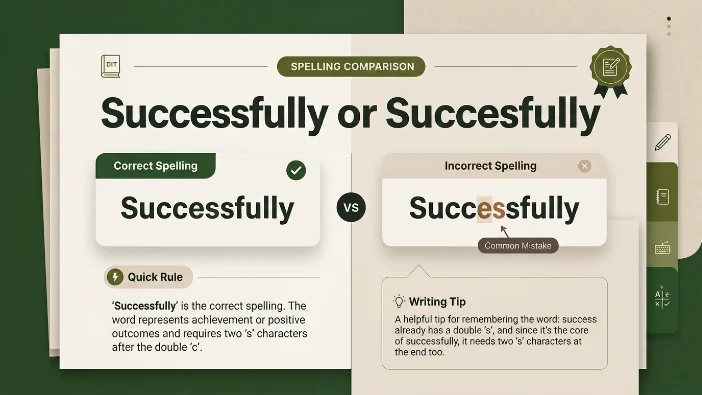
Quick Answer:
Only one of these spellings is real English. Successfully is correct, with two S’s in the middle (succes-s-fully). Succesfully is a common misspelling that drops one S by accident. If you’re checking a document, search-and-replace succesfully every time you find it.
Many people get confused between Successfully or Succesfully when writing emails, articles, or professional documents. Although both spellings may look similar, only one is correct in standard English. In this guide, we’ll explain the correct spelling, meaning, and why the extra “s” often causes confusion.
Why This Little Word Trips So Many People Up
You’re typing fast, your fingers move ahead of your brain, and suddenly you’re staring at a red squiggly line under a word you’ve used a thousand times. That’s usually how someone ends up Googling “successfully or succesfully” in the first place.
Here’s the short version: successfully is the only real word. It’s an adverb built from success, and it describes an action that was carried out with a good result you finished the project successfully, the surgery went successfully, the app launched successfully. Succesfully isn’t a variant spelling or an informal version. It’s simply what happens when the second S in the middle of the word gets left out, usually while typing quickly or sounding the word out phonetically.
The mix-up matters more than it seems. A misspelled word in an email, a resume, or a business report can make a reader pause, and that pause chips away at how polished and trustworthy the writing feels. By the end of this guide, you’ll know exactly why the double S belongs there, how to stop losing it, and how to catch it in your own writing before anyone else does.
Successfully vs Succesfully: What’s the Difference?
The difference isn’t about meaning at all it’s about spelling. Successfully is the correct, dictionary-recognized adverb. Succesfully is a spelling error that removes one of the two S’s sitting in the middle of the word.
Here’s what’s going on structurally. The word successfully is built in layers:
- success (noun) a good outcome
- success + ful → successful (adjective) describing something that achieved a good outcome
- successful + ly → successfully (adverb) describing how an action was done
Notice that “success” already contains a double S at the start (su-cc-ess) and ends in a single S. When you add “-ful,” that final S from “success” combines with the same letter pattern, which is where a lot of writers get confused and assume there’s only one S needed in the middle. In reality, the word carries two S’s back-to-back right before “fully” successfully.
| Feature | Successfully | Succesfully |
|---|---|---|
| Meaning | In a successful way; with a good result | No meaning misspelling |
| Part of Speech | Adverb | Not a word |
| Refers To | How an action was completed | N/A |
| Typical Usage | Formal and informal writing, business, academic | Should never be used |
| Example | She successfully passed the exam. | She succesfully passed the exam. (incorrect) |
| Common Confusion | Middle double S is dropped | Missing letter due to typing speed |
To recap: if you remember that success has a double S and that the word simply adds “-fully” on top of successful, you’ll never lose that second letter again. There’s no situation, formal or casual, where “succesfully” becomes acceptable it’s always a typo, not a stylistic choice.
Is This a Spelling Issue, a Grammar Issue, or Both?
This is purely a spelling issue, not a grammar problem. Grammatically, successfully behaves exactly the way any other adverb does it modifies a verb and usually answers the question “how?” (“How did she finish the race? Successfully.”) The word’s grammar isn’t in question; its spelling is.
That said, spelling and grammar often get lumped together because both affect how “correct” your writing looks to a reader. A grammar mistake might involve using the wrong tense or a misplaced modifier. A spelling mistake, like dropping a letter from successfully, doesn’t change the sentence structure at all it just makes the word itself wrong.
In formal writing, academic papers, and business communication, this distinction still matters just as much. A grammatically perfect sentence with a misspelled word can undercut your credibility just as fast as a grammar slip. Spell-check tools usually flag succesfully right away, but autocorrect doesn’t always catch it inside longer documents, especially PDFs or slide decks where spell-check is less reliable.
Practical takeaway: Treat successfully as a spelling checkpoint, not a grammar rule. If you get the letters right, the grammar takes care of itself.
A Closer Look at “Successfully”
Meaning: In a way that achieves the desired result or outcome.
Pronunciation: suk-SES-fuh-lee (the stress falls on the second syllable).
Part of Speech: Adverb.
Common Collocations: completed successfully, successfully launched, successfully negotiated, successfully passed, successfully implemented, successfully treated.
Typical Sentence Pattern: [Subject] + [verb] + successfully, or [Subject] + successfully + [verb].
Here’s how it shows up across everyday situations:
- Workplace: “The team successfully migrated the entire database over the weekend without any downtime.”
- Academic: “Her thesis successfully argues that early intervention reduces long-term costs.”
- Technology: “Your file has been successfully uploaded to the cloud.”
- Email: “I’m writing to confirm that your order has been successfully processed.”
- Daily conversation: “He successfully talked his way out of a parking ticket.”
One Learner Mistake: Non-native English speakers sometimes place successfully awkwardly in a sentence, such as “Successfully she finished the marathon,” instead of the more natural “She successfully finished the marathon” or “She finished the marathon successfully.” Adverbs like this one usually sit right before the verb or at the end of the sentence, not at the very front unless you’re deliberately adding emphasis.
Mini Recap: Successfully is a reliable, formal-friendly adverb that fits naturally in almost any sentence describing a positive outcome, as long as you keep both S’s in the middle.
When Writers Accidentally Use “Succesfully”
Since succesfully isn’t a real word, there’s no scenario where it’s the “correct” choice but it’s worth understanding exactly when and why people slip up, so you can catch it before it slips into your own writing.
- Typing too fast. Double letters are one of the most commonly dropped elements when people type quickly, especially on mobile keyboards.
- Sounding it out phonetically. Spoken aloud, the two S sounds blend together, so some writers only “hear” one S and spell it that way.
- Autocorrect gaps. Not every spell-checker flags this error, particularly in software with limited dictionaries, like some presentation tools or code comments.
- Copying from informal sources. If a writer picks up the habit from a colleague’s email or a casual chat message that already contains the typo, it can spread.
- Non-native spelling patterns. Some languages don’t use doubled consonants the way English does, which makes double-letter words like successfully, necessary, and embarrassed genuinely tricky to memorize.
- Rushed proofreading. Writers often reread their own work for meaning, not letter-by-letter accuracy, so a familiar-looking word gets skimmed past.
- Muscle memory from similar words. Words like successful and success reinforce the pattern until “-fully” gets tacked on without a second thought about the double S.
- Voice-to-text errors. Dictation software occasionally drops a letter in longer words, and writers don’t always proofread the transcription carefully.
The fix for all of these is the same: slow down on this specific word, or build a habit of running a final spell-check pass before sending anything important.
Common Mistakes Table
| Correct Sentence | Incorrect Sentence | Explanation |
|---|---|---|
| The surgery was completed successfully. | The surgery was completed succesfully. | Missing the second S in the middle of the word. |
| She successfully defended her dissertation. | She succesfully defended her dissertation. | Same spelling error, common in academic writing. |
| The app was successfully installed. | The app was succesfully installed. | Frequent typo in technical and IT documentation. |
| We successfully closed the deal by Friday. | We succesfully closed the deal by Friday. | Common in fast-typed business emails. |
| He successfully quit smoking last year. | He succesfully quit smoking last year. | Everyday conversational spelling slip. |
Decision Box
If you’re describing an action that turned out well, the word you want is successfully always spelled with two S’s in a row before “fully.
There is no situation where succesfully is the right choice. If you see it, it needs to be fixed.
Successfully in Real-World Communication
Office Communication: A manager might write, “The onboarding process was successfully updated to cut training time in half,” in a team memo summarizing quarterly wins.
Business Email: Confirmation emails rely heavily on this word: “Your payment has been successfully received and your subscription is now active.”
School or University: Professors often use it in feedback: “You successfully supported your argument with three strong sources.”
Customer Support: Support tickets frequently close with a line like, “Your issue has been successfully resolved. Please let us know if it happens again.”
Technology: Software notifications use it constantly “Update successfully installed,” “Backup successfully completed,” “Account successfully created.”
Artificial Intelligence: AI tools and chatbots often generate status messages such as, “Your request has been successfully processed by the model,” making accurate spelling important for anyone building or reviewing automated systems.
Daily Conversation: “I successfully avoided the traffic by leaving early” is the kind of everyday sentence where this word shows up without anyone thinking twice about it until the spelling goes sideways.
Successfully in Modern Technology
Software interfaces lean on this word heavily, which is exactly why the spelling matters so much in tech contexts. Confirmation messages, system logs, and status alerts almost always include a version of “successfully completed,” “successfully saved,” or “successfully connected.”
Virtual assistants and voice assistants generate this word constantly in response to commands: “Your reminder has been successfully set.” Chatbots use it to confirm actions taken on a user’s behalf, such as booking a flight or updating an account. Business tools like CRMs and project management platforms display it after every completed action, from “Task successfully assigned” to “Report successfully exported.”
Because these messages appear so frequently and are often auto-generated from templates, a single misspelled instance of “succesfully” in a company’s software can end up duplicated across thousands of user interactions if nobody catches it early. That’s a strong reason to double-check this word specifically during QA and content review for any digital product.
Expert Insight
When I’m teaching students about tricky double-letter words like this one, I tell them to picture the word in two pieces: success and fully. If you know that success already has that double S pattern built in, you’ll naturally carry it forward into successful and successfully. Most spelling errors in English aren’t about not knowing the word they’re about typing faster than your memory of the word’s structure. Slowing down for just one extra second on words with doubled letters solves the majority of these mistakes.
Error Prevention Checklist
- Always use successfully when describing an action, event, or task that achieved a good result.
- Always double-check for two S’s in a row before “fully” success-s-fully.
- Never confuse them if you remember that succesfully is never a real word in any context.
- Quick memory tip: Success has a double S, and successfully keeps that same double S right where it is.
Related Grammar Confusions
- Necessary vs Neccessary another commonly misspelled double-letter word that trips up even experienced writers.
- Embarrassed vs Embarassed worth learning since both letters (R and S) are frequently doubled incorrectly.
- Occurred vs Occured a classic example of a dropped double consonant in past tense verbs.
- Definitely vs Definately useful to review since it’s one of the most searched spelling questions in English.
- Recommend vs Reccomend helpful for anyone writing recommendation letters or reviews.
- Accommodate vs Acommodate a word with two sets of double letters, making it easy to under-spell.
- Committed vs Commited important for resumes and cover letters where this word appears often.
- Successful vs Succesful the adjective form of today’s topic, worth learning alongside the adverb.
- Business vs Buisness a frequently swapped letter order that’s easy to fix once you see the pattern.
- Grammar vs Grammer a fittingly ironic word to double-check when writing about grammar itself.
FAQs
Is “Succesfully” Ever an Accepted Alternate Spelling?
No, “succesfully” is never accepted as a correct alternative spelling in English. Unlike some words that have regional or historical spelling variations, “succesfully” is not recognized in standard dictionaries. It is simply a spelling mistake caused by missing the second s in “successfully.”
Why Does “Successfully” Have Two S’s in the Middle?
The spelling of “successfully” comes from the root word “success,” which already contains a double s. When the suffixes “-ful” and “-ly” are added, the original spelling remains unchanged. This is why related forms like “successful” and “successfully” keep the double s.
How Can I Remember the Correct Spelling of “Successfully”?
A simple trick is to break the word into two parts: “success” + “fully.” Once you remember how to spell “success,” the rest becomes easier. The double s stays in the same position, helping you avoid the common mistake of writing “succesfully.”
Does Spell Check Always Catch “Succesfully”?
Most modern spell checkers can identify “succesfully” as an error and suggest “successfully” as the correction. However, some older software, presentation tools, or applications with limited language databases may fail to detect it. A quick manual review is still helpful, especially in important documents.
Is “Successfully” Formal or Informal?
“Successfully” works well in both formal and informal writing. It is commonly used in academic papers, workplace reports, professional emails, casual conversations, and everyday communication. The word does not carry a formal or informal tone by itself.
What Part of Speech Is “Successfully”?
“Successfully” is an adverb. It is formed by adding “-ly” to the adjective “successful.” It describes how an action is completed or performed. For example, in the sentence “She successfully completed the project,” the word explains the manner in which the project was completed.
Conclusion
There’s really only one correct spelling here, and it’s successfully never “succesfully.” The entire confusion comes down to a single dropped letter in the middle of the word, usually from typing quickly or sounding the word out rather than spelling it from memory.
The easiest way to lock this in for good is to remember that “success” itself has a double S, and “successfully” simply keeps that same pattern all the way through. Next time your fingers move faster than your brain, pause for a second on this one word it’s a small fix that keeps your writing looking sharp and professional.
13 thoughts on “Successfully or Succesfully | Easy Trick to Remember the Correct Spelling Forever In 2026”