Quick Answer
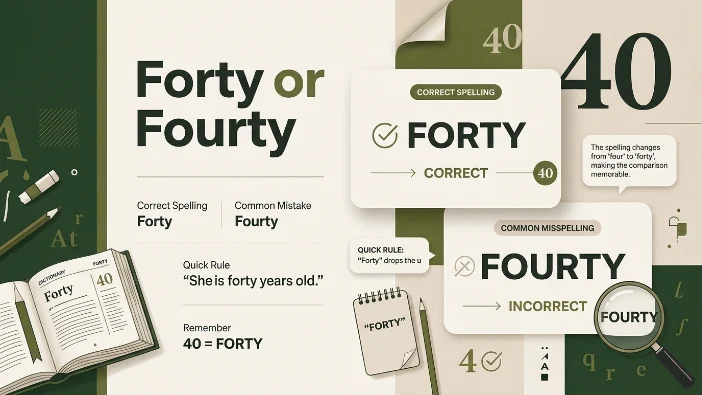
Forty is the only correct spelling of the number 40 in English. “Fourty” is a common misspelling that many writers create by copying the pattern from “four.” Even though “fourty” looks logical, dictionaries and style guides never recognize it as a real word. Stick with forty in every sentence, email, or document you write.
If you’re unsure whether to write Forty or Fourty, you’re not alone. This spelling can be confusing because the word comes from “four,” which makes “Fourty” seem logical. However, only one spelling is correct in standard English.
In this guide, we’ll explain why forty is the correct spelling and why fourty is considered incorrect. You’ll also see simple examples to help you remember the right form and avoid this common spelling mistake.
Why This Tiny Word Trips Up So Many Writers
You’re typing a sentence, you get to the number 40, and suddenly your fingers freeze. Is it “forty” or “fourty”? You know the number four has a “u” in it, so shouldn’t forty have one too? That little moment of doubt is more common than most people admit, and it happens to native speakers just as often as it happens to English learners.
The confusion makes sense once you look at where it comes from. English spelling doesn’t always follow the rules you’d expect, and numbers are one of the messiest corners of the language. “Four” has a u. “Fourteen” has a u. “Fourth” has a u. So your brain naturally assumes “forty” should follow the same pattern. It doesn’t, and that single exception is exactly what causes so many people to write it wrong.
In this guide, you’ll learn exactly why forty lost its “u,” how to remember the correct spelling for good, where fourty shows up most often, and how to avoid the mistake in emails, essays, and everyday writing. By the end, you won’t need to pause and second-guess yourself again.
Forty vs Fourty: What’s the Difference?
There isn’t a difference in meaning between these two spellings, because only one of them is actually a word. Forty is correct. Fourty is a spelling error, not an alternate form, not a British variation, and not an informal shortcut. It simply doesn’t appear in any standard English dictionary.
This surprises a lot of people because English numbers usually follow a predictable pattern once you learn the base word. Four becomes fourteen. Four becomes fourth. So it feels natural to assume four becomes fourty. But somewhere in the history of English spelling, forty broke away from that pattern and settled into its own form, and it’s stayed that way for centuries.
| Feature | Forty | Fourty |
|---|---|---|
| Correct spelling | Yes | No |
| Recognized in dictionaries | Yes (all major dictionaries) | No |
| Part of speech | Number / Adjective | Not applicable |
| Common context | Age, quantity, time, math | Typos and autocorrect misses |
| Typical usage | “She turned forty last week.” | Should be corrected to “forty” |
Once you see it laid out this way, the choice becomes obvious. There’s no situation, formal or informal, where fourty is the right call.
Is Forty a Grammar Issue or a Spelling Issue?
This mix-up isn’t a grammar problem at all. It’s purely a spelling issue. Grammar deals with sentence structure, verb agreement, and word order. Spelling deals with how individual words are written, and that’s exactly where forty and fourty diverge.
Because it’s a spelling issue rather than a grammar rule, there’s no exception clause to memorize, no context where the “wrong” version becomes acceptable, and no regional variation that changes the answer. British English and American English both use forty. Formal writing and casual texting both use forty. Academic papers and casual social media posts both use forty.
The only real skill here is training your memory to override the pattern your brain wants to apply from words like four and fourteen. Once that habit sets in, you’ll stop noticing the number at all, which is exactly the goal.
Practical takeaway: Treat forty as a standalone spelling to memorize, separate from the four-fourteen-fourth family, and the confusion disappears.
Understanding the Word: Forty
Meaning: The number equal to four tens, written as 40.
Part of speech: Cardinal number, functioning as an adjective when it modifies a noun.
Common collocations: forty years, forty minutes, forty percent, in her forties, forty winks, the fabulous forties.
Typical sentence pattern: Forty usually sits directly before a noun it’s counting, such as “forty dollars” or “forty students,” though it can also stand alone as a numeral in dates, ages, and measurements.
Workplace example: “We need forty additional units before Friday’s shipment goes out.
Academic example: “The study surveyed forty participants over a six-month period.”
Technology example: “The app processes forty transactions per second during peak hours.”
Email example: “Could you confirm the meeting will run for forty minutes instead of an hour?”
Daily conversation example: “I’ll be there in about forty minutes, traffic depending.”
Common learner mistake: Writing “fourty” because it mirrors the spelling of “four,” “fourteen,” and “fourth.
Mini recap: Forty is the correct, dictionary-approved spelling of the number 40, used consistently across every English-speaking region and every writing context.
Understanding the Non-Word: Fourty
Meaning: None. Fourty has no recognized meaning because it isn’t an actual English word.
Part of speech: Not applicable.
Why it appears so often: Writers borrow the “u” from four, fourteen, and fourth, assuming forty should follow the same visual pattern.
Where it shows up most: Handwritten notes, quick typing, non-native English writing, and situations where autocorrect fails to catch the error because the writer types quickly without reviewing.
How to catch it: If you ever see “fourty” in a document you’re reviewing, treat it exactly like any other typo. Replace it with forty and move on. There’s no gray area to weigh here, which actually makes this one of the easier spelling errors to fix once you know to look for it.
Mini recap: Fourty isn’t a variant spelling, a dialect form, or an accepted alternative. It’s simply an error that happens because of a pattern mismatch with related number words.
When People Mistakenly Use Fourty
1. They copy the spelling pattern from “four.” This is the single biggest reason for the mistake. Four has a u, so writers assume every word built from four should keep it.
2. They copy the spelling pattern from “fourteen.” Since fourteen keeps the u, people expect forty to behave the same way, especially if they learned the teen numbers before the tens numbers.
3. They copy the spelling pattern from “fourth.” Ordinal numbers reinforce the same expectation. If fourth has a u, why wouldn’t forty?
4. Autocorrect doesn’t always catch it. Some spell-checkers flag fourty immediately, but others, especially in quick messaging apps, sometimes let it slide through, particularly if the writer is typing fast on a mobile keyboard.
5. Non-native English learners apply logical spelling rules. Many languages have far more consistent spelling systems than English. Learners reasonably expect English numbers to follow one unified pattern, and forty is the exception that breaks that expectation.
6. Handwriting habits carry over into typing. Writers who grew up misspelling the word by hand often type it the same way without noticing, since the error became automatic long before anyone corrected it.
7. Similar-sounding words create confusion. Because forty and fourteen sound close when spoken quickly, some writers blend the spelling habits of both.
8. Nobody ever explicitly taught the exception. Most spelling instruction focuses on patterns. Forty is one of the rare number words that breaks its own family’s pattern, and if a teacher never called that out directly, the mistake can persist for years.
The good news is that once you know the reason behind the mistake, it becomes much easier to catch yourself before it happens again.
Common Mistakes Table
| Correct Sentence | Incorrect Sentence | Explanation |
|---|---|---|
| She just turned forty. | She just turned fourty. | Fourty is never a correct spelling, in any context. |
| The report took forty minutes to finish. | The report took fourty minutes to finish. | Numbers referring to time always use forty. |
| He scored forty points in the game. | He scored fourty points in the game. | Sports statistics follow standard spelling rules. |
| We have forty employees in this office. | We have fourty employees in this office. | Workplace documents should never include fourty. |
| The recipe serves forty guests. | The recipe serves fourty guests. | Even casual writing should avoid the misspelling. |
Quick Decision Box
If you’re writing the number 40 in any English sentence, always use forty.
There is no situation, formal or informal, where fourty is correct. If you remember nothing else from this article, remember that one rule.
Forty in Real World Situations
Office communication: “Please schedule the meeting for forty minutes so we have time for questions afterward.”
Business email: “Attached is the invoice for forty units, due by the end of the month.”
School or university: “The exam contains forty multiple-choice questions worth two points each.”
Customer support: “Your refund will be processed within forty business hours.”
Technology: “The server handles forty requests per second under normal load.”
Artificial Intelligence: “The chatbot was trained on a dataset containing forty thousand customer conversations.”
Daily conversation: “I turn forty next month, and honestly, I’m looking forward to it.”
Notice how forty appears the same way in every single context. There’s no formal version, no casual version, and no exception waiting to surprise you.
Forty in Modern Technology
Numbers like forty show up constantly in tech writing, and getting the spelling right matters more than people think, especially in professional or published content. AI writing assistants, chatbots, and virtual assistants are all trained on correctly spelled text, so when software generates responses involving the number 40, it will always produce “forty,” never “fourty.
This matters for content creators too. If you’re writing product descriptions, technical documentation, or AI prompts that reference quantities, using the correct spelling keeps your content polished and helps it read as professionally produced rather than rushed. Voice assistants convert spoken numbers into the standard written form automatically, which is another quiet reminder that forty is the accepted standard everywhere, from casual chat to enterprise software.
Even spell-checking tools built into browsers, word processors, and coding environments will flag fourty as an error, which is a useful signal if you’re ever unsure. If your software underlines it in red, trust that instinct.
Where the Word Forty Comes From
Forty traces back to Old English “feowertig,” a combination of “feower” (four) and “tig” (a suffix meaning group of ten, similar to how “-ty” works in twenty, thirty, and fifty). Over centuries, English spelling shifted and simplified, and the pronunciation of the number gradually dropped the “u” sound that four still carries.
Interestingly, forty is the only number between one and one hundred written without a “u” despite having “four” as its root. Every related word, four, fourteen, and fourth, kept the u. Forty is the outlier, and that’s precisely why it causes so much confusion even among careful writers.
Expert Insight
As a language instructor, I always tell students that forty is one of the best examples of why English spelling can’t always be predicted through logic alone. You can know every rule about numbers and still get tripped up by forty, simply because it doesn’t follow its own family’s pattern. The fix isn’t about understanding grammar more deeply. It’s about memorizing this one exception the same way you’d memorize an irregular verb. Once it clicks, it stays with you permanently.
Error Prevention Checklist
- Always use forty when writing the number 40 in any context.
- Never use fourty, even in casual writing, texting, or notes.
- Remember that forty is the exception among four-related number words.
- If your spell-checker underlines fourty, trust it and correct it immediately.
- Quick memory tip: “Four has a u, but forty lost it.” Saying this once out loud helps the correct spelling stick.
Related Grammar Confusions Worth Learning
- Thirty vs Thirdy Understanding why thirty also drops expected letters helps reinforce number-spelling patterns.
- Ninety vs Ninty Another commonly misspelled tens number that follows the same type of exception.
- Affect vs Effect A classic confusion pair that trips up even experienced writers.
- Its vs It’s One of the most searched grammar questions in English, tied to apostrophe rules.
- Their vs There vs They’re A foundational homophone group every learner eventually needs to master.
- Compliment vs Complement Two words that sound identical but carry completely different meanings.
- Advice vs Advise A noun-versus-verb distinction that causes frequent errors in professional writing.
- Fourth vs Forth Closely related to this very topic, since both come from the same number family.
- Principal vs Principle A common workplace and academic mix-up worth understanding early.
- Lose vs Loose A spelling confusion that shows up constantly in casual writing and social media.
FAQs
Is “fourty” ever acceptable in British English?
No. “Forty” is the correct spelling in both British and American English. The form fourty is a common spelling mistake rather than a regional variation. It is not accepted as the standard spelling in either variety.
Why does “four” have a “u” while “forty” does not?
The difference comes from the historical development of English spelling. Over time, the spelling of forty was simplified and the u was dropped. Related words such as four, fourteen, and fourth retained the letter, which is why forty can seem unusual by comparison.
Do Microsoft Word and other spell checkers flag “fourty”?
Yes. Most modern spell checkers, including those used by Microsoft Word, Google Docs, and major browsers, recognize fourty as an error and suggest forty instead. However, checking the spelling yourself is still useful when proofreading important writing.
Does “forty” change when used with other numbers?
No. The spelling remains forty in compound numbers. For example, you write forty one, forty two, and forty five when following a style that omits hyphens, or forty one with the appropriate compound number formatting. The important point is that fourty is never correct.
Why do so many people misspell “forty”?
The main reason is the spelling of four. Since fourteen and fourth also contain the u, it is natural to assume that forty should follow the same pattern. That expectation makes the missing u easy to overlook.
What’s an easy trick for remembering “forty”?
Try the phrase “forty forgot its u.” It creates a quick mental reminder that the number drops the u found in four. Once you connect the spelling with that phrase, it becomes easier to remember that forty, not fourty, is correct.
Conclusion
Forty is the only correct way to spell the number 40, and fourty is simply a common misspelling that comes from following the pattern of four, fourteen, and fourth. Once you understand why forty breaks that pattern, the mistake becomes much easier to avoid in every kind of writing, from quick text messages to formal reports.
The rule to remember is simple: four has a u, but forty doesn’t. Keep that one phrase in mind, and you’ll never have to pause over this word again.
1 thought on “Forty or Fourty | Right Way to Spell the Number 40 In 2026”