Quick Answer
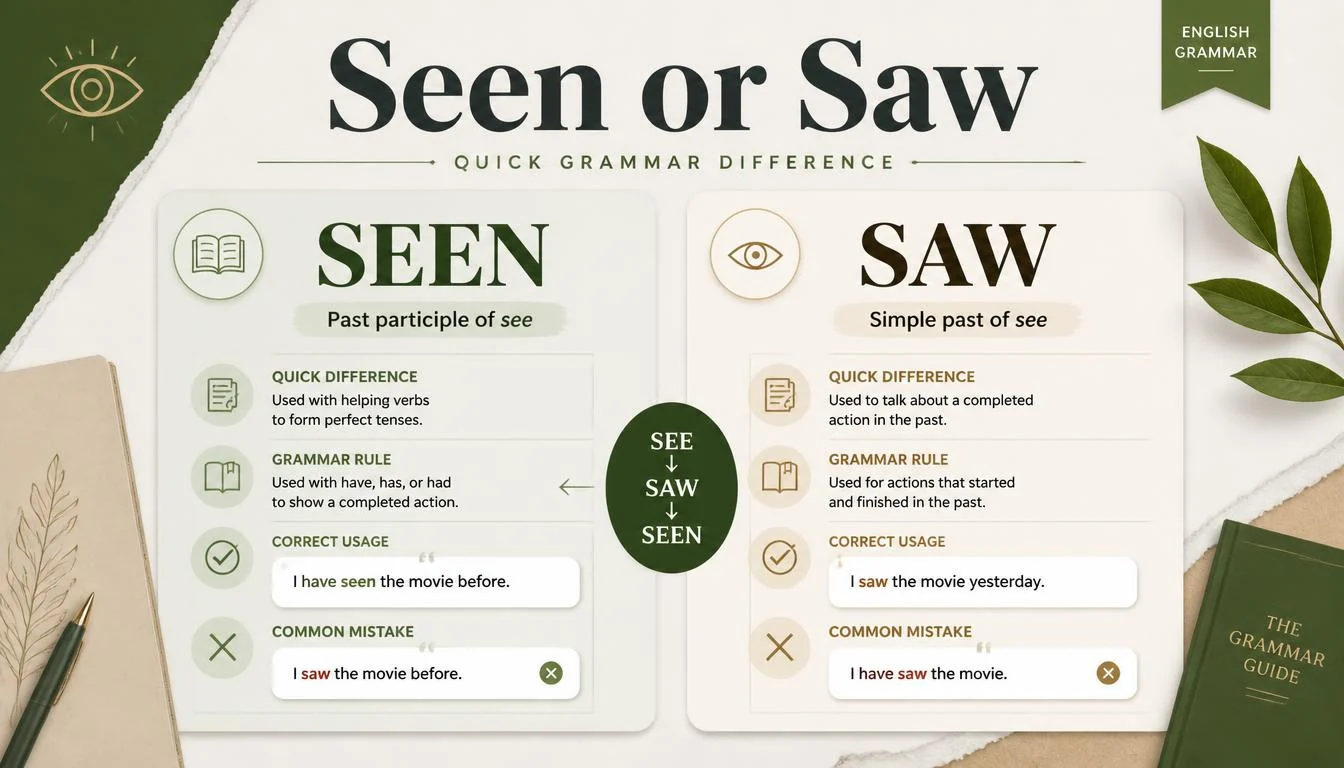
Use saw as the simple past tense of “see” (“I saw a movie yesterday”). Use seen only with a helping verb like have, has, had, or was (“I have seen that movie”). The seen or saw confusion happens because both words describe the past, but seen never stands alone in a sentence.
You’re writing a text to a friend, and you type “I seen him at the store.” Something feels off, but you’re not sure why. Or maybe you’re editing a report and you catch yourself second-guessing whether it should be “I have saw” or “I have seen.” This mix-up happens to native speakers and learners alike, and it’s one of the most common irregular verb errors in English.
The confusion exists because “see” doesn’t follow the neat, predictable pattern most verbs use. Regular verbs simply add “-ed” to form the past tense, but “see” is irregular. It has three separate forms: see, saw, and seen. Saw works alone as the simple past tense. Seen needs backup from a helping verb before it can appear in a sentence at all. Mixing these two up doesn’t just sound casual, it can make writing look careless in a resume, an email to a client, or a school assignment.
By the end of this guide, you’ll know exactly when to use saw, when to use seen, and how to catch the mistake before it slips into your writing. We’ll walk through real examples, common slip-ups, and a simple memory trick that sticks.
Seen or Saw: What’s the Difference?
The core difference is that saw is a standalone past tense verb, while seen is a past participle that always needs a helping verb like have, has, had, was, or were.
Both words come from the same root verb, “see,” which means to notice something with your eyes or to understand something mentally. The difference isn’t in meaning. It’s entirely about grammatical function. Saw finishes a thought by itself. Seen cannot. Try saying “I seen the movie” out loud and compare it to “I saw the movie.” The first one breaks a basic grammar rule because seen has no partner verb propping it up.
This distinction matters most in formal writing, job applications, and professional emails, where a single misused verb form can undercut an otherwise strong sentence.
| Meaning | Part of Speech | Refers To | Typical Usage | Example | Common Confusion |
|---|---|---|---|---|---|
| Simple past tense of “see” | Verb (simple past) | A completed action in the past | Standalone sentences describing a finished event | I saw the sunset last night. | Used instead of “seen” after “have/has/had” |
| Past participle of “see” | Verb (past participle) | An action connected to a helping verb | Perfect tenses and passive voice | I have seen that sunset before. | Used alone without a helping verb |
So here’s the short version: if there’s no “have,” “has,” “had,” “was,” or “were” sitting in front of it, you almost always want saw. If one of those helping verbs is present, seen is your word.
Is Seen or Saw a Grammar, Vocabulary, or Usage Issue?
This is purely a grammar issue, not a vocabulary problem. Both words mean exactly the same thing. The trouble comes from verb tense structure, not definition.
Saw and seen aren’t two different words competing for the same meaning, the way “affect” and “effect” are. They’re two forms of one verb, and English expects each form to appear in a specific grammatical slot. That makes this a classic case of irregular verb conjugation, something learners often study early on but keep tripping over years later, especially in fast speech or casual texting.
- In formal or academic writing, getting this wrong stands out immediately to an editor or professor.
- In business English, using “seen” without a helping verb in an email can make a message look rushed or under-edited.
- In everyday conversation, native speakers sometimes say “I seen” out of habit or regional dialect, but it’s still considered nonstandard in written English and in professional settings.
The two forms are not interchangeable in any context where correctness matters.
The practical takeaway: whenever you’re unsure, check if a helping verb is nearby. No helping verb means you need saw.
Saw: Meaning, Usage, and Examples
Saw is the simple past tense of “see,” used to describe something you noticed, watched, or understood at a specific point in the past.
It functions as a standalone verb, meaning it doesn’t need any other verb to support it in a sentence. You can drop saw straight into a sentence and it carries the full weight of the past tense on its own.
Common collocations include “saw a movie,” “saw the doctor,” “saw an opportunity,” and “saw it coming.” Notice the pattern: subject, then saw, then object. That’s the typical sentence structure.
Workplace example: “I saw the quarterly report before the meeting started.”
Academic example: “The researcher saw a clear pattern in the data after the third trial.”
Technology example: “Our team saw a spike in server traffic right after the app launched.”
Email example: “Hi Sarah, I saw your message this morning and I’ll respond by noon.”
Daily conversation example: “We saw a great documentary last weekend.”
One mistake learners make is pairing saw with a helping verb, writing something like “I have saw it” instead of “I have seen it.” Remember, saw never sits next to have, has, or had. If you spot a helping verb nearby, swap saw for seen.
Mini recap: Saw stands alone, describes a finished past action, and never follows have, has, or had.
Seen: Meaning, Usage, and Examples
Seen is the past participle of “see,” and it only appears in a sentence when paired with a helping verb such as have, has, had, was, or were.
On its own, seen isn’t a complete verb form. It needs a partner to signal the correct tense, which is why “I seen that” is grammatically incorrect while “I have seen that” is correct. This pairing creates what grammarians call the present perfect, past perfect, or passive voice, depending on which helping verb shows up.
Common collocations include “have seen,” “has seen,” “had seen,” “was seen,” and “never seen before.” The helping verb almost always comes right before seen.
Workplace example: “She has seen the updated budget and approved it.”
Academic example: “By the time the paper was submitted, the professor had already seen an earlier draft.”
Technology example: “This bug has been seen in three separate builds this month.”
Email example: “I just wanted to confirm you’ve seen my previous message about the deadline.”
Daily conversation example: “Have you seen the new coffee shop downtown?”
The most common learner mistake is dropping the helping verb entirely, saying “I seen her yesterday” instead of “I saw her yesterday.” Without have, has, or had, seen simply cannot function as the main verb in a sentence.
Mini recap: Seen always leans on a helping verb, and without one, it cannot carry a sentence by itself.
When Not to Use Each Word
Knowing when to avoid each word is just as useful as knowing when to use it. Here are the situations where writers most often pick the wrong one.
Don’t use seen right after a subject with no helping verb. “I seen him leave” is incorrect. The fix is “I saw him leave.” This happens because in fast speech, “have” often gets dropped or slurred, and the habit carries over into writing.
Don’t use saw after have, has, or had. “I have saw the results” should be “I have seen the results.” Writers sometimes default to the simpler-sounding word without checking what came before it.
Don’t use saw in passive voice constructions. Passive sentences need seen, not saw. “The suspect was saw near the building” is wrong. It should read “The suspect was seen near the building.”
Don’t use seen when describing a single, finished action with no time connection to now. If you’re simply stating that something happened and ended, saw usually fits better. “I seen it happen” should be “I saw it happen.”
Don’t confuse seen with scene. These are homophones, and autocorrect sometimes swaps them. “I seen a beautiful scene” is correct, but writers occasionally type “I saw a beautiful seen,” which is a spelling slip rather than a grammar one.
Don’t overuse “have seen” when simple past is clearer and more natural. In casual storytelling, “I have seen him at the gym” can sound stiffer than “I saw him at the gym,” depending on context and whether the action connects to the present moment.
Don’t mix tenses within the same sentence. Writing “I saw the email and have read it” without a clear reason for switching tenses can confuse readers. Stay consistent unless the timeline genuinely requires a shift.
Don’t rely on how something “sounds” in casual speech. Regional dialects sometimes normalize “I seen,” but formal writing still requires saw when there’s no helping verb present.
Common Mistakes Table
| Correct Sentence | Incorrect Sentence | Explanation |
|---|---|---|
| I saw her at the conference. | I seen her at the conference. | Seen needs a helping verb; saw doesn’t. |
| She has seen this issue before. | She has saw this issue before. | Has requires seen, not saw. |
| We had seen the storm coming. | We had saw the storm coming. | Had always pairs with seen. |
| The movie was seen by millions. | The movie was saw by millions. | Passive voice requires seen. |
| I saw the results this morning. | I have seen the results this morning. | “This morning” points to simple past, so saw fits better here. |
| Have you seen my keys? | Have you saw my keys? | Have always pairs with seen, never saw. |
Quick Decision Box
If there’s no helping verb nearby, use saw. If you see have, has, had, was, or were right before it, use seen. Ten-second rule: no helper, no seen.
Seen or Saw in Real-World Situations
Office communication: A manager writes, “I saw your draft this morning and left comments.” Simple, direct, no helping verb needed.
Business email: “Please confirm you’ve seen the attached invoice before Friday.” Here, “have” is contracted to “‘ve,” but it’s still doing its job in front of seen.
School or university: A student says, “I saw the assignment posted late last night.” Straightforward past tense, no complications.
Customer support: An agent types, “I can see you’ve had this issue before, and our records show we’ve seen similar reports this week.” Two different helping verbs, both correctly paired with seen.
Technology: A developer notes, “This error has been seen across multiple devices, but I saw it happen live during testing.” Notice how both forms show up correctly in the same message, each doing a different job.
Daily conversation: “I saw your car in the driveway, so I knew you were home.”
Seen or Saw in Modern Technology
Search engines, spell checkers, and grammar tools flag “I seen” as an error almost instantly, but voice assistants and chatbots don’t always catch it in casual spoken input, since spoken English is more forgiving of dialect variations.
When you talk to a voice assistant and say, “Have you seen my calendar for tomorrow?” the software processes seen correctly because it recognizes the helping verb “have” in your phrasing. But if someone dictates “I seen the notification,” most transcription tools will type exactly what was said, errors included, since they’re built to capture speech, not correct grammar.
AI writing assistants and grammar checkers built into word processors are generally reliable at catching a lone “seen” with no helping verb, or a “saw” awkwardly paired with “have.” Still, it’s worth understanding the rule yourself rather than depending entirely on software, especially in fast-paced messaging apps where autocorrect sometimes changes the wrong word entirely.
Where the Confusion Comes From
The verb “see” traces back to Old English “seon,” which already had irregular past forms centuries ago. Irregular verbs like this one resisted the simplification that regular verbs went through over time, which is part of why English still has dozens of these exceptions today. Saw and seen split off early as separate grammatical roles, one for simple past action and one for participial use, and that split has stayed remarkably stable through centuries of language change.
Expert Insight
In my years teaching English grammar, the seen-versus-saw mix-up is one of the fastest habits to fix once a learner has a clear anchor point. I always tell students to picture seen as a verb that can’t walk into a room alone. It needs to be introduced by have, has, had, was, or were. Saw, on the other hand, walks in confidently, no introduction required. Once that image sticks, the errors tend to disappear within a week or two of conscious practice.
Error Prevention Checklist
- Always use saw when there’s no helping verb in the sentence.
- Always use seen when have, has, had, was, or were appears right before it.
- Never confuse seen with scene, its homophone.
- Quick memory tip: “Saw stands alone. Seen needs a friend.”
Related Grammar Confusions
Went vs. Gone — Another irregular verb pair that follows the exact same simple-past-versus-participle pattern as saw and seen.
Did vs. Done — Learners often mix these up for the same reason: did stands alone, done needs a helping verb.
Came vs. Come — A tricky pair since “come” looks identical in both present and past participle form, which trips up even confident writers.
Ate vs. Eaten — Follows the same rule structure and is one of the most commonly confused irregular verbs in spoken English.
Broke vs. Broken — Useful to study alongside seen and saw since the pattern of simple past versus participle repeats here too.
Began vs. Begun — A classic pair that mirrors the saw-seen relationship almost exactly.
Wrote vs. Written — Frequently confused in academic writing, especially by non-native English speakers.
Their, There, and They’re — Not a verb tense issue, but a commonly searched grammar confusion worth understanding for cleaner writing.
Affect vs. Effect — A true vocabulary confusion, unlike seen and saw, and worth comparing to understand the difference between usage and meaning errors.
Lay vs. Lie — One of the most notoriously confusing irregular verb pairs in English, and a natural next topic after mastering seen and saw.
FAQs
Is it correct to say “I have saw”?
No. “I have saw” is grammatically incorrect. The correct phrase is “I have seen,” since seen must follow the helping verb have in this type of sentence.
Can “seen” ever be used without a helping verb?
No, not in standard English. Seen always requires a helping verb such as have, has, had, was, or were to function correctly in a sentence.
Why do people say “I seen” instead of “I saw”?
This often comes from regional dialects or casual speech patterns where the helping verb is naturally dropped in conversation. However, “I seen” is considered nonstandard in formal English.
Is “saw” always the correct past tense of “see”?
Yes, when you are using the simple past tense without a helping verb. Saw is the standard past tense of see and describes a completed action in the past.
What’s the difference between “I saw” and “I have seen”?
“I saw” describes a specific, completed event in the past, while “I have seen” connects a past experience to the present, often emphasizing experience or current relevance.
Does “seen” ever appear in passive voice?
Yes. Seen is used in passive constructions, such as “The bird was seen near the lake.” Here, was acts as the helping verb, allowing seen to function correctly.
Conclusion
The seen or saw confusion comes down to one simple rule: saw stands on its own, while seen always needs a helping verb like have, has, had, was, or were standing right in front of it. Once you internalize that single distinction, the rest falls into place naturally, whether you’re writing a quick text or a formal report.
Next time you’re unsure which one to use, just check for a helping verb nearby. If it’s missing, reach for saw. If it’s there, seen is your word. That one habit will clean up this mistake for good.
Read More Related Articles:
- Foot or Feet | Simple Rule That Fixes This Mix-Up for Good In 2026
- Yeses or Yesses | One Extra S Can Change Everything In 2026
- Since or Sense | Don’t Confuse These Words Again In 2026

Caleb Dawson is a content writer at synoseek.com, where he works on simple, reader-focused articles across a range of everyday topics. His writing style is practical and grounded, aiming to present information in a clear and relatable way without unnecessary complexity.
1 thought on “Seen or Saw | Simple Guide to Using Each Word Correctly In 2026”