Quick Answer
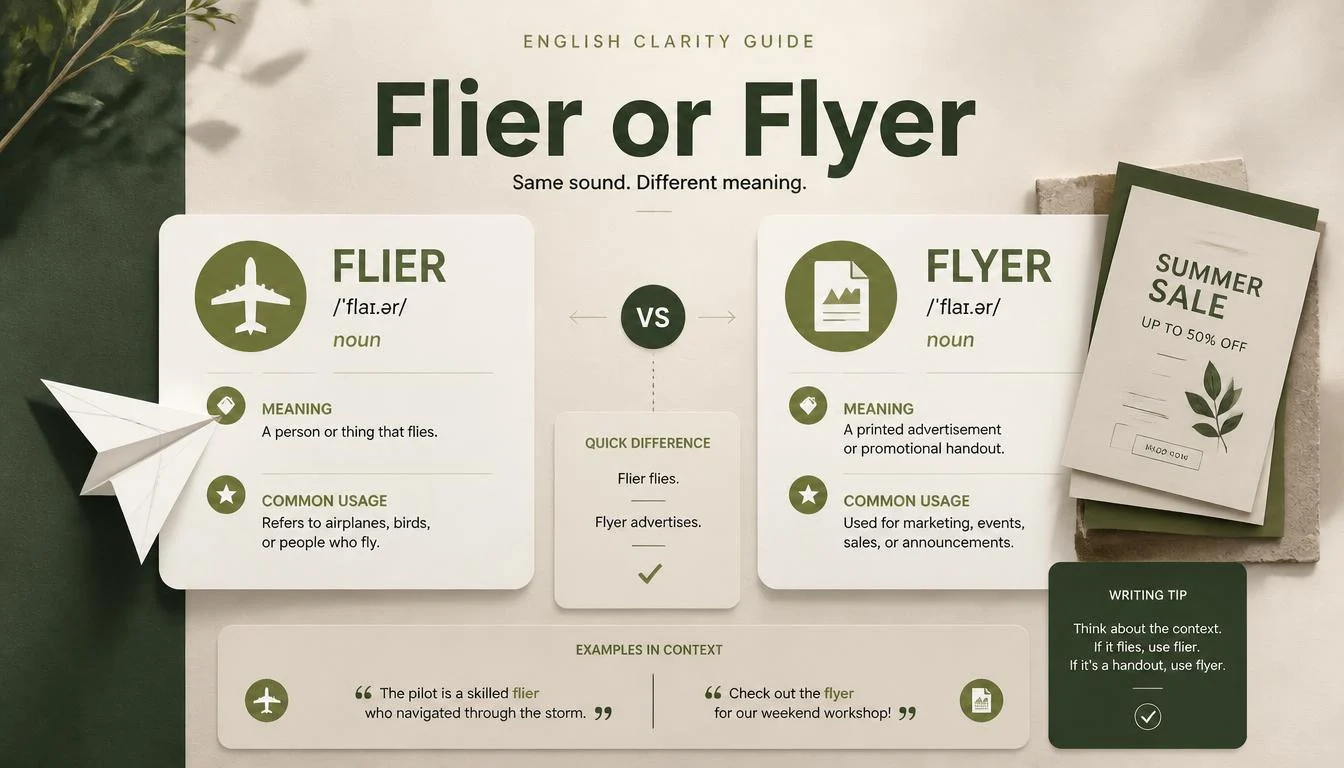
Flier and flyer are two accepted spellings of the same word, both referring to a person or thing that flies or a printed advertisement. American English traditionally used flier for aviators and flyer for handbills, but modern usage accepts both. Flyer is now more common in most contexts worldwide.
If you are wondering whether Flier or Flyer is the correct spelling, you are not alone. Both forms are used in English, but their usage can vary depending on the meaning and regional preference. Understanding the difference can help you choose the right word in your writing.
In this guide, we will explain Flier or Flyer with simple examples and clear usage rules. You will also learn when to use each spelling and why flyer is generally more common in modern English.
What’s the Difference Between Flier and Flyer?
The core difference between flier and flyer comes down to spelling preference and regional convention rather than meaning. Both words function as nouns with two primary definitions:
| Aspect | Flier | Flyer |
|---|---|---|
| Meaning | Person/thing that flies; printed advertisement | Person/thing that flies; printed advertisement |
| Part of Speech | Noun | Noun |
| Refers To | Aviators, passengers, birds, handbills, promotional papers | Aviators, passengers, birds, handbills, promotional papers |
| Typical Usage | Less common; favored by some US style guides historically | More common globally; preferred in British English |
| Example | “The frequent flier program offers priority boarding.” | “We designed a flyer to promote the event.” |
| Common Confusion | Some style guides restrict this to “one who flies” | Some style guides restrict this to “handbill” |
The traditional distinction which still appears in some style guides separated the two by meaning. In this older system, flier was reserved for a person or animal that flies, while flyer was used for a printed handbill or advertisement . The Chicago Manual of Style still suggests using flier for anyone or anything that flies and flyer for advertising circulars .
However, modern usage has largely abandoned this distinction. Most dictionaries now list both spellings as acceptable variants for all meanings . Flyer has emerged as the more common spelling overall, particularly for printed advertisements, while flier persists in certain traditional contexts like the idiom “take a flier” (meaning to take a risk) .
Is This a Grammar, Vocabulary, or Usage Issue?
This question sits at the intersection of usage and spelling conventions rather than grammar or vocabulary.
Grammar classification: Neither spelling is grammatically incorrect. Both are standard nouns that follow all the same grammatical rules. You can pluralize either word (fliers/flyers), use it in possessive forms (flier’s/flyer’s), and employ it in any noun position within a sentence.
Vocabulary difference: There is no vocabulary difference. The definitions are identical. What we’re dealing with is a spelling variant, similar to color/colour or theater/theatre .
Usage difference: The distinction is entirely about when and where to use each spelling. This is comparable to other “usage issues” where two forms coexist:
- Formal English: Both spellings appear in formal writing, though flyer is increasingly preferred.
- Business English: Flyer is more common in business contexts, especially for marketing materials.
- Academic writing: Both are acceptable, but most academic style guides recommend consistency above all else.
- Everyday conversation: This is a written distinction only both words sound identical when spoken.
One practical takeaway: If you’re unsure which spelling to use, default to flyer. It’s the more common spelling in nearly every context and will rarely be marked incorrect by editors or spell-checkers .
When to Use Flier (One Who Flies)
Flier has historically been the preferred American spelling for a person, animal or object that flies. This usage has deep roots in U.S. English, where dictionaries commonly list flier as a spelling for the “one who flies” meaning.
Common Collocations and Typical Sentence Patterns
- Frequent flier (traveler who flies often)
- Nervous flier (someone anxious about flying)
- First flier (a person’s first flight experience)
- Strong flier (a bird or aircraft that flies well)
Workplace Example
“As a frequent flier for the company’s international accounts, Marcus had accumulated enough miles for two personal trips to Japan.”
Academic Example
“The peregrine falcon is an exceptionally powerful flier, reaching diving speeds of over 200 miles per hour.”
Technology Example
“The drone proved to be a remarkably stable flier even in moderate wind conditions, making it ideal for aerial photography.”
Email Example
To: Sales Team
Subject: New Frequent Flier Program Details
“Attached you’ll find the updated policy for our business travel. Please review the changes before your next trip.”
Daily Conversation Example
“I’m not the world’s most confident flier, but I’ve gotten better over the years.”
One Learner Mistake to Avoid
Don’t assume flier is exclusively used for people or things that fly while flyer is only used for printed materials. Although some older style guides make this distinction, modern usage accepts both spellings for both meanings.
Mini Recap
Flier is a perfectly acceptable spelling, particularly in American English, for anyone or anything that flies. It appears frequently in airline contexts and idiomatic expressions.
When to Use Flyer (Printed Advertisement and Everything Else)
Flyer has become the dominant spelling for printed handbills, pamphlets and advertisements distributed to the public. This spelling is preferred in British English and is also widely used in American English, where it has become common across many contexts.
Common Collocations and Typical Sentence Patterns
- Promotional flyer
- Event flyer
- Marketing flyer
- Hand out flyers
- Distribute flyers
- Poster and flyer campaign
Workplace Example
“Our marketing team distributed over five hundred flyers at the trade show, generating more than a hundred qualified leads.”
Academic Example
“For the campus awareness campaign, students posted flyers on every bulletin board and distributed them at the student union.”
Technology Example
“Rather than printing paper flyers, the company created a digital flyer that could be shared across social media and email lists.”
Email Example
To: Community Outreach Team
Subject: Flyer Design for Next Week’s Event
“Please review the attached draft of the flyer. We need to finalize the text by Thursday for the printer.”
Daily Conversation Example
“I picked up a flyer for the neighborhood yard sale. Looks like there are going to be quite a few good deals this weekend.”
One Learner Mistake to Avoid
Don’t assume flyer is wrong in American English. While some older textbooks may have taught a flier/flyer distinction, modern American usage widely accepts flyer for different meanings. Your AutoCorrect may still prefer one spelling, but neither form is automatically incorrect.
Mini Recap
Flyer is the standard spelling for printed advertisements and promotional materials in most English-speaking contexts. It is also widely accepted for people who fly.
When Not to Use Each Word
Choosing the less expected spelling is rarely a serious error, but there are situations where following the preferred form can help your writing look consistent and appropriate for its audience.
1. Following a Specific Style Guide
If your organization follows the AP Stylebook, you should know that AP has shifted toward flyer for most uses except the idiom “take a flier.” The Chicago Manual of Style, however, still recommends flier for “one who flies” and flyer for handbills. Always check the style guide your company or publication follows.
Why the mistake happens: People assume all style guides agree, but they don’t.
Which word is correct: It depends on which guide you’re following.
How to remember: When in doubt, ask your editor or check the specific style guide your organization uses.
2. Writing for an American Audience in the Airline Industry
Many airlines still use flier in phrases such as “frequent flier,” reflecting the traditional American preference. Using flyer in this context may look unusual to readers who are familiar with that industry terminology.
Why the mistake happens: The airline industry has traditional spelling preferences.
Which word is correct: Flier is often preferred in aviation contexts.
How to remember: Airlines are in the flying business, and flier traditionally meant “one who flies.”
3. Using the Idiom “Take a Flier” vs. “Take a Flyer”
The idiomatic expression meaning “to take a risk” is traditionally spelled “take a flier.” While “take a flyer” is also used, flier is the more traditional spelling and is favored by the AP Stylebook.
Why the mistake happens: People apply the general rule that flyer is the standard spelling.
Which word is correct: Flier is the preferred traditional spelling for this idiom.
How to remember: Think of a risk as a risky flier, since it represents the more traditional spelling.
4. In British English Contexts
British English generally prefers flyer for both meanings. Using flier in British publications may therefore appear distinctly American.
Why the mistake happens: People assume American spelling conventions apply everywhere.
Which word is correct: Flyer is standard in British English.
How to remember: When writing for a British audience, flyer is usually the safer choice.
5. When Consistency Matters Most
Some publications choose one spelling and use it consistently throughout their content. Switching between flier and flyer without a clear reason can make a document look inconsistent.
Why the mistake happens: Writers don’t check for consistency.
Which word is correct: Whichever spelling your publication has adopted.
How to remember: Decide once and use the chosen spelling consistently.
Common Mistakes with Flier vs. Flyer
| Correct Sentence | Incorrect Sentence | Explanation |
|---|---|---|
| “We printed 500 flyers for the concert.” | “We printed 500 fliers for the concert.” | While both are technically correct, flyers is the more common spelling for printed materials. |
| “She’s a nervous flier and always requests an aisle seat.” | “She’s a nervous flyer and always requests an aisle seat.” | Both are used, but flier has stronger historical precedent for passengers. |
| “He took a flier on that startup investment.” | “He took a flyer on that startup investment.” | AP style recommends flier for this idiomatic expression. |
| “The airline’s frequent flier program offers premium perks.” | “The airline’s frequent flyer program offers premium perks.” | Many airlines, especially American carriers, use flier for their loyalty programs. |
| “The office bulletin board is covered with flyers.” | “The office bulletin board is covered with fliers.” | Flyers is now the more widely accepted spelling for handbills. |
Quick Decision Guide
1 If you mean the action of flying or a person who flies:
- Use flier in traditional American English contexts.
- Use flyer in British English or when following AP Style.
- Both are acceptable; either will be understood.
2 If you mean a printed promotional document:
- Use flyer in most modern contexts.
- Use flier only if required by a specific style guide.
3 If you’re writing an idiom:
- Use flier for “take a flier” (taking a risk).
- Use flyer for “frequent flyer” or “flyer miles” if you prefer the modern spelling.
4 If you want to play it safe:
- Default to flyer for all uses it’s now the more common spelling worldwide and will rarely be considered incorrect.
Real World Examples in Context
Office Communication
“The HR department created a flyer announcing the new wellness program and posted it in every break room.”
Business Email
“To: All Staff / Subject: Annual Company Picnic / I’ve attached the flyer for this year’s picnic. Please print and display it in your departments.”
School or University
“Student volunteers distributed flyers across campus to promote the guest lecture series and attendance increased by forty percent compared to the previous year.”
Customer Support
“We’ve prepared a flyer explaining the new return policy to give to customers who ask about their options.”
Technology
“Rather than using traditional paper flyers, our marketing team created QR codes that customers could scan to access our digital promotional content.”
Artificial Intelligence
“The AI tool generated multiple flyer designs based on our brand guidelines, selecting layouts that previous campaigns had shown to be most effective.”
Daily Conversation
“Someone was handing out flyers at the mall entrance and I ended up buying the most amazing coffee from that new shop.”
News Context
“The city council heard concerns about flyers being posted on utility poles and discussed new regulations for public announcements.”
Modern Technology and Digital Flyers
The digital age has transformed how we use the word flyer. While the traditional paper handbill remains common, digital flyers have become increasingly important in marketing and communication.
Artificial Intelligence and Flyers
AI tools can now:
- Generate flyer designs automatically based on brand guidelines
- A/B test different flyer layouts to optimize engagement
- Create personalized flyers for different audience segments
Virtual Assistants and Voice Search
Virtual assistants like Siri and Alexa have introduced a new layer of meaning, though they are typically called assistants rather than flyers. The “flier” spelling remains relevant in voice search because users may ask questions such as “How do you spell flier?” or “Is it flyer or flier?”
Chatbots and Software
Chatbots and software can now create and distribute flyers digitally through email marketing platforms and social media management tools. This has broadened the term’s application beyond printed materials.
Business Tools for Creating Flyers
Business tools such as Canva, Adobe Express and other design platforms have made it easier for anyone to create professional looking flyers. These platforms have also helped establish flyer as the dominant spelling for promotional materials.
Word Origin: A Brief History
The word flyer (and its variant flier) comes from the verb fly plus the suffix -er, indicating a person or thing that performs the action. The earliest recorded use dates back to the late Middle English period (1400-1450) .
The spelling distinction emerged in American English around the early 20th century when some style guides began recommending flier for “one who flies” and flyer for “handbill.” This distinction gained traction because of the general rule that when a word ends in “y,” you change the “y” to “i” when adding a suffix as seen in try/tries or hurry/hurried .
However, in practice, this distinction was never universally adopted. For decades, The Associated Press Stylebook preferred flier for handbills and flyer for aviators, only to reverse this position in 2017 when it made flyer the standard for most cases . Today, the trend is toward simplification, with flyer becoming the default in most contexts.
Expert Insight
“One of the most common questions I get from students is whether flier or flyer is ‘correct.’ The answer is both. When you’re choosing between the two, you’re not choosing right versus wrong you’re choosing convention. The key is understanding your audience: if you’re writing for a British publication or a modern marketing team, flyer is your safest bet. If you’re working within the airline industry or following older American style guides, flier might be preferred. The real mark of a professional writer isn’t memorizing every rule it’s knowing when rules apply and when they don’t. In this case, consistency matters more than the specific spelling.”
Error Prevention Checklist
- Always use flier when:
- Writing for publications following older American style guides (pre-2017 AP Style)
- Using the idiom “take a flier” (take a risk)
- Following The Chicago Manual of Style’s recommendation for “one who flies”
- Writing in contexts where consistency with “flier” has already been established
- Always use flyer when:
- Writing for British English publications
- Creating printed or digital promotional materials
- Following AP Style (2017 onwards)
- Writing in a modern business context
- You want the safest, most widely accepted spelling
- Never confuse them if:
- Your organization has a house style that specifies one form
- You’re writing for publication and need to follow style guide rules
- You want to maintain professional consistency
- Quick memory tip:
- Flier = Fly + lier (think of a person who flies)
- Flyer = Fly + yer (think of paper you might yield to someone okay, it’s a stretch, but you’ll remember it!)
Related Grammar Confusions
If you found the flier/flyer distinction interesting, you may also want to explore:
- Advice vs. Advise – One is a noun, one is a verb; understanding the difference helps avoid embarrassing writing errors.
- Affect vs. Effect – The classic grammar challenge that trips up both native and non-native speakers.
- Compliment vs. Complement – One is about praise, the other about things that go well together.
- Principal vs. Principle – A school official vs. a fundamental truth or rule.
- Stationary vs. Stationery – Staying still vs. writing paper.
- Than vs. Then – Comparison vs. sequence.
- To vs. Too vs. Two – Three distinct meanings that sound identical.
- Your vs. You’re – Possession vs. contraction.
- Its vs. It’s – Possession vs. contraction (one of the most common errors in English).
- There vs. Their vs. They’re – Three homophones with very different meanings.
Each of these pairs involves either spelling confusion, homophone confusion, or grammatical distinction similar to the flier/flyer issue.
FAQs
Is “Flier” or “Flyer” the Correct Spelling?
Both spellings are correct. Flyer is more common in modern English, especially for printed advertisements, while flier has historical use in American English for someone who flies. The choice can depend on the context and the style guide being followed.
What Is the Plural of “Flyer” and “Flier”?
Both words have regular plural forms: flyers and fliers. The plural follows the same spelling used in the singular form. You simply add -s to either word, and both plural forms are correct.
Is It “Frequent Flyer” or “Frequent Flier”?
Both spellings are used, but frequent flyer is more common overall. Some airlines, particularly American carriers, still use frequent flier, reflecting the traditional American preference for flier in aviation contexts.
How Do You Use “Take a Flier” in a Sentence?
“Take a flier” means to take a risk or make a risky attempt. For example: “The investors decided to take a flier on the new technology company despite its limited track record.” The traditional idiom uses flier, although take a flyer is also used.
Do British and American English Differ on These Spellings?
Yes, there has historically been a difference. British English has generally preferred flyer for both meanings, while American English traditionally used flier for “one who flies” and flyer for handbills. Today, flyer is increasingly common in American English as well.
Why Are There Two Spellings of This Word?
The -ier spelling developed from the general English spelling pattern in which words ending in -y may change the y to i before adding a suffix. For example, fly can become flier. However, flyer has also been established as a standard spelling and is now widely used, especially for promotional materials.
Conclusion
Choosing between flier and flyer isn’t about right or wrong it’s about understanding context. Both spellings are grammatically correct and widely accepted, making this one of the more forgiving spelling dilemmas in English. The trend in modern writing is clear: flyer has become the preferred spelling for most uses, particularly for printed advertisements and promotional materials.
The traditional distinction that separated flier (one who flies) from flyer (handbill) persists in some style guides but is fading from everyday use. The one exception is the idiom “take a flier,” where this spelling remains the standard.
Here’s a simple rule to remember: when you’re writing about a promotional handout, flyer is almost always your best choice. When you’re writing in an aviation context or following older American style guides, consider using flier. And when in doubt, default to flyer it’s now the more common form and will rarely be marked incorrect.
Read More Related Articles:
- Panel or Pannel | Quick Guide to the Correct English Spelling In 2026
- Modeled or Modelled | Master the Difference in Minutes In 2026
- Neighbour or Neighbor | One Word, Two English Spellings In 2026

Zoe Chambers works as a content writer at synoseek.com, contributing thoughtful pieces on everyday subjects and ideas. She writes in a simple, grounded way, often drawing from real-world experiences. Her focus is on keeping content natural, clear and easy for readers to connect with.
2 thoughts on “Flier or Flyer | Easy Way to Tell These Two Words Apart In 2026”