Quick Answer
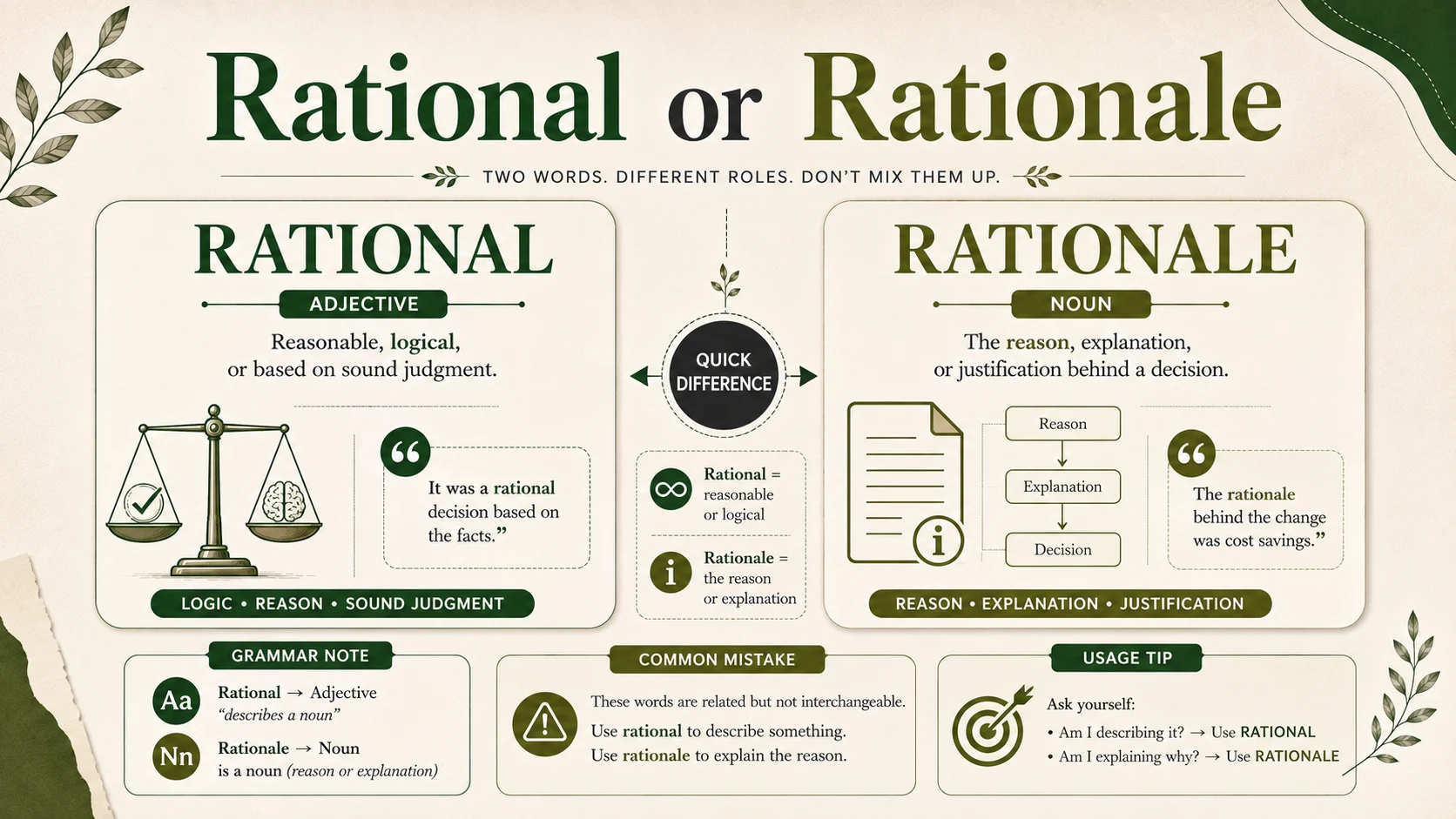
The difference between rational and rationale comes down to their function. Rational is an adjective meaning logical or reasonable, describing people, decisions, or thinking. Rationale is a noun meaning the underlying reason or logical explanation for something. Use rational when describing something as logical, and rationale when referring to the justification itself.
Anyone who has written a business proposal, academic paper, or even a simple email has probably paused at least once, staring at the screen, wondering: should I use rational or rationale? It’s one of those word pairs that looks similar, sounds almost identical in casual conversation, but serves completely different purposes in writing.
The confusion is completely understandable. Both words share the same Latin root and both relate to logic and reasoning. But using one when you mean the other immediately signals a language error that can undermine your credibility, especially in professional or academic settings. If you write “I need to explain my rational” instead of “I need to explain my rationale,” readers will notice something is off. This guide will clear up the confusion once and for all, giving you practical rules and real-world examples you can actually use.
By the end of this article, you’ll know exactly which word fits your sentence, why it fits, and how to avoid the most common mistakes that trip up even experienced writers.
What’s the Difference Between Rational and Rationale?
The fundamental difference between rational and rationale lies in their grammatical function and what they describe. Rational is an adjective that modifies nouns, describing something as logical, sensible, or based on reason. Rationale is a noun that names the logical foundation itself.
Think of it this way: if you’re describing a person, decision, or thought process, you’re likely using rational. If you’re naming the explanation or justification behind something, you need rationale. Let’s break this down clearly.
| Aspect | Rational | Rationale |
|---|---|---|
| Part of Speech | Adjective | Noun |
| Refers To | A quality or characteristic | A set of reasons or explanations |
| Typical Usage | Describes people, decisions, thinking, behavior | Names the justification, logical basis, or reasoning behind actions |
| Example | She made a rational choice.” | “She explained the rationale for her choice.” |
| Common Confusion | Confused with “rationale” when describing reasons | Confused with “rational” when describing logical people or things |
Recap: In simple terms, rational is about being logical, while rationale is about the logic itself. If you can replace the word with “logical,” use rational. If you can replace it with “reason” or “justification,” use rationale.
Is This a Grammar, Vocabulary, or Usage Issue?
Understanding whether the rational vs. rationale confusion is a grammar problem, a vocabulary problem, or a usage issue helps clarify how to approach it.
Grammatically, the distinction is clear: rational is an adjective, and rationale is a noun. Mixing them up means using the wrong part of speech for your sentence structure. If you say “What’s your rational?” you’ve used an adjective where a noun belongs.
Vocabulary-wise, both words relate to logic and reason, but they name different things. One is a descriptor; the other is an entity. Building a strong vocabulary means knowing not just definitions but also the specific roles words play.
In terms of usage, the mistake happens because the words sound similar and share a root. Many writers know the difference intellectually but slip up in practice, especially when writing quickly.
Are they interchangeable? Absolutely not. Using one in place of the other changes your sentence structure and meaning. In formal and business English, precision matters. An error like this can make your writing appear careless. In everyday conversation, people might not notice the difference, but in written communication, especially in professional contexts, using these words correctly signals attention to detail.
Practical takeaway: Always check whether you need an adjective (rational) or a noun (rationale). This one simple check will prevent nearly all mistakes.
Understanding Rational: Logic as a Quality
Meaning and Definition
Rational means having or exercising reason, sound judgment, or good sense. It describes something or someone that is logical, sensible, and not driven by emotion or irrationality. A rational decision is one based on facts and careful thinking. A rational person is someone who makes decisions that way.
Pronunciation
RASH-uh-nul (three syllables, stress on the first)
Part of Speech
Adjective – it modifies nouns and pronouns.
Common Collocations
These word combinations appear frequently in professional and academic writing:
- Rational decision
- Rational thinking
- Rational choice
- Rational explanation
- Rational behavior
- Rational approach
- Rational mind
- Rational argument
Typical Sentence Patterns
Pattern 1: Noun + is + rational
Example: “Her approach to the problem is entirely rational.”
Pattern 2: Rational + noun
Example: “We need a rational explanation for these results.”
Pattern 3: Make + noun + rational
Example: “Try to make your decision as rational as possible.”
Natural Workplace Example
“Our team needs to take a rational approach to this budget issue. Emotional reactions won’t help us solve the actual problem.”
Academic Example
“The researcher argued that the study’s methodology was rational given the available resources and time constraints.”
Technology Example
“The algorithm makes rational decisions based on the data it receives, removing human bias from the equation.”
Email Example
“Subject: Proposal Review
I’d like us to have a rational discussion about the proposed timeline. Let’s look at the facts before we make any decisions.”
Daily Conversation Example
“I know you’re upset, but try to be rational about this. Getting angry won’t fix the situation.”
One Learner Mistake
Incorrect: “Can you give me a rational for your decision?”
Correct: “Can you give me a rationale for your decision?”
Remember: if you’re asking for an explanation, you need the noun rationale. Rational describes things, not names them.
Mini Recap
Rational is about describing logic. If you’re painting a picture of someone or something as logical, sensible, or based on reason, this is your word. It always describes or modifies something else.
Understanding Rationale: The Logic Itself
Meaning and Definition
Rationale means the underlying reason, explanation, or logical basis for a particular action, belief, or decision. It’s the “why” behind something. When you provide a rationale, you’re giving the thought process that led to a conclusion.
Pronunciation
RASH-uh-nal (three syllables, stress on the first) – this sounds very similar to “rational,” which is part of why the confusion persists.
Part of Speech
Noun – it names a thing, specifically a set of reasons or a logical explanation.
Common Collocations
- Provide a rationale
- Explain the rationale
- Understand the rationale
- Rationale for something
- Rationale behind something
- Sound rationale
- Clear rationale
- Strong rationale
Typical Sentence Patterns
Pattern 1: The rationale for + noun/noun phrase + is
Example: “The rationale for the policy change is to reduce costs.”
Pattern 2: Provide + a rationale + for + noun
Example: “Please provide a rationale for your budget request.”
Pattern 3: The rationale behind + noun/noun phrase + is
Example: “The rationale behind the new system is to improve efficiency.”
Natural Workplace Example
“The committee’s rationale for rejecting the proposal was that it didn’t align with our long-term goals. We need to address these concerns before resubmitting.”
Academic Example
“The rationale for conducting this experiment stems from previous research that suggested a connection between sleep quality and cognitive performance.”
Technology Example
“The development team’s rationale for choosing Python over Java was its flexibility and the availability of machine learning libraries.”
Email Example
“Subject: Rationale for Extended Deadline
Please find attached my rationale for requesting a three-week extension on the project. The additional time will allow us to complete the testing phase thoroughly.”
Daily Conversation Example
“I understand the rationale behind your decision, but I still think we should have considered other options before making a final choice.”
One Learner Mistake
Incorrect: “Is she a rationale person?”
Correct: “Is she a rational person?”
Remember: rationale cannot describe people. If you’re describing someone as logical, you need the adjective rational.
Mini Recap
Rationale is about naming the reasons. If you’re pointing to the explanation, justification, or thought process behind something, this is your word. It names a thing, it does not describe one.
When NOT to Use Each Word
Many writers misuse these words because they sound similar and share a common root. Here are specific situations where choosing the wrong word creates problems.
Mistake 1: Using “Rational” When You Need a Noun
Why it happens: You want to name a reason or explanation, but you reach for the more familiar word “rational” because you’ve heard it more often.
Correction: When you need a noun that names the reasoning behind something, use “rationale.”
Mistake 2: Using “Rationale” as an Adjective
Why it happens: You’re describing a person, decision, or thought process as logical, but you mistakenly use the noun form.
Correction: When you’re describing something as logical or sensible, use “rational.”
Mistake 3: Using “Rationale” to Describe a Person
Why it happens: The words sound alike, and you might think “rationale” is just a fancier version of “rational.”
Correction: People are rational. Decisions can be rational. Arguments can be rational. But a person is never a rationale. The rationale is the explanation itself.
Mistake 4: Confusing the Two in Professional Writing
Why it happens: Business writing often involves both logical thinking and explaining reasons. It’s easy to mix them up when you’re writing quickly.
Correction: Take an extra second to check your sentence structure. If you need a modifier, use “rational.” If you need a subject or object, use “rationale.”
Mistake 5: Misspelling “Rationale”
Why it happens: Because “rational” ends with “al,” people sometimes write “rational” when they mean “rationale.
Correction: The noun has an “e” at the end. Always include it.
Mistake 6: Using “Rationale” in Place of “Reason” in Every Context
Why it happens: You want to sound more formal or sophisticated.
Correction: “Rationale” implies a complete logical basis, not just a simple reason. Use it when you’re referring to a thorough explanation or justification, not just any reason.
Common Mistakes Table
| Correct Sentence | Incorrect Sentence | Explanation |
|---|---|---|
| “What’s the rationale for this change?” | “What’s the rational for this change?” | You need a noun to name the explanation. “Rational” is an adjective. |
| “She’s a rational person.” | “She’s a rationale person.” | “Rationale” is not an adjective and cannot describe people. |
| “The decision was rational.” | “The decision was rationale.” | “Rationale” cannot describe decisions. It names the explanation for them. |
| “Can you explain your rationale?” | “Can you explain your rational?” | You’re asking for an explanation (a noun), not describing something. |
| “We need a rational solution.” | “We need a rationale solution.” | “Rationale” cannot modify “solution.” It describes, not modifies. |
| “His rationale was flawed.” | “His rational was flawed.” | You’re talking about his reasoning (a noun), not describing him. |
Quick Decision Box
Use RATIONAL if:
- You’re describing someone or something as logical, sensible, or based on reason.
- You need an adjective.
- You can replace it with “logical.”
Use RATIONALE if:
- You’re naming a reason, explanation, or justification.
- You need a noun.
- You can replace it with “reason” or “justification.”
Pro Tip: If you’re stuck, ask yourself: am I describing something, or am I naming something? Describing = rational. Naming = rationale.
Real-World Examples in Action
Office Communication
“To address the budget cuts, management decided to reduce travel expenses. Their rationale was that virtual meetings could replace most in-person visits, which seemed rational given the current financial climate.”
Business Email
“I’ve attached the rationale for my recommendation. I believe this is the most rational approach given our limited resources.”
University Setting
“The student’s rationale for choosing this research topic was based on her personal experience. Her professors found this to be a rational justification for the study.”
Customer Support
“We understand your frustration. The rationale for the new policy is to improve service times, which we believe is a rational trade-off for our customers.”
Technology
“The system’s rationale for flagging your transaction was based on unusual activity patterns. The automated decision was rational given the data available.”
Artificial Intelligence
“AI systems are designed to make rational decisions, but they still need human oversight to evaluate the rationale behind those decisions.”
Daily Conversation
“I know you’re worried about moving to a new city, but try to be rational about it. Let me explain my rationale for choosing this neighborhood.”
Modern Technology Context
In today’s digital landscape, both rational and rationale appear frequently in technology discussions, often in relation to artificial intelligence and automated systems.
AI and Machine Learning: When we talk about AI decision-making, we discuss whether the system is making rational choices based on data. However, when explaining why an algorithm reached a specific conclusion, engineers need to provide a rationale for its decisions, which is often called “explainable AI.”
Virtual Assistants and Chatbots: Voice assistants like Siri or Alexa might be described as making rational responses to queries. The rationale for a particular response might involve natural language processing algorithms that determine the most appropriate answer.
Business Software: Project management tools often require team members to provide a rationale for changing deadlines or shifting resources. This ensures decisions aren’t arbitrary and can be reviewed later. A rational approach would involve using data to support these changes.
Understanding these modern contexts helps, but the basic rule remains unchanged: use rational to describe logical things, and rationale to name logical explanations.
Word Origin
Understanding where these words come from helps cement the difference in your mind. Both rational and rationale trace back to the Latin word rationalis, meaning “of or belonging to reason,” which comes from ratio meaning “reckoning, computation, or reason.”
Rational entered English in the late 14th century from Old French rationel or directly from Latin rationalis. It has always been an adjective describing the quality of having reason.
Rationale arrived later, in the 17th century, directly from Latin rationale which was the neuter form of rationalis, used as a noun meaning “a logical basis or explanation.” It was originally used in philosophical and theological contexts before spreading to general use.
Understanding this shared origin explains why the words are so similar, and why so many writers confuse them. They’re linguistic cousins with different jobs, like siblings who share the same family resemblance but have completely different careers.
Expert Insight
Teaching the difference between “rational” and “rationale” comes down to helping students see words not as isolated vocabulary items but as functional tools in a sentence. The most effective method I’ve found is the “modifier versus thing” test.
When a student pauses, unsure which word to use, I ask them to read their sentence aloud and pause after the word in question. If the sentence sounds incomplete or like it needs something to describe, they probably need “rational.” If the sentence sounds like it needs a named concept, they need “rationale.”
Another technique that works well is replacing the word with “logical” or “reason.” If “logical” fits, use “rational.” If “reason” fits, use “rationale.” This simple substitution eliminates almost all confusion. I’ve seen students master this distinction in minutes using this method, whereas memorizing definitions alone often leaves them uncertain.
The key is to move from memorizing to understanding function. Language is about how words work together, not just what they mean in isolation.
Error Prevention Checklist
Always use RATIONAL when:
- Describing a person, decision, thought, or behavior as logical
- The word functions as an adjective in your sentence
- You can substitute “logical” and the sentence still makes sense
- You’re modifying a noun
Always use RATIONALE when:
- You’re naming a reason, explanation, or justification
- The word functions as a noun in your sentence
- You can substitute “reason” or “justification” and the sentence still makes sense
- You’re pointing to the “why” behind something
Never confuse them if:
- The sentence has a noun that needs modification (needs rational)
- The sentence needs a subject or object (needs rationale)
Quick memory tip: Rational has an “a” like “adjective” – both start with A. Rationale has an “e” like “explanation” – both contain E.
Related Grammar Confusions
These word pairs present similar challenges to writers. Learning them together helps build pattern recognition:
- Affect vs. Effect – One is usually a verb, the other a noun
- Principal vs. Principle – One describes a person or role, the other a rule
- Complement vs. Compliment – One completes, the other praises
- Stationary vs. Stationery – One means still, the other means writing paper
- Cite vs. Site – One means to reference, the other means a location
- Elicit vs. Illicit – One means to draw out, the other means illegal
- Discreet vs. Discrete – One means careful, the other means separate
- Allude vs. Elude – One means to hint at, the other means to escape
- Emigrate vs. Immigrate – One means to leave a country, the other to enter one
- Former vs. Latter – One refers to the first item, the other to the second
Each of these pairs follows a similar pattern: two words that sound or look similar but serve different grammatical or semantic functions.
FAQs
Is rationale the same as reason?
Not exactly. While “rationale” often means “reason,” it carries a more specific meaning. A rationale is the complete logical basis or underlying explanation for something, involving a set of reasons rather than just one simple cause. Think of it as the full justification rather than just a single reason.
Can rational be used as a noun?
No. In standard English, “rational” is exclusively an adjective. It describes nouns but does not function as a noun itself. If you need a noun, use “rationale.” The only exception appears in specific philosophical contexts where “rational” might be used as a noun meaning “a rational being,” but this usage is extremely rare and technical.
Why do so many people confuse these two words?
The confusion is understandable. Both words are derived from the same Latin root, both relate to logic and reason, and their pronunciations are nearly identical in casual speech. The only significant difference is their grammatical function—one is an adjective, the other is a noun—which is less obvious to people who aren’t thinking about grammar.
Can I use rationale in everyday conversation?
Absolutely. While “rationale” might sound formal, it’s perfectly appropriate in everyday conversation when you need a precise word for a logical explanation. I don’t understand the rationale behind that rule” sounds natural and clear. It’s not pretentious; it’s precise.
What’s the best way to remember the difference?
Use this simple memory trick: “Rational” contains “rat” like “adjective” starts with “a” – it’s a describing word. “Rationale” contains “e” like “explanation” – it’s the explanation. Or simply: rational = logical, rationale = the logic itself.
Is rationale always singular?
Yes. The word “rationale” is always singular, even when referring to multiple reasons. You would say “the rationale for these policies” (singular) not “rationales” unless you’re specifically referring to multiple distinct explanations from different contexts. Stick with the singular form in most writing.
Conclusion
The difference between rational and rationale comes down to one simple distinction: rational is an adjective that describes logical qualities, while rationale is a noun that names the logical explanation itself.
If you remember nothing else from this guide, remember this: use rational when you’re describing something as logical, and use rationale when you’re naming the reason behind something. If you can replace the word with “logical,” choose rational. If you can replace it with “reason” or “justification,” choose rationale.
Mastering this distinction will improve your professional writing, academic work, and everyday communication. It shows attention to detail and precision in language use, qualities that build credibility with readers. The next time you pause before writing one of these words, take a second to check the function of the word in your sentence. Your writing will be clearer, more professional, and more effective.