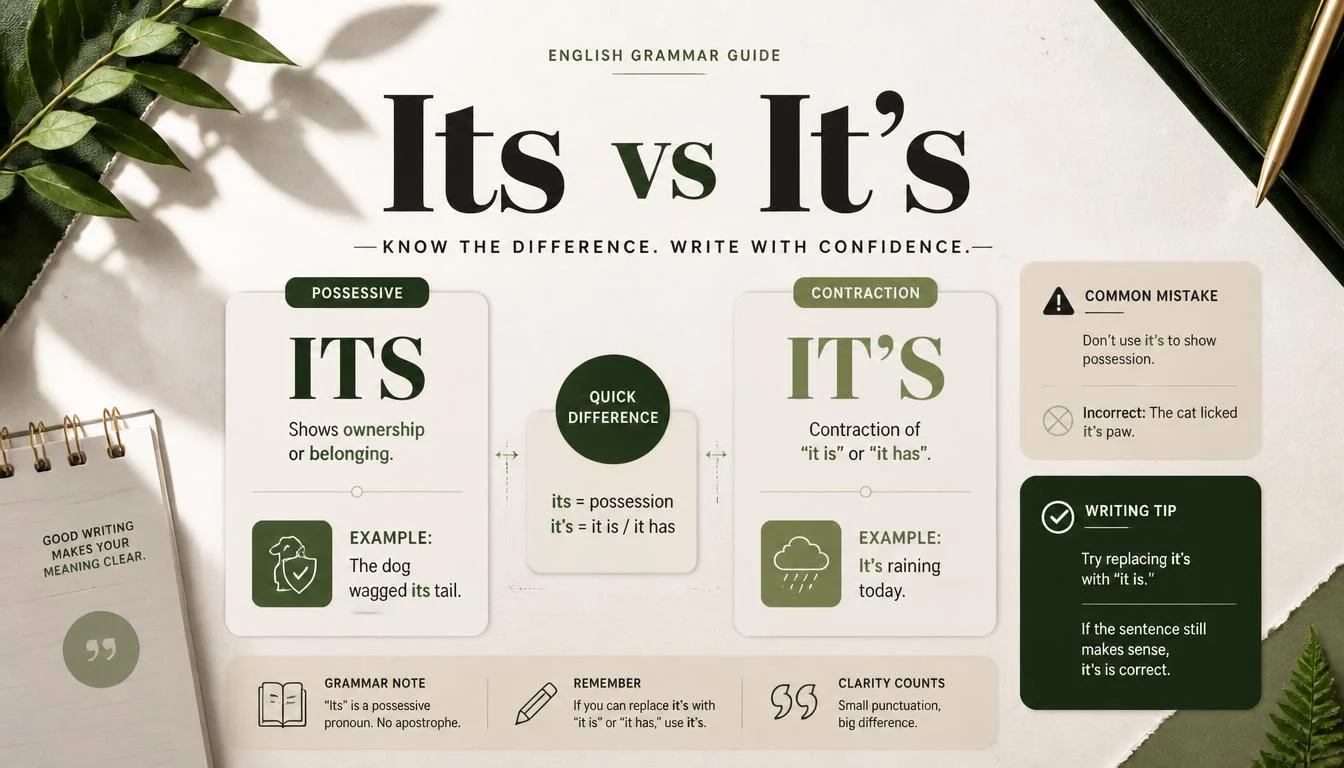
Quick Answer
The difference between its and it’s is simple: its is a possessive pronoun meaning “belonging to it,” while it’s is a contraction for “it is” or “it has.” Use its when showing ownership or possession. Use it’s only when you can expand it to “it is” or “it has” in the sentence.
You’re writing an important email, drafting a business proposal, or finishing a school essay, and suddenly you freeze. Should you type its or it’s? You know one has an apostrophe, but which one? And does it really matter?
This tiny punctuation mark creates outsized confusion for native English speakers and learners alike. The good news is that understanding the difference between its and it’s doesn’t require memorizing complex grammar rules. Once you grasp the logic behind the apostrophe’s role, you’ll never second-guess yourself again.
In this comprehensive guide, you’ll learn exactly when to use its and when to use it’s, why people confuse them, and practical memory tricks that actually work in real writing situations.
What’s the Difference Between Its and It’s?
Here’s the core difference: its shows possession, while it’s is a contraction.
The confusion stems from English grammar conventions. Usually, we add an apostrophe plus *s* to indicate possession, as in “Sarah’s book” or “the company’s policy.” But possessive pronouns including its, yours, theirs, and ours never use apostrophes. They follow different rules because they already indicate ownership by their nature.
Comparison Table: Its vs. It’s
| Aspect | Its | It’s |
|---|---|---|
| Meaning | Belonging to it | It is or it has |
| Part of Speech | Possessive pronoun | Contraction |
| Refers To | Ownership or association | Action or state of being |
| Typical Usage | “The team celebrated its victory” | “It’s raining outside” |
| Example | “The cat licked its paw” | “It’s been a long day” |
| Common Confusion | Often mistaken for it’s | Often mistaken for its |
The apostrophe in it’s signals missing letters, not ownership. When you see that apostrophe, think “something is missing” rather than “something belongs.” This simple mental shift resolves most confusion immediately.
Grammar and Usage Classification
Is its versus it’s a grammar issue, a vocabulary issue, or a usage issue? It’s primarily a usage issue with grammar implications.
The grammar classification involves understanding the difference between possessive pronouns and contractions. This distinction matters in formal English, business writing, and academic contexts. While some might consider it a punctuation problem, the real challenge lies in recognizing how English handles possession differently for pronouns compared to regular nouns.
Grammar Classification: Possessive pronouns never take apostrophes. Regular nouns take apostrophe + *s* for possession. Contractions take apostrophes to show missing letters.
Vocabulary Difference: These are not synonyms with subtle differences. They have completely distinct meanings and functions.
Usage Difference: Both appear frequently in writing, but serve entirely different purposes.
Interchangeability: Never. Using one when you mean the other creates a grammatical error that can confuse readers.
Formal English: Errors here appear unprofessional and careless. Editors and hiring managers notice this mistake.
Business Writing: Incorrect usage undermines credibility, even in informal internal communications.
Academic Writing: This error can cost points on assignments and appears frequently in student writing.
Everyday Conversation: Since both words sound identical in speech, this error only appears in writing. Many people write automatically without thinking about the distinction.
Practical Takeaway: Replace it’s with “it is” or “it has” in your mind. If the sentence still makes sense, you need the apostrophe. If not, you need the possessive its.
Understanding Its
Its is a possessive pronoun that indicates something belongs to or is associated with a previously mentioned thing. It can refer to animals, objects, organizations, concepts, or abstract ideas.
Pronunciation: /ɪts/ (rhymes with “hits”)
Part of Speech: Possessive pronoun
Common Collocations:
- Its own
- Its way
- Its purpose
- Its value
- Its potential
- Its impact
- Its influence
Typical Sentence Patterns:
- [Noun] + its + [possessed item]
- Its + [noun] + verb
- [Action] + its + [result]
Natural Workplace Example: “The marketing team presented its quarterly strategy to the board. The presentation exceeded its expected reach by forty percent.”
Academic Example: “The study reached its conclusion after analyzing data from five thousand participants. Its findings challenge previous assumptions about cognitive development in children.”
Technology Example: “The software runs on its own proprietary algorithm. Users appreciate its intuitive interface and minimal learning curve.”
Email Example: “The company values its relationship with long-term clients. We appreciate your patience as we upgrade our systems to better serve your needs.”
Daily Conversation Example: “That restaurant is famous for its brunch menu. I love its relaxed atmosphere and friendly staff.”
One Learner Mistake: Writing “The dog wagged it’s tail” when you mean “The dog wagged its tail.” The apostrophe creates an error because you wouldn’t say “The dog wagged it is tail.
Mini Recap: Its shows possession without an apostrophe. Use it whenever you need to indicate that something belongs to “it.”
Understanding It’s
It’s is a contraction that combines either “it is” or “it has.” The apostrophe replaces the missing letters.
Pronunciation: /ɪts/ (identical to its in spoken English)
Part of Speech: Contraction (combination of pronoun and verb)
Common Collocations:
- It’s time
- It’s going to
- It’s been
- It’s not
- It’s important
- It’s possible
- It’s worth
Typical Sentence Patterns:
- It’s + [adjective/noun]
- It’s + been + [past participle]
- It’s + going to + [verb]
- It’s + [adverb] + [adjective] + to
Natural Workplace Example: “It’s essential that we submit the proposal by Friday. It’s been in development for three weeks, and we’re almost ready to share it with the client.”
Academic Example: “It’s widely accepted that early childhood education significantly impacts adult outcomes. It’s also important to consider socioeconomic factors when analyzing these patterns.”
Technology Example: “It’s worth updating your operating system regularly. It’s not just about new features; security improvements matter too.”
Email Example: “It’s great to connect with you again. It’s been too long since our last conversation about the project timeline.”
Daily Conversation Example: “It’s raining again, and it’s starting to get cold. It’s been a long week, and I’m ready for the weekend.”
One Learner Mistake: Writing “Its a beautiful day” when you mean “It’s a beautiful day.” The missing apostrophe changes the meaning completely and creates confusion.
Mini Recap: It’s always expands to “it is” or “it has.” If you can’t substitute either phrase, you need its instead.
When Not to Use Each Word
Understanding when to avoid each form prevents common mistakes. Here are situations where writers frequently choose the wrong option.
Situation 1: Possession Without an Apostrophe
You might feel tempted to add an apostrophe to its because you’re showing possession. But possessive pronouns never take apostrophes. Use its instead.
Situation 2: Contractions in Formal Writing
While it’s is grammatically correct, formal academic and business writing often discourages contractions. Consider using “it is” instead of it’s in these contexts.
Situation 3: When “It Is” Sounds Awkward
If you can’t expand it’s to “it is” or “it has,” you need its. Many writers automatically add apostrophes without checking.
Situation 4: Beginning Sentences
Both words can start sentences, but be careful with its because readers might expect a contraction. The context usually clarifies the meaning.
Situation 5: After Prepositions
Its often follows prepositions naturally. It’s rarely appears immediately after a preposition.
Situation 6: Ambiguous References
If you’re unsure which word to use, rewrite the sentence. Clear communication matters more than using either word specifically.
Situation 7: Automated Writing Tools
Spell checkers won’t catch its versus it’s errors. You need to rely on your understanding rather than technology.
Situation 8: Quick Writing
Emails and messages often contain errors. Take an extra moment to check your apostrophe usage.
Common Mistakes Table
| Correct Sentence | Incorrect Sentence | Explanation |
|---|---|---|
| The organization announced its annual budget. | The organization announced it’s annual budget. | “It is annual budget” doesn’t make sense. Use possessive its. |
| It’s time to review our strategy. | Its time to review our strategy. | “Time” doesn’t belong to “it.” Use contraction it’s for “it is time.” |
| The company increased its prices. | The company increased it’s prices. | Prices belong to the company, so use its without apostrophe. |
| It’s been a productive quarter. | Its been a productive quarter. | “Been” requires “has” before it, so use it’s as a contraction for “it has.” |
| The committee changed its position. | The committee changed it’s position. | The position belongs to the committee; no apostrophe needed. |
Quick Decision Box
If you mean belonging to it → use its
If you mean it is or it has → use it’s
Memory Tip: When you see the apostrophe, imagine it’s holding the place of a missing letter. No missing letters? No apostrophe.
Real-World Examples
Understanding the difference becomes easier when you see these words in authentic contexts.
Office Communication
“Your team’s proposal impressed the leadership. However, the board has expressed concerns about its budget projections. It’s crucial that you address these concerns before the next meeting.”
Business Email
“Thank you for submitting your application. Our hiring committee is reviewing its options carefully. It’s important to note that we’ll contact all candidates within two weeks.”
School or University
“The research paper must include its bibliography on a separate page. It’s also necessary to follow APA formatting guidelines throughout the document.”
Customer Support
“Your order has shipped, and we’ve sent tracking information to your email. The package should arrive within its estimated delivery window. It’s possible that weather conditions could affect timing.”
Technology
“The new AI system updates its knowledge base automatically. It’s designed to learn from every interaction. Its developers continue to improve the algorithm based on user feedback.”
Artificial Intelligence
“Every AI model has its limitations. It’s important to understand what the technology can and cannot do. The system refines its responses through constant training.”
Daily Conversation
“The coffee shop just renovated. Its new layout creates more seating space. It’s definitely worth visiting if you haven’t been there recently.”
Its and It’s in Modern Technology
The distinction between its and it’s appears frequently in technology discussions, where algorithms, systems, and artificial intelligence are described.
Artificial Intelligence: “The AI processed its training data efficiently. It’s fascinating how quickly neural networks learn patterns.”
Virtual Assistants: “The assistant completed its tasks ahead of schedule. It’s capable of handling complex requests without human intervention.”
Voice Assistants: “The device recognizes its owner’s voice patterns. It’s becoming more accurate with each software update.”
Chatbots: “The chatbot improved its response accuracy. It’s now able to resolve seventy percent of customer inquiries automatically.”
Software: “The application optimizes its performance based on usage patterns. It’s designed to work seamlessly across multiple platforms.”
Business Tools: “The project management tool organizes its features based on team size. It’s particularly effective for distributed work environments.”
Word Origins
Understanding the historical development of these words helps explain why they follow different rules.
Origin: Old English and Germanic roots
Language History: It comes from Old English hit, which was neuter pronoun. The possessive form developed as his historically, but by the seventeenth century, its emerged as the possessive pronoun.
Meaning Development: It’s developed as a contraction of “it is” and “it has” during the same period. The apostrophe marks the omission of letters in contracted forms.
Practical Insight: English used to have different possessive forms for masculine and neuter nouns. The modern its emerged relatively recently in linguistic terms, which explains why it follows different rules than other possessive forms.
Expert Insight
As an experienced language educator, I’ve noticed that students who struggle with its versus it’s often have trouble with apostrophe usage in general. The key is understanding the apostrophe’s two primary functions: indicating possession for nouns and showing missing letters in contractions.
What makes its and it’s unique is that they represent both functions in a single pair of words, with the apostrophe determining which role applies. Think of the apostrophe as a signal. When you see it before the *s* in it’s, ask yourself what’s missing. If nothing is missing, you’ve used the wrong word.
I recommend reading your writing aloud and substituting the expanded form. If it sounds unnatural, change to its. This technique works because our ears catch what our eyes sometimes miss.
Error Prevention Checklist
Always use its when:
- You’re showing possession or ownership
- You can substitute “belonging to it”
- The word “belong” makes sense in context
Always use it’s when:
Never confuse them if:
- You pause to expand it’s in your mind
- You remember possessive pronouns don’t need apostrophes
- You think about what the apostrophe represents
Quick Memory Tip: The apostrophe in it’s is like a flag indicating something missing. If nothing’s missing, no flag needed.
Related Grammar Confusions
- Your vs. You’re – Another possessive vs. contraction pair that confuses writers
- Their vs. They’re vs. There – Three distinct words with similar pronunciations
- Whose vs. Who’s – More possessive vs. contraction confusion
- Affect vs. Effect – Commonly misused words in professional writing
- Less vs. Fewer – Understanding countable versus uncountable nouns
- Then vs. Than – Temporal versus comparative confusion
- Who vs. Whom – Subject versus object pronoun distinction
- Which vs. That – Essential versus non-essential clause distinctions
FAQs
Is “its” correct without an apostrophe?
Yes, its without an apostrophe is the correct possessive form. Possessive pronouns such as its, yours, theirs, and ours do not use apostrophes. This differs from regular nouns, which can use an apostrophe + s to show possession.
When should I use “it’s” in writing?
Use it’s when you mean “it is” or “it has.” For example, “It’s raining” means “It is raining,” while “It’s been nice” means “It has been nice.” A simple way to check is to replace it’s with “it is” or “it has” and see whether the sentence still makes sense.
Is “it’s” ever considered formal writing?
Yes, it’s is grammatically correct, but contractions are sometimes avoided in formal academic writing and highly formal business correspondence. In many modern professional settings, however, contractions are perfectly acceptable and can make writing sound more natural.
Why is it difficult to remember “its” vs. “it’s”?
The confusion comes from the usual English possession rule, where an apostrophe + s often shows possession, as in “the dog’s bone.” Its is different because it is a possessive pronoun, so it shows possession without an apostrophe.
Do native speakers confuse “its” and “it’s” frequently?
Yes, its and it’s are frequently confused, even by native English speakers. Their identical pronunciation makes the distinction impossible to hear in speech, while automatic writing habits and spell checkers do not always catch the error.
Conclusion
The difference between its and it’s comes down to one simple question: are you showing possession or forming a contraction? Its without the apostrophe shows ownership, while it’s with the apostrophe stands for “it is” or “it has.” This distinction matters in all writing contexts, from casual emails to academic papers.
Remember this practical rule: when you write it’s, always check whether “it is” or “it has” fits your sentence. If neither works, drop the apostrophe and use its. With consistent practice and awareness, choosing between these words will become automatic. Your readers will appreciate the clarity, and your writing will gain professional polish.
Read More Related Articles:
- Lier or Liar | Easy Way to Get This Word Right In 2026
- Layed or Laid | Stop Making This Common Spelling Mistake In 2026
- Ballon or Balloon | Avoid This Common Spelling Error In 2026

Lucas Mitchell is a content writer at synoseek.com. He writes simple, thoughtful pieces that focus on everyday ideas, observations and general knowledge topics. His work is shaped by a calm, realistic tone that keeps the reader engaged without overstatement.
6 thoughts on “Its vs It’s | Ultimate Grammar Guide for Clear Communication In 2026”