Quick Answer
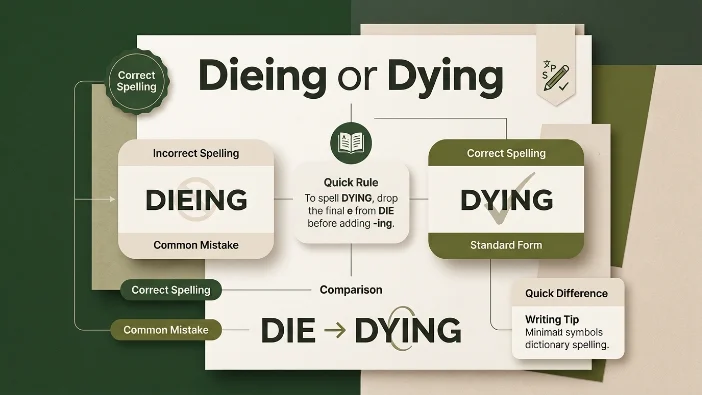
The correct spelling is dying when referring to the process of death, the gradual decline of something, or the end of a process. Dieing is a misspelling that appears occasionally but is not recognized as standard English. Always use “dying” in formal writing, business communication, and everyday conversation.
Have you ever paused mid-sentence, unsure whether to write “dieing” or “dying”? You are not alone. This common spelling dilemma trips up native English speakers and learners alike, particularly when writing under pressure or in professional contexts where accuracy matters.
The confusion is understandable. English spelling rules often seem inconsistent, and words that change form can feel unpredictable. The verb “to die” follows a pattern that surprises many writers because it does not simply add -ing like most verbs. Instead, the spelling shifts in a way that feels counterintuitive if you have not learned the rule.
This guide will clear up the confusion once and for all. You will learn why “dying” is always correct, why “dieing” appears in some contexts, and how to remember the difference without second-guessing yourself. Whether you are writing a business email, an academic paper, or a creative piece, you will leave this article confident in your spelling choices.
What’s the Difference Between Dieing and Dying?
The core difference between these two words is simple: one is correct, and the other is almost always a spelling error. Dying is the present participle of the verb “to die.” It is the only standard spelling recognized by major dictionaries including Oxford, Cambridge, and Merriam-Webster.
Dieing appears occasionally in informal writing and online content, but it is not considered correct English. Some writers mistakenly believe “dieing” follows the regular pattern of adding -ing to a base verb, like “tying” or “lying.” However, English has specific spelling rules for verbs ending in -ie, and “dying” is the exception that proves the rule.
Here is a comparison to make the distinction clear:
| Aspect | Dying | Dieing |
|---|---|---|
| Meaning | The process of death or ending | Incorrect spelling (not recognized) |
| Part of Speech | Present participle, gerund | Misspelling |
| Refers To | Death, decline, termination of something | No standard meaning |
| Typical Usage | “The plant is dying,” “His career is dying” | Occasional informal writing errors |
| Example | “She is dying to see the new movie” | ❌ “She is dieing to see the new movie” |
| Common Confusion | Think it should be “dieing” due to pattern | Believing all verbs add -ing directly |
The spelling rule that governs “dying” applies specifically to verbs that end in -ie. When adding -ing, the -ie changes to -y. This is why “die” becomes “dying,” “lie” becomes “lying,” and “tie” becomes “tying.” The rule exists to maintain consistent pronunciation and avoid awkward vowel combinations.
Remember: if you are writing about something ending, ceasing, or passing away, the spelling is always D-Y-I-N-G. There is no acceptable alternative in standard English.
Is This a Grammar, Vocabulary, or Usage Issue?
The “dieing versus dying” confusion sits at the intersection of spelling rules and vocabulary choice, with important implications for usage across different English contexts.
Grammar Classification: This is primarily a spelling and grammar issue. The verb “to die” follows a specific conjugation pattern that requires the -ie to change to -y before adding -ing. Understanding this rule helps you avoid errors with similar verbs like “lie,” “tie,” and “vie.”
Vocabulary Difference: While “dying” is a recognized word, “dieing” does not appear in standard dictionaries. Some sources note that “dieing” might refer to the process of using a die (the tool for cutting or stamping) or to the act of playing dice, but these uses are so rare that they effectively do not exist in modern English.
Usage Difference: You will never need to use “dieing” in any formal writing context. Business English, academic writing, professional correspondence, and everyday conversation all require “dying” exclusively.
Formal English: Always use “dying.” Any formal document containing “dieing” would be considered to have a spelling error.
Business English: “Dying” appears in professional contexts when discussing declining sales, fading brands, or ending projects. Example: “Our legacy system is dying; we need to upgrade.”
Academic Writing: Use “dying” in research papers, essays, and scholarly articles. The word often appears in medical, sociological, and environmental contexts.
Everyday Conversation: “Dying” is common in casual speech, both literally (“The flowers are dying”) and figuratively (“I am dying of thirst”). “Dieing” never appears in correct spoken or written English.
Practical Takeaway: This is not a stylistic choice or a matter of preference. One spelling is correct, and the other is a mistake that should be avoided in all written communication.
Understanding Dying
Meaning and Usage
Dying serves as the present participle and gerund form of the verb “to die.” It describes the process of ceasing to live, exist, or function. The word carries both literal and figurative meanings that appear across all types of English communication.
The literal meaning refers to the end of biological life. Medical professionals, veterinarians, and anyone discussing health use this term regularly. Example: “The patient is dying despite aggressive treatment.”
Figuratively, “dying” describes anything that is fading, declining, or coming to an end. Businesses die, trends die, relationships die, and even technology dies. This broader usage makes the word relevant in countless professional and personal contexts.
Pronunciation
“dying” is pronounced as /ˈdaɪɪŋ/. The first syllable rhymes with “eye,” and the second syllable is a soft “ing” sound. The pronunciation provides a clue to the spelling—the long “i” sound requires the change from “die” to “dying.”
Common Collocations
- Dying wish (a final request)
- Dying breed (something becoming rare)
- Dying art (a skill being lost)
- Dying words (final statement)
- Dying light (fading illumination)
- Dying embers (remaining warmth)
- Dying industry (declining sector)
Sentence Patterns
1: Subject + is/are/am + dying
- The coral reefs are dying because of rising water temperatures.
- My phone battery is dying; I need to find a charger.
2: Subject + dying to + verb
- I am dying to try that new restaurant downtown.
- The children are dying to open their Christmas presents.
3: Dying + noun
- The dying patient requested to see their family.
- The dying company laid off its remaining employees.
Workplace Example
“After three quarters of declining revenue, our product line is clearly dying. We need to pivot toward new offerings or accept that this division will not survive another year.
Academic Example
“Research indicates that bee populations are dying at alarming rates, threatening global food production and ecosystem stability.”
Technology Example
“The Java applet is dying technology. Most modern browsers have stopped supporting it entirely, and developers have moved to HTML5.”
Email Example
Subject: Urgent: System Update Required
“Hi Team,
Our server is dying. I have monitored performance metrics all morning, and we are seeing critical failures every few minutes. Please drop everything and run the backup procedure immediately.”
Daily Conversation Example
“I cannot believe how quickly these flowers are dying. I watered them yesterday, but they already look wilted. Maybe I should move them out of direct sunlight.”
Learner Mistake
❌ Incorrect: “The plant is dieing because I forgot to water it.”
✅ Correct: “The plant is dying because I forgot to water it.”
Mini Recap
Dying” is the correct spelling for all meanings of the verb “to die.” Use it literally for biological death and figuratively for anything that is ending or declining. Remember that the -ie changes to -y before adding -ing, giving you d-y-i-n-g.
Why “Dieing” Is Incorrect
The Misspelling Problem
Dieing is not a word in standard English. It appears in writing only as a misspelling of “dying.” The mistake usually happens when writers apply the regular rule of adding -ing directly to the base verb “die,” producing “dieing.” This error is common among English learners and even native speakers who write quickly or rely on spellcheck without understanding the underlying rule.
Why the Mistake Happens
Several factors contribute to the “dieing” error:
- Overgeneralization: Writers assume all verbs simply add -ing to the base form.
- Confusion with similar verbs: Some -ie verbs follow different patterns, though most change to -y.
- Spellcheck limitations: Basic spellcheckers may not flag “dieing” in certain contexts, leading writers to assume it is correct.
- Informal writing habits: People grow accustomed to seeing misspellings online and assume they are acceptable.
Contexts Where “Dieing” Might Appear
While “dieing” is never correct in standard English, it occasionally appears in:
- Informal online comments where spelling standards are low
- Text messages typed quickly
- Handwritten notes where the writer is unsure of spelling
- Non-native English writing where learners have not learned the rule
However, none of these contexts make “dieing” acceptable. In every situation where you mean the process of death or ending, the spelling should be “dying.
The Rare Exception
Some sources suggest that “dieing” could theoretically refer to the act of using a die (a tool for cutting or stamping metal) or the act of playing dice. However, these uses are so obscure that they effectively do not exist in modern English. Even in manufacturing contexts, professionals use terms like “stamping” or “cutting” rather than “dieing.”
How to Remember
A simple memory trick: think of the phrase “dying is dying” to reinforce that the correct spelling has only one ‘i’ before the ‘ng.’ Alternatively, remember that “die” becomes “dying” the same way “lie” becomes “lying”—the ‘i’ and ‘e’ swap places before the ‘ing’ is added.
Common Mistakes and How to Avoid Them
| Correct Sentence | Incorrect Sentence | Explanation |
|---|---|---|
| “The old tree is dying after the storm.” | “The old tree is dieing after the storm.” | The -ie changes to -y. “Dieing” is a misspelling. |
| “I am dying to hear the news.” | “I am dieing to hear the news.” | “Dying” is the only correct form for the verb “to die.” |
| “Her career is dying slowly.” | “Her career is dieing slowly.” | The figurative use follows the same spelling rule. |
| “The dying tradition needs preservation.” | “The dieing tradition needs preservation.” | The present participle always follows the -y pattern. |
| “He was dying of laughter.” | “He was dieing of laughter.” | Even idiomatic expressions use “dying.” |
Real-World Examples Across Contexts
Office Communication
“After reviewing the project timeline, it is clear that our momentum is dying. We need to address the bottlenecks immediately or risk missing the deadline entirely.”
Business Email
Subject: Product Sunset
“Dear Partners,
Please be aware that we are dying our support for the Legacy 2.0 system effective December 31. All clients must migrate to the new platform by this date.”
School or University
“The professor explained that the debate format is dying in modern political discourse. He encouraged us to research alternative approaches to public discussion.”
Customer Support
“Hello Michelle,
I understand your frustration with the loading times. Our servers are currently dying under the increased traffic, but we are deploying additional capacity within the hour.”
Technology
“Punch cards are dying technology. They were essential in the early days of computing, but modern data storage has made them completely obsolete.”
Artificial Intelligence
“Some experts argue that traditional search algorithms are dying. Neural networks and AI-driven models are rapidly replacing the older technologies.”
Daily Conversation
“Please stop asking me to help you move furniture. I am dying after that workout. I cannot lift another box.”
Modern Technology Context
In the technology sector, “dying” appears frequently when discussing obsolete systems, declining software, and hardware failures. The word captures the sense of something that once functioned well but now struggles to survive.
Artificial Intelligence specialists talk about dying algorithms when discussing machine learning models that no longer perform effectively. Example: “Our recommendation engine is dying because it cannot process the new user data formats.”
Virtual Assistants like Siri and Alexa sometimes produce funny “dying” moments when users ask about their own mortality. However, the word appears more seriously in technology discussions about product lifecycles.
Chatbots and customer service systems might use “dying” in responses about system status, but careful businesses avoid negative language in customer-facing communications.
Software Development teams discuss dying code bases, dying programming languages, and dying frameworks. Example: “Ruby on Rails is not dying, but its popularity has certainly declined compared to React and Node.js.”
Business Tools like CRM systems or project management platforms might describe declining engagement as “dying adoption rates.”
The technology context reinforces that “dying” has broad applications beyond biological death. Any process that is ending, declining, or ceasing to function qualifies as dying.
Word Origin
Understanding the origin of “dying” helps explain why the spelling differs from regular -ing verbs.
The verb “to die” comes from Old English “dēogan,” which itself has roots in Old Norse “deyja” and Proto-Germanic “dawjan.” The word has always meant the cessation of life, though it has expanded over centuries to include figurative meanings.
The unusual spelling pattern where “die” becomes “dying” dates back to Early Modern English. During this period, English underwent significant spelling changes, and the -ie to -y shift became standard for certain verbs to maintain pronunciation clarity. The alternative spellings “dyenge” and “dynge” appear in Middle English texts, showing that the “y” spelling has been common for centuries.
Language historians note that the “dieing” spelling would have created pronunciation confusion. When written as “dieing,” readers might pronounce it with a long “e” sound (dee-ing) rather than the correct long “i” sound (dye-ing). The change to “dying” signals the correct pronunciation to readers.
Expert Insight: Understanding the Rule
When teaching this concept to my students, I often start with a simple question: “How do you pronounce ‘dieing’?” The answer reveals the problem. If you follow standard English pronunciation, “dieing” would sound like “dee-ing,” which is not the word you want. The correct pronunciation requires a long ‘i’ sound, and that is precisely what the ‘y’ provides.
This is why English uses the -ie to -y rule. It is not arbitrary—it serves a clear purpose. When you see “dying,” you know immediately how to pronounce it. When you see “dieing,” you pause, confused. That moment of hesitation tells you something is wrong.
The rule extends to several other common verbs, making it worth learning. “Lie” becomes “lying,” “tie” becomes “tying,” and “vie” becomes “vying.” Once you recognize the pattern, you will stop making this mistake entirely.
Error Prevention Checklist
- ✅ Always use “dying” when referring to the process of death or ending
- ✅ Never use “dieing” in formal writing, business communication, or academic work
- ❌ Never confuse “dying” with “dyeing” (which refers to coloring fabric or hair)
- ❌ Never trust spellcheck alone when writing about death or decline
- 💡 Quick memory tip: D-Y-I-N-G has the ‘y’ you can see when you are sad about something dying
Related Grammar Confusions
If you found this article helpful, you may also want to learn about:
- Lie vs. Lay – Understanding the difference between reclining and placing objects
- Affect vs. Effect – Mastering the verb and noun forms of influence
- Which vs. That – Knowing when to use restrictive and non-restrictive clauses
- Who vs. Whom – Distinguishing subject and object pronouns
- Its vs. It’s – Avoiding the apostrophe confusion
- Your vs. You’re – Keeping possession and contraction separate
- Then vs. Than – Understanding time versus comparison
- To vs. Too vs. Two – Avoiding one of the most common spelling errors
- There vs. Their vs. They’re – Mastering homophones
- Lose vs. Loose – Distinguishing misplacement from looseness
FAQs
Is “dieing” ever acceptable in formal writing?
No. “Dieing” is never acceptable in formal writing. Major dictionaries including Oxford, Cambridge, and Merriam-Webster do not recognize it as a standard spelling. Always use “dying” in professional communication, academic work, and any formal context.
Why do people spell it as “dieing” if it is wrong?
The mistake occurs because writers overgeneralize the rule for adding -ing to verbs. They see “die” and simply add -ing, producing “dieing.” Additionally, some spellcheckers do not flag this error, leading people to believe it is correct. Understanding the -ie to -y rule prevents this mistake.
Does “dying” have the same meaning as “dieing” would?
Yes, if “dieing” were a real word, it would mean the same thing as “dying.” However, since “dieing” is not recognized in standard English, the meaning is irrelevant. In every context where you mean the process of death or ending, the correct spelling is “dying.
Are there any situations where “dieing” is correct?
Some sources mention that “dieing” might refer to using a die tool or playing dice, but these uses are virtually nonexistent in modern English. In practice, you will never need to use “dieing” correctly. Always choose “dying” for all writing contexts.
How can I remember to spell it “dying” not “dieing”?
Use this memory trick: Dying is sad, and the word has a ‘y’ that looks like a tear falling from the ‘d.’ Alternatively, remember the rule: when a verb ends in -ie, change the -ie to -y before adding -ing. Practice with “lie” → “lying” and “tie” → “tying” to reinforce the pattern.
Is the confusion between “dieing” and “dying” common?
Yes, this is one of the most common spelling errors in English. Native speakers and learners both make this mistake, particularly when writing quickly. The confusion persists because “die” looks like it should follow the regular pattern of adding -ing, and the correct spelling feels unexpected.
Conclusion
The distinction between “dieing” and “dying” is not a matter of preference or regional variation—it is about correctness. “Dying” is the only standard spelling for the process of death, decline, or ending. “Dieing” is a misspelling that has no place in formal or informal writing.
Understanding the -ie to -y rule makes this distinction easy to remember. When a verb ends in -ie, change the -ie to -y before adding -ing. “Die” becomes “dying,” just as “lie” becomes “lying” and “tie” becomes “tying.” This rule exists to maintain consistent pronunciation and is worth learning thoroughly.
The next time you write about something that is ending, ceasing, or declining, remember: D-Y-I-N-G is the correct spelling. Your writing will be clearer, more professional, and free from this common error. Whether you are composing an important business email, writing an academic paper, or simply sending a text message, you can feel confident in your spelling choice.