Quick Answer
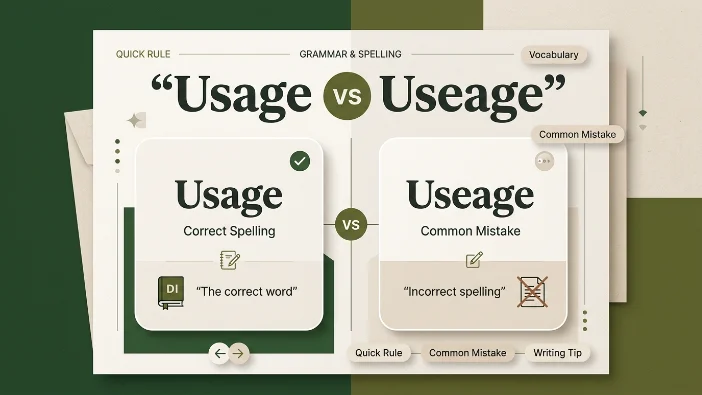
Usage is the only correct spelling in standard English. “Useage” is a common misspelling that doesn’t appear in any major dictionary. Usage refers to the way something is used, applied, or practiced, whether that’s a word, a resource, or a piece of technology. If you’re ever unsure which one to type, usage is always the safe choice.
You’ve probably typed “useage” at least once, hit send, and then wondered if it looked a little off. You’re not alone. This is one of the most common spelling mix-ups in English, and it trips up native speakers just as often as learners.
The confusion makes sense once you break it down. The word “use” already contains an “e,” so adding another one before “-age” feels logical. Unfortunately, English spelling doesn’t always follow logic. Usage dropped that extra “e” centuries ago, while useage never became a recognized word at all.
Getting this right matters more than it seems. A misspelled word in a resume, business report, or software manual can quietly damage your credibility, even if the reader understands what you meant. In this guide, you’ll learn exactly why usage is correct, why useage keeps showing up anyway, and how to make sure you never second-guess yourself again.
Usage vs Useage: What’s the Difference?
There isn’t a real difference between these two spellings because only one of them is actually a word. Usage is a standard English noun. Useage is a spelling error that mimics the sound of usage but breaks basic English spelling conventions.
Usage comes from the verb “use” combined with the suffix “-age,” which typically describes an action, process, or result (think “storage,” “coverage,” or “breakage”). When “-age” attaches to “use,” the final “e” in “use” gets dropped, giving you “usage.” This pattern shows up throughout English, so usage isn’t an exception; it’s actually following the rule.
| Feature | Usage | Useage |
|---|---|---|
| Meaning | The act or way of using something | No meaning; not a real word |
| Part of Speech | Noun | Not applicable |
| Recognized By Dictionaries | Yes (Merriam-Webster, Oxford, Cambridge) | No |
| Typical Context | Language, technology, resources, habits | N/A |
| Common Confusion | Mistaken as “useage” due to spelling pattern | Mistaken for a valid alternate spelling |
Once you see it laid out this way, the choice becomes simple. There’s no formal, informal, British, or American version of “useage.” It’s not regional, and it’s not old-fashioned. It’s just incorrect.
Is Usage a Grammar, Vocabulary, or Spelling Issue?
This particular mix-up is a spelling issue, not a grammar or vocabulary problem. Grammar deals with sentence structure and word relationships. Vocabulary deals with meaning and word choice. Spelling deals with how a word is written, and that’s exactly where usage and useage diverge.
Because useage isn’t recognized as an alternate form, there’s no situation where it becomes acceptable, not in casual texting, not in academic writing, and not in business communication. Formal writing, technical documentation, and everyday conversation all rely on the same spelling: usage.
If you’ve been unsure which one to use in professional emails or reports, the takeaway is straightforward: usage works everywhere, and useage works nowhere.
Usage: Meaning, Examples, and Common Patterns
Usage is a noun that describes how something is used, the amount something is used, or the accepted way a word or phrase is applied in language.
Pronunciation-wise, it’s “YOO-sij,” with the stress on the first syllable. It often pairs with words like “data usage,” “language usage,” “water usage,” and “fair usage.
Workplace example: “Our team needs to review server usage before the next billing cycle.”
Academic example: “The professor asked students to analyze usage patterns of modal verbs in formal writing.”
Technology example: “Check your phone’s data usage settings if your bill seems higher than expected.”
Email example: “Attached is a summary of your monthly software usage for March.”
Daily conversation example: “I’ve cut down my screen usage a lot since I started tracking it.”
One mistake learners often make is treating usage as interchangeable with “use” in every context. While related, usage typically refers to a pattern, habit, or accepted practice, while “use” more often describes a single act of using something.
Mini recap: Usage is your go-to word for describing patterns, habits, or amounts of use, and it’s the only correct spelling of the two.
Useage: Why It Isn’t a Real Word
Useage doesn’t have a dictionary meaning because it isn’t recognized as a standard English word. It’s a spelling error, not an alternate form of usage.
People usually write “useage” because they’re mentally combining “use” and “-age” without remembering that the final “e” in “use” needs to drop. It’s an understandable slip, especially for fast typers or non-native speakers applying spelling rules from other languages.
You won’t find “useage” in Merriam-Webster, Oxford, or Cambridge dictionaries. Word processors and browsers typically flag it with a red squiggly line, which is a helpful signal that something’s off.
Learner mistake: Writing “fair useage policy” instead of “fair usage policy” in a business document, which can look careless in professional settings.
Mini recap: If you ever type useage, treat it as an automatic signal to fix your spelling to usage.
When Writers Commonly Choose the Wrong Word
Here are the situations where “useage” tends to sneak into writing, along with how to catch it.
1. Typing quickly without proofreading. Fast typing often leads to inserting extra letters, especially when a word “sounds” like it needs them.
2. Relying on phonetic spelling. Because “use” has a long “u” sound, some writers assume the “-age” ending needs the same vowel pattern, leading to useage.
3. Confusing it with words like “acreage” or “breakage.” These words keep their base spelling before adding “-age,” which creates a false pattern that doesn’t apply to usage.
4. Autocorrect inconsistencies. Some spellcheckers catch the error immediately, but others, especially in casual messaging apps, may not flag it at all.
5. Non-native English speakers applying rules from their first language. Some languages preserve base spellings more consistently, which can make dropping the “e” feel unnatural.
6. Copying old or unedited documents. If useage appears in a template or forwarded email, writers sometimes assume it’s correct simply because someone else used it first.
7. Writing under time pressure. Deadlines increase the chance of small spelling slips, especially with words that already look a little unusual.
8. Overcorrecting spelling. Ironically, some writers who know “use” ends in “e” try to preserve that spelling out of caution, not realizing the suffix rule removes it.
The simplest way to remember the difference: usage drops the “e,” just like most “-age” words that come from verbs ending in a silent “e.
Common Mistakes Table
| Correct Sentence | Incorrect Sentence | Explanation |
|---|---|---|
| Please review your data usage this month. | Please review your data useage this month. | “Useage” is not a recognized spelling. |
| The company updated its fair usage policy. | The company updated its fair useage policy. | Business documents should always use “usage.” |
| Language usage changes over time. | Language useage changes over time. | “Usage” refers to accepted patterns of use. |
| Check your app’s storage and usage stats. | Check your app’s storage and useage stats. | Technology contexts always use “usage.” |
Quick Decision
- If you’re describing how something is used, applied, or practiced, use usage.
- There’s no situation where useage is correct, so if you’re ever unsure, default to usage every time.
Usage in Real World Situations
Office communication: “Let’s track printer usage to reduce paper waste this quarter.”
Business email: “Your current plan includes unlimited data usage during off-peak hours.”
School or university: “The essay focused on regional usage differences between American and British English.”
Customer support: “Our records show unusual usage activity on your account this week.”
Technology: “The app displays real-time battery usage statistics.”
Artificial Intelligence: “Developers monitor API usage to prevent overloading the system.”
Daily conversation: “I’m trying to reduce my phone usage before bed.”
Each of these examples reinforces the same pattern: usage fits naturally into technical, professional, and casual settings alike, while useage never appears in any of them correctly.
Usage in Modern Technology
Usage shows up constantly in tech-related writing, and getting the spelling right matters even more here because so much of it appears in user-facing interfaces.
In artificial intelligence and machine learning, “usage” often refers to how much computing power, data, or API calls a system consumes. Companies track “token usage” or “compute usage” to manage costs and performance.
Virtual assistants and voice assistants log usage data to understand how often certain commands or features get triggered, helping developers refine responses over time.
Chatbots frequently reference “usage limits” when explaining how many messages or requests a user can send within a certain period.
Software platforms display “usage dashboards” so users can monitor storage, bandwidth, or subscription limits.
Business tools rely on usage reports to help companies understand which features employees rely on most, guiding future updates and pricing decisions.
Because so much of modern communication happens through apps, dashboards, and automated systems, a single spelling error like “useage” can appear in thousands of user-facing messages if it slips through unnoticed. That’s one more reason to lock in the correct spelling early.
Where Usage Comes From
Usage traces back to Old French “usage,” which itself developed from the Latin word “usus,” meaning “use” or “custom.” The “-age” suffix has long been used in English and French to describe a process, condition, or result tied to an action.
This history explains why usage follows the same spelling pattern as words like “storage” or “coverage.” It’s not a random exception; it’s part of a much older and consistent naming convention borrowed from French into English centuries ago.
Expert Insight
As a language instructor, one of the most effective ways to help students remember correct spellings is to connect new words to familiar patterns. Usage fits neatly into a group of English words that drop a silent “e” before adding “-age,” including “storage,” “coverage,” and “breakage.” Once a learner recognizes that shared pattern, the spelling starts to feel automatic instead of something they need to memorize word by word.
Error Prevention Checklist
- Always use usage when describing how something is used, applied, or measured.
- Never use useage in any context; it isn’t a recognized English word.
- If your spellchecker flags a word in red, trust it rather than assuming it’s wrong.
- Quick memory tip: think of “storage” and “coverage.” Usage follows the same spelling pattern.
Related Grammar Confusions You Should Master
Many English words look or sound similar but have different meanings, grammatical roles, or spelling rules. Learning these common pairs can improve accuracy in professional writing, academic work, and everyday communication.
Advice vs Advise
Advice is a noun that means a recommendation or suggestion, while advise is a verb that means to give guidance. Mixing them up is especially common in emails and professional communication.
Affect vs Effect
This is one of the most common English word confusions. Affect is usually a verb meaning to influence something, while effect is usually a noun referring to a result or outcome.
Its vs It’s
A small apostrophe creates a completely different meaning. Its shows possession, while it’s is a contraction of it is or it has.
Then vs Than
These words are often confused because they sound similar in fast speech. Then relates to time or sequence, while than is used for comparisons.
Compliment vs Complement
Although they look nearly identical, these words have different meanings. A compliment is praise, while a complement is something that completes or improves another thing.
Practice vs Practise
This difference depends on English variety. In American English, practice is used for both the noun and verb forms. In British English, practice is usually the noun, while practise is the verb.
Loose vs Lose
A single letter separates these two words, but their meanings are completely different. Loose means not tight or firmly attached, while lose means to no longer have something or fail to win.
Principal vs Principle
Principal usually refers to a person or something most important, while principle refers to a rule, belief, or standard of behavior.
Accept vs Except
These words sound similar but perform different roles. Accept means to receive or agree to something, while except means excluding something.
Farther vs Further
Both words relate to distance, but the difference is often based on context. Farther usually refers to physical distance, while further is commonly used for figurative progress or additional information.
FAQs
Is “useage” ever an accepted alternate spelling?
No, “useage” is never considered a correct spelling in standard English. It does not appear as an accepted word in major dictionaries. The correct spelling is always “usage”, whether you are writing formally, casually, academically, or professionally.
Why does “useage” look correct to so many people?
Many writers add the extra “e” because the word begins with “use” and they assume the original spelling remains unchanged. However, when the suffix “-age” is added, the final silent “e” is removed. The same pattern appears in words such as storage, coverage, and breakage.
Does British English spell “usage” differently than American English?
No. Both British and American English use the same spelling: “usage.” Unlike some words that have regional spelling differences, this word follows the same spelling rule across English varieties.
Can “useage” be used informally in texting?
No. Informal writing does not make “useage” acceptable. Even in quick messages, social media posts, or casual notes, “usage” remains the correct spelling.
What is the easiest way to remember the correct spelling?
Remember similar words ending in “-age”, such as storage, coverage, and breakage. They all remove the final silent “e” before adding the suffix. The same rule applies to usage.
Is “usage” the same as “use” in every sentence?
Not exactly. “Use” usually refers to an individual action or purpose, while “usage” often describes a pattern, habit, or general way something is used over time.
Examples:
The use of this tool saved time.
The website tracks user usage data.
Understanding this difference helps you choose the right word depending on whether you mean a specific action or a broader pattern.
Conclusion
The difference between usage and useage really comes down to one simple fact: only one of them exists in the English language. Usage is the correct, dictionary-recognized spelling that fits naturally into everyday writing, technology, business communication, and academic work. Useage, on the other hand, is a common but avoidable spelling mistake.
If you remember one rule from this guide, let it be this: usage drops the silent “e,” just like storage and coverage. Keep that pattern in mind, and you’ll never second-guess this spelling again.
3 thoughts on “Usage vs Useage | Stop Making This Spelling Mistake in Your Writing In 2026”