Quick Answer
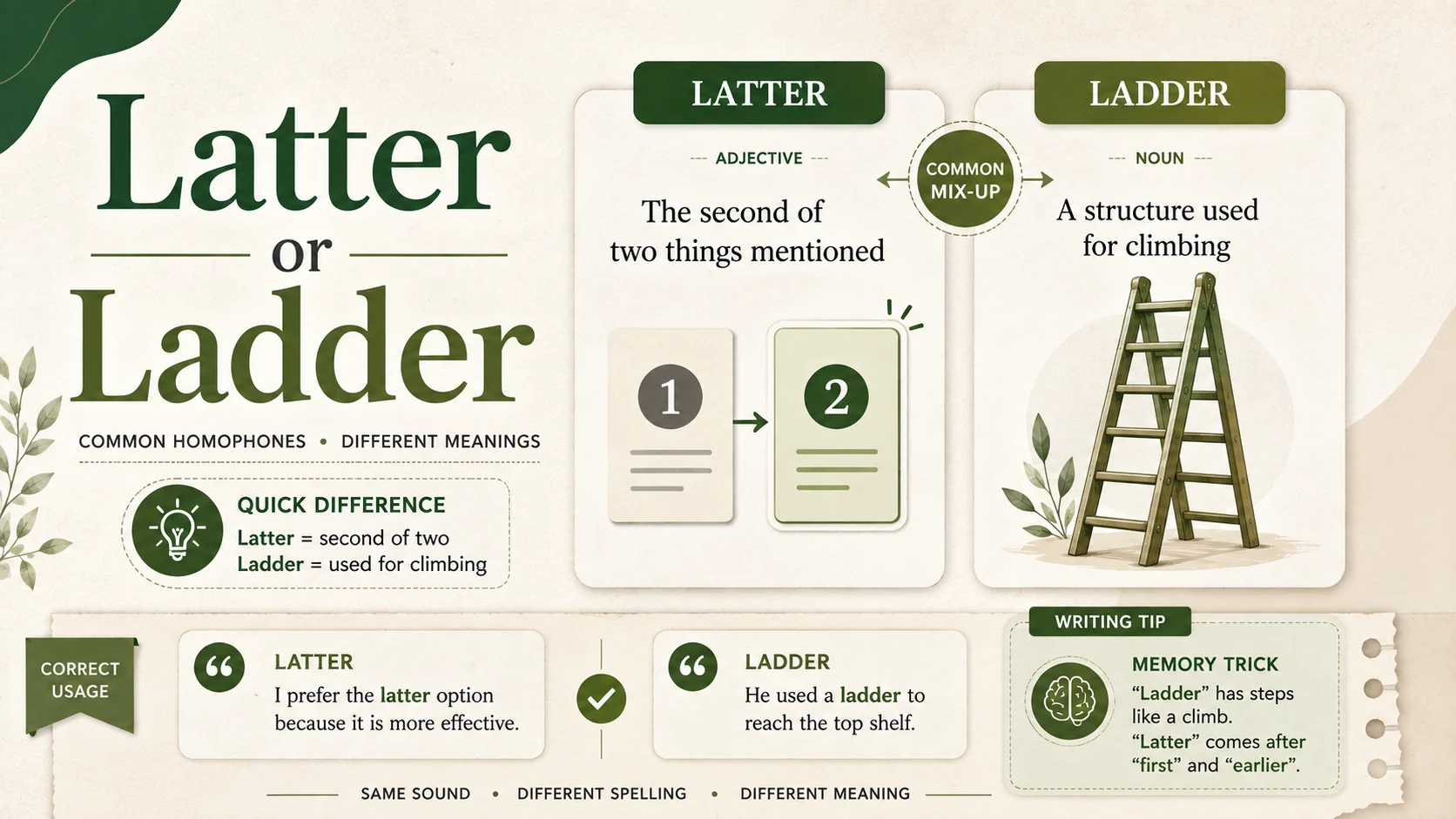
The difference between latter and ladder comes down to meaning and pronunciation. Latter refers to the second of two items previously mentioned, while ladder is a physical tool with rungs for climbing. These words sound similar but have completely different meanings, and using them incorrectly can confuse your readers.
Few word pairs cause as much confusion for English learners and even native speakers as “latter” and “ladder.” You might have found yourself pausing mid-sentence, wondering which word belongs in your email, report, or casual message. The frustration is real, and the stakes can be surprisingly high in professional communication.
Here’s what makes these words tricky: they sound almost identical in some American English pronunciations, yet they carry completely unrelated meanings. One describes a position in a sequence, while the other describes a physical object you climb. Latter or ladder confusion can create embarrassing misunderstandings, especially in written communication where context cues are limited.
By the time you finish this guide, you’ll never hesitate again. We’ll explore their meanings, usage patterns, common mistakes, and memory tricks that actually work for real-world situations.
What’s the Difference Between Latter and Ladder?
Latter refers to the second of two things or people already mentioned, while ladder is a portable structure with rungs used for climbing up or down. The difference is fundamental: one is a sequencing word, and the other is a physical object.
Let’s break this down clearly:
| Aspect | Latter | Ladder |
|---|---|---|
| Meaning | The second of two items mentioned | A climbing device with steps or rungs |
| Part of Speech | Adjective, noun | Noun |
| Refers To | Sequence or position | Physical object |
| Typical Usage | “Between tea and coffee, I prefer the latter.” | “He climbed the ladder to fix the roof.” |
| Example | “The latter option seems more practical.” | “She carefully descended the ladder.” |
| Common Confusion | Mistaken for “former” sometimes | Misspelled as “latter” by some writers |
The relationship between these words isn’t about similar meanings but similar sounds. This is what linguists call a “phonetic confusion” rather than a semantic one. The words aren’t synonyms or even related concepts they just happen to sound alike enough to trip people up, especially in fast speech or when typing quickly.
When you’re deciding between latter or ladder, ask yourself: are you talking about position in a list, or are you talking about something you physically climb? That single question will guide you every time.
Is This a Grammar, Vocabulary, or Usage Issue?
The latter or ladder confusion touches on several aspects of English language learning. Understanding how these words function helps you use them correctly and diagnose your own mistakes.
Grammar classification: “Latter” functions primarily as an adjective or pronoun, while “ladder” is a concrete noun. This grammatical difference affects how each word fits into sentences and combines with other words.
Vocabulary difference: These words belong to completely different vocabulary categories. “Latter” is a sequencing word that helps writers organize information and refer back to previous content. “Ladder” is a concrete noun describing a physical object you can see, touch, and use.
Usage difference: “Latter” appears mainly in written English, formal contexts, and when listing or comparing two items. “Ladder” appears in everyday conversation, workplace safety discussions, and physical descriptions.
Are they interchangeable? Absolutely not. Using one when you mean the other creates confusion that ranges from humorous to problematic. Imagine a safety report warning about “latter safety” or an academic essay discussing “the ladder point” these errors undermine credibility and clarity.
In different English varieties: Both words maintain their meanings across American, British, Australian, and other English varieties. However, pronunciation differences can affect how easily native speakers distinguish them. In British English, the “er” sound in “latter” is typically more distinct from the “add” sound in “ladder.”
The practical takeaway: This is primarily a spelling and pronunciation issue rooted in vocabulary knowledge. Once you understand the core difference, you can avoid errors by focusing on context and meaning rather than sound alone.
Latter: Meaning, Usage, and Examples
Latter refers to the second of two previously mentioned people, things, or options. It functions as an adjective or pronoun and appears most frequently in writing and formal speech.
Pronunciation: In American English, “latter” sounds roughly like “LAT-er” with a soft “t” that almost resembles a “d” in fast speech. This pronunciation similarity to “ladder” creates most of the confusion.
Part of speech: Adjective or pronoun. As an adjective: “The latter half of the year.” As a pronoun: “Between the two proposals, I prefer the latter.”
Common collocations:
- The latter part of
- In the latter half
- The latter option
- The latter example
- The latter category
Typical sentence patterns:
- “Between X and Y, I prefer the latter.”
- “The latter approach seems more effective.”
- “In the latter stages of development…”
Workplace example:
“Between the in-person meeting and the virtual option, I recommend the latter because it accommodates our remote team members.”
Academic example:
“The study examined both quantitative and qualitative methods. The latter proved more effective for capturing participant experiences.”
Technology example:
“We evaluated Python and JavaScript for the project. The latter offers better performance for front-end development.”
Email example:
“Regarding your questions about budget and timeline, I’ll address the latter first in our meeting tomorrow.”
Daily conversation example:
“I’m torn between the red dress and the blue one. I think I’ll go with the latter.”
One learner mistake to avoid: Don’t use “latter” when you’ve mentioned more than two items. “Latter” only works with exactly two things. If you’ve listed three or more, use “last” instead.
Mini recap: “Latter” is all about sequence specifically, the second of two. It’s a writer’s tool for avoiding repetition and creating clear references.
Ladder: Meaning, Usage, and Examples
Ladder is a physical object consisting of two side rails connected by horizontal rungs, used for climbing up or down. It’s a common tool in construction, maintenance, and everyday situations.
Pronunciation: “Ladder” sounds like “LAD-er” with a clear “d” sound. In some American dialects, it’s nearly indistinguishable from “latter,” which is why context matters so much.
Part of speech: Noun, countable. You can have one ladder, two ladders, or a ladder with ten rungs.
Common collocations:
- Climb a ladder
- Descend a ladder
- Step ladder
- Extension ladder
- Ladder rung
- Ladder safety
Typical sentence patterns:
- “She climbed the ladder to reach the top shelf.”
- “The ladder needs to be extended to reach the roof.”
- “Always maintain three points of contact on a ladder.”
Workplace example:
“The warehouse supervisor inspected every ladder for stability and wear before allowing staff to use them.”
Academic example:
“Researchers used a ladder metaphor to describe career progression, where each rung represents a new skill level.”
Technology example:
“IT professionals often discuss the ‘technology ladder’ when describing career advancement, though the concept isn’t literal.”
Email example:
“Please ensure the extension ladder is returned to the storage room after the window cleaning is complete.”
Daily conversation example:
“Can you hold the ladder steady while I change this lightbulb?”
One learner mistake to avoid: Don’t use “ladder” to refer to a sequence or order. It’s a physical object, not a sequencing word. “Career ladder” works as a metaphor, but “the ladder point” doesn’t make sense.
Mini recap: “Ladder” is concrete and physical. If you can’t climb it, you probably need “latter” instead.
When Not to Use Each Word
Many writers, especially English learners, choose the wrong word because they rely on sound alone. Understanding specific situations where errors commonly occur helps you avoid them.
Common Situations Where Writers Use “Latter” Incorrectly
When describing physical climbing equipment: Never use “latter” to describe a ladder. “He climbed the latter to fix the gutter” is incorrect. The rungs of a “ladder” are physical; there’s no such thing as “latter rungs.”
When referring to more than two items: Writers sometimes use “latter” to mean “last” when discussing long lists. This creates confusion because “latter” only refers to one of two. If you’ve mentioned three options, “last” is the correct choice.
When the antecedent is unclear: Using “latter” requires a clear, recent reference. If readers can’t determine what two things you’re referring to, choose different phrasing instead.
Common Situations Where Writers Use “Ladder” Incorrectly
When referring to the second of two choices: “Between pasta and pizza, I prefer the ladder” is a classic error. You’re not climbing a food item you mean “latter.
In academic writing about order: “The ladder section of the paper” makes no sense. You mean “latter section,” the second part of your discussion.
When describing sequence: “We’ll discuss the ladder point first” doesn’t work. There’s no physical object involved you mean “latter.
Why These Mistakes Happen
Pronunciation overlap is the primary culprit. In rapid or casual American speech, “latter” and “ladder” sound so similar that even native speakers occasionally misspell them.
Typing errors also contribute. Your fingers might automatically type “ladder” when you’re thinking “latter” because the keyboard patterns are similar.
Memory confusion can cause problems when you’re unsure which word matches which concept. The spelling similarity (both contain “la–er”) doesn’t help.
How to Remember the Difference
- Latter contains “t” for “two” – it refers to the second of two items.
- Ladder contains “d” for “device” – it’s a physical climbing device.
- Think about whether you’re referring to time/order (latter) or physical objects (ladder).
- If you can’t climb it, you don’t need “ladder.”
Common Mistakes Table
| Correct Sentence | Incorrect Sentence | Why the Mistake Happens |
|---|---|---|
| Between the two candidates, we hired the latter. | Between the two candidates, we hired the ladder. | The writer relied on pronunciation rather than meaning. |
| Please grab the ladder from the garage. | Please grab the latter from the garage. | The writer thought “latter” was a physical object. |
| I prefer the latter half of the book. | I prefer the ladder half of the book. | Confusing sequencing with physical objects. |
| She climbed the ladder to reach the top shelf. | She climbed the latter to reach the top shelf. | Using a sequencing word for physical action. |
| The latter option saves us money. | The ladder option saves us money. | Mistaking a concrete noun for an adjective. |
| Let’s focus on the latter part of the project. | Let’s focus on the ladder part of the project. | Sound-based spelling error. |
| He extended the ladder fully. | He extended the latter fully. | Trying to use “latter” as a noun for a physical object. |
Quick Decision Box
If you’re ever stuck choosing between these words, run through this quick mental check:
✅ Use LATER (latter) when:
- You’re referring to the second of two things
- You’re talking about sequence or order
- You’ve already mentioned two items and need to reference one
- You can replace it with “second” and the sentence still works
✅ Use LADDER (ladder) when:
- You’re talking about a climbing device
- There are rungs, rails, or steps involved
- Someone can physically climb it
- Safety considerations matter
The ten-second test: If you can’t climb it, it’s not a ladder. If you’re not talking about climbing, you probably need “latter.”
Real-World Examples
Understanding how these words function in authentic situations helps solidify your knowledge. Here are examples from various contexts:
Office Communication
“In the performance review, we discussed both your technical skills and your teamwork. I’d like to focus on the latter for improvement.”
Business Email
“Thank you for sending both the budget estimate and the project timeline. I’ve reviewed the latter and have a few questions.”
School or University
“The course covers macroeconomics and microeconomics. The latter requires more mathematical preparation, which is why we’re offering a bridging course.”
Customer Support
“We received your inquiry about both the billing error and the shipping delay. Let me address the latter first, as it’s time-sensitive.”
Technology Context
“When comparing Android and iOS development, the latter often requires more specialized hardware resources.”
Artificial Intelligence
“AI models typically process training data and user prompts. The latter arrives in real-time and influences immediate responses.”
Daily Conversation
“I bought both apples and oranges for the fruit salad. I’ll use the latter because they’re sweeter.”
Latter and Ladder in Modern Technology
While “ladder” remains primarily a physical object, it has developed metaphorical meanings in technology contexts. “Career ladder” describes professional advancement, and “ladder logic” refers to a programming language used in industrial automation.
Ladder Logic is a visual programming language used to create control systems. Programmers “climb” through the logic steps, though the term doesn’t describe physical movement.
Career Ladder appears frequently in HR and professional development discussions. Employees “climb the corporate ladder” through promotions and skill acquisition.
Technology Ladder describes the progression of technological complexity or advancement. Organizations might assess their “technology ladder” to plan upgrades.
Latter in Tech is also common. Software developers often discuss “the latter approach” when comparing programming methodologies. AI researchers compare “latter models” when discussing generations of language models.
The pronunciation similarity between these words creates specific challenges in tech contexts. Imagine a developer saying, “We implemented the ladder approach for database scaling” that’s confusing and likely incorrect. They almost certainly mean “the latter approach.
Expert Insight
From an experienced language instructor:
“Here’s what I tell my students about latter or ladder: stop listening to your ears and start paying attention to your context. These words are a perfect example of why context matters more than pronunciation in English.
When you read or hear ‘latter,’ you should immediately think ‘second of two.’ It’s a pointer word that helps readers track your argument. When you read or hear ‘ladder,’ you should picture something with rungs. That mental image test works every time.
I’ve found that teaching students to pair these words with clear mental images eliminates 90% of errors. Pair ‘latter’ with ‘second’ and ‘ladder’ with ‘climb.’ Write these associations on sticky notes if you need reminders. Eventually, your brain will process the correct word automatically.
Remember, language isn’t just about what words mean it’s about what they do in context. Understanding function is often more useful than memorizing definitions.”
Error Prevention Checklist
Always choose “latter” when:
- You’re referring to the second of exactly two items
- You’re describing the second half or part of something
- You’ve already mentioned two things and need to reference one again
- You could replace it with “second”
Always choose “ladder” when:
- You’re describing a physical climbing device
- You’re talking about rungs, steps, or rails
- Someone is climbing up or down
- You’re discussing safety around climbing equipment
Never confuse them if:
- You can visualize the object (it’s a ladder)
- You’re following a sequence (it’s the latter)
- The word follows “the former” in a sentence (it’s the latter)
- Someone is physically reaching upward (it’s a ladder)
Quick memory tip: LATTER has a T for Two the second of two. LADDER has a D for Device a physical object.
Related Grammar Confusions Worth Learning
These similar word pairs often confuse English learners and native speakers alike. Understanding them strengthens your overall language skills:
- Former vs. Latter: Former refers to the first of two, latter to the second. This pair works together to make references clear.
- Later vs. Latter: “Later” refers to time (“I’ll do it later”), while “latter” refers to sequence. These are often confused by English learners.
- Beside vs. Besides: “Beside” means “next to,” while “besides” means “in addition to.” Similar spelling creates confusion.
- Affect vs. Effect: “Affect” is usually a verb meaning to influence, while “effect” is usually a noun meaning result. This classic confusion requires careful attention.
- Accept vs. Except: “Accept” means to receive, while “except” means to exclude. The single-letter difference creates significant meaning changes.
- Principle vs. Principal: “Principle” is a rule or belief, while “principal” means main or primary. They’re easily mixed up in professional writing.
- Complement vs. Compliment: “Complement” means something that completes, while “compliment” means praise. The spelling difference matters greatly.
- Elicit vs. Illicit: “Elicit” means to draw out, while “illicit” means illegal. The pronunciation similarity creates confusion.
- Discreet vs. Discrete: “Discreet” means careful or subtle, while “discrete” means separate or distinct. These are often confused in professional contexts.
- Stationary vs. Stationery: “Stationary” means not moving, while “stationery” is writing materials. This pair trips up many native speakers.
FAQs
What is the difference between former and latter?
Former refers to the first of two previously mentioned items, while latter refers to the second. Use these words together to make clear references: “I like cats and dogs. The former are independent, while the latter are loyal.”
Is “latter” formal or informal English?
Latter appears more frequently in written and formal contexts, though it’s acceptable in everyday speech. In casual conversation, many speakers prefer phrasing like “the second one” or simply using noun repetition.
Can “latter” be used with more than two items?
No. Latter only refers to the second of two things. If you’ve mentioned more than two items, use “last” to refer to the final one or “the last-mentioned” to be clear about your reference.
Is “ladder” only a physical object?
While ladder is primarily a physical climbing device, it appears in metaphors like “corporate ladder” or “career ladder.” Even in these metaphorical uses, the image of climbing upward persists.
How do you pronounce “latter” in American English?
In American English, “latter” typically sounds like “LAT-er” with a soft “t” that sometimes blends into a “d” sound in fast speech. This similarity to “ladder” creates most of the confusion between these words.
Can “latter” refer to people?
Yes. “We interviewed both candidates and hired the latter” correctly uses “latter” to refer to a person. The word can refer to people, objects, ideas, or anything else that can appear as the second of two items.
What’s the opposite of “latter”?
The opposite is “former.” These words work as a pair to clearly identify which of two items you’re referring to: “Between options A and B, I prefer the former, while my colleague prefers the latter.”
Should I use “latter” or “last” in a series?
Use “last” when you’ve mentioned more than two items and need to refer to the final one. Use “latter” only when referring to exactly the second of two items. The number of items in your list determines which word is correct.
Conclusion
The latter or ladder distinction is simpler than it might seem at first glance. When you’re referring to the second of two items, use “latter.” When you’re talking about a climbing device, use “ladder.” These words share similar sounds but serve completely different purposes in English.
We’ve covered the definitions, usage patterns, common mistakes, and memory tricks that help you choose correctly every time. The key insight is to focus on meaning and function rather than sound alone. When you understand what each word does, the correct choice becomes obvious.
Here’s a practical rule to remember: If you’re choosing between two things, “latter” is your word. If you’re climbing to reach something, “ladder” is correct. This single guideline will prevent most errors and give you confidence in your writing.
Whether you’re drafting a business email, writing an academic paper, or simply having a conversation, knowing the difference between these words strengthens your communication. Clear word choice reflects clear thinking, and that’s a skill worth developing.