Quick Answer
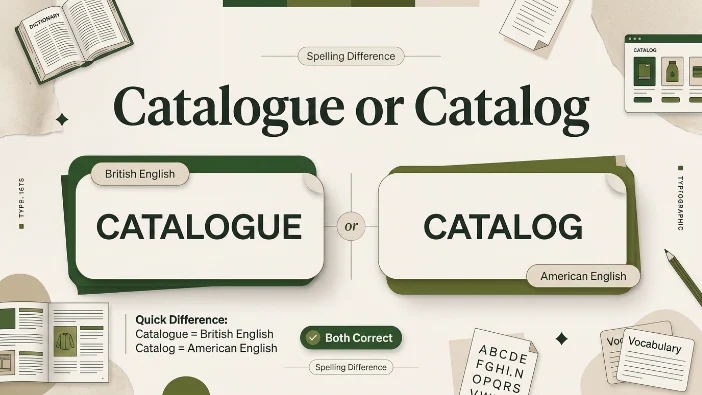
The difference between catalogue and catalog is purely regional spelling preference rather than any meaningful distinction in meaning. Catalogue is the standard British English spelling, while catalog is the preferred American English spelling. Both words refer to a complete list of items, products, or resources arranged systematically for reference.
If you’ve ever paused mid-sentence wondering whether to write “catalogue” or “catalog,” you’re not alone. Many English learners and even native speakers find themselves confused by these two spellings, uncertain which one is “correct.” The confusion is understandable both appear regularly in professional writing, and different sources seem to prefer different versions.
Here’s the good news: both spellings are correct. The difference between catalogue and catalog is entirely about geography, not grammar. The longer version with “ue” is standard in British English, while the shorter spelling dominates in American English. However, like many language quirks, there’s more nuance to this distinction than simply “British versus American.” Understanding when and where to use each version and how to remain consistent can significantly improve your professional writing.
By the end of this guide, you’ll know exactly which spelling to choose in any situation, understand the subtle usage patterns in different English varieties, and never second-guess yourself when writing catalogue or catalog again.
Catalogue vs. Catalog: What’s the Difference?
At its core, the distinction between catalogue and catalog is simple: catalogue is the preferred spelling in British English, while catalog is the standard in American English. Both words function as nouns (referring to a systematic list of items) and verbs (meaning to create such a list or to arrange items systematically).
The difference stems from historical spelling conventions. The word entered English from the French catalogue and ultimately from the Greek katalogos (meaning “a listing” or “register”). British English retained the French-influenced spelling with the “-ue” ending, while American English, influenced by Noah Webster’s spelling reforms that favored simplified spellings, dropped the unnecessary “ue.”
Understanding this distinction is essential because using the “wrong” spelling for your audience can make your writing appear less professional. A British client reading “catalog” might perceive it as an Americanism, while an American reader might find “catalogue” slightly old-fashioned or overly formal though neither is incorrect.
Comparison Table
| Feature | Catalogue | Catalog |
|---|---|---|
| Meaning | A systematic list of items | A systematic list of items |
| Part of Speech | Noun and verb | Noun and verb |
| Primary Usage | British English, Commonwealth English | American English |
| Typical Context | UK writing, Australian/Canadian/NZ documents | US writing, American publications |
| Example | “Please refer to the product catalogue.” | “Please refer to the product catalog.” |
| Common Confusion | Often mistaken for “more formal” or “more correct” | Often mistaken for “incorrect” or “Americanism” |
Both spellings mean exactly the same thing and are grammatically identical in every way. The choice between them is one of the most straightforward regional spelling differences in English much simpler than variations like “colour/color” or “centre/center,” where the spelling change also affects pronunciation patterns.
Is This a Grammar, Vocabulary, or Usage Issue?
The catalogue vs. catalog question is primarily a usage issue rather than a grammar or vocabulary problem. Here’s how to think about it:
Grammar classification: Neither spelling affects grammar. Both words function identically as nouns and verbs, follow the same conjugation patterns, and take the same modifiers. The grammatical rules governing both are identical.
Vocabulary difference: There is no vocabulary difference between catalogue and catalog. They are simply different spellings of the same word, much like “theatre” and “theater.” Both are recognized in dictionaries worldwide, though their regional acceptance varies.
Usage difference: This is where the real distinction lies. The choice between catalogue and catalog depends on your audience, your publication’s style guide, and your writing context. Some formal or traditional institutions prefer “catalogue” even in American contexts, while many American businesses have fully adopted “catalog.”
Interchangeability: Yes, these words are completely interchangeable in meaning, provided you consider regional preferences. An American reader will understand “catalogue,” and a British reader will understand “catalog.” The issue is one of style and consistency rather than comprehension.
Writing contexts:
- Formal English: Both are acceptable, though “catalogue” may appear more traditional
- Business English: American businesses typically use “catalog”; British businesses use “catalogue”
- Academic writing: Follow your institution’s style guide or the preferred English variety of your publication
Practical takeaway: If your primary audience is American, use “catalog.” If your primary audience is British, Commonwealth, or international (with a preference for British conventions), use “catalogue.” Most importantly, be consistent throughout your document.
Understanding “Catalogue”
Catalogue (pronounced KAT-uh-log) is the standard spelling in British English and all English varieties influenced by British conventions, including Australian, New Zealand, South African, and many other Commonwealth English speakers.
Meaning and Usage
As a noun, a catalogue refers to a comprehensive list of items, products, people, or resources organized systematically, often with descriptive details. As a verb, it means to create such a list or to arrange items in a systematic order.
Common Collocations
- Product catalogue
- Mail-order catalogue
- Library catalogue
- Exhibition catalogue
- Catalogue raisonné (a comprehensive catalogue of an artist’s works)
- To catalogue something
Workplace Example
“Our marketing team is finalising the new autumn product catalogue for distribution to our European clients. We need to catalogue every item with precise specifications and images.
Academic Example
“The university library maintains a comprehensive digital catalogue of all its holdings, making it simple for researchers to locate rare manuscripts and archived materials.”
Technology Example
“The software’s primary function is to catalogue incoming support tickets automatically, categorising them by priority level and assigning them to the appropriate technical team.”
Email Example
“Dear Team, please find attached the updated supplier catalogue for review. We need to catalogue these new vendor options before our quarterly meeting with procurement.”
Daily Conversation Example
“I spent all afternoon cataloguing my grandmother’s recipe collection she had hundreds of handwritten cards, and I wanted to organise them by type of dish.”
Common Learner Mistake
Many learners assume “catalogue” is the “more correct” spelling and use it in all contexts, including American writing. While not wrong, it can look out of place in American publications. Similarly, British writers sometimes worry “catalogue” looks outdated when “catalog” is more common online.
Mini Recap
“Catalogue” is the standard British spelling, used throughout the UK, Australia, New Zealand, and many other English-speaking regions. It’s fully acceptable in all contexts but is the preferred choice for British-style English.
Understanding “Catalog”
Catalog (pronounced KAT-uh-log) is the standard spelling in American English, reflecting the influence of Noah Webster’s spelling reforms that sought to simplify and rationalize English spelling.
Meaning and Usage
Like its British counterpart, “catalog” functions as both a noun (a systematic list) and a verb (to create such a list). The meaning is identical to “catalogue” the only difference is the spelling.
Common Collocations
- Product catalog
- Online catalog
- Mail-order catalog
- Library catalog
- Course catalog
- Sales catalog
- Catalog system
- To catalog something
Workplace Example
“Our e-commerce team is updating the digital catalog with new inventory from our suppliers. Once all products are cataloged, we can launch the seasonal promotion.”
Academic Example
“The university publishes a comprehensive course catalog each semester, with detailed descriptions of every class offered across all departments.”
Technology Example
“The search engine algorithm catalogs billions of web pages, indexing them based on relevance and ranking factors to deliver accurate search results.”
Email Example
“Hi everyone, please review the updated vendor catalog attached to this email. I’ll be cataloging all new submissions by Friday for final approval.”
Daily Conversation Example
“I need to catalog my music collection before I can decide which albums to digitise there are hundreds of CDs and vinyl records taking up space in my closet.”
Common Learner Mistake
Some learners mistakenly believe “catalog” is a “shortened” or “informal” version of “catalogue.” While it is shorter, it’s not informal it’s simply the standard American spelling. Using “catalog” in American contexts is the professional choice, not a casual alternative.
Mini Recap
“Catalog” is the standard American spelling, used throughout the United States and in publications following American English conventions. It’s the preferred choice for American audiences and styles.
When NOT to Use Each Word
Understanding when NOT to use each spelling can be just as important as knowing when to use them. Here are situations where writers commonly choose the wrong version:
When Not to Use “Catalogue”
- When writing for an American audience: If your readers are primarily American or your publication follows American English conventions, “catalogue” will look out of place. For example, an American marketing email should use “catalog.”
- When following American style guides: If your organisation uses the AP Stylebook, Chicago Manual of Style (in US settings), or any American editorial style, “catalog” is the required spelling.
- When writing for a US-based tech company: Most American tech companies use “catalog” in their documentation, even if some of their international teams prefer the British spelling.
When Not to Use “Catalog”
- When writing for a British or Commonwealth audience: If your readers are in the UK, Australia, New Zealand, or other Commonwealth countries, “catalog” will look like an Americanism. British readers won’t misunderstand, but they may perceive it as less polished.
- When following British style guides: If you’re writing for a publication that follows the Oxford Style Guide or any British editorial convention, “catalogue” is the expected spelling.
- When writing for traditional institutions: Some American institutions, particularly libraries and museums, still prefer “catalogue” for its traditional feel, even in American English. For example, the Library of Congress uses “catalogue.”
Remember: both spellings are correct; the key is knowing your audience and maintaining consistency.
Common Mistakes Table
| Correct Sentence | Incorrect Sentence | Explanation |
|---|---|---|
| “The university catalog lists all available courses.” | “The university catalogue lists all available courses.” | In American English (US university context), “catalog” is preferred. “Catalogue” isn’t wrong but would be inconsistent. |
| “Our British office needs the new product catalogue.” | “Our British office needs the new product catalog.” | When specifying British context, use the British spelling “catalogue.” |
| “Please catalog these books for the library.” | “Please catalogue these books for the library.” | Use “catalog” for American library contexts; “catalogue” for British ones. |
| “The art museum’s catalogue raisonné is comprehensive.” | “The art museum’s catalog raisonné is comprehensive.” | In art world terminology, “catalogue raisonné” traditionally uses the British spelling even in American contexts. |
| “I spent hours cataloging my digital files.” | “I spent hours cataloguing my digital files.” | The verb form follows the same regional pattern: “cataloging” (US) vs. “cataloguing” (UK). |
| “This mail-order catalog offers excellent value.” | “This mail-order catalogue offers excellent value.” | In American English, “catalog” is standard; in British English, “catalogue” is standard. |
Quick Decision Box
Choose “catalog” if:
- Writing for a primarily American audience
- Following American English style guides
- Publishing in US-based media or companies
- Writing SEO content for US search engines
Choose “catalogue” if:
- Writing for a primarily British or Commonwealth audience
- Following British English style guides
- Publishing in UK, Australian, or Canadian media
- Writing for traditional institutions that prefer it
The golden rule: Be consistent throughout your document. Mixing spellings looks unprofessional.
Real-World Examples
Office Communication
“Could you please update the client contact catalog? I need to catalogue these new accounts before the quarterly review.”
The verb “catalogue” works perfectly here, but “catalog” would be equally acceptable in American English.
Business Email
“Dear Team, attached is the latest product catalog for the upcoming sales presentation. Please review and let me know if any items need to be recatalogued.
This email works in British English. In American English, it would be “recataloged.”
School or University
“The university’s extensive course catalog helped me choose my major, but I still needed to catalogue all the prerequisites for graduation.”
Customer Support
“Please navigate to the online support catalog to find product documentation. Our system automatically catalogs all user queries for quality assurance.”
Technology
“The database management system catalogs user data efficiently, but we need to update the API catalog weekly.”
Artificial Intelligence
“The AI model catalogs training data automatically, but developers must maintain a comprehensive catalog of all data sources.”
Daily Conversation
“My grandmother used to love browsing mail-order catalogs. She would catalogue her favorite items and wait for sales.”
Modern Technology
The rise of e-commerce, digital libraries, and AI systems has made the word catalog/catalogue more relevant than ever. In technology contexts, the spelling choice follows the same regional patterns:
Artificial Intelligence: AI systems often “catalog” training data, but British developers may use “catalogue.” Both spellings appear in technical documentation, though American tech companies typically prefer “catalog.”
Virtual Assistants: Alexa, Google Assistant, and Siri all access “catalogs” of information. American companies use the shorter spelling, while British developers might use the longer version.
Chatbots: Chatbots “catalog” user interactions and maintain “catalogs” of FAQs. The spelling depends on the company’s regional base and audience.
Business Tools: CRM systems, inventory management software, and e-commerce platforms all use some form of “catalog” to describe their product listings. American systems almost universally use “catalog.”
Cloud Services: AWS, Google Cloud, and Azure all use “catalog” in their American English documentation. However, regional variations may appear in international versions.
Practical advice: If you’re a non-native English speaker working in tech, choose the spelling preferred by your company’s primary market. For international audiences, consider using both spellings in documentation or defaulting to the more neutral “catalog” for American-dominated tech spaces.
Word Origin
The word “catalogue” entered English in the 15th century from French, which borrowed it from the Late Latin catalogus, derived from the Greek katalogos (meaning “a register” or “a listing”). The Greek word comes from katalegien, meaning “to recount” or “to enumerate.”
The Greek roots break down as:
- Kata-: “Down” or “completely”
- Legien: “To count” or “to speak”
So etymologically, a catalogue is a “complete counting” or “full enumeration” of items.
The American spelling “catalog” emerged in the 19th century as part of Noah Webster’s spelling reforms. Webster advocated removing silent or unnecessary letters from words to simplify spelling and distinguish American English from British conventions. Other similar changes include:
- Colour → color
- Centre → center
- Programme → program
Understanding this etymology helps explain why both spellings exist and why neither is “incorrect” they simply reflect different historical paths
Expert Insight
Think of “catalogue” and “catalog” like two professional suits in your wardrobe both are perfectly acceptable, but one is tailored for London, the other for New York.
The secret to mastering this distinction isn’t memorizing which spelling is “correct,” because both are. Instead, focus on developing awareness of your audience and context.
- If you’re writing for an international audience, consider which English variety they expect.
- If your client is American, “catalog” shows you understand their expectations.
- If your client is British, “catalogue” demonstrates attention to their conventions.
Many of my students worry about these regional spellings, but the real issue is inconsistency, not which spelling you choose. A document that uses “catalogue” in one paragraph and “catalog” in the next looks careless. Pick one spelling and stick with it throughout your work. Your readers will appreciate the professionalism.
Error Prevention Checklist
✔️ Always use “catalog” when:
- Writing for American readers
- Following American English style guides
- Publishing in US-based publications
- Writing for a US-based company’s internal documentation
✔️ Always use “catalogue” when:
- Writing for British readers
- Following British English style guides
- Publishing in UK-based publications
- Writing for Commonwealth audiences
✔️ Never confuse them if:
- You understand your audience’s regional expectations
- You know which English variety your publication follows
- You verify your organization’s preferred spelling
Quick memory tip:
- America → A = “catalog” (shorter, like Americans prefer)
- Britain → B = “catalogue” (longer, like British spelling)
Related Grammar Confusions
Here are other common regional spelling variations that follow similar patterns:
- Color vs. Colour – American vs. British spelling distinction
- Theater vs. Theatre – American vs. British spelling (though “theatre” sometimes used in American performing arts contexts)
- Center vs. Centre – American vs. British spelling
- Liter vs. Litre – American vs. British spelling
- Program vs. Programme – American vs. British spelling (with specific exceptions)
- Traveling vs. Travelling – American (single ‘l’) vs. British (double ‘l’)
- Organize vs. Organise – American vs. British spelling
- Apologize vs. Apologise – American vs. British spelling
- License vs. Licence – American (verb and noun) vs. British (verb vs. noun distinction)
- Practice vs. Practise – American (verb and noun) vs. British (verb vs. noun distinction)
Understanding these patterns helps writers navigate regional differences more confidently and avoid common mistakes in international communication.
FAQs
Is “catalogue” or “catalog” more correct?
Both are correct spellings of the same word. The difference is mainly regional. Catalogue is the standard form in British English, while catalog is more common in American English. Your choice should match the variety of English you’re using.
Can I use “catalogue” if I’m American?
Yes. Catalogue is not incorrect in American English, but catalog is the more familiar form for most US readers. If you’re following an American style guide, consistency usually favors catalog.
Do the verb forms follow the same spelling pattern?
Yes. The same regional distinction appears in the verb forms. American English uses cataloged and cataloging, while British English generally uses catalogued and cataloguing. Whichever form you choose, keep the spelling consistent throughout your writing.
Which spelling should I use for an international audience?
There is no single rule for international readers. Consider where most of your audience is located and follow the spelling style they are most likely to expect. For a mixed audience, either form can work as long as you use it consistently.
Does “catalogue” have a different meaning in art?
The spelling itself does not create a different meaning. However, the term catalogue raisonné has a specialized meaning in the art world. It refers to a comprehensive, usually annotated, record of an artist’s known works. The French expression traditionally retains its established spelling.
Why does American English use “catalog” without “ue”?
The shorter spelling reflects a broader tendency in American English to simplify certain words. This pattern can also be seen in forms such as color instead of colour and center instead of centre. Over time, catalog became the standard American form.
Conclusion
The difference between catalogue and catalog is one of the most straightforward regional spelling distinctions in English. Both versions mean exactly the same thing and function identically as nouns and verbs. The choice between them boils down to a simple rule: use “catalogue” for British and Commonwealth audiences, and “catalog” for American audiences.
What matters most is consistency. Choose the spelling that fits your audience and stick with it throughout your entire document. Mixing regional spellings can make your writing appear careless, while consistent usage demonstrates professional attention to detail.
Remember this practical rule: America shortens, Britain keeps the full length. If you’re writing for Americans, drop the “ue.” If you’re writing for British readers, keep it. When in doubt, check your audience, and you’ll never go wrong with catalogue or catalog.