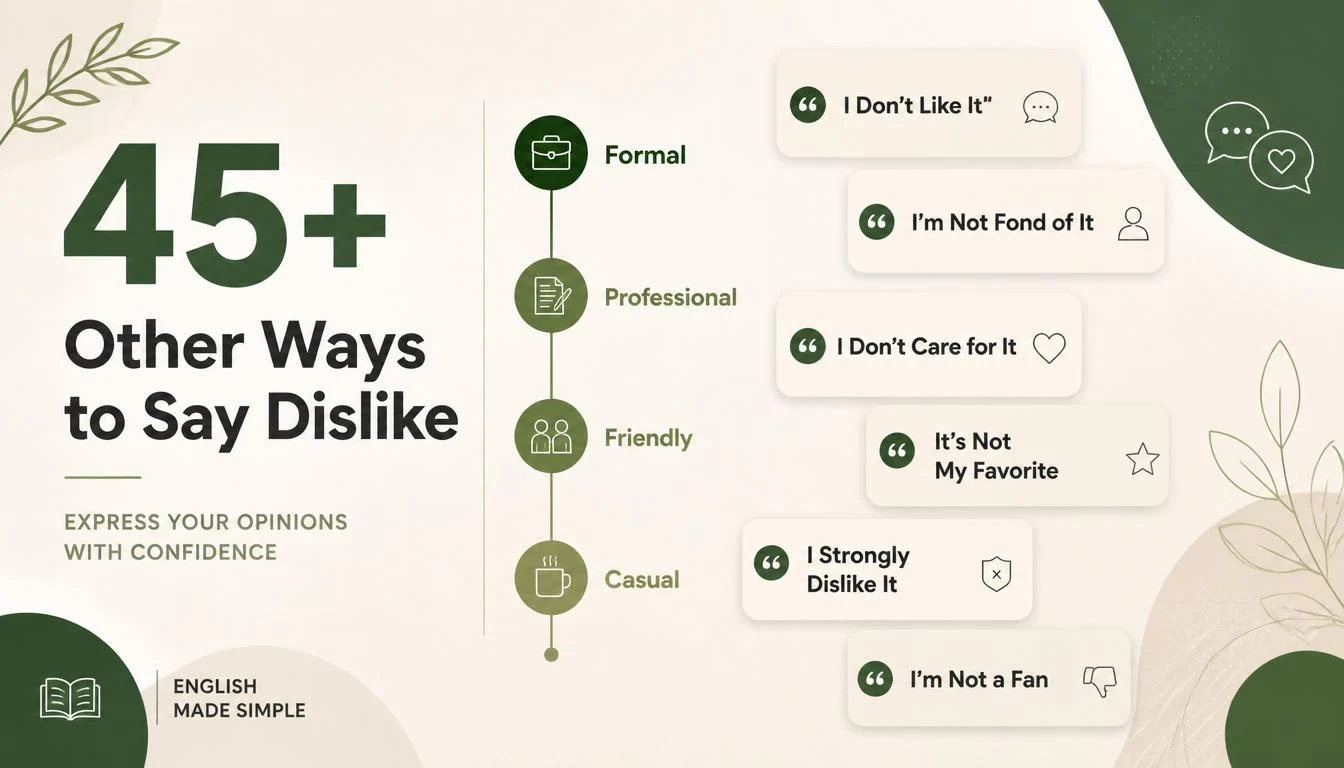
Quick Answer
Dislike means to feel aversion or disapproval toward someone or something, regarding them as unpleasant or repugnant . It’s a general term for not liking something, commonly used in both spoken and written English.Best alternatives: Don’t care for, Not a fan of, Can’t stand, Not my cup of tea, Have no interest in
Looking for other ways to say dislike? Whether you want to express a mild preference, strong negative feelings, or simple irritation, the right phrase can make your meaning clearer. English offers many natural alternatives depending on how strong or direct you want to sound.
In this guide, you’ll find 45+ other ways to say dislike, from everyday expressions to stronger words and polite alternatives. These phrases can help you describe your feelings naturally in conversations, writing, workplace communication, and everyday situations.
Why Do People Search For Other Ways to Say Dislike
When users search for “other ways to say dislike,” they’re typically looking to expand their vocabulary for expressing negative preferences more precisely and naturally. This search often arises from several needs:
What users are looking for:
- Professional alternatives for workplace communication
- Polite expressions for social situations
- Stronger expressions for when “dislike” feels too weak
- Softer alternatives for sensitive conversations
- Natural-sounding phrases used by native speakers
Why they search this phrase:
Many English learners and even native speakers recognize that repeating “I dislike” sounds monotonous and unnatural. They want to sound more fluent, varied, and situationally appropriate. In everyday conversation, native speakers rarely say “I dislike” – they’re more likely to say “I’m not a fan of” or “I don’t really care for” .
Spoken vs written usage:
In spoken English, expressions like “can’t stand,” “don’t like,” and “not my thing” are common. Written English, especially in professional contexts, favors phrases like “I’m not particularly fond of,” “I have reservations about,” or “it doesn’t appeal to me.”
Formal vs informal communication intent:
The choice of expression signals your relationship with the listener and the context. Using “I abhor” in casual conversation sounds overly dramatic, while “I can’t stand it” in a job interview would be inappropriate.
Tone Ladder System
Very Formal
- I find it disagreeable
- It does not meet with my approval
- I have reservations about
- I am not favorably disposed toward
Best use: Official correspondence, academic writing, formal complaints
Formal
- I don’t particularly care for
- I’m not overly fond of
- It doesn’t appeal to me
- I’m not enthusiastic about
Best use: Business emails, professional conversations, polite disagreements
Neutral
- I’m not a fan of
- I don’t like
- It’s not to my taste
- I’m not keen on
Best use: Most everyday situations, casual professional settings
Casual
- It’s not really my thing
- I’m not into
- It doesn’t do it for me
- I could take it or leave it
Best use: Conversations with friends, social settings
Informal
- I can’t stand
- It drives me wild
- It gets on my nerves
- I have a thing about
- I can’t stomach
Best use: Close relationships, expressing strong feelings informally
Tone Classification Table
| Phrase | Tone Level | Formality | Best Situation |
|---|---|---|---|
| I find it disagreeable | Very Formal | 5/5 | Official complaints, formal letters |
| It does not meet with my approval | Very Formal | 5/5 | Business correspondence, formal meetings |
| I have reservations about | Very Formal | 5/5 | Professional feedback, formal contexts |
| I’m not particularly fond of | Formal | 4/5 | Polite professional conversations |
| It doesn’t appeal to me | Formal | 4/5 | Business emails, polite refusals |
| I’m not a fan of | Neutral | 3/5 | Everyday conversation, social media |
| I’m not keen on | Neutral | 3/5 | British English, polite contexts |
| It’s not my cup of tea | Casual | 2/5 | Social conversations, friendly settings |
| It’s not really my thing | Casual | 2/5 | Casual conversations, social situations |
| I can’t stand | Informal | 1/5 | Strong feelings, close relationships |
| It drives me wild | Informal | 1/5 | Expressing frustration informally |
| I have a thing about | Informal | 1/5 | Describing specific pet peeves |
Quick Selection Guide (Decision Block)
In a job interview: → “I’m not particularly drawn to roles that involve…” or “I find that type of work less appealing because…”
In a professional email: → “I’m not particularly fond of…” or “I have reservations about the proposal because…”
At a networking event: → “I’m not as familiar with that approach” or “That’s not really my area of expertise”
In a casual conversation: → “I’m not a big fan of…” or “It’s not really my thing”
When giving polite feedback: → “I’m not entirely convinced by…” or “I find that approach somewhat challenging”
When you strongly dislike something: → “I can’t stand…” (informal) or “I have a strong aversion to…” (formal)
Real-Life Conversation Transformations
Job Interview Scenario
Before (weak/unnatural):
Interviewer: “How do you feel about working with difficult clients?”
Candidate: “I dislike difficult clients.”
After (natural and professional):
Interviewer: “How do you feel about working with difficult clients?”
Candidate: “I’m not particularly drawn to conflict, but I’ve developed strategies for handling challenging situations professionally. I find that maintaining clear communication usually resolves most issues.”
Why it works: The improved version softens the negative expression, shows self-awareness, and demonstrates problem-solving skills rather than just stating a dislike.
Networking Event Scenario
Before (blunt/awkward):
“Oh, I dislike working in sales.”
After (conversational and polite):
“To be honest, sales isn’t really my strong suit. I’m much more comfortable on the creative side of things.”
Why it works: The improved version redirects the conversation positively while expressing the same sentiment more naturally. Using “to be honest” softens the statement , and mentioning what you do like keeps the conversation positive.
Email Scenario
Before (unprofessional):
“I dislike this proposal and don’t want to move forward with it.”
After (professional and constructive):
“After reviewing the proposal, I have some reservations about a few key points. I’d like to discuss alternative approaches that might work better for our team.”
Why it works: The improved version is diplomatic, offers specific feedback, and suggests solutions rather than just rejecting an idea.
Casual Conversation Scenario
Before (repetitive/boring):
“I dislike that restaurant. I dislike the food there.”
After (natural and varied):
“That place isn’t really my cup of tea. I’ve tried it a couple of times, but the food just doesn’t do it for me.”
Why it works: The improved version sounds more like natural English conversation, with varied vocabulary that flows better and feels more authentic.
45+ Other Ways to Say Dislike
1. Not a fan of
Meaning: A polite, casual way to say you don’t like something without being harsh .
Explanation: This is one of the most common alternatives in everyday English. It softens the negative feeling while being clear about your preference.
Example sentence: “I’m not a fan of early morning meetings.”
Tone: Neutral-casual
Best use: Everyday conversation, social media, informal emails
Worst use: Formal business letters, academic writing
Context variability: Very widely used in American and British English; works in both spoken and written contexts.
2. Don’t care for
Meaning: A polite way to express that something isn’t to your taste .
Explanation: This phrase is gentler than “dislike” and often used in polite company. It implies a lack of preference rather than active disapproval.
Example sentence: “I don’t really care for spicy food.”
Tone: Formal-neutral
Best use: Polite social situations, professional settings
Worst use: When you need to express strong disapproval
Context variability: More common in British English but widely understood and used in American English as well.
3. Can’t stand
Meaning: A strong expression of dislike, indicating something is intolerable .
Explanation: This is an emphatic, informal way to say you really dislike something. It’s much stronger than “dislike” and suggests the thing is annoying or unpleasant to the point of being unbearable.
Example sentence: “I can’t stand people who are constantly late.”
Tone: Informal
Best use: Casual conversations with friends, expressing strong opinions
Worst use: Professional settings, formal writing
Context variability: Very common in spoken English; should be used carefully in written contexts unless writing informally.
4. Not my cup of tea
Meaning: A classic British expression meaning something isn’t to your taste .
Explanation: This idiomatic expression is polite and gentle. It suggests something doesn’t suit your preferences rather than being actively bad.
Example sentence: “Horror movies aren’t really my cup of tea.”
Tone: Casual
Best use: Social conversations, polite refusals
Worst use: Professional emails, formal writing
Context variability: More common in British English but understood globally. Can be used in casual American English too.
5. Have a thing about
Meaning: To have a strong negative feeling about something, often a specific pet peeve .
Explanation: While “have a thing for” means to like something, “have a thing about” means to have an irrational dislike or aversion. It suggests a personal quirk rather than a reasoned opinion.
Example sentence: “I have a thing about people leaving dishes in the sink.”
Tone: Informal
Best use: Describing personal pet peeves, casual conversation
Worst use: Professional settings, formal writing
Context variability: Mostly used in spoken English; very natural in conversation with friends and family.
6. Not particularly fond of
Meaning: A polite, somewhat formal way to express mild dislike.
Explanation: This is a classic English understatement. The phrase is softened by “particularly,” making it less direct and more polite. It often implies stronger dislike than the words suggest.
Example sentence: “I’m not particularly fond of opera.”
Tone: Formal
Best use: Professional conversations, polite social situations
Worst use: Very casual settings
Context variability: Works well in both British and American English; considered a very safe, polite expression.
7. Not keen on
meaning: A British expression meaning you don’t like or aren’t interested in something.
Explanation: This is a common alternative in British English that’s polite but clear. It suggests a lack of enthusiasm rather than active dislike.
Example sentence: “I’m not keen on the new office layout.”
Tone: Neutral-formal
Best use: British English contexts, professional settings
Worst use: American casual conversation (though understood)
Context variability: Predominantly British but increasingly understood in American English; best used in professional or polite contexts.
8. Could take it or leave it
Meaning: Complete indifference or mild dislike.
Explanation: This expression suggests you have no strong feelings either way, but it’s often used to express mild dislike without being negative. It’s a very gentle way to say you don’t care for something.
Example sentence: “I could take or leave reality TV.”
Tone: Casual
Best use: Social conversations, expressing mild preferences
Worst use: When you need to express strong feelings
Context variability: Widely used in spoken English; sounds natural and conversational.
9. Not my thing
Meaning: A casual, gentle way to say something doesn’t suit your interests.
Explanation: This is a very common, safe expression in casual conversation. It’s a softer, less formal version of “not my cup of tea.”
Example sentence: “Dancing isn’t really my thing.”
Tone: Casual
Best use: Social conversations, casual settings
Worst use: Professional or formal writing
Context variability: Very common in American English; works well in informal spoken contexts.
10. Have no interest in
Meaning: Complete lack of interest or desire.
Explanation: This phrase is more neutral than “dislike” and focuses on lack of interest rather than active disapproval.
Example sentence: “I have no interest in learning to play the guitar.”
Tone: Neutral
Best use: Both spoken and written contexts, polite refusals
Worst use: When you want to express strong negative feelings
Context variability: Works well in most contexts; considered polite and clear.
11. Can’t tolerate
Meaning: A formal, strong expression of dislike.
Explanation: This phrase suggests the thing is unacceptable or impossible to endure. It’s stronger than “dislike” and more formal than “can’t stand.”
Example sentence: “I can’t tolerate dishonesty in the workplace.”
Tone: Formal
Best use: Professional settings, expressing principles
Worst use: Casual conversation (sounds too serious)
Context variability: Mostly used in formal or professional contexts; would sound overly dramatic in casual conversation.
12. Have an aversion to
Meaning: A strong, often irrational dislike.
Explanation: This is a formal term that suggests a deep-seated or instinctive dislike, often with the implication that it’s somewhat unreasonable.
Example sentence: “I have an aversion to public speaking.”
Tone: Very formal
Best use: Academic writing, formal contexts
Worst use: Everyday conversation
Context variability: Used in written English more than spoken; sounds intellectual and formal.
13. Turn off by
Meaning: To be discouraged or put off by something.
Explanation: This phrase suggests that something made you lose interest or enthusiasm. It’s often used to explain why you don’t like something.
Example sentence: “I was really turned off by the poor customer service.”
Tone: Casual-neutral
Best use: Conversation about experiences, reviews
Worst use: Formal writing
Context variability: Very natural in spoken English; common in both American and British English.
14. Doesn’t appeal to me
Meaning: A polite way to say something isn’t attractive or interesting.
Explanation: This is a diplomatic way to express dislike by focusing on lack of appeal rather than active dislike.
Example sentence: “Traveling alone doesn’t really appeal to me.”
Tone: Formal
Best use: Professional conversations, polite social situations
Worst use: Casual conversations with friends
Context variability: Works in both spoken and written English; considered polite and well-mannered.
15. Can’t abide
Meaning: A somewhat formal or old-fashioned way to say you can’t tolerate something.
Explanation: This is a stronger expression that suggests enduring something would be impossible. It’s a bit literary or old-fashioned but still used.
Example sentence: “I can’t abide poor manners.”
Tone: Formal-old fashioned
Best use: Literary writing, formal expressions
Worst use: Casual modern conversation
Context variability: Less common in everyday speech but used in formal writing and older English.
16. Not to my liking
Meaning: A formal way to say something doesn’t suit your taste.
Explanation: This phrase sounds quite formal and can even sound a bit pretentious. It’s useful when you need to express a preference politely but formally.
Example sentence: “The new proposal is not to my liking.”
Tone: Very formal
Best use: Formal letters, polite complaints
Worst use: Everyday conversation
Context variability: More common in written English than spoken; sounds quite stiff in conversation.
17. Can’t stomach
Meaning: To be unable to tolerate something, often because it’s unpleasant or disturbing.
Explanation: This is a vivid, informal way to express strong dislike, particularly for things that are distasteful. It comes from the idea of not being able to “stomach” or digest something.
Example sentence: “I can’t stomach watching horror movies.”
Tone: Informal
Best use: Casual conversation, expressing strong distaste
Worst use: Professional contexts
Context variability: Mostly spoken; considered quite informal and vivid.
18. Give the cold shoulder to
Meaning: To deliberately ignore or show dislike toward someone.
Explanation: This idiom is specifically about people and social situations. It means to act coldly or ignore someone to show your dislike.
Example sentence: “She gave me the cold shoulder after our disagreement.”
Tone: Informal
Best use: Describing social situations, relationships
Worst use: Professional or formal writing
Context variability: Used in conversation about personal situations; wouldn’t be used in formal contexts.
19. Have no use for
Meaning: To consider something unnecessary or worthless.
Explanation: This phrase suggests you have no practical use or respect for the thing, often implying disdain.
Example sentence: “I have no use for people who lie.”
Tone: Informal
Best use: Expressing strong opinions, casual conversation
Worst use: Professional contexts
Context variability: Common in spoken English; often used to express strong disapproval.
20. Disapprove of
Meaning: To regard with disfavor; to have a negative opinion .
Explanation: This is about disapproval rather than dislike. It’s more about moral or reasoned objection than personal taste.
Example sentence: “My parents disapprove of my career choice.”
Tone: Neutral-formal
Best use: Discussing opinions, values, parental/societal views
Worst use: Casual conversation about simple preferences
Context variability: Works in both formal and informal contexts, depending on what’s being disapproved.
21. Be averse to
Meaning: To have a strong opposition or reluctance toward something.
Explanation: This is a formal way to express dislike or reluctance. It suggests an avoidance motivated by dislike or fear.
Example sentence: “I’m not averse to trying new foods.”
Tone: Formal
Best use: Written English, formal discussions
Worst use: Casual conversation
Context variability: Often used in the negative (“not averse”) to mean willingness; sounds quite formal in speech.
22. Detest
Meaning: To dislike intensely; to hate .
Explanation: This is a very strong, formal word. It’s much more powerful than “dislike” and approaches “hate” in intensity.
Example sentence: “I detest hypocrisy in all its forms.”
Tone: Formal
Best use: Expressing strong moral objections, formal writing
Worst use: Everyday conversation (sounds too strong)
Context variability: More common in formal or literary contexts; rarely used in casual speech.
23. Loathe
Meaning: To feel intense dislike or disgust for something .
Explanation: Like “detest,” this is a very strong word that’s close to “hate.” It suggests not just dislike but disgust.
Example sentence: “I loathe the way people treat each other online.”
Tone: Formal
Best use: Expressing strong feelings, literary contexts
Worst use: Casual conversation
Context variability: Used more in writing than speech; considered quite dramatic in conversation.
24. Abhor
Meaning: To regard with horror and detestation.
Explanation: This is perhaps the strongest word for dislike available. It suggests moral revulsion and intense disgust.
Example sentence: “I abhor violence in all forms.”
Tone: Very formal
Best use: Moral or ethical statements, formal writing
Worst use: Casual conversation
Context variability: Used almost exclusively in formal or literary contexts; sounds overly dramatic in everyday speech.
25. Antipathy toward
Meaning: A deep-seated feeling of dislike or aversion .
Explanation: This noun describes a lasting, fundamental dislike. It suggests an instinctive or ingrained negative reaction.
Example sentence: “She has an antipathy toward modern art.”
Tone: Very formal
Best use: Academic writing, formal discussions
Worst use: Everyday conversation
Context variability: Almost exclusively used in formal or academic contexts.
26. Distaste for
Meaning: A mild, aesthetic dislike .
Explanation: This is a formal but not too strong word. It often suggests a refined or aesthetic dislike rather than a moral objection.
Example sentence: “I have a distaste for overly sweet desserts.”
Tone: Formal
Best use: Discussing preferences politely, formal contexts
Worst use: Strong emotional expressions
Context variability: Used in both spoken and written formal contexts; sounds refined and polite.
27. Disapproval of
Meaning: An unfavorable opinion or judgment.
Explanation: This focuses on the opinion or judgment aspect of dislike, suggesting you think something is wrong or bad.
Example sentence: “Her disapproval of my choices was obvious.”
Tone: Neutral
Best use: Describing others’ opinions, social contexts
Worst use: Expressing personal feelings (less direct)
Context variability: Works in most contexts; more about judgment than personal taste.
28. Displeasure with
Meaning: A feeling of annoyance or dissatisfaction .
Explanation: This phrase suggests mild annoyance or disappointment rather than strong dislike.
Example sentence: “I expressed my displeasure with the service.”
Tone: Formal
Best use: Complaints, expressing dissatisfaction politely
Worst use: Casual conversation (sounds stiff)
Context variability: Common in formal complaints and polite expressions of dissatisfaction.
29. Have a distaste for
Meaning: A formal way to say you dislike something.
Explanation: Similar to “distaste,” this phrase suggests a refined or aesthetic objection. It’s often used about food, art, or cultural preferences.
Example sentence: “I have a distaste for modern architecture.”
Tone: Formal
Best use: Discussing aesthetic preferences, formal settings
Worst use: Strong emotional expressions
Context variability: Often used in written or formal spoken contexts.
30. Couldn’t care less about
Meaning: To have no interest or concern about something.
Explanation: This phrase expresses indifference that often borders on dislike. It implies you care so little that you wouldn’t even notice if the thing disappeared.
Example sentence: “I couldn’t care less about celebrity gossip.”
Tone: Informal
Best use: Casual conversation, expressing indifference
Worst use: Formal or professional contexts
Context variability: Very common in spoken English; considered casual and sometimes dismissive.
31. Have no stomach for
Meaning: To lack the courage or tolerance for something.
Explanation: This phrase often implies both dislike and a lack of willingness to engage with something unpleasant.
Example sentence: “I have no stomach for office politics.”
Tone: Informal
Best use: Expressing unwillingness to tolerate something
Worst use: Formal contexts
Context variability: Mostly used in casual conversation; emphasizes both dislike and avoidance.
32. Doesn’t sit right with me
Meaning: To feel instinctively that something is wrong or not good.
Explanation: This is an idiomatic way to express discomfort or moral unease rather than simple dislike.
Example sentence: “That decision doesn’t sit right with me.”
Tone: Casual-neutral
Best use: Expressing moral unease, opinions
Worst use: Formal writing
Context variability: Very natural in spoken English; suggests an intuitive feeling of wrongness.
33. Take a dim view of
Meaning: To regard with disapproval or suspicion.
Explanation: This is a formal or literary way to say you disapprove of something.
Example sentence: “The company takes a dim view of employees using social media at work.”
Tone: Formal
Best use: Company policies, formal opinions
Worst use: Casual conversation
Context variability: Often used in formal or institutional contexts.
34. Get on my nerves
Meaning: To annoy or irritate.
Explanation: This phrase describes the effect of the disliked thing rather than simply stating dislike. It suggests ongoing irritation.
Example sentence: “Her constant humming really gets on my nerves.”
Tone: Informal
Best use: Expressing irritation, casual conversation
Worst use: Professional contexts
Context variability: Very common in casual speech; about irritation rather than general dislike.
35. Rub me the wrong way
Meaning: To annoy or irritate someone.
Explanation: This idiom suggests that something or someone creates a negative impression or feeling.
Example sentence: “Something about him rubs me the wrong way.”
Tone: Informal
Best use: Expressing interpersonal dislike, casual conversation
Worst use: Formal writing
Context variability: Very common in American English; about intangible negative feelings toward people.
36. Be put off by
Meaning: To be discouraged or made to feel negative about something.
Explanation: This suggests that something specific about the thing caused you to dislike it.
Example sentence: “I was put off by the restaurant’s dirty bathroom.”
Tone: Casual-neutral
Best use: Explaining why you didn’t like something
Worst use: Formal writing
Context variability: Common in conversation; focuses on the trigger for dislike.
37. Have a bugaboo about
Meaning: An irrational or exaggerated dislike of something .
Explanation: This is a more obscure, playful way to describe a specific pet peeve or irrational dislike.
Example sentence: “I have a bugaboo about hard candy in my pocket.”
Tone: Informal-playful
Best use: Describing personal quirks, humor
Worst use: Serious or professional contexts
Context variability: Uncommon but colorful; best used in informal conversation.
38. Give someone the creeps
Meaning: To cause a feeling of fear, disgust, or unease.
Explanation: This is about a visceral, uncomfortable feeling rather than reasoned dislike.
Example sentence: “That abandoned house gives me the creeps.”
Tone: Informal
Best use: Describing unease or fear
Worst use: Formal contexts
Context variability: Common in casual conversation; suggests fear or unease more than simple dislike.
39. Have had enough of
Meaning: To be unable to tolerate something any longer.
Explanation: This suggests that dislike has built up over time to the point of intolerance.
Example sentence: “I’ve had enough of your excuses.”
Tone: Informal
Best use: Expressing frustration, ending tolerance
Worst use: Professional or formal contexts (though sometimes used)
Context variability: Used when someone has reached their limit; implies the dislike has grown over time.
40. Could do without
Meaning: Would prefer not to have to deal with something.
Explanation: This is an understated way to say you dislike something and would be happier without it.
Example sentence: “I could do without his constant complaining.”
Tone: Neutral-casual
Best use: Gentle complaints, informal conversation
Worst use: Strong expressions of dislike
Context variability: Common in spoken English; a polite way to complain.
41. Not have a high opinion of
Meaning: To think poorly of someone or something.
Explanation: This focuses on judgment rather than feeling. It suggests you think the thing isn’t good.
Example sentence: “I don’t have a high opinion of that policy.”
Tone: Formal
Best use: Professional opinions, polite criticism
Worst use: Casual conversation
Context variability: More about judgment than feeling; common in professional contexts.
42. Be lukewarm about
Meaning: To have mild or unenthusiastic feelings.
Explanation: This suggests you’re not excited about something, often implying mild dislike or indifference.
Example sentence: “I’m lukewarm about the new proposal.”
Tone: Neutral
Best use: Professional contexts, polite opinions
Worst use: Strong feelings, casual conversation
Context variability: Suggests mild, unenthusiastic feelings; useful in professional settings.
43. Have a thing against
Meaning: To have a specific reason to dislike something or someone.
Explanation: This is the negative counterpart to “have a thing for” or “have a thing about.” It suggests a specific, perhaps irrational, dislike.
Example sentence: “I have a thing against people who chew loudly.”
Tone: Informal
Best use: Describing pet peeves, casual conversation
Worst use: Professional contexts
Context variability: Similar to “have a thing about” but more focused on the object of dislike.
Usage Comparison Table
| Phrase | Spoken Use | Written Use | Context |
|---|---|---|---|
| Not a fan of | Very common | Common in informal writing | Everyday conversation |
| Don’t care for | Common | Common in formal writing | Polite social situations |
| Can’t stand | Very common | Uncommon | Strong feelings, informal |
| Not my cup of tea | Common | Uncommon | Casual, British English |
| Have a thing about | Common | Uncommon | Pet peeves, informal |
| Not particularly fond of | Common | Very common | Professional settings |
| Not keen on | Common (UK) | Common (UK) | British English |
| Could take or leave it | Common | Uncommon | Indifference, casual |
| Not my thing | Very common | Uncommon | Casual conversation |
| Have no interest in | Common | Common | Neutral contexts |
| Can’t tolerate | Uncommon | Common | Formal contexts |
| Have an aversion to | Uncommon | Common | Academic/formal |
| Turn off by | Common | Common in informal writing | Experiences |
| Doesn’t appeal to me | Common | Common | Polite opinions |
| Can’t abide | Rare | Uncommon | Old-fashioned |
| Not to my liking | Rare | Common | Very formal |
| Can’t stomach | Common | Uncommon | Strong distaste |
| Give the cold shoulder to | Common | Uncommon | Interpersonal |
| Have no use for | Common | Uncommon | Strong opinions |
| Disapprove of | Common | Common | Opinions, values |
| Be averse to | Uncommon | Common | Formal |
| Detest | Rare | Common | Strong feelings |
| Loathe | Rare | Common | Very strong feelings |
| Abhor | Rare | Rare | Extremely strong |
| Antipathy toward | Rare | Common | Academic |
| Distaste for | Rare | Common | Formal |
| Disapproval of | Common | Common | Judgment |
| Displeasure with | Common | Common | Complaints |
| Have a distaste for | Rare | Common | Formal |
| Couldn’t care less about | Very common | Common in informal writing | Indifference |
Email + LinkedIn Ready Expressions
Professional Email Phrases
Expressing preference professionally:
- “I’m not particularly drawn to roles that focus heavily on…”
- “I have some reservations about the approach because…”
- “I find that style of working less effective for our team”
- “From my perspective, that approach presents some challenges”
Polite decline in emails:
- “While I appreciate the opportunity, this isn’t quite the right fit for me”
- “I have some concerns about moving forward in this direction”
- “I’m not entirely convinced this aligns with our objectives”
LinkedIn Connection Messages
Politely declining connection requests:
- “I appreciate your reaching out, though I don’t think our professional paths align at this time”
Expressing preferences in your profile:
- “I’m most drawn to collaborative environments rather than highly competitive ones”
Follow-Up Lines
Professional feedback:
- “I was less convinced by the data presented in the third section”
- “The methodology doesn’t quite align with best practices in our field”
Native Speaker Insight Box
Natural Usage Patterns:
Native English speakers rarely say “I dislike” in everyday conversation. It sounds formal and stiff. Instead, they use softer or more colorful expressions .
What sounds natural:
- “I’m not a huge fan” (common softening)
- “It’s not really my thing” (casual dismissal)
- “I can’t stand it” (strong opinion, informal)
- “I’m not keen” (British, polite)
What sounds unnatural:
- “I dislike that very much” (too formal for conversation)
- “That incites my antipathy” (too academic)
- “I have a strong aversion to pizza” (overly dramatic for everyday)
Shortened spoken versions:
- “Not my fave” (very casual)
- “Can’t hack it” (British slang)
- “Not for me” (short and clear)
Preferred professional alternatives:
- “I have some reservations” (in meetings)
- “I’m not entirely convinced” (in feedback)
- “That approach presents challenges” (diplomatic)
What native speakers actually say:
In a 2023 study of everyday English, the most common ways to express dislike in natural conversation were: “I don’t like,” “I’m not a fan,” “not my thing,” and “can’t stand” in increasing order of strength .
Common Mistakes + What Not to Say
Unnatural Phrases
- ❌ “I dislike this food.” → ✔ “I’m not really a fan of this food.” (Too direct; sounds like a robot)
- ❌ “I have a dislike for modern art.” → ✔ “Modern art isn’t really my thing.” (Too formal for conversation)
- ❌ “I can’t stand that meeting.” → ✔ “I wasn’t too keen on that meeting.” (Too dramatic for professional context)
Tone Mismatch
- ❌ Using “I abhor” in casual conversation: “I abhor pineapple on pizza.” (Sounds pretentious)
- ❌ Using “not my cup of tea” in a job interview: “Team collaboration isn’t my cup of tea.” (Too casual)
- ❌ Using “can’t stand” in an email to a client: “I can’t stand the new software.” (Unprofessional)
Grammar Mistakes
- ❌ “I’m not much of a fan about that” → ✔ “I’m not much of a fan of that”
- ❌ “I have a distaste to spicy food” → ✔ “I have a distaste for spicy food”
- ❌ “I’m not keen in that idea” → ✔ “I’m not keen on that idea”
Over-Formal or Awkward Usage
❌ “I am not favorably disposed toward this proposal.” (Sounds like a 19th-century novel)
❌ “That doesn’t meet with my approval.” (Sounds like a Victorian parent)
Expansion Phrases (Semantic SEO Boost)
Greeting Variations
- “To be honest, I don’t really like…”
- “Actually, I’m not a huge fan of…”
- “If I’m being completely honest, it’s not my favorite”
Introduction Phrases
- “I should mention upfront that I’m not keen on…”
- “Before we go further, I should say I have reservations about…”
- “I want to be transparent about my feelings toward…”
Polite Communication Alternatives
- “I have some concerns about…”
- “I find that approach somewhat challenging”
- “That’s not exactly my area of comfort”
Conversational English Upgrades
- Instead of: “I dislike it”
Say: “It doesn’t really do it for me” - Instead of: “I don’t like it”
Say: “I’m not sold on it” - Instead of: “I hate it”
Say: “I can’t get on board with it”
Decision-Making Table
| Situation | Best Phrase | Why It Works |
|---|---|---|
| Turning down a job offer | “I’m not entirely convinced this is the right fit” | Professional, diplomatic, leaves doors open |
| Declining an invitation | “That’s not really my thing, but thank you” | Polite, personal, appreciative |
| Giving negative feedback at work | “I have some reservations about the approach” | Professional, constructive, non-confrontational |
| Expressing strong dislike to friends | “I can’t stand it!” | Natural, emphatic, appropriate for informal settings |
| Politely refusing food | “I’m not particularly fond of mushrooms” | Gentle, personal, not insulting |
| Stating a preference in a meeting | “I’m not convinced that’s the best direction” | Professional, evidence-focused, collaborative |
| Describing a pet peeve | “I have a thing about people who…” | Casual, personal, identifies specific trigger |
| Expressing disapproval in writing | “I don’t have a high opinion of that policy” | Clear, professional, judgment-focused |
| Softening criticism | “I’m lukewarm about the proposal” | Gentle, suggests room for improvement |
| Ending an argument | “Could do without this conversation” | Casual, disengaging without aggression |
Quick Fast List (Snippet Targeting)
Top 5 Best Alternatives:
- Not a fan of – Best for everyday use, polite and natural
- Don’t care for – Best for professional settings, gentle
- Can’t stand – Best for strong feelings, informal contexts
- Not my cup of tea – Best for casual British English
- Not particularly fond of – Best for formal situations
5 More Strong Alternatives:
- Can’t tolerate – Professional, strong
- Have an aversion to – Formal, psychological
- Can’t stomach – Vivid, informal
- Detest – Very strong, formal
- Loathe – Intense dislike, formal
5 Soft/Polite Alternatives:
- Not keen on – British, polite
- Could take it or leave it – Indifferent, mild
- Doesn’t appeal to me – Diplomatic
- Not to my liking – Very formal
- Not my thing – Casual, gentle
Mini Quiz
Question 1: You’re in a job interview and the interviewer asks how you feel about cold calling. Which response is most appropriate?
A) “I can’t stand cold calling”
B) “Cold calling isn’t really my cup of tea”
C) “I’m not particularly drawn to cold calling, but I understand it’s sometimes necessary”
D) “I hate cold calling with a passion”
Answer: C – It’s honest, professional, and shows you’re willing to do what’s needed.
Question 2: You’re at a restaurant with friends and the waiter asks what you think of your meal. It’s not great, but you don’t want to be rude. What do you say?
A) “I dislike this food”
B) “I have a distaste for this meal”
C) “It’s not my favorite, but it’s okay”
D) “I can’t stand it”
Answer: C – It’s polite, honest, and socially appropriate.
Question 3: You’re writing an email to a client and need to express that you don’t agree with their approach. Which is most professional?
A) “I’m not a fan of this approach”
B) “I have some reservations about this approach”
C) “I don’t like this approach at all”
D) “This approach rubs me the wrong way”
Answer: B – “Reservations” is professional, diplomatic, and suggests you’re open to discussion.
Question 4: You’re in a casual conversation with a friend about a movie they loved. You didn’t like it. What’s the most natural response?
A) “I have an aversion to that movie”
B) “I detest that movie”
C) “It wasn’t really my thing, to be honest”
D) “I dislike that movie”
Answer: C – “It wasn’t really my thing” is natural, casual, and polite.
Question 5: You’re describing a personal pet peeve to your friend. What’s the most natural way?
A) “I have a bugaboo about people being late”
B) “I have an antipathy toward lateness”
C) “I can’t stand it when people are late”
D) “I’m not favorably disposed toward lateness”
Answer: C – “I can’t stand it when…” is the most natural way to express a pet peeve.
FAQs
Is it polite to say “I dislike” something?
“I dislike” is grammatically correct but can sound direct and formal in everyday conversation . Native speakers typically use alternatives like “I’m not a fan of” or “I don’t really care for” in casual contexts. In professional settings, “I have reservations about” or “I’m not entirely convinced” are more diplomatic. The politeness depends on context, but generally, “I dislike” is safe in formal writing but sounds stiff in speech.
What is more professional than “I don’t like”?
Professional alternatives include: “I have reservations about,” “I’m not entirely convinced,” “I find that approach challenging,” “That doesn’t quite align with my thinking,” and “I have some concerns about.” These phrases focus on reasoned objections rather than personal preference, making them more suitable for workplace communication.
Can I use “I can’t stand” in a professional email?
No. “I can’t stand” is too informal and emotional for professional emails . Instead, use: “I find it difficult to work with,” “I have concerns about,” or “That approach presents some challenges.” These maintain professionalism while expressing your negative feelings.
What do native speakers say instead of “I dislike”?
Native speakers most commonly say: “I don’t like” (informally), “I’m not a fan of,” “It’s not my thing,” “I’m not keen on” (British), or “I can’t stand” (strong feelings) . The phrase “I don’t like” is actually more common in everyday speech than “I dislike,” which sounds too formal . The choice depends on how strong the feeling is and the social context.
What is the best alternative for professional feedback?
The best professional alternative is “I have some reservations about…” because it’s diplomatic, suggests thoughtfulness, and opens the door for discussion. Other excellent options include: “I’m not entirely convinced that…,” “I find that approach less effective because…,” and “From my perspective, this presents some challenges.” These phrases focus on the issue rather than personal preference.
Conclusion
Expressing dislike in English doesn’t have to be difficult or repetitive. By varying your vocabulary and matching your tone to the situation, you can communicate your feelings more naturally and effectively. The key is understanding the context: formal situations call for phrases like “I have reservations about,” while casual conversations allow for “not my thing” or “can’t stand.”
Remember, native English speakers rarely use “dislike” in everyday conversation they opt for softer, more colorful, or more precise expressions depending on the situation and their relationship with the listener. Practice these alternatives and pay attention to how they’re used in different contexts. With time, you’ll develop an instinct for which phrase fits each situation, making your English sound more fluent, natural, and native-like.
Read More Related Articles:
- 35+ Other Ways to Say Happy Thursday | Make Your Greetings More Engaging In 2026
- 35+ Other Ways to Say “Nice to Meet You” | Formal to Casual In 2026
- 35+ Other Ways to Say “Did You Sleep Well” | For Better Communication In 2026

Zoe Chambers works as a content writer at synoseek.com, contributing thoughtful pieces on everyday subjects and ideas. She writes in a simple, grounded way, often drawing from real-world experiences. Her focus is on keeping content natural, clear and easy for readers to connect with.
8 thoughts on “45+ Other Ways to Say Dislike | Words for Every Situation In 2026”