Quick Answer
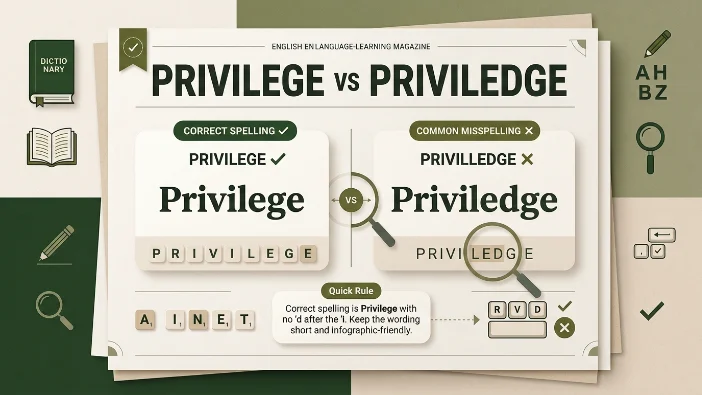
Privilege is the only correct spelling in English. Priviledge is a common misspelling caused by the way the word sounds when spoken quickly. There’s no rule that adds a “d” before “ge” the word comes from the Latin privilegium, and every major dictionary, including Merriam-Webster and Oxford, recognizes only one accepted spelling: privilege.
You’re typing an email to your manager, and right before you hit send, something feels off about the word “privilege.” Is there a “d” in there somewhere? Does it look right without one? If you’ve ever paused mid-sentence wondering whether you should write privilege or priviledge, you’re dealing with one of the most common spelling mix-ups in English.
Here’s the short version: only one of these spellings actually exists. Privilege is a real, dictionary-recognized word. Priviledge is not it’s a misspelling that happens so often it almost feels like it should be correct. The confusion usually comes from how the word sounds out loud, where that middle syllable seems to beg for an extra letter that simply isn’t there in the written form.
This mix-up matters more than people think. A misspelled word in a job application, a business proposal, or a college essay can quietly undercut your credibility, even when your ideas are strong. By the end of this guide, you’ll know exactly why priviledge keeps showing up, how to stop typing it by accident, and how to use privilege correctly in every context from casual conversation to formal writing.
Privilege vs Priviledge: What’s the Difference?
The real difference is simple: privilege is a word, and priviledge is an error. There isn’t a second, alternate spelling hiding in some regional dictionary or older style guide. This isn’t like “color” versus “colour,” where British and American English genuinely split. It’s closer to writing “definately” instead of “definitely” a spelling that feels intuitive but is objectively wrong.
Privilege functions as both a noun and a verb. As a noun, it refers to a special right, benefit, or advantage that isn’t available to everyone. As a verb, it means to grant someone that special right or treatment. Priviledge, on the other hand, has no function at all in standard English because it isn’t a recognized word in any dictionary, style guide, or academic reference.
| Feature | Privilege | Priviledge |
|---|---|---|
| Meaning | A special right, benefit, or advantage | No meaning not a real word |
| Part of Speech | Noun and verb | None |
| Refers To | Rights, advantages, honors | Nothing; it’s a spelling error |
| Typical Usage | Formal and everyday English | Should never appear in writing |
| Example | “Voting is both a right and a privilege.” | Incorrect version of “privilege” |
| Common Confusion | Extra “d” often added before “ge” | Mistaken for a valid variant |
So the recap here is short and useful: there’s no debate to settle, no regional variation to track, and no context where priviledge becomes acceptable. If you remember one thing from this section, remember that privilege stands alone as the correct form, and treating priviledge as a stylistic choice will only cause problems in professional or academic writing.
Is Privilege a Grammar, Vocabulary, or Spelling Issue?
This confusion is purely a spelling issue, not a grammar or vocabulary problem. Grammar concerns how words function together in a sentence verb tense, subject-verb agreement, word order. Vocabulary concerns meaning and word choice. Spelling is about how a word is written down, and that’s exactly where privilege and priviledge diverge.
Because it’s a spelling issue, the two forms aren’t interchangeable in any register of English. This isn’t a case where priviledge might be acceptable in casual texting but wrong in a business report. It’s wrong everywhere: formal English, business communication, academic writing, and everyday conversation all require the same spelling privilege.
The practical takeaway is this: since spelling errors are less forgiving than grammar slips in written English, it helps to build a specific habit around this word rather than relying on general spelling instincts, especially since spell-checkers don’t always catch it the way you’d expect.
Understanding “Privilege”
Meaning: A privilege is a special right, benefit, or advantage granted to a particular person or group, often one not available to everyone else. It can also describe the honor or pleasure of experiencing something meaningful.
Pronunciation: Privilege is pronounced PRIV-uh-lij, with the stress on the first syllable. That middle “i” often gets swallowed in fast speech, which is part of why writers instinctively want to add a “d” sound that doesn’t actually belong there.
Part of speech: Privilege works as a noun (“It was a privilege to meet her”) and as a verb (“The policy privileges longtime employees over new hires”).
Common collocations: special privilege, executive privilege, attorney-client privilege, take the privilege, abuse a privilege, earn a privilege, revoke a privilege.
Typical sentence patterns: “It is a privilege to…” / “[Someone] has the privilege of…” / “[Group] enjoys certain privileges…”
Workplace example: “Senior staff have the privilege of choosing their own project assignments.”
Academic example: “The professor discussed how educational privilege shapes access to opportunity.”
Technology example: “Admin accounts are granted elevated privileges that regular users don’t have.”
Email example: “It’s been a privilege collaborating with your team on this launch.”
Daily conversation example: “Honestly, having a quiet weekend at home feels like a privilege these days.”
One learner mistake: Many learners confuse “privilege” with “right,” treating them as identical. A right is something guaranteed to everyone by law or principle, while a privilege is a benefit that can be earned, granted, or taken away that distinction matters especially in legal and political writing.
Mini recap: Privilege is a flexible word used across professional, academic, and casual settings, and getting comfortable with its spelling pays off because the word appears constantly in everyday English.
Why People Misspell Privilege as Priviledge
The priviledge spelling isn’t random it follows a predictable pattern that shows up with several other English words. Here’s what’s actually happening when someone adds that extra “d.”
It mirrors words that genuinely contain “dge.” English has plenty of words like knowledge, edge, and judge, where “dge” is completely standard. Because your brain has stored that pattern as familiar and correct, it can subconsciously apply it to privilege even though the word’s actual spelling doesn’t follow that pattern.
The word “knowledge” is the biggest culprit. Privilege and knowledge share a similar rhythm and a similar abstract, formal feel, so many writers unconsciously blend the spelling of the two. If you already write “knowledge” correctly, that same instinct can misfire when you reach for “privilege.”
Fast speech blurs the syllables. When privilege is spoken quickly, the middle syllable can sound like it has a slight “d” quality to it, especially in casual speech. Written language should follow spelling rules rather than phonetic guesses, but our ears aren’t always reliable narrators.
Autocorrect doesn’t always catch it. Some spell-checkers flag priviledge instantly, but others especially on older software or certain mobile keyboards sometimes let it slip through, particularly if autocorrect has learned it as a “custom” word from repeated typing.
Visual memory competes with sound memory. People who read privilege often but rarely write it by hand tend to rely on how the word sounds rather than how it looks, and that’s when the extra “d” tends to creep in.
When Not to Use “Priviledge”
Since priviledge isn’t a real word, the honest answer is that you should never use it but understanding exactly where it tends to sneak in can help you catch it before it does.
In formal documents. Resumes, cover letters, and official reports are the worst places for this mistake to appear, since they’re often the first impression a reader forms of your attention to detail.
In academic essays. Professors and graders notice repeated spelling errors quickly, and priviledge is common enough that many instructors mentally flag it immediately.
In business emails. A misspelled word in a client-facing email can come across as careless, even if the actual message is thoughtful and well-organized.
In social media captions. While casual writing tolerates more flexibility, misspellings still get noticed, especially by readers who work in education, editing, or communications.
In legal or contractual language. Terms like “executive privilege” or “attorney-client privilege” carry precise legal weight, and a misspelling here can look unprofessional in a field built on precision.
In published content. Blog posts, articles, and marketing copy get shared widely, and errors tend to get pointed out publicly, which can hurt a brand’s credibility.
When typing quickly under pressure. Ironically, this is when the mistake happens most, since people rely on muscle memory rather than double-checking, especially during timed writing like exams or live chat support.
When relying purely on how the word sounds. Because privilege doesn’t spell the way it sounds, sounding it out phonetically is one of the least reliable ways to get it right.
Common Mistakes Table
| Correct Sentence | Incorrect Sentence | Explanation |
|---|---|---|
| “It’s a privilege to be here today.” | “It’s a priviledge to be here today.” | Priviledge is not a recognized spelling in any dictionary. |
| “She was granted special privileges.” | “She was granted special priviledges.” | The plural form still follows the same correct spelling rule. |
| “He abused his position of privilege.” | “He abused his position of priviledge.” | No context changes the correct spelling. |
| “The company privileges experience over education.” | “The company priviledges experience over education.” | Even as a verb, the spelling stays consistent. |
| “Attorney-client privilege protects this conversation.” | “Attorney-client priviledge protects this conversation.” | Legal terminology always uses the standard spelling. |
Decision Box
If you’re unsure which spelling to use, remember this: always write privilege, never priviledge. There is no situation, formal or informal, where the “d” version is correct. If you can picture the word “knowledge” and mentally separate it from “privilege,” you’ll break the habit fast.
Real World Examples
Office communication: “Thank you for the privilege of leading this project.”
Business email: “We consider it a privilege to partner with such a respected organization.”
School or university: “Attending this university has been both a challenge and a privilege.”
Customer support: “It’s our privilege to assist you with this issue today.”
Technology: “Only accounts with admin privileges can modify these system settings.”
Artificial Intelligence: “The AI model was trained to avoid granting unnecessary privileges to unauthorized users.”
Daily conversation: “Getting to travel this much for work really is a privilege, even on the hard days.”
Each of these examples shows privilege doing real work in a sentence expressing gratitude, describing access, or setting boundaries around who gets special treatment. None of them would function correctly with the priviledge spelling, no matter how natural it might feel to type.
Privilege in Modern Technology
Quick Answer: In modern technology, “privilege” most often describes the level of access a user or program has within a system, and getting the spelling right matters just as much in code comments, documentation, and security policies as it does in everyday writing.
In software and cybersecurity, the term “privileges” refers to permissions what a user or program is allowed to do within a system. You’ll see this in phrases like “elevated privileges,” “privilege escalation,” and “least privilege access,” all of which describe how much control a user has over files, settings, or data.
Artificial Intelligence: AI systems are often designed with strict privilege controls to prevent unauthorized access to sensitive data or admin-level functions.
Virtual Assistants: Voice assistants like Siri or Alexa operate with limited privileges by design, meaning they can’t access certain personal data without explicit permission.
Chatbots: Customer service chatbots are frequently given restricted privileges so they can answer questions without accessing confidential account details.
Software: Installing certain programs requires “administrator privileges,” a phrase that appears constantly in tech support documentation and error messages.
Business tools: Project management platforms often let managers assign different privilege levels to team members, controlling who can edit, view, or delete content.
Because “privilege escalation” is a widely used term in cybersecurity describing when a user gains more access than they should have getting the spelling wrong in technical writing can look especially out of place, since precision is the whole point of that field.
Word Origin
Privilege comes from the Latin word privilegium, a combination of privus (meaning “private” or “individual”) and lex (meaning “law”). Originally, it referred to a law that applied to a single person rather than to everyone essentially, a rule made just for one individual’s benefit.
The word traveled through Old French as “privilege” before settling into English with the same spelling it has today. Understanding this origin actually helps explain the spelling: since the word has always ended in “-lege,” tracing back to “lex” (law), there was never a “d” sound built into its structure. The priviledge spelling isn’t an older variant that fell out of use it simply never existed as a legitimate form.
Expert Insight
As a language instructor, I often tell students that the words most likely to trip them up aren’t the difficult ones they’re the deceptively simple ones that sound like they should follow a familiar pattern. Privilege is a perfect example. It looks and sounds like it belongs in the same family as knowledge or edge, so the brain fills in a “d” that was never there to begin with. The fix isn’t memorizing a complicated rule; it’s building a quick, personal association picturing the word “privilege” next to “college” or “village,” two words that share that same “-lege” and “-lage” ending without any extra letters. Once that visual link sticks, the mistake tends to disappear for good.
Error Prevention Checklist
- Always use privilege when referring to a special right, benefit, or advantage.
- Never use priviledge it isn’t a recognized word in any English dictionary.
- Double-check spelling in formal writing, since spell-checkers occasionally miss this one.
- Quick memory tip: think of “college” or “village” same ending pattern, no extra “d.”
Related Grammar Confusions
Definitely vs Definately Another common typo caused by how the word sounds rather than how it’s spelled, and it’s worth learning since it appears in nearly every kind of writing.
Occurred vs Occured This one trips people up because of the doubled consonant rule, which is easy to forget under time pressure.
Embarrass vs Embarass Double letters strike again here, making it one of the most frequently misspelled words in English.
Accommodate vs Acomodate Worth learning because it contains two sets of double letters that are easy to drop by accident.
Separate vs Seperate A classic mix-up that stems from how the middle vowel sounds when spoken casually.
License vs Lisence Useful to master since this word shows up constantly in legal, medical, and business contexts.
Recommend vs Recomend Learning this helps avoid a common error in professional recommendation letters and reviews.
Maintenance vs Maintainance A frequently misspelled word in workplace and technical writing that benefits from the same memory-trick approach.
Existence vs Existance Worth reviewing because the “-ence” versus “-ance” ending confuses even advanced English speakers.
Government vs Goverment A surprisingly common typo, especially in fast typing, that’s worth catching before it becomes a habit.
FAQs
Is “priviledge” ever an acceptable spelling in British English?
No. “Priviledge” is incorrect in both British and American English. The standard spelling is always “privilege.” Unlike words such as colour and color, this word has no British and American spelling difference.
Why does “privilege” sometimes sound like it has a “d”?
The pronunciation of “privilege” can make the spelling confusing, particularly when the word is spoken quickly. Some speakers may hear a slight sound between syllables that resembles a d, but that sound does not appear in the written form.
Does spell check always catch “priviledge”?
Most modern spell checkers will identify “priviledge” as a spelling error. However, no automated tool is completely reliable. Older software, certain mobile keyboards, or documents with spell checking disabled may allow the mistake to remain unnoticed, so proofreading is still useful.
Is “privileged” the correct adjective spelling?
Yes. The correct adjective is “privileged,” not “priviledged.” The word keeps the ge ending from privilege when the d ending is added. For example, you might write, “She was privileged to attend the ceremony.”
What’s an easy way to remember the spelling of “privilege”?
Focus on the ending “lege.” Think of words such as college and village that use a similar letter pattern. You can also remember the simple rule: privilege has no d before the ge.
Can “privilege” be used as a verb?
Yes. Although “privilege” is more commonly used as a noun, it can also function as a verb. In formal or academic writing, it can mean giving preference or special importance to something. For example: “The policy privileges experience over seniority.”
Conclusion
The difference between privilege and priviledge really comes down to one simple fact: only privilege exists as a real, dictionary-recognized word. Priviledge is a misspelling shaped by how the word sounds and by its resemblance to words like knowledge, but it has no place in correct written English, whether you’re writing an email, an essay, or a line of code documentation.
If you take one rule away from this guide, let it be this: whenever you’re tempted to add a “d” before “ge” in this word, picture “college” or “village” instead, and let that quick mental image guide your hand toward the correct spelling every time.
3 thoughts on “Privilege vs Priviledge | Learn the Correct Word Fast In 2026”