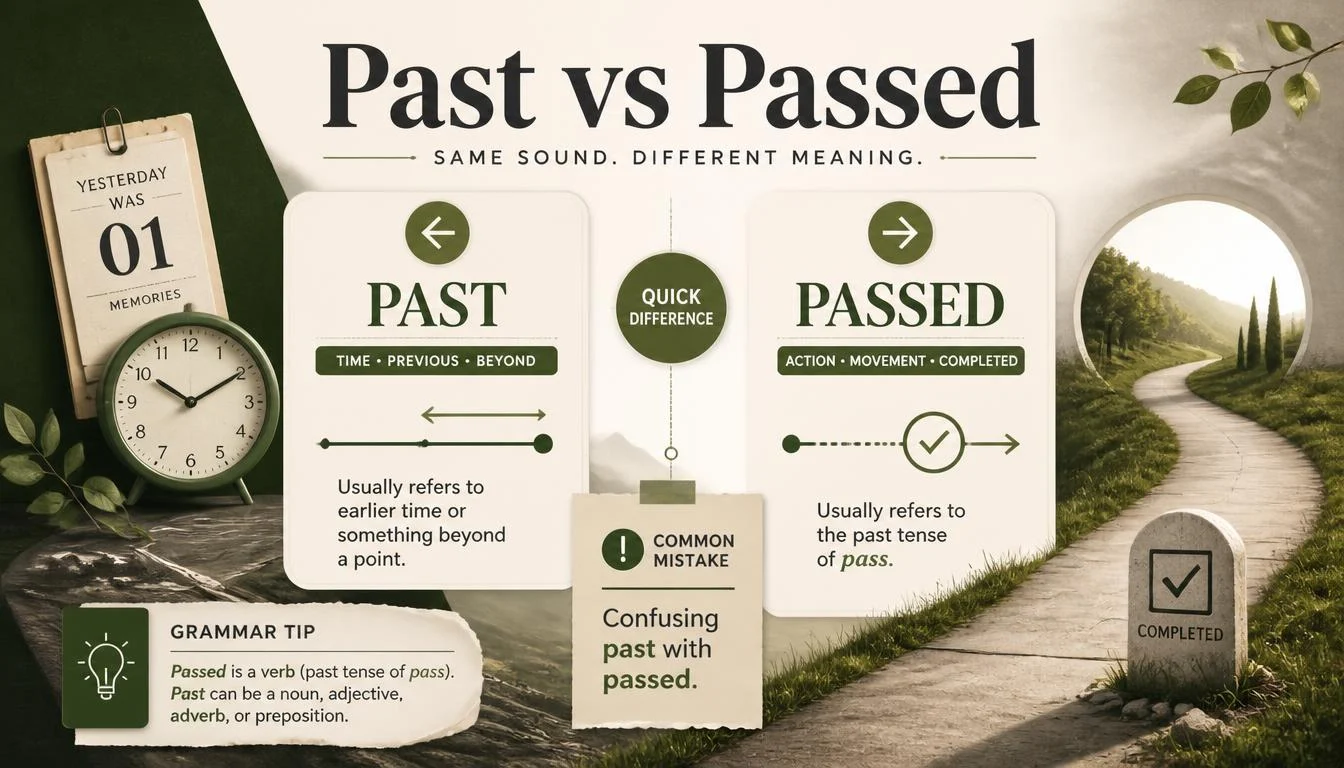
Quick Answer
Past describes something that already happened a time, place, or condition, as in “the past year.” Passed is the verb form of “pass,” showing an action that occurred, like “she passed the exam.” When you’re unsure whether to write past or passed, ask if you need a noun/adjective or an action verb that single question solves nearly every mix-up.
You’re typing an email, and your cursor freezes right before that one word. Did the deadline slip “past” you, or did it “pass” you? This tiny decision trips up native speakers just as often as English learners, and it happens because past and passed sound identical when spoken aloud but do completely different grammatical jobs on the page.
Past works as a noun, an adjective, or a preposition it points to time that has already gone by, like “in the past” or “past experience.” Passed is strictly a verb, the past tense and past participle of “pass,” describing something that moved, succeeded, or elapsed through action. The confusion isn’t really about meaning; it’s about function. People know both words relate to something being “over,” but they don’t pause to check which job the sentence needs.
Getting this wrong doesn’t just look careless in a resume or a business email it can genuinely muddy your meaning. “I drove passed the store” reads as a verb doing a job it can’t do, and sharp-eyed readers, teachers, and hiring managers notice. By the end of this guide, you’ll have a fast mental test for choosing correctly every time, plus real examples from workplace writing, school assignments, and everyday texting.
Past vs Passed: What’s the Difference?
The core difference is simple: past never acts as a verb, while passed always does. Past sits still, describing a time or state. Passed moves it’s the action of one thing going by another.
Past can function as a noun (“she lived in the past”), an adjective (“past performance”), or a preposition (“he walked past the school”). Passed only ever functions as a verb, either simple past tense (“he passed the ball”) or past participle (“the deadline has passed”). This is the one distinction that solves almost every confusion, because once you know which grammatical role your sentence needs, the correct word picks itself.
| Meaning | Part of Speech | Refers To | Typical Usage | Example | Common Confusion |
|---|---|---|---|---|---|
| Past | Noun / Adjective / Preposition | A time period, prior state, or location beyond a point | Describing history, prior experience, or movement beside something | “In the past, we met weekly.” | Used instead of “passed” as if it were a verb |
| Passed | Verb (past tense/participle of “pass”) | An action of moving by, succeeding, or elapsing | Describing an event or action that occurred | “He passed the test yesterday.” | Used instead of “past” as a time reference |
Here’s the recap: if your sentence is naming a time, a memory, or something that exists beyond a certain point, reach for past. If your sentence is describing something in motion a car going by, a student succeeding on an exam, time ticking away passed is doing the work of a verb. Once you separate “describing” from “doing,” the choice stops being a guessing game.
Is Past vs Passed a Grammar, Vocabulary, or Usage Issue?
This is fundamentally a grammar classification issue, not a vocabulary problem. Both words trace back to the same root verb, “pass,” but English split them into two separate grammatical categories over time. Past became frozen as a non-verb form, while passed kept its full verb duties.
That means the two words are never truly interchangeable, even though they’re homophones. In formal English, academic writing, and business communication, this distinction matters even more, because a misused verb form signals a lack of attention to detail in fields where precision is currency legal writing, technical reports, and academic essays especially. In everyday conversation, people forgive the slip because speech doesn’t reveal spelling. But the moment you write it down, the error becomes visible.
The practical takeaway: treat this as a spelling-meets-grammar checkpoint. If your brain says “this word needs an action,” it’s passed. If your brain says “this word needs a description of when or where,” it’s past.
Past: Meaning, Usage, and Real Examples
Past refers to time, states, or positions that already exist beyond a certain point. It’s pronounced with a short “a” sound, like “past” rhyming with “fast,” and it never changes form regardless of tense.
As a part of speech, past is flexible it shows up as a noun (“forget the past”), an adjective (“past mistakes”), and a preposition (“walk past the library”). Common collocations include “in the past,” “past experience,” “past due,” “past tense,” and “half past” (as in telling time). Typical sentence patterns place past directly before a noun when used as an adjective, or after a verb of motion when used as a preposition.
Workplace example: “Our past sales figures show a steady increase every quarter.”
Academic example: “The professor asked us to analyze past civilizations and their trade routes.”
Technology example: “The app stores your past search history for quick access.”
Email example: “Thank you for your patience over the past few weeks while we resolved the issue.”
Daily conversation example: “It’s already half past six we should leave now.”
One common learner mistake is using past where a verb is genuinely required, such as writing “The train past the station” instead of “The train passed the station.” Since past cannot act as a verb, this sentence is grammatically broken.
Mini recap: past describes time, history, or a fixed position never an action someone performs.
Passed: Meaning, Usage, and Real Examples
Passed is the verb form showing that something happened an object moved by, a person succeeded, or time went by through an event rather than existing as a static state. It’s pronounced exactly like “past,” which is precisely why writers mix them up.
Grammatically, passed only functions as a verb. It works as simple past tense (“she passed the note”) and as a past participle paired with helping verbs like “has,” “have,” or “had” (“the storm has passed”). Frequent collocations include “passed away,” “passed the exam,” “passed by,” “passed out,” and “time passed.”
Workplace example: “The proposal passed through three rounds of review before approval.”
Academic example: “Ninety percent of the class passed the final exam this semester.”
Technology example: “The software update passed all security checks without errors.”
Email example: “I wanted to follow up now that the deadline has passed.”
Daily conversation example: “We passed a really cute coffee shop on our walk this morning.”
A frequent learner mistake is reaching for past when describing an action, such as writing “Two hours past before he called” instead of “Two hours passed before he called.” Since the sentence needs an action verb showing time elapsing, only passed fits.
Mini recap: passed always shows an action movement, success, or time genuinely elapsing through an event.
When Not to Use Each Word
Mistake 1: Using “past” after a helping verb. Sentences like “has past” or “have past” are always wrong because helping verbs demand a genuine verb form afterward. Remember: helping verbs need action words, and past never provides one.
Mistake 2: Using “passed” as a preposition of location. Writing “he ran passed the tree” is incorrect because location prepositions need past, not the verb passed. Picture past as a signpost marking a spot it doesn’t move on its own.
Mistake 3: Confusing “past due” with “passed due.” Bills and invoices are always “past due,” never “passed due,” because due describes a state, not an action. Think of “past due” as a status label stuck onto the invoice.
Mistake 4: Writing “in the passed” instead of “in the past.” Since “the past” functions as a noun phrase referring to history, only past belongs here. If you can replace the phrase with “history” and it still makes sense, use past.
Mistake 5: Saying someone “past away.” The correct phrase is always “passed away,” since it describes the action of dying, not a location or time period. This is one of the most common errors in condolence messages.
Mistake 6: Using “past” for physical movement by an object. “The car past me on the highway” should be “The car passed me on the highway,” because movement always requires the verb form.
Mistake 7: Writing “past out” instead of “passed out.” Fainting is an action, so it needs the verb: “she passed out from the heat.”
Mistake 8: Mixing them in time expressions. “It’s half passed nine” is incorrect; time expressions borrow past as a preposition, giving us “half past nine.”
Common Mistakes Table
| Correct Sentence | Incorrect Sentence | Explanation |
|---|---|---|
| The deadline has passed. | The deadline has past. | “Has” needs a verb form, so passed is required. |
| I walked past the bakery. | I walked passed the bakery. | Location beside something needs the preposition past. |
| My grandfather passed away last year. | My grandfather past away last year. | “Passed away” is a fixed verb phrase for dying. |
| The invoice is past due. | The invoice is passed due. | “Due” describes a state, which needs the adjective past. |
| She passed the driving test. | She past the driving test. | Success on a test is an action, requiring the verb passed. |
| It happened in the past. | It happened in the passed. | “The past” is a noun phrase referring to history. |
Decision Box
If you’re describing an action something moving, succeeding, or elapsing use Passed.
If you’re describing a time, memory, or fixed position use Past.
Still unsure? Try replacing the word with “went by.” If the sentence still makes sense, passed is correct. If it sounds odd, past is your answer.
Real World Examples of Past and Passed
Office communication: “In the past, our team met in person, but now most meetings have passed to a virtual format.” Here both words appear naturally in one message past sets the timeframe, passed shows the shift happening.
Business email: “Following up since your invoice is now past due and the payment window has passed.” This line uses past as an adjective and passed as a verb within the same sentence, showing how naturally they coexist.
School or university: “She studied the past decade of climate data and passed her thesis defense with excellent feedback.”
Customer support: “I see your warranty period has passed, but I can check if past customers received any extensions.”
Technology: “The app flagged past login attempts after the security scan passed without issues.”
Artificial Intelligence: “AI models are trained on vast amounts of past data, and once a model has passed its evaluation benchmarks, it’s considered ready for deployment.”
Daily conversation: “We passed by your old street the other day it made me think about the past.”
Past and Passed in Modern Technology
In the world of AI, software, and virtual assistants, both words show up constantly, often within the same sentence. Voice assistants and chatbots are trained on massive datasets of past conversations, meaning historical text and speech patterns that already exist. Meanwhile, developers describe a model as having passed testing benchmarks, which is an action showing successful completion.
Software release notes frequently mix the two: “This build has passed all past regression tests.” Business tools like project trackers also lean on both words a task’s “past due” status (adjective) versus a milestone that has “passed” review (verb). Understanding this distinction becomes especially useful for anyone writing technical documentation, changelogs, or AI training summaries, where precision genuinely affects how instructions are interpreted.
Word Origin
Both words descend from the Old French “passer,” meaning “to go by” or “to cross,” which itself traces back to Latin “passus,” meaning “step.” Over centuries, English speakers split the word into two functions: past froze into a fixed form used for time and description, while passed retained full verb conjugation. This split explains why they sound alike today they share a common ancestor but evolved into separate grammatical roles as English grammar standardized.
Expert Insight
Think of past as a snapshot and passed as a video clip. A snapshot captures a moment a memory, a due date, a fixed point in time without showing any movement. A video clip captures action unfolding, whether that’s a car driving by, a student earning a passing grade, or minutes ticking away on a clock. When you’re stuck between the two, ask yourself whether your sentence needs a still image or a moving scene. That mental shift usually reveals the answer faster than any grammar rule.
Error Prevention Checklist
- Always use past when describing time, history, or a fixed location.
- Always use passed when describing an action, movement, or achievement.
- Never confuse them if you remember: passed always has an action attached to it.
- Quick memory tip: passed has “ass” hidden in “pass,” reminding you it’s still acting like the verb “pass.” Past has no verb energy at all it just sits there marking a moment.
Related Grammar Confusions Worth Learning
- Then vs Than one shows sequence, the other shows comparison, and mixing them changes meaning entirely.
- Affect vs Effect a classic verb-versus-noun mix-up similar to past and passed.
- Its vs It’s a possessive pronoun confused with a contraction, tripping up even experienced writers.
- Lose vs Loose a spelling pair that changes both pronunciation and meaning.
- Your vs You’re another homophone pair that reveals careless proofreading when mixed up.
- Advice vs Advise a noun and verb pair that mirrors the past/passed grammar pattern.
- Complement vs Compliment subtle spelling shift, completely different meanings.
- Farther vs Further distance versus degree, a distinction many writers overlook.
- Who’s vs Whose contraction versus possessive, frequently swapped in casual writing.
- Stationary vs Stationery one describes staying still, the other describes paper products.
FAQs
Is It “Past” or “Passed” Away?
It’s always “passed away.” Since dying is described as an action, the sentence needs the verb passed, not the noun or adjective past.
How Do You Use “Past” and “Passed” in One Sentence?
You can use both words naturally in a sentence such as, “In the past, fewer students passed this exam.” Past sets the timeframe, while passed describes the action that happened within it.
Is “Past Due” or “Passed Due” Correct?
“Past due” is correct because due describes a state or condition. It pairs with the adjective past, not the verb passed.
Why Do “Past” and “Passed” Sound the Same?
They share the same pronunciation because both words developed from the same root verb, pass. Over time, English developed different forms and grammatical roles for them.
Can “Past” Ever Be Used as a Verb?
No. Past does not function as a verb in modern English. When a sentence needs an action word, especially after helping verbs such as has, have, or had, use passed instead.
What Is a Simple Trick to Remember the Difference?
Ask yourself whether the sentence needs an action. If it does, use passed. If you’re referring to time, memory, or position without describing an action, use past.
Conclusion
The difference between past and passed comes down to one clear rule: past never acts, while passed always does. Past marks time, history, and position as a noun, adjective, or preposition, while passed carries out actions as a verb, whether that’s succeeding on a test, moving by something, or letting time elapse.
Next time your cursor hesitates between these two words, ask yourself a simple question: is something happening, or am I just describing when or where? If something is happening, write passed. If you’re simply pointing to a moment in time, write past. That one-second check will keep your writing accurate every single time.
Read More Related Articles:
- Foot or Feet | Simple Rule That Fixes This Mix-Up for Good In 2026
- Yeses or Yesses | One Extra S Can Change Everything In 2026
- Since or Sense | Don’t Confuse These Words Again In 2026

Caleb Dawson is a content writer at synoseek.com, where he works on simple, reader-focused articles across a range of everyday topics. His writing style is practical and grounded, aiming to present information in a clear and relatable way without unnecessary complexity.
2 thoughts on “Past vs Passed | Grammar Guide That Finally Makes It Click In 2026”