Quick Answer
The word “cause” means to make something happen or to be the reason behind an event. The best alternatives include bring about, give rise to, lead to, result in, and trigger. Other strong options are spark, generate, produce, provoke, and contribute to. The right choice depends on tone, whether you’re speaking or writing, and how strong or direct you want to sound.
Looking for 30+ Other Ways to Say Cause? The word is useful in many situations, but repeating it too often can make your writing feel plain or repetitive. Choosing the right alternative can make your sentences clearer and more precise.
Whether you are writing an essay, email, report, or everyday message, there are plenty of words and phrases you can use instead of “cause.” This guide covers 30+ alternatives with examples to help you choose the right expression for your context.
Why People Search for Other Ways to Say Cause
“Cause” is one of the most overused words in English writing and speech. Students use it in essays, professionals use it in reports, and everyday speakers use it in casual conversation. Because it shows up so often, writing can start to feel repetitive, flat, or even a little lazy if it’s the only word used to describe why something happened.
People searching for alternatives to cause are usually trying to solve one of a few problems. Some want to avoid repeating the same word across a paragraph or an entire essay. Others are writing something formal, like a report or academic paper, and want language that sounds more precise and professional. Some are speaking in interviews, meetings, or presentations and want phrases that sound natural rather than robotic. And many are simply trying to build a stronger vocabulary for everyday conversational English.
Spoken English tends to favor shorter, more casual expressions like “lead to” or “bring on,” while written English, especially academic or business writing, leans toward phrases like “give rise to” or “result in.” Knowing the difference between formal English phrases and informal expressions in English is key to sounding natural in any situation, whether you’re writing a report or chatting with a coworker.
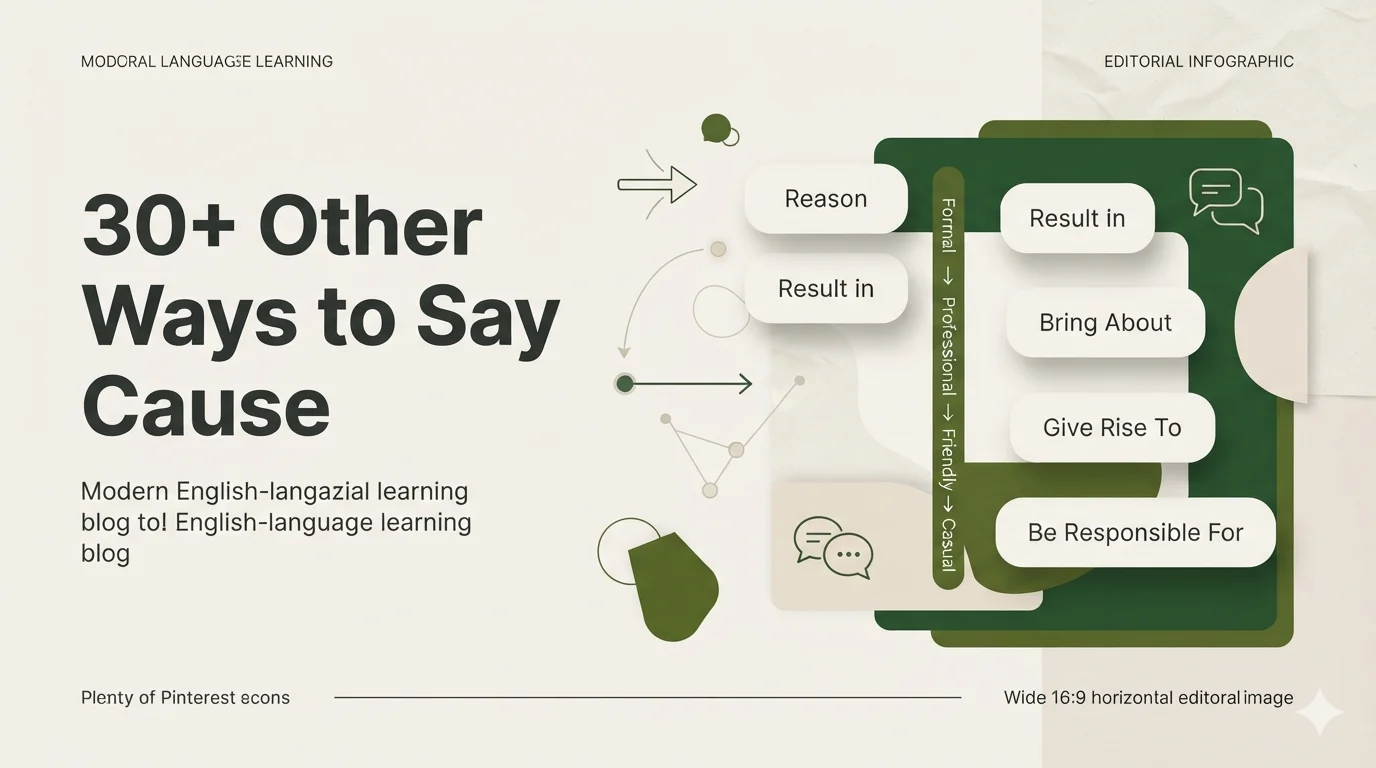
Tone Ladder for Cause
Not every synonym for “cause” carries the same weight. Some sound clinical and academic, others sound casual and conversational. Understanding this tone ladder helps you pick the right word instantly, without guessing.
At the very formal end, you’ll find phrases like “engender” and “precipitate.” These work well in academic writing, legal documents, or highly polished reports, but they can sound stiff or even pretentious in daily conversation. Formal phrases like “give rise to” and “result in” sit a step below that. They’re professional and polished but still readable, making them ideal for business writing, emails, and presentations.
Neutral phrases like “lead to” and “bring about” are the safest choice in almost any setting. They sound natural whether you’re writing an email or speaking during a meeting, and this is usually the sweet spot most people are looking for.
Casual phrases such as “spark” and “set off” bring energy and are great for blog posts, marketing copy, or storytelling. At the most informal end, expressions like “kick off” or “start something” fit best in relaxed conversations among friends or in very casual writing, and they should generally be avoided in professional settings.
Tone Classification Table
| Phrase | Tone Level | Formality | Best Situation |
|---|---|---|---|
| Engender | Very Formal | High | Academic papers, legal writing |
| Precipitate | Very Formal | High | Formal reports, research writing |
| Give rise to | Formal | High | Business reports, essays |
| Result in | Formal | High | Reports, formal emails |
| Bring about | Neutral | Medium | Emails, presentations, essays |
| Lead to | Neutral | Medium | Everyday writing and speech |
| Contribute to | Neutral | Medium | Analysis, discussions, reports |
| Spark | Casual | Medium Low | Blog posts, storytelling |
| Trigger | Casual | Medium Low | Marketing, conversational writing |
| Set off | Casual | Low | Informal writing, spoken English |
| Kick off | Informal | Low | Casual conversation, social media |
Quick Selection Guide
If you’re in a job interview, “contribute to” or “result in” will sound polished and thoughtful without being overly stiff. In a professional email, “give rise to” or “lead to” strike the right balance between formal and readable. At a networking event, “bring about” or “spark” sound confident and natural in spoken conversation. In a casual chat with friends, “start” or “kick off” fit the relaxed tone perfectly.
Real-Life Conversation Transformations
Job Interview Scenario
Before: “My mistake caused a delay in the project.”
After: “My oversight contributed to a delay in the project, which taught me to double-check timelines going forward.”
The upgraded version sounds more accountable and reflective, which interviewers respond well to.
Networking Event Scenario
Before: “This new trend is causing a lot of changes in our industry.”
After: “This new trend is sparking a lot of change across our industry right now.”
Swapping in “sparking” makes the sentence sound more current and engaging in a live conversation.
Email Scenario
Before: “The system update caused several errors.”
After: “The system update gave rise to several errors that our team is currently resolving.”
This version sounds more professional and appropriate for a formal email thread.
Casual Conversation Scenario
Before: “That comment caused an argument.”
After: “That comment kind of set off an argument between them.”
The casual phrasing matches the relaxed tone of an everyday conversation between friends.
30+ Other Ways to Say “Cause”
Below is a detailed breakdown of the strongest alternatives, including their meaning, tone, and how each one is best used.
1. Bring About
Bring about means to make something happen, often through direct action.
Example: “Her leadership brought about real change in the company.”
Tone: Neutral
Best use: Business writing and speeches
Worst use: Very casual texting
2. Give Rise To
Give rise to means to lead to the creation or start of something.
Example: “The new policy gave rise to widespread debate.”
Tone: Formal
Best use: Reports and essays
Worst use: Casual conversation
3. Lead To
Lead to means to result in something happening next.
Example: “Poor sleep can lead to reduced focus.”
Tone: Neutral
Best use: Almost any context
Worst use: None. It is highly versatile.
4. Result In
Result in means to produce a particular outcome.
Example: “The negotiations resulted in a new agreement.”
Tone: Formal
Best use: Business and legal writing
Worst use: Casual speech
5. Trigger
Trigger means to set off a reaction, often suddenly.
Example: “The announcement triggered a wave of questions.”
Tone: Casual to neutral
Best use: Marketing, psychology, and storytelling
Worst use: Overly formal writing
6. Spark
Spark means to ignite interest or a reaction.
Example: “The idea sparked a lively discussion.”
Tone: Casual
Best use: Blog posts and conversations
Worst use: Legal documents
7. Provoke
Provoke means to cause a strong or emotional reaction.
Example: “The decision provoked criticism from employees.”
Tone: Neutral to formal
Best use: News writing and analysis
Worst use: Light conversation
8. Generate
Generate means to produce or create something.
Example: “The campaign generated significant attention online.”
Tone: Neutral
Best use: Marketing and business contexts
Worst use: Emotional or personal topics
9. Produce
Produce means to bring something into existence.
Example: “The experiment produced unexpected results.”
Tone: Neutral
Best use: Science and research writing
Worst use: Casual chat
10. Contribute To
Contribute to means to play a part in causing something, often along with other factors.
Example: “Stress can contribute to health problems.”
Tone: Neutral
Best use: Analysis and interviews
Worst use: When a single clear cause is being described
11. Instigate
Instigate means to start or provoke something, often something negative.
Example: “He was accused of instigating the conflict.”
Tone: Formal
Best use: News and legal writing
Worst use: Positive or neutral contexts
12. Precipitate
Precipitate means to cause something to happen suddenly.
Example: “The scandal precipitated his resignation.”
Tone: Very formal
Best use: Journalism and academic writing
Worst use: Everyday speech
13. Engender
Engender means to give rise to a feeling or situation.
Example: “The policy engendered trust among employees.”
Tone: Very formal
Best use: Academic and formal writing
Worst use: Casual settings
14. Induce
Induce means to bring about a state or condition.
Example: “The medication can induce drowsiness.”
Tone: Formal
Best use: Medical and scientific writing
Worst use: Casual conversation
15. Prompt
Prompt means to cause someone to act or something to happen.
Example: “The feedback prompted a redesign of the product.”
Tone: Neutral
Best use: Business writing
Worst use: Very technical reports
16. Set Off
Set off means to trigger a chain reaction.
Example: “The remark set off a heated debate.”
Tone: Casual
Best use: Storytelling and conversation
Worst use: Formal reports
17. Kick Off
Kick off means to start something, often an event or process.
Example: “The announcement kicked off a wave of applications.”
Tone: Informal
Best use: Casual writing and social media
Worst use: Academic writing
18. Foster
Foster means to encourage the development of something.
Example: “The program fosters collaboration among teams.”
Tone: Formal
Best use: Business and educational writing
Worst use: Describing negative outcomes
19. Create
Create means to make something exist.
Example: “The delay created frustration among customers.”
Tone: Neutral
Best use: General writing
Worst use: Highly technical contexts
20. Effect
Effect, when used as a verb, means to bring about a result.
Example: “The new manager effected several changes.”
Tone: Formal
Best use: Business and leadership writing
Worst use: Casual speech
21. Incite
Incite means to encourage or stir up strong action.
Example: “The speech incited protests across the city.”
Tone: Formal
Best use: News reporting
Worst use: Mild or neutral situations
22. Foment
Foment means to stir up or instigate trouble.
Example: “Rumors fomented distrust within the team.”
Tone: Formal
Best use: Political and analytical writing
Worst use: Everyday conversation
23. Breed
Breed means to create or lead to a condition, often a negative one.
Example: “Uncertainty breeds anxiety in the workplace.”
Tone: Neutral to formal
Best use: Analytical writing
Worst use: Casual chat
24. Yield
Yield means to produce a result.
Example: “The strategy yielded strong results.”
Tone: Formal
Best use: Business and research writing
Worst use: Casual speech
25. Spawn
Spawn means to give rise to something, often multiple things.
Example: “The viral post spawned countless memes.”
Tone: Casual
Best use: Pop culture and marketing writing
Worst use: Formal reports
26. Stir Up
Stir up means to provoke a reaction or emotion.
Example: “The comment stirred up controversy online.”
Tone: Casual
Best use: Storytelling and social commentary
Worst use: Legal writing
27. Occasion
Occasion, when used as a verb, means to cause something to happen.
Example: “The visit occasioned a change in plans.”
Tone: Very formal
Best use: Older or highly formal writing
Worst use: Modern casual writing
28. Bring On
Bring on means to cause something to happen, often quickly.
Example: “The stress brought on a headache.”
Tone: Casual
Best use: Health and everyday topics
Worst use: Formal reports
29. Drive
Drive means to be a major force behind something.
Example: “Customer demand drives our product decisions.”
Tone: Neutral
Best use: Business and strategy writing
Worst use: Personal emotional topics
30. Fuel
Fuel means to intensify or encourage something.
Example: “Social media fueled the spread of the story.”
Tone: Neutral to casual
Best use: News and marketing
Worst use: Legal writing
Usage Comparison Table
| Phrase | Spoken Use | Written Use | Context |
|---|---|---|---|
| Lead to | High | High | General, everyday |
| Bring about | Medium | High | Business, speeches |
| Give rise to | Low | High | Reports, essays |
| Trigger | High | High | Casual and marketing |
| Spark | High | Medium | Blogs, conversation |
| Result in | Medium | High | Formal writing |
| Contribute to | Medium | High | Analysis, interviews |
| Set off | High | Low | Spoken storytelling |
| Kick off | High | Medium | Informal writing |
| Engender | Low | High | Academic writing only |
Email and LinkedIn Ready Expressions
For professional greetings, try opening with “I wanted to reach out regarding an issue that has led to…” For introductions, “I’m reaching out because a recent change has contributed to…” works well. LinkedIn connection messages often benefit from phrases like “I noticed your work has sparked some great discussion around…” For follow-up emails, “Following up on what gave rise to our last conversation” sounds polished without being stiff.
Native Speaker Insight
Native English speakers rarely repeat “cause” more than once in a paragraph. In spoken English, shortened and casual versions like “led to” or “set off” are far more common than formal alternatives like “engendered” or “precipitated,” which can sound unnatural or overly academic in daily conversation. Professionals in business settings tend to favor “resulted in,” “contributed to,” and “led to” because they sound confident without being showy. A phrase like “occasioned” or “effected,” while grammatically correct, often sounds outdated or overly formal to native ears in casual or even semi-formal conversation.
Common Mistakes and What Not to Say
One common mistake is using very formal words like “engender” or “precipitate” in casual conversation, which can sound awkward or overly stiff. Another mistake is overusing intense words like “incite” or “instigate” for neutral situations, since these words carry strong negative connotations. Grammar mistakes also show up frequently, such as saying “caused by due to” instead of choosing one phrase. Finally, using “occasion” as a verb in modern writing can sound old-fashioned unless the context calls for a formal or literary tone.
Expansion Phrases
Related expressions worth knowing include “as a result of,” “on account of,” “owing to,” and “due to,” all of which help explain cause and effect relationships in different tones. Polite communication alternatives like “this may have contributed to” soften direct statements, while conversational upgrades such as “that’s what got the ball rolling” add personality to everyday speech.
Decision Making Table
| Situation | Best Phrase | Why It Works |
|---|---|---|
| Formal report | Give rise to | Sounds professional and precise |
| Business email | Lead to | Clear and appropriately formal |
| Job interview | Contributed to | Shows accountability and reflection |
| Casual conversation | Set off or kick off | Sounds natural and relaxed |
| Academic essay | Precipitate or engender | Matches scholarly tone |
| Marketing copy | Spark or trigger | Adds energy and engagement |
Quick Fast List
The fastest and most versatile alternatives to “cause” are lead to, bring about, result in, trigger, spark, contribute to, give rise to, prompt, generate, and set off.
Mini Quiz
1. Which phrase is best for a formal business report?
A) Kick off
B) Give rise to
C) Set off
Answer: B – “Give rise to” works well in formal and professional writing.
2. Which word fits a casual conversation about an argument?
A) Precipitated
B) Set off
C) Engendered
Answer: B – “Set off” sounds natural in casual conversation.
3. Which phrase works best in a job interview when describing a mistake?
A) Instigated
B) Contributed to
C) Spawned
Answer: B – “Contributed to” is professional and measured when discussing a mistake.
4. Which word is most natural in spoken English?
A) Occasioned
B) Led to
C) Precipitated
Answer: B – “Led to” is common and natural in everyday spoken English.
5. Which phrase suits an academic paper?
A) Kicked off
B) Engendered
C) Sparked
Answer: B – “Engendered” is appropriate for formal and academic writing.
FAQs
Is it polite to say something “caused” a problem?
Yes, but softer alternatives such as “contributed to” or “led to” can sound less direct when discussing sensitive issues.
What is more professional than “cause”?
Phrases such as “give rise to,” “result in,” and “contribute to” sound professional and work well in business or academic contexts.
Can I use “trigger” in a formal email?
Yes, “trigger” can be used in a neutral tone. However, “result in” or “lead to” may be safer choices for very formal communication.
What do native speakers say instead of “cause” in conversation?
Native speakers often use “led to,” “brought on,” or “set off” because these expressions sound natural and unforced in everyday speech.
What is the best alternative for academic writing?
“Give rise to,” “engender,” and “precipitate” are strong alternatives for scholarly and research based writing.
Conclusion
Learning different ways to say “cause” makes your writing and speech sound more natural, more precise, and less repetitive. Whether you’re writing a formal report, sending a professional email, or chatting casually with a friend, choosing the right word for the right tone makes a real difference in how your message lands.
The key is to match the formality of the phrase to the situation you’re in. With the tone ladder, comparison tables, and real-life examples above, you now have a full toolkit of alternatives to reach for anytime “cause” starts to feel overused. Practice using a few of these in your next conversation or piece of writing, and it will quickly become second nature.
12 thoughts on “30+ Other Ways to Say Cause | Stronger Words to Improve Your Writing In 2026”