Quick Answer
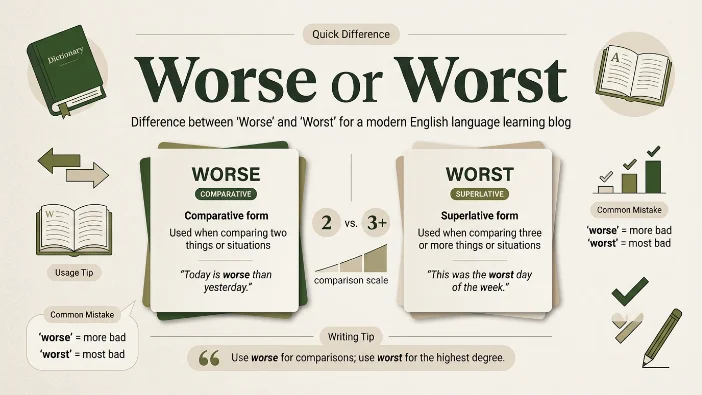
The difference between “worse” and “worst” comes down to comparison level. Worse compares two things (the lesser of two evils), while worst compares three or more things (the absolute lowest). If you’re comparing exactly two items, use worse. If you’re identifying the bottom of a larger group, use worst.
Ever paused mid-sentence, unsure whether to say “worse” or “worst”? You’re not alone. These two words trip up native English speakers and learners alike, partly because they sound similar and both deal with negative comparisons. Yet using them incorrectly can change your meaning entirely and sometimes make you sound less credible in professional writing.
Here’s the good news: the distinction is straightforward once you understand the logic behind it. In this guide, we’ll break down exactly when to use worse versus worst, provide plenty of real-world examples, and give you memory tricks that actually work. By the end, you’ll choose the right word without hesitation.
What’s the Difference Between Worse and Worst?
At its simplest, the difference is about the number of items you’re comparing. Worse compares two things, while worst compares three or more.
Both words are forms of the adjective “bad,” but they occupy different positions on the comparison scale. Think of it this way: bad → worse → worst. This pattern mirrors other irregular adjectives like good → better → best.
Quick Comparison Table
| Aspect | Worse | Worst |
|---|---|---|
| Meaning | More bad than something else | The most bad of all |
| Part of Speech | Adjective (comparative) | Adjective (superlative) |
| Refers To | Two items | Three or more items |
| Typical Usage | Comparing two things | Identifying the extreme |
| Example | “This coffee is worse than tea.” | “This is the worst coffee I’ve ever had.” |
| Common Confusion | Using it for three or more items | Using it when only two items exist |
The critical takeaway: if you’re standing between two options and one is more unpleasant, it’s worse. If you’re looking at a whole group and picking the absolute bottom, that’s worst.
Is This a Grammar, Vocabulary, or Usage Issue?
The worse/worst distinction falls primarily into grammar and usage territory, with a dash of vocabulary education.
Grammar classification: Both words are irregular comparative and superlative adjectives. They follow the same grammatical pattern as good/better/best, which means they don’t take the standard -er/-est endings.
Vocabulary difference: While both derive from “bad,” they occupy different degrees of comparison. Understanding them requires knowing how English builds comparative and superlative forms.
Usage difference: The choice depends entirely on your context specifically, how many things you’re comparing. This makes it a practical usage issue more than a complex grammatical rule.
In formal English, misuse of worse/worst stands out immediately. Business writing, academic papers, and professional correspondence demand correct usage. In everyday conversation, people might let it slide, but careful speakers still make the distinction.
Interchangeable? Absolutely not. You cannot swap these words without changing meaning. Saying “This is the worse option” when you mean “the worst option” among a dozen choices makes no logical sense.
Practical takeaway: This is a usage rule you’ll apply constantly. Master it, and your writing becomes instantly more precise.
Understanding “Worse” (Comparative Form)
Meaning and Function
Worse is the comparative form of bad. It describes something that is more unpleasant, less good, or lower in quality than something else. Importantly, it always involves exactly two things even if one of them is implied rather than stated.
Pronunciation
Pronounced /wɜrs/ (rhymes with “purse”).
Part of Speech
Adjective (comparative degree). It can also function as a noun in phrases like “things could get worse.”
Common Collocations
- Get worse
- Make worse
- Worse than
- Even worse
- Worse yet
- Worse off
Natural Workplace Example
“Our sales numbers for Q3 are worse than Q2, but we’re still ahead of last year.”
Academic Example
“The experimental group performed worse than the control group on all cognitive measures.”
Technology Example
“Battery life on this model is significantly worse than the previous version.”
Email Example
“I need to share some news the server issues are worse than we initially thought.”
Daily Conversation Example
“This restaurant has gotten worse since they changed the menu.”
One Learner Mistake
❌ “This is the worse day of my life.” (when comparing to many days)
✅ “This is the worst day of my life.”
Mini Recap
Remember: worse = two things. One is bad, the other is worse. That’s it.
Understanding “Worst” (Superlative Form)
Meaning and Function
Worst is the superlative form of bad. It describes the most unpleasant, least good, or lowest quality item within a group of three or more. It represents the absolute bottom nothing else can be more bad.
Pronunciation
Pronounced /wɜrst/ (rhymes with “thirst”).
Part of Speech
Adjective (superlative degree). It also functions as a noun in phrases like “the worst is yet to come.”
Common Collocations
- The worst
- Worst case scenario
- At worst
- Worst ever
- Worst possible
- The worst of
Natural Workplace Example
“That client complaint was the worst we’ve handled this quarter.”
Academic Example
“Among all the treatment options, chemotherapy had the worst side effect profile.”
Technology Example
“Security vulnerabilities are among the worst issues we face in software development.”
Email Example
“I’m afraid we received the worst possible news from the legal team this morning.”
Daily Conversation Example
“That storm was the worst we’ve seen in decades.”
One Learner Mistake
❌ “Between these two restaurants, this one is worst.”
✅ “Between these two restaurants, this one is worse.”
Mini Recap
Worst = three or more things. It picks the absolute bottom of the bunch.
When Not to Use Each Word
Situations Where Writers Choose “Worse” Incorrectly
1. Comparing more than two items
- Why it happens: Writers know worst exists but forget the three-or-more rule.
- Correct choice: Use worst when ranking three or more.
- Memory tip: Count your items. If you’re picking the bottom of a group of three or more, it’s worst.
2. Talking about an absolute extreme
- Why it happens: Worse feels less dramatic than worst, so writers sometimes default to it.
- Correct choice: If something is the absolute lowest, use worst.
- Memory tip: If you could add “the” in front, you probably need worst.
Situations Where Writers Choose “Worst” Incorrectly
1. Comparing exactly two things
- Why it happens: Worst feels stronger, so writers use it for emphasis.
- Correct choice: Two items always take worse.
- Memory tip: “Two for worse, three for worst.”
2. Using it before “than”
- Why it happens: Writers think worst is just a stronger version of worse.
- Correct choice: The structure “X than Y” always takes the comparative form (worse).
- Memory tip: “Than” signals comparison between two things.
3. Describing a situation that could still decline
- Why it happens: Writers overstate problems.
- Correct choice: If things can still get more bad, use worse.
- Memory tip: Worst is final nothing else can follow.
4. In comparative idioms
- Why it happens: Writers memorize phrases incorrectly.
- Correct choice: “Worse comes to worst” (not “worst comes to worse”).
- Memory tip: Things get worse before they reach the worst.
Common Mistakes Table
| Correct Sentence | Incorrect Sentence | Explanation |
|---|---|---|
| Between tea and coffee, I think tea tastes worse. | Between tea and coffee, I think tea tastes worst. | Comparing two items requires worse. |
| This is the worst movie I’ve ever seen. | This is the worse movie I’ve ever seen. | Comparing one movie against all others requires worst. |
| Her condition is worse today than yesterday. | Her condition is worst today than yesterday. | Comparing two days requires worse. |
| Of all the candidates, he performed worst. | Of all the candidates, he performed worse. | Ranking a group of three or more requires worst. |
| The worse thing about this job is the commute. | The worst thing about this job is the commute. | When “the” precedes the adjective and no direct comparison exists, you need worst. |
| If worse comes to worst, we’ll cancel. | If worst comes to worse, we’ll cancel. | Idiom requires “worse comes to worst.” |
Quick Decision Guide
If you mean the less good of two options → Use WORSE
If you mean the least good among three or more → Use WORST
Real-World Examples
Office Communication
“Our team’s productivity this month is worse than last month, but we’re still performing well compared to the other departments.”
Business Email
“Dear Team, I need to address the budget situation. The new cuts are worse than we anticipated. However, we’re not in the worst position among our regional offices.”
School or University
“Your essay has improved since the first draft. The second version was worse than the third, but the worst submission I received came from a student who didn’t follow the instructions at all.”
Customer Support
“Between these two solutions, the first option is worse because it creates more problems than it solves. The worst approach would be ignoring the issue entirely.”
Technology
“Our initial prototype performed worse than the competitor’s model in every test. The worst performance came during the stress testing phase, which we’ve since addressed.”
Artificial Intelligence
“ChatGPT’s responses in 2022 were worse than its 2025 outputs. The worst hallucinations I’ve seen came from early versions of the technology.”
Daily Conversation
“I thought yesterday was bad, but today is even worse. This week is turning out to be the worst one this year.”
Worse and Worst in Modern Technology
The rise of artificial intelligence and digital communication has created new contexts for these words:
Artificial Intelligence: AI systems sometimes produce outputs that are worse than human-created content. The worst examples appear when models generate text on topics with limited training data.
Virtual Assistants: Voice recognition often performs worse in noisy environments. The worst performance typically occurs with non-native accents or technical vocabulary.
Software Testing: Engineers compare bug severity using comparative and superlative language. One issue might be worse than another, while a critical vulnerability represents the worst-case scenario.
User Experience: UX designers frequently discuss which interfaces perform worse in usability tests, and which design decisions produce the worst outcomes for specific user groups.
Data Analytics: Performance metrics reveal which quarters are worse than others and which year showed the worst overall results.
Word Origins
Both worse and worst trace their roots to Old English. Worse comes from the Old English “wyrsa” or “wiersa,” meaning “more evil” or “more bad.” Worst evolved from “wierrest” or “wyrsest,” the superlative form.
These words share ancestry with the Old High German “wirs” and “wirst,” showing that the comparative/superlative distinction in Germanic languages has remained consistent for over a thousand years. Understanding this history helps explain why the forms are irregular they’ve been part of English since before standardization.
Expert Insight
Think of worse and worst like positions on a scale. You’re standing at the bottom of a staircase. Worse is one step below where you are. Worst is the basement floor where there are no more steps down. If you’re talking about moving one level lower, that’s worse. If you’re identifying the absolute bottom you can possibly go, that’s worst. The key is that you can’t be in the basement when only two options exist you’re simply on the lower of two floors. This spatial way of thinking helps learners visualize the distinction instantly.
Error Prevention Checklist
☑️ Always use worse when:
- Comparing exactly two things
- Using “than” to show comparison
- Describing a decline from a previous state
- Using idioms like “worse comes to worst”
☑️ Always use worst when:
- Comparing three or more things
- Identifying an absolute bottom or extreme
- Using “the” before the adjective
- Describing a final, unchangeable state
☑️ Never confuse them if:
- You count your items first
- You remember “two for worse, three for worst”
☑️ Quick memory tip:
“Worse is two; worst is through” (as in “through” the whole group to the bottom).
Related Grammar Confusions Worth Exploring
- Better vs. Best – The same logic applies to comparative/superlative pairs.
- More vs. Most – Regular comparatives and superlatives follow a similar distinction.
- Less vs. Least – The comparative/superlative for “little” follows the same pattern.
- Farther vs. Furthest – Physical distance comparatives and superlatives.
- Latter vs. Last – Positional comparisons with similar logic.
- Older vs. Oldest – Age comparisons follow the same rule.
- Later vs. Latest – Time-based comparisons.
- Lower vs. Lowest – Spatial or hierarchical comparisons.
- Greater vs. Greatest – Positive comparisons mirror the negative pattern.
- Fewer vs. Fewest – Countable items follow the same comparative/superlative logic.
FAQs
What is the difference between “worse” and “worst”?
Worse is the comparative form of bad and is generally used when comparing two things. Worst is the superlative form and identifies the lowest or most negative option in a group of three or more. For example, “Today is worse than yesterday” compares two days, while “Today is the worst day of the week” identifies one day as the lowest point.
Can “worse” and “worst” be used interchangeably?
No. Worse and worst have different grammatical roles and meanings. Use worse when making a comparison and worst when describing something as the most negative or least desirable in a group.
Is it “worse comes to worst” or “worst comes to worse”?
The standard idiom is “if worse comes to worst.” It means that a difficult situation develops into the most unfavorable possible outcome. The expression moves from the comparative worse to the superlative worst.
When should I use “the worst” instead of “worst”?
Use the worst when identifying a particular person, thing, or situation as the most negative in a group. For example, “That was the worst part of the trip.” Without the, worst can appear in expressions such as “worst of all” or “worst-case scenario.”
What is the opposite of “worse”?
The opposite of worse is better. Both are comparative forms used to compare things or situations. For example, “This option is better than the previous one,” while “The previous option is worse.”
What is the opposite of “worst”?
The opposite of worst is best. Both are superlative forms used to identify the highest or lowest level within a group. For example, “She chose the best option” and “She rejected the worst option.”
Conclusion
The distinction between worse and worst boils down to one simple concept: how many things you’re comparing. Two things? Use worse. Three or more? Use worst. This rule applies across all contexts business writing, academic papers, emails, and everyday conversation.
Remember that worse is always a comparative adjective showing that one thing is more bad than another. Worst is always a superlative adjective showing that something is the most bad among a larger group.
Keep this memory rule handy: “Two’s worse, three’s worst.” With that simple phrase, you’ll never hesitate again.