Quick Answer
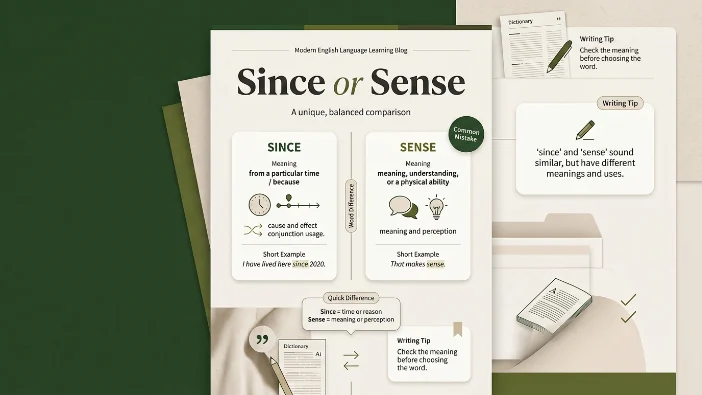
The primary difference between since and sense is that since refers to time or causation, while sense relates to perception, meaning, or feeling. Since functions as a conjunction, preposition, or adverb indicating time or reason. Sense is primarily a noun or verb connected to understanding, perception, or awareness. These words sound similar but serve entirely different grammatical purposes and should never be used interchangeably.
If you’ve ever paused mid-sentence wondering whether to write “since” or “sense,” you’re not alone. These two common English words sound similar, which creates confusion for many writers, especially non-native speakers. But they couldn’t be more different in meaning and usage. Using the wrong one can completely change what you’re trying to say or worse, make your writing confusing or unprofessional.
In this guide, we’ll break down exactly when to use since and when to use sense, with clear explanations, real-world examples, and practical tips that will help you remember the difference forever. By the end, you’ll feel confident choosing the right word every time.
What’s the Difference Between Since and Sense?
The core difference is straightforward: since deals with time or reason, while sense deals with perception, feeling, or meaning. They belong to different grammatical categories and serve entirely different functions in sentences.
Detailed Comparison
| Category | Since | Sense |
|---|---|---|
| Meaning | From a point in time; because; as | A feeling, perception, or understanding; to perceive |
| Part of Speech | Conjunction, Preposition, Adverb | Noun, Verb |
| Refers To | Time, duration, cause, reason | Senses, perception, meaning, feeling |
| Typical Usage | Since 2019; Since you asked | Common sense; Make sense; Sense of humor |
| Example | She has worked here since 2018. | I sense something wrong. |
| Common Confusion | Confused with “because” or “from” | Confused with “since” due to similar sound |
Understanding the Core Distinction
Think of since as your timekeeper or explainer. It either tells you when something started (“I’ve known her since college”) or gives a reason for something (“Since you’re here, let’s talk”). It’s about chronology or causation.
Sense, on the other hand, is your perception tool. It’s about what you feel, understand, or perceive. When you “make sense” of something, you understand it. When you “sense” danger, you feel it. When something “makes sense,” it’s logical or understandable.
Is This a Grammar, Vocabulary, or Usage Issue?
The since vs. sense confusion falls primarily into the usage and vocabulary categories, though there are grammatical elements involved.
Grammar Classification
- Since requires understanding of time expressions and subordinating conjunctions.
- Sense requires knowing its use as both a noun and verb.
Vocabulary Difference
These are entirely different words with distinct meanings. Confusing them is a vocabulary error, not a structural grammar error. You won’t make incorrect verb forms you’ll simply choose the wrong word.
Usage Distinction
This is a classic common usage error where words sound similar (homophones in some contexts) but have completely different meanings. Many English learners struggle because both words are common and appear in everyday conversation.
Are They Interchangeable?
Absolutely not. These words are never interchangeable. Using one in place of the other always results in an error that can confuse readers.
Formality and Context
Since is appropriate across all contexts:
- Formal English: “Since the board approved the proposal…”
- Business English: “Since our last meeting…”
- Academic English: “Since the data supports this hypothesis…”
- Everyday English: “Since you mentioned it…”
Sense is equally universal:
- Formal English: “It makes economic sense…”
- Business English: “We need someone with business sense…”
- Academic English: “The argument lacks logical sense…”
- Everyday English: “That makes no sense!”
Practical Takeaway
When you’re writing, ask yourself: “Am I talking about time/reason or perception/meaning?” The answer tells you which word to choose.
The Complete Guide to “Since”
Meaning and Definition
Since indicates:
- Time: From a past point in time until now
- Reason: Because; considering that
- Duration: Throughout the period between then and now
Pronunciation
/sɪns/ (rhymes with “fins”)
Part of Speech
- Conjunction (most common)
- Preposition
- Adverb
Common Collocations
- Since then
- Ever since
- Since when
- Since the beginning
- Since childhood
- Since yesterday
- Long since
- Since time immemorial
Typical Sentence Patterns
As a conjunction (time):
[Action] + since + [past event]
Example: I’ve felt better since I started exercising.
As a conjunction (reason):
Since + [reason] + comma + [result]
Example: Since you asked, I’ll explain.
As a preposition:
[Action] + since + [specific time/date]
Example: She’s been waiting since morning.
As an adverb:
[Action] + since
Example: We met in 2010 and haven’t seen each other since.
Natural Workplace Example
“I’ve managed this department since 2019, and since we implemented the new software, productivity has increased by 30 percent.”
Academic Example
“Since the study began in 2012, researchers have documented significant changes in the patient’s cognitive abilities.”
Technology Example
“Since the latest update, the application loads twice as fast and since users reported fewer bugs, we’re planning a wider rollout.”
Email Example
“Since our last conversation, I’ve been reviewing the budget proposals. Since we’re approaching the deadline, I’d appreciate your feedback by Friday.”
Daily Conversation Example
“I haven’t seen my college roommate since graduation, but since we’re both in town this week, we should get coffee.”
One Learner Mistake
Incorrect: “I’ve been waiting here sense 9 o’clock.”
Correct: “I’ve been waiting here since 9 o’clock.”
This error happens because “since” and “sense” sound similar in rapid speech. Remember: time = since.
Mini Recap
Use since when you’re talking about time passing (“since yesterday”) or giving a reason (“since you’re here”). It connects events to earlier moments or provides explanations.
The Complete Guide to “Sense”
Meaning and Definition
Sense has multiple meanings:
- Perception: Any of the five senses (sight, hearing, smell, taste, touch)
- Feeling: A vague awareness or impression
- Understanding: Practical intelligence or good judgment
- Meaning: Significance or value (as in “making sense”)
Pronunciation
/sɛns/ (rhymes with “fence”)
Part of Speech
- Noun (most common)
- Verb
Common Collocations
- Make sense
- Common sense
- Sense of humor
- Sense of direction
- Sense of accomplishment
- Good sense
- Sixth sense
- Business sense
- Sense of purpose
- Sense of belonging
Typical Sentence Patterns
As a noun (perception):
[Subject] + has/possesses + sense of + [thing perceived]
Example: She has a great sense of humor.
As a noun (understanding):
It + makes + sense + (to + person) + that + [clause]
Example: It makes sense to save money.
As a verb (perceive):
[Subject] + sense + [object/perception]
Example: I sense something wrong.
As a noun (feeling/awareness):
[Subject] + feels/has + sense + that + [clause]
Example: He has a sense that something will happen.
Natural Workplace Example
“After reviewing the reports, I sense we’re about to see a major shift in customer preferences. It makes business sense to adjust our strategy now.”
Academic Example
“Researchers are examining whether animals possess a sense of time that influences their decision-making patterns.”
Technology Example
“The new AI system can sense user frustration based on typing patterns and adjust its responses accordingly making the interaction feel more human.”
Email Example
“I have a sense that we’re overcomplicating this project. Let’s simplify and make sure every action makes strategic sense.”
Daily Conversation Example
“I have a terrible sense of direction, but my phone’s GPS makes getting around so much easier.”
One Learner Mistake
Incorrect: “Your explanation doesn’t since any meaning to me.
Correct: “Your explanation doesn’t make sense to me.”
This error occurs when learners confuse “sense” with “since.” Remember: understanding = sense.
Mini Recap
Use sense when you’re talking about feeling, perceiving, understanding, or meaning. If something is logical, it “makes sense.” If you detect something, you “sense” it.
When NOT to Use Each Word
When NOT to Use “Since”
- When you mean perception or feeling: Don’t say “I since something wrong.” Use “sense” instead.
- When talking about logical meaning: Don’t say “It doesn’t since.” Use “make sense.
- When referring to common sense or understanding: Don’t say “Use your since.” Use “sense.”
- When describing physical senses: Don’t say “My since of smell.” Use “sense.”
- When meaning “to perceive”: Don’t say “She since his hesitation.” Use “sensed.
- When you mean “meaningful” or “logical”: Don’t say “His argument since to me.” Use “makes sense to me.
Remember: If you’re not talking about time, reason, or duration, reconsider using “since.”
When NOT to Use “Sense”
- When indicating time: Don’t say “I’ve worked here sense 2018.” Use “since.
- When giving a reason: Don’t say “Sense you’re here, let’s talk.” Use “since.
- When referring to duration: Don’t say “I’ve known her sense college.” Use “since.”
- When meaning “because”: Don’t say “Sense you asked, I’ll explain.” Use “since.
- When talking about “from then until now”: Don’t say “We’ve been friends ever sense.” Use “since.”
- When referring to a point in time: Don’t say “Sense last Tuesday.” Use “since.”
Remember: If you’re talking about time or causation, “sense” is always wrong.
Common Mistakes Table
| Correct Sentence | Incorrect Sentence | Explanation |
|---|---|---|
| I’ve worked here since 2019. | I’ve worked here sense 2019. | Use since for time references. |
| Your explanation makes sense. | Your explanation makes since. | Use sense for logic and understanding. |
| Since you asked, I’ll tell you. | Sense you asked, I’ll tell you. | Use since as a conjunction meaning “because.” |
| She has a great sense of humor. | She has a great since of humor. | Use sense for perception and feeling. |
| He sensed something unusual. | He since something unusual. | Use sense as a verb meaning “perceive.” |
| We haven’t spoken since then. | We haven’t spoken sense then. | Use since for time expressions. |
| It makes business sense. | It makes business since. | Use sense for practical value. |
| Since I arrived, I’ve felt welcome. | Sense I arrived, I’ve felt welcome. | Use since when referring to arrival time. |
Decision Box
Use SINCE when:
- Referring to time (since Monday)
- Giving reasons (since you’re here)
- Expressing duration (ever since)
Use SENSE when:
- Talking about perception or feeling
- Referring to logic (makes sense)
- Describing understanding or meaning
Quick Memory Tip: “Since” = Time/cause (both start with “s” and have “ince”). “Sense” = Senses/smart (both start with “s” and have “ense”).
Real-World Examples
Office Communication
Since: “Since we implemented the new software, our team has saved approximately 10 hours per week on administrative tasks.”
Sense: “The new workflow makes better sense than our previous system, and I sense the team appreciates the improvement.”
Business Email
Since: “Since our quarterly review is scheduled for next week, please prepare your department’s performance metrics.”
Sense: “I have a sense that these numbers aren’t telling the full story let’s dig deeper to make sense of the data.”
School or University
Since: “Since the semester began in August, attendance has consistently improved in all sections.”
Sense: “The research findings make little sense without proper context, so we need to help students develop a better sense of historical perspective.”
Customer Support
Since: “Since you contacted us about this issue last Tuesday, we’ve escalated your case to our senior team.”
Sense: “It makes sense that you’re frustrated, and I sense you’d prefer to speak with a supervisor directly.”
Technology
Since: “Since we released version 2.0, user engagement has increased 45 percent and bug reports have decreased significantly.”
Sense: “The algorithm can sense patterns in user behavior and make real-time adjustments that create a more personalized experience.”
Artificial Intelligence
Since: “Since ChatGPT was introduced in 2022, AI language models have evolved at an unprecedented pace.”
Sense: “Modern AI systems can sense when users are confused and adapt their responses accordingly making the interaction feel more natural.”
Daily Conversation
Since: “Since I started taking Spanish classes, I’ve been able to understand more of what my neighbors are saying.”
Sense: “I have a sense that my Spanish is improving, even though I sometimes struggle to make sense of faster conversations.”
Since and Sense in Modern Technology
The distinction between since and sense appears frequently in technology discussions. Since is commonly used to describe product updates, implementation timelines, and user behavior changes. For example, “User engagement has increased since the redesign.”
Sense is particularly relevant in AI and user experience discussions. We talk about AI systems that “sense” user intent, “sensors” that detect environmental changes, and user interfaces that “make sense” intuitively. When we say something “makes technological sense,” we’re evaluating its practicality and value.
Technology Word Distinction
- Since = Timeline and progress tracking (“Since our last sprint…”)
- Sense = Detection, meaning, value, and perception (“The software senses your location…”)
Word Origin: A Brief History
Since
Since” comes from Middle English sithen and Old English siththan, meaning “after that” or “since that time.” The word evolved from the phrase sith tham (“after that”) and has been used in English since the 14th century. Its meaning has remained relatively stable, referring to time and causation.
Sense
“Sense” comes from the Latin sensus, meaning “feeling, perception, or meaning.” It entered English through French sens around the 14th century. The word has always been connected to perception and understanding, expanding over time to include practical intelligence and good judgment.
Understanding these origins helps explain why the words are so different despite sounding similar. They come from different language roots and have always served different purposes.
Expert Insight
As a language instructor with over 15 years of teaching experience, I’ve noticed that students who struggle with “since” and “sense” often try to translate these words directly from their native languages instead of understanding their distinct functions in English. The breakthrough moment comes when they stop thinking of them as similar words and start seeing them as completely different tools serving different purposes. Think of “since” as your time-travel word and “sense” as your perception word once you categorize them mentally, the confusion practically disappears.
Error Prevention Checklist
Always Use “SINCE” When:
- Expressing a starting point in time
- Explaining why something happened
- Connecting a past event to the present
- Using phrases like “ever since” or “since then”
Always Use “SENSE” When:
- Discussing logic or meaning
- Describing physical senses or feelings
- Using “make sense” or “makes sense”
- Referring to perception or awareness
Never Confuse Them If:
- You’re writing about time → since
- You’re writing about feeling → sense
- You’re giving a reason → since
- You’re talking about logic → sense
Quick Memory Tip:
Since = Start time (both start with “S” and have “ince”)
Sense = Senses (both start with “S” and have “ense”)
Visual Trick: Imagine the “i” in “since” as a point on a timeline. Imagine the “e” in “sense” as your eyes or ears perceiving something.
Related Grammar Confusions
- Effect vs. Affect – Understanding when something causes an effect versus when something affects you.
- Then vs. Than – Distinguishing between time/sequence and comparison.
- Accept vs. Except – Knowing when to receive something versus when to exclude something.
- Its vs. It’s – Understanding possessive versus contraction.
- Your vs. You’re – Differentiating ownership from “you are.”
- There vs. Their vs. They’re – Location, possession, and contraction.
- To vs. Too vs. Two – Direction, excess, and number.
- Lose vs. Loose – Misplacing versus not tight.
- Principle vs. Principal – Rule versus primary person.
- Compliment vs. Complement – Praise versus completion.
Each of these common confusions involves words that sound similar but have completely different meanings, just like “since” and “sense.
FAQs
Is “since” used for time or reason?
“Since” can be used for both. When referring to time, it means “from that point onward.” When giving a reason, it means “because” or “considering that.” For example: “I’ve been running since 2010” (time) and “Since you’re ready, let’s leave” (reason).
Can I use “since” and “sense” interchangeably?
No, these words are never interchangeable. “Since” relates to time and reason, while “sense” relates to perception, feeling, and understanding. Using one in place of the other always results in a grammatical error.
What does “make sense” mean?
“Make sense” means to be logical, understandable, or clear. For example, “Your explanation makes sense” means your explanation is logical and easy to understand. It’s a common phrase using “sense” that confuses learners who mistakenly write “make since.
Is “common sense” one or two words?
“Common sense” is two words. It means sound practical judgment based on simple perception of the situation. For example, “It’s just common sense to wear a seatbelt.” Never write “commonsense” as one word in formal writing.
Why do people confuse “since” and “sense”?
People confuse these words because they sound similar in rapid speech, especially in American English where final consonant sounds are sometimes reduced. Additionally, both words are common and appear frequently in everyday conversation, making the error more likely.
How can I remember which word to use?
Remember this simple trick: “Since” has an “i” which stands for “time.” “Sense” has an “e” which stands for “eyes/ears” (perception). If you’re talking about time or reason, use “since.” If you’re talking about feeling or logic, use “sense.”
Conclusion
The distinction between since and sense comes down to one fundamental concept: since is about time and reason, while sense is about perception and meaning. They’re not interchangeable, they don’t mean similar things, and using the wrong one can confuse your readers or make you appear less professional.
Here’s your final rule to remember: Since = time or cause; Sense = feeling or logic. When you’re writing, pause for a moment and ask yourself which category your sentence belongs to. That brief mental check will ensure you always choose the right word.
Mastering this distinction will improve your writing clarity and confidence. Keep practicing, and soon choosing between “since” and “sense” will become second nature just like knowing the difference between night and day.
Read More Related Articles:
- Shiny or Shiney | Avoid This Simple Spelling Error in English In 2026
- Occasion or Ocassion | Common Mistake Explained with Real-Life Examples In 2026
- Cacoon or Cocoon | Simple Rule You’ll Never Forget In 2026

Caleb Dawson is a content writer at synoseek.com, where he works on simple, reader-focused articles across a range of everyday topics. His writing style is practical and grounded, aiming to present information in a clear and relatable way without unnecessary complexity.
4 thoughts on “Since or Sense | Don’t Confuse These Words Again In 2026”