Quick Answer
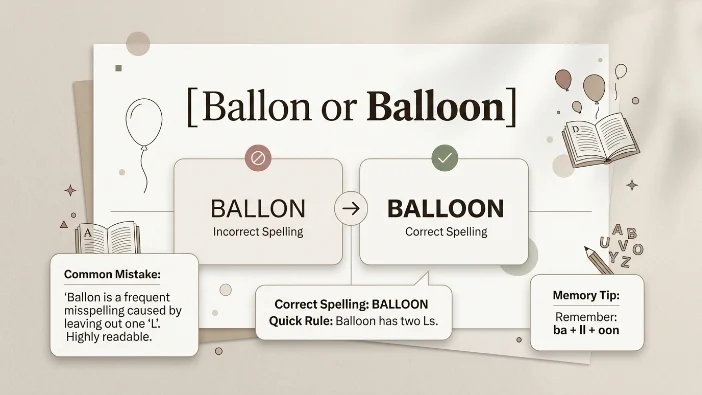
The correct spelling is balloon when referring to the inflatable object used for decoration, transportation, or celebration. Ballon is a misspelling in English, though it exists as a French word meaning “ball” or as a ballet term referring to a dancer’s lightness and grace. Always use balloon for everyday English usage.
You’re writing an invitation, drafting a children’s story, or perhaps composing a business email about event decorations. Then you pause. Is it ballon or balloon? Your spellchecker might not even flag the misspelling, leaving you uncertain about which version is correct.
This confusion happens more often than you might think. The single versus double letter pattern in English creates frequent spelling dilemmas. Many people assume ballon is simply an alternative spelling, but this misunderstanding leads to avoidable errors in professional and academic writing.
In this comprehensive guide, you’ll learn exactly when to use each spelling, understand the grammatical differences, and discover practical memory techniques that prevent future mistakes. Whether you’re an English learner, business professional, or content creator, mastering this distinction will strengthen your overall spelling accuracy.
What’s the Difference Between Ballon and Balloon?
The core difference between these two terms lies in their spelling validity and usage contexts in English. Balloon is the correct English spelling for the inflatable object we all recognize. Ballon is primarily considered a misspelling in English, though it has specific meanings in French and ballet terminology.
Here’s a clear comparison:
| Aspect | Ballon | Balloon |
|---|---|---|
| Meaning | A ballet term describing lightness and bounce; French for “ball” | An inflatable flexible bag used for decoration, scientific research, or transportation |
| Part of Speech | Noun (French origin, used in ballet contexts) | Noun and Verb |
| Refers To | Dancer’s quality of elevation; a ball in French | Decorative or functional inflatable object |
| Typical Usage | Ballet criticism, French language contexts | Everyday English, celebrations, science, medicine |
| Example | “The dancer’s ballon impressed the audience.” | “We released dozens of colorful balloons into the sky.” |
| Common Confusion | Mistaken as the English spelling | The only correct English spelling |
In everyday American and British English, balloon is the word you’ll encounter millions of times. The spelling with two L’s appears in children’s books, party supply catalogs, weather reports, and medical textbooks. The single L version appears almost exclusively in specialized contexts—ballet reviews, French-language materials, or as a common spelling error.
Is This a Grammar, Vocabulary, or Usage Issue?
This particular spelling confusion sits at the intersection of vocabulary and usage, with a touch of grammatical awareness.
Grammar Classification: The word balloon functions as a noun (“The balloon floated upward”) and a verb (“The company’s expenses ballooned unexpectedly”). Ballon serves primarily as a noun in specialized contexts.
Vocabulary Difference: While balloon belongs to everyday English vocabulary, ballon represents specialized terminology from French and ballet. Most English speakers need only the former.
Usage Context: The distinction matters most in written English. In spoken conversation, both spellings sound identical when pronounced, so confusion only appears in writing.
Interchangeability: These words are not interchangeable in English. Using ballon where balloon belongs marks your writing as containing a spelling error. The only exception occurs when writing about ballet technique or French language content.
Formal and Academic Writing: Professional documents require the double-L spelling. Academic papers in English should never use the single-L version except when citing French sources or discussing ballet terminology.
Practical Takeaway: Unless you’re writing specifically about ballet or in French, always choose balloon. The double-L spelling is your default option for all general English communication.
Understanding Balloon in Detail
Meaning and Definition
Balloon refers to a flexible, inflatable bag typically made of rubber, latex, or plastic, filled with air or gas such as helium. The term extends beyond party decorations to include scientific weather balloons, medical angioplasty balloons, and hot air balloons used for transportation.
Pronunciation
Pronounced /bəˈluːn/ in American English, with emphasis on the second syllable. The “loon” rhymes with “moon” and “soon.”
Part of Speech
- Noun: “The balloon drifted toward the clouds.”
- Verb: “Healthcare costs continue to balloon each year.”
- Adjective: “Balloon payment loans require careful planning.”
Common Collocations
- Birthday balloons
- Hot air balloon
- Weather balloon
- Helium balloon
- Balloon decorations
- Balloon ride
- Balloon arch
- Water balloon
- Balloon payment
- Balloon artist
Typical Sentence Patterns
Pattern 1: Noun as Subject
“The balloon floated gracefully through the air.”
Pattern 2: Verb with Preposition
“Your expenses will balloon over time.”
Pattern 3: Noun Modifier
“The balloon artist created incredible animal shapes.”
Real-World Examples
Workplace Context:
“The marketing team ordered 200 branded balloons for the product launch event.” Here the spelling helps convey a professional, celebratory context.
Academic Context:
“Scientists use weather balloons to measure atmospheric pressure and temperature at high altitudes.” This demonstrates how the term appears in scientific literature.
Technology Context:
“The software company’s user base ballooned from 10,000 to over a million in eighteen months.” The verb form describes rapid growth.
Email Example:
“Please confirm how many helium balloons we need for the anniversary party.” Clear, professional communication about event planning.
Daily Conversation:
Mom, can we get balloons for the birthday party?” This casual usage reflects everyday American English.
Common Learner Mistake
Many English learners incorrectly write “ballon” because they associate the word with other single-L terms like “melon” or “camel.” Remember that balloon, like “moon,” contains the double O sound that justifies the double L spelling.
Mini Recap
Balloon represents the standard English spelling across all contexts. Its versatility as a noun and verb makes it essential vocabulary for anyone learning English.
Understanding Ballon in Detail
Meaning and Definition
Ballon primarily appears in two contexts. In ballet, it describes the quality of lightness and bounce in a dancer’s movements. In French, it simply means “ball” or can refer to a ball-shaped object. Outside these specialized areas, it remains a spelling error.
Pronunciation
In ballet contexts, pronounced /baˈlɔ̃/ with a nasal French ending. In English spelling confusion, some mispronounce it /bəˈlun/ like the English word, which only compounds the spelling issue.
Part of Speech
- Noun: “Her ballon made every jump appear effortless.”
- French Noun: “Le ballon est rouge” (The ball is red).
Common Contexts
- Ballet criticism
- Dance technique discussions
- French language materials
- Historical dance literature
Typical Usage
Ballet Context:
“The company’s principal dancer displayed exceptional ballon, seeming to defy gravity during each leap.” Here the term describes technical excellence.
French Language Context:
“Il a acheté un ballon pour jouer au football.” (He bought a ball to play football.) Only appropriate when writing in French.
Real-World Examples
Professional Dance Review:
“Critics praised the ballerina’s remarkable ballon, noting how she floated through each sequence.” Specialized terminology for dance professionals.
Artistic Discussion:
“The dancer’s ballon transformed ordinary movements into extraordinary visual poetry.” Academic or artistic writing only.
French Correspondence:
“Pourriez-vous acheter un ballon?” (Could you buy a ball?) Only French learners need this usage.
Common Misunderstanding
Many people incorrectly believe ballon represents a valid English variant or older spelling. This misconception likely stems from encountering the word in French contexts and assuming it applies universally.
Mini Recap
Ballon serves niche purposes: ballet and French. For general English writing, it’s a misspelling that should be avoided.
When Not to Use Each Word
Mistake 1: Party Decorations
Why the mistake happens: People see French influences on English and assume the French spelling works universally.
The correction: “We need colorful balloons for the party,” not “ballons.” English uses the double-L spelling.
Memory trick: Think “loo” as in “bathroom” when imagining the double L.
Mistake 2: Scientific Writing
Why it’s wrong: Science journalism and research papers require precise English spelling.
The correction: “Meteorologists launched weather balloons to track the storm.”
Why it matters: Inaccurate spelling undermines professional credibility.
Mistake 3: Business Communication
Why it’s problematic: Spellings errors in client communications diminish perceived professionalism.
The correction: “The balloon payment comes due in December.”
Quick fix: Proofread for double L’s when discussing finance or events.
Mistake 4: Medical Terminology
Why it matters: Medical documentation demands accuracy.
The correction: “The surgeon used a balloon catheter to clear the artery.
Professional standard: Medical journals universally use the double-L spelling.
Mistake 5: Children’s Literature
Why the mistake occurs: Writers sometimes assume simplified spelling helps young readers.
The correction: “The children chased the floating red balloon.”
Educational reason: Teaching correct spelling from the start prevents future confusion.
Mistake 6: Marketing and Advertising
Why it’s damaging: Marketing materials with spelling errors lose consumer trust.
The correction: “Our balloon arch will create an unforgettable entrance.”
Brand impact: Professional presentation matters for conversions.
Common Mistakes Table
| Correct Sentence | Incorrect Sentence | Explanation |
|---|---|---|
| “Helium balloons decorated the entire venue.” | “Helium ballons decorated the entire venue.” | Missing double L creates a misspelling. |
| “The hot air balloon lifted off at sunrise.” | “The hot air ballon lifted off at sunrise.” | Air travel requires the correct English term. |
| “Company profits ballooned this quarter.” | “Company profits balloned this quarter.” | Verb form maintains the double L throughout. |
| “We celebrated with sixty colorful balloons.” | “We celebrated with sixty colorful ballons.” | Event planning contexts demand English spelling. |
| “The balloon payment will be due in March.” | “The ballon payment will be due in March.” | Financial terminology uses standard English. |
| “Her ballon impressed the ballet critics.” | “Her balloon impressed the ballet critics.” | Ballet contexts use the French spelling specifically. |
Quick Decision Guide
When to use BALLOON:
- Describing inflatable party decorations
- Referring to hot air or helium aircraft
- Discussing scientific weather instruments
- Writing about medical procedures
- Using the verb form meaning “to expand rapidly
- Any general English communication
When to use BALLON:
- Writing about ballet technique specifically
- Creating French language content
- Discussing a dancer’s quality of elevation
Remember this rule: If you can see it floating in the sky, it’s balloon with two L’s. If you’re discussing a dancer’s graceful jump, you might use ballon with one L.
Real-World Examples
Office Communication
“Tracy, please confirm the balloon quantity for next week’s conference. I need to approve the decoration budget by Friday.”
Business Email
“Dear Team, Our quarterly growth numbers have ballooned beyond projections. This success demands a celebration with proper decorations—balloons included.”
Academic Setting
“Professor Martinez instructed us to use weather balloon data for our atmospheric science project. The university’s equipment includes several specialized meteorological balloons.”
Customer Support Context
“Thank you for contacting Party Supplies Plus. We’ve updated your balloon order from 100 to 150 per your request. The new total reflects your updated decoration plan.”
Technology Sector
“The early startup’s user base ballooned after the viral campaign, requiring infrastructure scaling that rivaled established platforms.”
Artificial Intelligence
“AI language models have ballooned in complexity over the past five years, moving from simple pattern recognition to sophisticated contextual understanding.”
Daily Conversation
“Look at that balloon floating toward the clouds! Someone must have let it go at the park.”
Balloon in Modern Technology
The word balloon appears frequently in contemporary technology contexts, though often metaphorically rather than literally.
Artificial Intelligence: Machine learning models sometimes “balloon” in size and complexity as they incorporate more parameters and training data. These technological “balloons” represent computational resources rather than physical objects.
Virtual Assistants: While your smartphone assistant doesn’t physically hold balloons, the term appears in event planning applications and weather apps that reference historical balloon data.
Software Development: Programmers discuss “ballooning memory usage” when applications consume excessive system resources. This technical usage maintains the double-L spelling.
Business Tools: Project management software often includes “balloon” metaphors for visualizing growth trajectories and budget expansions.
Weather Technology: Modern forecasting heavily relies on data from weather balloons, though the term remains literal in this context.
Word Origin
Balloon derives from the French word ballon, which itself came from Italian ballone, meaning “large ball.” The French ballon traces further back to the Germanic balla or ball.
The English adoption occurred in the 16th century, initially referring to the game played with a large leather ball. By the 18th century, when hot air balloons captured public imagination, the term evolved to describe these floating vessels.
Ballon (French) maintains its original meaning of “ball” or “large ball,” while the English adaptation added the double L to distinguish the inflated object and perhaps to emphasize the long vowel sound.
Expert Insight
The spelling confusion between ballon and balloon highlights how English borrows words from other languages but modifies them for native usage patterns. When French words enter English, they often undergo spelling transformations that align with English phonetics and conventions.
As an experienced language educator, I’ve observed that learners who understand this borrowing pattern make fewer spelling errors. The double L in balloon serves a phonetic purpose—it signals the long “oo” sound that follows. When you hear the word pronounced, your ear recognizes the drawn-out vowel, and the double consonant visually represents that length.
This principle applies broadly in English spelling: after short vowels, we typically use single consonants (like “tot”), while long vowels often pair with double consonants (like “tool” and “balloon”). Remembering this rule helps you avoid a wide range of spelling mistakes beyond this specific example.
Error Prevention Checklist
Always use BALLOON when:
- Describing anything that floats, inflates, or decorates
- Writing in general English contexts
- Discussing scientific, medical, or business topics
- Using the verb form to describe expansion
- Creating professional documentation
Always use BALLON when:
- Writing ballet or dance technique criticism
- Working with French language materials
- Referring specifically to a dancer’s jumping ability
Never confuse them if:
- You remember that balloons float, and floating objects need two L’s to stay afloat
- You recall that French words often lose their second consonant when borrowed
- You pronounce the word and recognize the long vowel sound
Quick Memory Tip: Imagine a balloon floating with a moon in the background. Both words have double O’s and double consonants (balloon and moon both have one L but pattern suggests double consonants for the long vowel sound). Or simpler: balloons have two L’s because they last twice as long.
Related Grammar Confusions
- Compliment vs. Complement – Both sound similar but describe different relationships.
- Principal vs. Principle – One refers to people and money; the other to rules and beliefs.
- Stationary vs. Stationery – One means not moving; the other means writing supplies.
- Desert vs. Dessert – An extra S makes the difference between sand and sweets.
- Affect vs. Effect – One is usually a verb; the other usually a noun.
- Further vs. Farther – Distance versus degree distinction.
- Who vs. Whom – Subject versus object pronoun distinction.
- Then vs. Than – Time versus comparison distinction.
- Its vs. It’s – Possessive versus contraction distinction.
- There vs. Their vs. They’re – Location, possession, and contraction distinction.
Learning to differentiate these common confusions builds overall writing confidence.
FAQs
Is “ballon” a word?
Yes, “ballon” is a word, but its use depends on the language and context. In French, ballon means “ball” and is also used in some ballet terminology. In standard English, however, balloon is the correct spelling for the inflatable object.
Why do people misspell “balloon” as “ballon”?
The mistake can come from familiarity with the French word ballon, which looks almost identical to the English spelling. Writers may also forget that balloon contains two l’s and two o’s. Because the pronunciation doesn’t reveal the spelling difference, the error can easily go unnoticed.
Which spelling is correct in American English?
For the inflatable object, balloon is the correct spelling in American English. The spelling ballon may appear when an English text uses the French term or discusses specialized ballet terminology, but it isn’t the standard spelling for an ordinary balloon.
Can “ballon” ever be correct in English?
Yes, although its use is quite specialized. “Ballon” can appear in English ballet terminology, where it refers to a dancer’s lightness or ability to appear suspended in the air. Outside such contexts, use balloon when referring to the familiar inflatable object.
Is there a pronunciation difference between “ballon” and “balloon”?
In ordinary English speech, the two spellings may be pronounced very similarly, particularly when ballon is being used as a specialized term. This is one reason the spelling can be confusing. The important distinction is usually found in the written form and the context.
Does the spelling change the meaning?
Yes. “Balloon” clearly refers to the inflatable object in standard English. “Ballon” may indicate the French word or the specialized ballet term, while in an ordinary English sentence it will usually be understood as a misspelling of balloon. Choosing the correct spelling keeps your meaning clear.
Conclusion
The distinction between ballon and balloon ultimately comes down to context and correctness. Balloon serves as your reliable English spelling for inflatable objects, decoration needs, and any general communication. It works as a noun, verb, and modifier across professional, academic, and casual settings.
Ballon remains confined to ballet technique terminology and French-language content. For the vast majority of English writers, it’s simply a misspelling to avoid.
Remember this practical rule: if it floats, it’s a balloon with two L’s. If you’re describing a dancer’s graceful jump, you might need the specialized term with one L. For everything else, double the L and double your confidence in correct spelling.
By mastering this distinction, you strengthen not only your spelling accuracy but also your understanding of how English borrows and adapts words from other languages.
2 thoughts on “Ballon or Balloon | Avoid This Common Spelling Error In 2026”