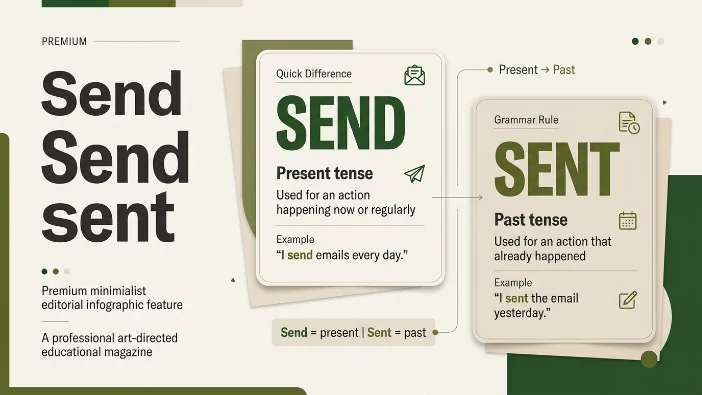
Quick Answer
Send is the base form of the verb, used for present and future actions (“I will send the email”). Sent is the past tense and past participle, used for completed actions (“I sent the email yesterday” or “I have sent the email”). The confusion between send and sent almost always comes down to timing: is the action happening now, or has it already happened?
You’re typing an email, and your cursor hovers over one word: “I send you the file yesterday” or “I sent you the file yesterday”? Something feels off, but you’re not sure which version is correct. This happens to native speakers and English learners alike, and it happens more often than most people admit.
The issue isn’t really about vocabulary. Both send and sent come from the same verb, but they belong to different points in time. Send describes an action happening right now or something you plan to do. Sent describes something that already happened. Mixing them up doesn’t just sound awkward, it can genuinely confuse a reader about whether a task is done or still pending, which matters a lot in business writing and customer communication.
In this guide, you’ll learn exactly when to use each word, why the confusion happens in the first place, and how to remember the difference permanently, whether you’re writing a work email, a school assignment, or a quick text message.
Send vs Sent: What’s the Difference?
The core difference is tense: send is present tense, sent is past tense and past participle. Once you lock that idea in, almost every mistake involving these two words disappears.
Send functions as the base verb form. You use it when talking about something happening now, something habitual, or something planned for later. It also appears after helping verbs like “will,” “can,” and “should.” Sent, on the other hand, only shows up when an action is already finished. It pairs with “have,” “has,” or “had” to form perfect tenses, and it stands alone in simple past sentences.
Here’s a side-by-side breakdown to make the distinction easier to scan.
| Meaning | Part of Speech | Refers To | Typical Usage | Example |
|---|---|---|---|---|
| Base form of the verb “to send” | Verb (present/base) | An action happening now or planned | Present, future, imperative | “Please send the report today.” |
| Past tense/past participle of “send” | Verb (past form) | A completed action | Simple past, present perfect, past perfect | “I sent the report this morning.” |
Notice that send never changes form for completed actions, and sent never appears for something that hasn’t happened yet. Once you separate the timeline in your head, present versus past, the choice becomes automatic rather than something you have to stop and think about.
Is Send vs Sent a Grammar, Vocabulary, or Usage Issue?
This is purely a grammar issue, specifically a verb tense issue, not a vocabulary or spelling problem. Both words share identical meaning; they just occupy different positions on the timeline of an action.
Send is classified as the infinitive and simple present form of an irregular verb. Sent is the simple past and past participle form. English has many irregular verbs like this, where the past tense doesn’t simply add “-ed” (think “go” and “went,” or “buy” and “bought”). Because send doesn’t follow the regular pattern, learners sometimes default to “sended,” which is incorrect, or they hesitate between send and sent because the transformation feels unfamiliar.
These two words are never interchangeable. In formal business English, academic writing, and everyday conversation alike, tense accuracy matters just as much as word choice. A misplaced tense in a client email can make it look like a task hasn’t been completed when it actually has, or vice versa. The practical takeaway: before you write either word, ask yourself whether the action is finished. If yes, use sent. If not, use send.
Send: A Closer Look
Send means to cause something to go or be transmitted from one place, person, or system to another. It’s most commonly used with letters, emails, messages, packages, or signals, but it also extends to abstract things like sending a warning or sending someone into a particular mood.
As a verb, send is irregular, and its principal parts are send, sent, sent (base, past, past participle). It commonly pairs with objects like “email,” “message,” “package,” “link,” “invitation,” and “request.” You’ll often see it in patterns like “send + someone + something” (send me the file) or “send + something + to + someone” (send the file to me).
Here’s how it shows up across different real-life contexts:
Workplace: “Can you send the meeting notes to the whole team by end of day?”
Academic: “Students should send their assignments through the university portal, not by email.”
Technology: “The app will automatically send a notification when your order ships.”
Email: “I’ll send you the updated contract as soon as legal reviews it.
Daily conversation: “Send me a text when you land.”
A common learner mistake is writing “sended” instead of “sent” for the past tense, since regular verbs simply add “-ed.” Another frequent error is using send in a sentence that clearly needs a completed action, such as “I send it already,” which should be “I already sent it” or “I have already sent it.”
Quick recap: use send whenever the action is happening now, is habitual, or is planned for the future. It never changes form for past events.
Sent: A Closer Look
Sent is the past tense and past participle of send, used to describe an action that has already been completed. It’s pronounced with a short “e” sound, rhyming with “bent” or “went,” which is worth noting because learners sometimes mispronounce it to rhyme with “send” itself, softening the vowel incorrectly.
As a past form, sent appears in two main grammatical roles: as the simple past tense verb on its own (“I sent the invoice”), and as a past participle after auxiliary verbs like “have,” “has,” or “had” to build perfect tenses (“She has sent the invoice,” “They had already sent the invoice before the deadline”). It frequently pairs with time markers like “yesterday,” “last week,” “already,” “just,” and “earlier.”
Here’s how sent looks across common situations:
Workplace: “I sent the proposal to the client an hour ago.”
Academic: “The professor sent feedback on our essays through the online portal.”
Technology: “The system has already sent a confirmation email to your inbox.”
Email: “As I mentioned in the message I sent yesterday, the deadline moved to Friday.”
Daily conversation: “She sent me a photo from the trip last night.”
The most common mistake learners make is using sent where send belongs, especially after “will” or “to,” producing incorrect phrases like “I will sent it tomorrow” or “I need to sent this today.” Sent never follows “will,” “to,” or “can” because those constructions require the base form.
Quick recap: sent only belongs to finished actions, whether you’re describing them directly in the past or building a perfect tense with a helping verb.
When Not to Use Each Word
Even confident writers slip up in specific, predictable situations. Here are the most common traps.
After “will” or “going to.” Future constructions always need the base form. “I will sent the file” is wrong; it should be “I will send the file.” The word “will” already signals future time, so the verb stays in its base form.
After “to” in an infinitive. Phrases like “I need to send” or “I want to sent” only work one way. Infinitives always use the base verb: “I need to send this today,” never “I need to sent this today.”
With “have,” “has,” or “had” but choosing send instead. Perfect tenses require the past participle. “I have send it” is incorrect; the correct form is “I have sent it.”
In simple past statements. If the action already happened and you’re stating it directly, sent is required, not send. “Yesterday I send the package” should be “Yesterday I sent the package.”
After modal verbs like “can,” “could,” “should,” or “must.” These all require the base form. “You should sent this now” is incorrect; it should be “You should send this now.”
When describing habitual or repeated actions. Routines use the present form. “Every Monday, I sent the weekly report” is wrong; it should be “Every Monday, I send the weekly report.”
In imperative sentences (commands or requests). Commands use the base form. “Sent me the document” is incorrect; the correct command is “Send me the document.”
When the timeline is ambiguous without context. If you’re unsure whether an action is complete, add a time clue (“already,” “yesterday,” “next week”) to guide your reader and confirm your own tense choice.
Common Mistakes Table
| Correct Sentence | Incorrect Sentence | Explanation |
|---|---|---|
| I will send the invoice tomorrow. | I will sent the invoice tomorrow. | “Will” requires the base form, not the past form. |
| She has already sent the email. | She has already send the email. | Perfect tense needs the past participle “sent.” |
| Please send me your resume. | Please sent me your resume. | Commands use the base verb form. |
| He sent the package last week. | He send the package last week. | Simple past statements require “sent,” not “send.” |
| I need to send this file today. | I need to sent this file today. | Infinitives (“to” + verb) always use the base form. |
| They send updates every Friday. | They sent updates every Friday. | Habitual, repeated actions use present tense “send.” |
Quick Decision Box
If the action hasn’t happened yet, or happens regularly, use Send.
If the action is already finished, use Sent.
Ask yourself one question: “Has this already happened?” If yes, sent. If no, send. You should be able to answer within ten seconds.
Send and Sent in Real-World Situations
Office communication: A manager writes, “Send the updated deck to the client before noon,” clearly instructing a future action, while a colleague replies, “I already sent it an hour ago,” confirming the task is done.
Business email: “I’m sending this email to confirm receipt of the documents you sent last Tuesday.” Notice how both forms can appear naturally in one sentence when the timeline shifts.
School or university: A teacher announces, “Send your essays through the portal by Friday,” and a student later messages, “I sent mine this morning, did you receive it?”
Customer support: A support agent writes, “We’ve sent a replacement item to your address,” reassuring the customer the shipment already happened, versus “We will send tracking details shortly,” which sets an expectation for the future.
Technology: “The app failed to send the message” describes a present or repeated failure, while “The app has sent 200 notifications today” describes completed actions within a timeframe.
Artificial intelligence: “The chatbot will send a follow-up message if you don’t respond within an hour” uses the future form, while “The system sent an automated alert at 3 a.m.” describes something already logged.
Daily conversation: “Send me the address” is a simple request, while “I sent you the address twenty minutes ago” clarifies that the task is already handled.
Send and Sent in Modern Technology
In artificial intelligence and software design, tense accuracy in interface text genuinely affects user trust. A button that says “Send” tells the user an action is about to happen, while a confirmation message that says “Message sent” tells them the action is complete. Getting this wrong, using “Sent” on a button or “Send” in a confirmation, can confuse users about whether they’ve actually completed a task.
Virtual assistants and chatbots rely heavily on this distinction too. A voice assistant might say, “I’ll send that reminder now,” using the present/future form to describe an upcoming action, then later confirm with, “Your reminder has been sent,” using the past participle to close the loop. Software notifications follow the same logic: “Sending…” appears during the process, and “Sent” appears once it’s finished. This small grammar detail is actually a core part of good UX writing, since users subconsciously read tense as a status indicator.
Business tools like email platforms, project management software, and customer relationship systems also depend on this pattern. Status labels like “Sent,” “Scheduled,” and “Draft” only work because sent accurately signals completion, distinct from an action still pending.
Word Origin
Send comes from the Old English word “sendan,” which meant to cause to go or to dispatch. It has Germanic roots and belongs to a small group of irregular verbs that changed their vowel sound to form the past tense instead of adding a regular ending, a pattern linguists trace back over a thousand years in the English language’s development. This origin explains why send behaves differently from regular verbs like “walk” or “talk,” and why memorizing it as an irregular verb, rather than trying to apply a rule, is the most reliable approach.
Expert Insight
Here’s a teaching trick that works well in the classroom: think of send and sent as a light switch. Send is the moment you flip the switch, the action itself, whether it’s about to happen or happens regularly. Sent is the switch already flipped, the light already on, the action already complete. Whenever a sentence hesitates between the two, ask which stage of that switch you’re describing. This mental shortcut removes the guesswork faster than memorizing grammar rules, because it ties the abstract tense concept to something visual and immediate.
Error Prevention Checklist
- Always use Send when the action is happening now, is habitual, or hasn’t occurred yet.
- Always use Sent when the action is already finished, whether in simple past or paired with “have/has/had.”
- Never confuse them if you remember: send = coming up, sent = already done.
- Quick memory tip: “Send” rhymes with “trend,” something ongoing or upcoming; “Sent” rhymes with “went,” something that already happened and left.
Related Grammar Confusions
Go vs Gone Another irregular verb pair where tense timing trips up learners the same way send and sent do.
Do vs Did vs Done Useful for understanding how English handles present, past, and past participle forms together.
Bring vs Brought A close cousin to send and sent, following a similar irregular past-tense pattern.
Lend vs Lent Nearly identical in structure and sound to send and sent, making it a natural next topic.
Spend vs Spent Shares the same “-end” to “-ent” transformation, which helps reinforce the pattern learned here.
Affect vs Effect A classic confusion pair worth mastering for anyone focused on precise business writing.
Its vs It’s Essential for avoiding one of the most common punctuation mistakes in professional emails.
Then vs Than Frequently confused due to similar spelling, despite serving completely different grammatical roles.
Advice vs Advise A useful next step for learners working on noun-versus-verb distinctions.
Complement vs Compliment Another word pair where a single letter changes meaning entirely, ideal for vocabulary-focused learners.
FAQs
Is it “I have send” or “I have sent”?
The correct form is “I have sent.” After have, has, or had, you need the past participle. Since sent is the past participle of send, the correct sentence is “I have sent the email.”
What is the past tense of send?
The past tense of send is sent. It is an irregular verb, so it does not take the regular -ed ending. For example: “I sent the documents yesterday.”
Can I say “I will sent it”?
No. After will, always use the base form of the verb. The correct sentence is “I will send it.” You should not say “I will sent it.”
Is “sended” a real word?
No. Sended is not the standard past tense or past participle of send. The correct forms are send for the base form and sent for both the past tense and past participle.
Why do people confuse send and sent so often?
The words send and sent look and sound very similar, which can cause confusion. English learners may also expect send to follow a regular -ed pattern, but it is an irregular verb that changes to sent.
Does “sent” ever refer to a future action?
No. Sent normally refers to a completed action in the past or a completed action expressed through a perfect tense. For a future action, use send, as in “I will send it tomorrow.”
Conclusion
The difference between send and sent comes down to one simple question: has the action already happened? Send covers the present, the future, and anything routine, while sent belongs strictly to completed actions, whether in simple past or paired with a helping verb like “have” or “had.”
Once you internalize that timeline, this mistake becomes easy to avoid permanently. A simple rule to carry forward: if it’s happening or about to happen, send it; if it’s already done, you sent it.
Read More Related Articles:
- Usage vs Useage | Stop Making This Spelling Mistake in Your Writing In 2026
- Losing vs Loosing | How One Extra “O” Changes the Entire Meaning In 2026
- Successfully or Succesfully | Easy Trick to Remember the Correct Spelling Forever In 2026

Caleb Dawson is a content writer at synoseek.com, where he works on simple, reader-focused articles across a range of everyday topics. His writing style is practical and grounded, aiming to present information in a clear and relatable way without unnecessary complexity.