Quick Answer
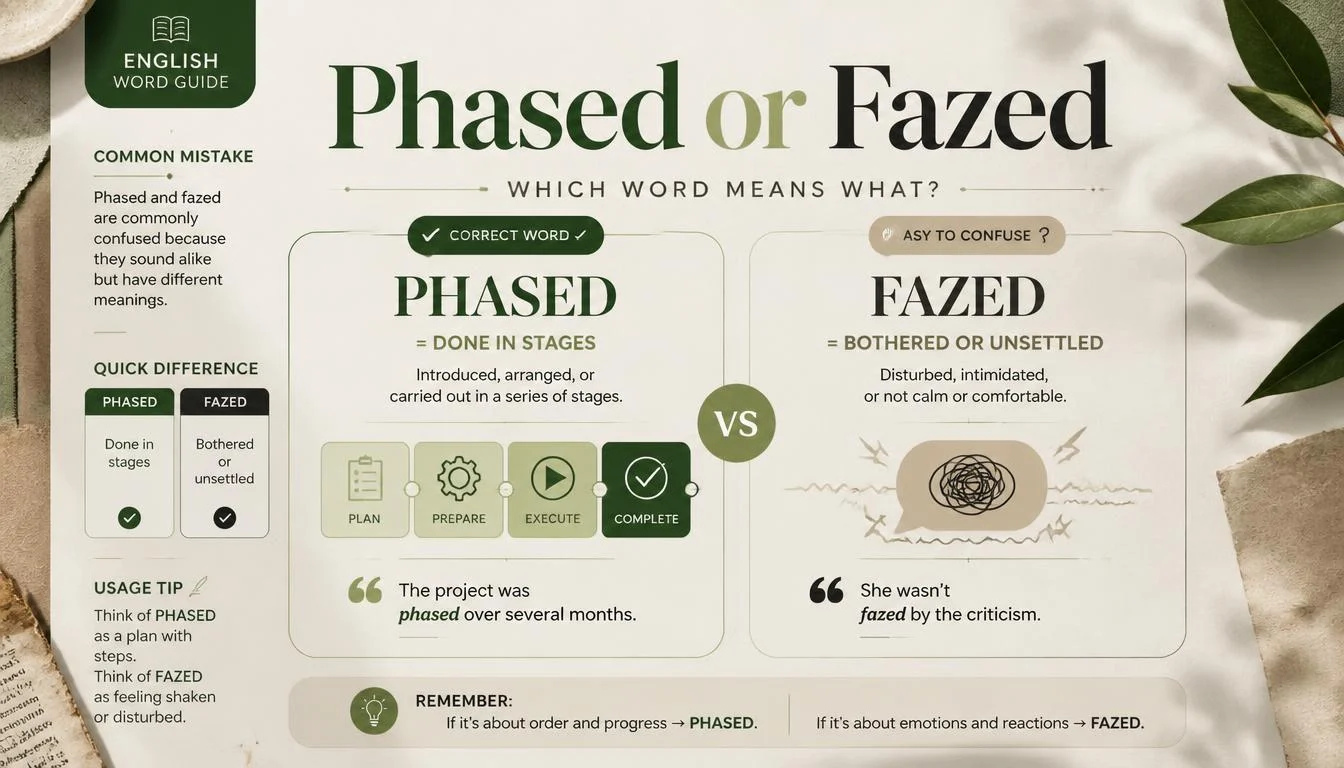
Are you “phased” or “fazed”? The correct choice depends entirely on meaning. Use phased for gradual processes carried out in stages like a new policy phased in over months. Use fazed for emotional reactions being disturbed or unsettled. If you’re not bothered by something, you’re unfazed, not unphased.
You’re writing an important email or a work report. You want to say the new system is being implemented gradually. But a doubt creeps in should that be “phased” or “fazed”? It’s a frustrating mental stumble. These two words sound exactly alike, yet they inhabit completely different worlds of meaning. Using the wrong one doesn’t just feel off; it can make your writing appear careless to anyone who knows the difference.
This guide exists to banish that confusion forever. We’ll explore why these words trip people up, clarify their distinct meanings, and give you practical tools to choose correctly every single time whether you’re writing a business proposal, an academic paper, or a quick email.
What’s the Difference Between Phased and Fazed?
The core distinction is between action and reaction, process and emotion.
Phased relates to a “phase,” which is a stage in a process. When something is phased, it is carried out in gradual steps . The company phased in the new software over a year. This is about a plan, a schedule, a project.
Fazed means disturbed, unsettled, or thrown off . She wasn’t fazed by the criticism. This is about emotion and composure how a person reacts to something.
For a clearer view, the table below breaks down the key differences.
| Feature | Phased | Fazed |
|---|---|---|
| Core Meaning | Carried out gradually in stages | Disturbed, bothered, or unsettled |
| Part of Speech | Verb (past tense of “phase”) / Adjective | Verb (past tense of “faze”) / Adjective |
| What It Refers To | Processes, plans, steps, stages | Reactions, emotions, composure |
| Typical Context | Business, project management, technology | Personal reactions, stress, confidence |
| Common Example | “The new policy will be phased in.” | “She remained unfazed by the noise.” |
| Common Mistake | Saying “I was phased” to mean “I was disturbed | Saying “We fazed out” to mean “We removed gradually |
In essence, you implement a plan in phases, but a difficult situation might leave you fazed. The difference is critical. A “phased” project is carefully planned, while a “fazed” person is reacting emotionally.
Is This a Grammar, Vocabulary, or Usage Issue?
This is fundamentally a usage problem, though it touches on vocabulary and grammar.
It’s not a grammatical error like subject-verb agreement. The grammar of both words is identical; they’re both verbs. The issue is lexical a wrong-word error. You’re using the correct part of speech but the wrong word entirely. It’s a vocabulary issue because you’re choosing between two words with distinct definitions that happen to sound the same .
In formal writing, this is considered a significant usage error. It signals a lack of attention to detail. In a professional context, a “phased” plan is about logistics, while a “fazed” employee is about psychology . Confusing the two can make your meaning unclear or even comical.
Takeaway: Your choice is a vocabulary and usage decision. Always consider meaning before spelling.
Understanding “Phased”: The Word for Planning
Definition
Phased is the past tense of the verb “phase.” It means to carry out or introduce something in gradual, planned stages . The project was phased over several months. It’s synonymous with “staged” or “introduced gradually.” The term is often used in business and project management .
Common Collocations and Usage
The verb “phase” almost always appears in two phrasal verb forms :
- Phase in to introduce something gradually: “The company will phase in the new overtime policy.”
- Phase out to withdraw or discontinue something gradually: “Single-use plastics are being phased out.”
It’s used whenever a change happens over time rather than all at once.
Workplace Example
“The implementation of the new CRM will be phased over six months to minimize disruption to daily operations.”
Academic Example
“The study used a phased approach, starting with a literature review before moving to data collection.”
Technology Example
“The software update was phased to different users by region to catch any bugs early.”
Email Example
“Hi Team, Just an update on the shift to our new project management tool. The transition will be phased, starting with the design team next week.”
Daily Conversation Example
“I don’t think we can change everything overnight. It’ll have to be a phased transition.”
What Learners Mistake
A common mistake is using “phased” to describe a reaction. “She was very phased by the surprise.” This is incorrect. The word needed here is “fazed” (if she was disturbed) or “unfazed” (if she was not) .
Mini Recap: “Phased” is about careful, gradual execution of a plan. Think stages, steps, and schedules.
Understanding “Fazed”: The Word for Reactions
Definition
Fazed is the past tense of the verb “faze,” which means to disturb, disconcert, or unsettle . If you are not fazed by something, it doesn’t bother you, no matter how unexpected or difficult . It is almost always used in the negative someone is “not fazed” or is “unfazed.”
Common Usage and Collocations
“Fazed” describes an emotional or psychological state of being bothered or thrown off balance . The most common collocation is with the adverb “not”: “not fazed at all,” “seemingly unfazed.”
Workplace Example
“Despite the negative feedback from the client, Sarah remained unfazed and focused on making the revisions.”
Academic Example
“The professor was not fazed by the many questions from the students and answered each one calmly.”
Technology Example
“The system crashed, but our lead developer was unfazed; she had already worked out a solution.”
Email Example
“Hey, just a heads up, the meeting has been rescheduled. I know it’s a hassle, but I’m not fazed if you can’t make it.”
Daily Conversation Example
“He was totally unfazed by the chaos around him.”
What Learners Mistake
The most frequent error is using “phased” when “fazed” is correct. “I’m not phased by your criticism.” This is incorrect. If you are not bothered, you are “not fazed” . Another mistake is forgetting the negative prefix: “unphased” should be “unfazed” .
Mini Recap: “Fazed” is about internal reaction. Think emotion, disturbance, and whether someone is bothered.
When Not to Use Each Word
Writers commonly choose the wrong word in these situations:
- When describing a person’s reaction to stress. The correct word is fazed (or unfazed). “She wasn’t fazed by the tight deadline.”
- When describing how a plan is executed. The correct word is phased. “The restructuring will be phased over the next quarter.”
- When using “un-” as a prefix. The correct word is unfazed (not “unphased”) . “Unphased” is not a recognized word.
- When describing a temporary period in someone’s life. The word is phase (noun), not “faze.” “He’s going through a difficult phase.”
- In any context involving emotions. Choose “fazed” when the subject is a person. “Phased” does not describe people’s feelings .
- When the word “out” or “in” is involved. The correct phrasal verbs are “phase out” and “phase in” . “Faze out” is incorrect.
Common Mistakes Table
| Correct Sentence | Incorrect Sentence | Explanation |
|---|---|---|
| “She was unfazed by the criticism.” | “She was unphased by the criticism.” | “Unphased” is not a word. You mean “unfazed. |
| “The new system will be phased in over a year.” | “The new system will be fazed in over a year.” | You can’t “faze” a process. You “phase” it. |
| “He wasn’t fazed by the loud noise.” | “He wasn’t phased by the loud noise.” | The noise didn’t disturb him. “Phased” is for stages. |
| “We need to phase out single-use plastics.” | “We need to faze out single-use plastics.” | Again, “faze” is for emotions, not gradual removal. |
Decision Box: Make the Right Choice in 10 Seconds
If you mean the action of doing something step-by-step over time, use PHASED.
If you mean the emotion of being disturbed or bothered, or you’re describing someone’s reaction, use FAZED.
Real-World Examples
Let’s see these words in action in realistic scenarios.
- Office Communication: “Our CEO was completely unfazed by the unexpected downturn in sales. She calmly explained our phased recovery plan.”
- Business Email: “I know the timing was a bit chaotic. I’m not fazed by the changes. But let’s make sure the rollout itself is phased to avoid overwhelming the support team.”
- School or University: “The student was unfazed by the challenging exam questions, having prepared thoroughly. The school’s new curriculum will be phased in over two semesters.”
- Customer Support: “The support agent was not fazed by the angry customer. The software’s new features are being phased in weekly to reduce user confusion.”
- Technology: “The AI updates are being phased in to ensure stability. The team is unfazed by the monumental task ahead.”
Modern Technology and “Phased” vs. “Fazed”
Both words find relevance in the tech sector.
- Phased is a foundational concept in software development, representing a phased rollout or phased deployment. Companies frequently adopt a phased approach to release new features, minimizing disruption and catching bugs early . In projects, a timeline might be divided into multiple phases.
- Fazed isn’t a technical term, but it describes the human element. A developer remains unfazed by a daunting task; a team is unfazed by a critical server issue . It’s about the resilience of the people behind the technology.
In the context of Artificial Intelligence, businesses implement systems using a phased plan, but human users must remain unfazed by the technology’s learning curve.
The Origin of the Words
Phased derives from the noun “phase,” which entered English from the Greek “phasis,” meaning “appearance.” Its roots in Middle French and Latin further trace back to the concept of a stage in a cycle .
Fazed has a different history. It is a variant of the obsolete English word “feeze,” which meant to frighten or drive away. It first appeared in the late 19th century and is a verb that means to disturb . The modern spelling “fazed” eventually won out.
Understanding these origins reveals the logic behind the difference: one is about the systematic appearance of things, the other about being driven away or upset.
Expert Insight: The Human Element in Word Choice
As an English language instructor, I often see students paralyzed by perfect vocabulary, but errors like “phased” vs. “fazed” are a reassuring sign of progress. They show you’re wrestling with nuance, not just memorizing definitions. However, context is king. In a professional email, using “fazed” when you mean “phased” creates confusion. It’s not a spelling mistake; it’s a meaning mistake that signals a lack of precision. The reader might pause and question your understanding of the project itself. This is about being clear, and clarity is the foundation of professional trust. Don’t let a tiny word trip up a big idea.
Error Prevention Checklist
- Always use “PHASED” when:
- Referring to a plan, project, or policy introduced in stages.
- Using the phrasal verbs “phase in” or “phase out.”
- Describing a schedule or timeline that involves steps.
- Always use “FAZED” when:
- Describing a person’s emotional reaction to something.
- Saying someone is “not bothered” or “unperturbed.
- Using the word “unfazed.”
- Never confuse them if:
- You are writing about a person’s feelings (“fazed”).
- You are writing about a process or time-based plan (“phased”).
- Quick memory tip:
- Phased = Process in Planned Phases.
- Fazed = Feeling Fear or Frustration. (Or “Fazed” = Flustered)
Related Grammar Confusions
Exploring these words can help you master other common English mix-ups:
- Affect vs. Effect a classic confusion between a verb and a noun.
- Principle vs. Principal commonly confused in academic and professional writing.
- Compliment vs. Complement about praise vs. completion.
- Stationary vs. Stationery staying still vs. paper supplies.
- Your vs. You’re a common possessive and contraction error.
- Its vs. It’s the possessive pronoun vs. the contraction for “it is.”
- Then vs. Than time vs. comparison.
- Lose vs. Loose misplacing something vs. something not being tight.
- Who’s vs. Whose a contraction of “who is” vs. the possessive pronoun.
FAQs
Can “phased” mean “bothered”?
No. “Phased” refers to stages or steps in a process. It is never used to describe being bothered or disturbed. If you mean someone is upset, use “fazed” .
Is “unphased” a real word?
No, “unphased” is not a recognized word in standard English. The correct word for someone who is not disturbed or bothered is “unfazed” .
Are “phased” and “fazed” pronounced the same?
Yes, they are homophones, meaning they have the same pronunciation (/feɪzd/). This is the primary reason for the confusion between them .
Can “fazed” be used in formal writing?
Yes, “fazed” can be used in formal writing, but it is generally more informal and best used to describe a clear reaction. Using “unfazed” is common and acceptable in most professional contexts .
What is the difference between “phase” and “faze”?
“Phase” is a noun (a stage in a process) or a verb (to carry out in stages). “Faze” is a verb meaning to disturb or disconcert . The confusion arises with their past tense forms: “phased” and “fazed.”
Which is correct: “I’m not phased” or “I’m not fazed”?
The correct phrase is “I’m not fazed.” This is a common saying meaning “I’m not disturbed or bothered.” Using “phased” in this context is a very common and noticeable error .
Conclusion:
Mastering the distinction between “phased” and “fazed” is a simple but powerful way to sharpen your writing. One is about the logical progression of a plan; the other is about the emotional reaction of a person. Remember that a project can be phased, but a person is fazed. When you’re in doubt, just ask yourself: “Are we talking about a plan or a person?” This single question will guide you to the correct choice and ensure your communication is always precise.
Read More Related Articles:
- Lended or Lent | Easy Way to Remember the Difference In 2026
- Addition vs Edition | Key Difference You Need to Know In 2026
- Nosy or Nosey | Simple Guide to Getting the Spelling Right In 2026

Zoe Chambers works as a content writer at synoseek.com, contributing thoughtful pieces on everyday subjects and ideas. She writes in a simple, grounded way, often drawing from real-world experiences. Her focus is on keeping content natural, clear and easy for readers to connect with.