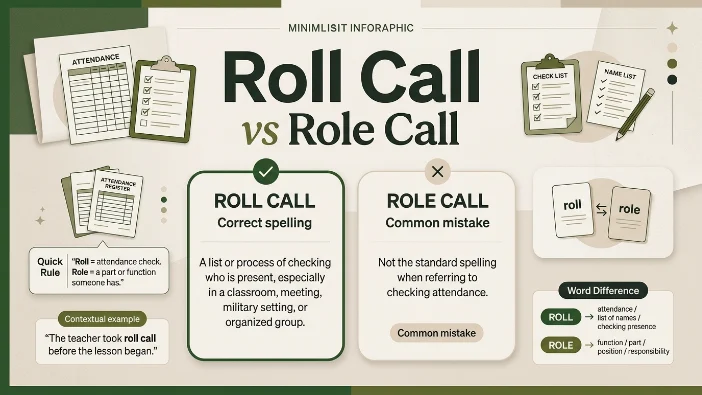
Quick Answer:
Only roll call is correct English. It means checking who is present by reading names aloud, as teachers, the military, and courts do daily. Role call” is a common misspelling based on how the phrase sounds, not how it’s spelled. If you’re checking attendance, “roll call” is the term you want every time.
If you’re unsure about Roll Call vs Role Call, you’re not alone. These two phrases sound identical, but only one is correct when you’re referring to checking who is present. Understanding the difference can help you avoid a common spelling mistake in school, workplace, and formal writing.
In this guide, we’ll explain Roll Call vs Role Call in simple terms, with examples to show when each word is appropriate. You’ll also learn why “roll call” is the correct phrase and how to remember it easily.
Why This Mix-Up Happens More Than You’d Think
If you’ve ever typed “role call” into an email and then paused, wondering if that’s actually right, you’re not alone. This is one of those phrases that trips up even confident writers, and the reason is simple: “role” and “roll” sound identical when spoken. Your ear can’t tell them apart, so your fingers sometimes pick the wrong one.
“Roll call” refers to the practice of reading a list of names out loud to confirm who’s present think of a teacher checking attendance, a sergeant lining up troops, or a courtroom clerk verifying who’s shown up for jury duty. “Role,” on the other hand, refers to a part someone plays, like a job title, a character in a play, or a function within a team.
The confusion isn’t really about grammar. It’s about spelling two homophones correctly. Get it wrong in a school memo or a business email, and it can look like a careless typo which is exactly why understanding the difference matters, even if it seems like a small thing. By the end of this guide, you’ll know exactly why “roll” wins, how to remember it permanently, and where each word actually belongs.
Roll Call vs Role Call: What’s the Difference?
The short answer is that “roll call” is a real compound noun, while “role call” is a spelling error that happens to look like a real phrase.
“Roll” traces back to the idea of a rolled-up document or list historically, attendance records were literally written on rolled parchment. That’s where we get phrases like “payroll” and “muster roll.” When you call the roll, you’re reading names off that list. Role” comes from a completely different root related to theater and the parts actors play, which later expanded to mean any function or position a person holds.
| Term | Meaning | Part of Speech | Refers To | Typical Usage | Example |
|---|---|---|---|---|---|
| Roll Call | Reading names to check attendance | Compound noun | A list or record of people | Schools, military, courts, meetings | “The sergeant conducted roll call at 6 a.m.” |
| Role Call | Not a standard English term | N/A | Sometimes mistakenly used for casting/assigning duties | Rare, usually incorrect | “We had a role call meeting” (should be “roll call” or reworded) |
So here’s the recap: “roll call” is the only version with a dictionary entry and a clear, consistent meaning across military, educational, and legal contexts. Role call” isn’t recognized by major dictionaries as a standard phrase it’s almost always a misheard or mistyped version of “roll call.” If you ever see someone using “role call” to mean assigning parts or responsibilities, that’s a nonstandard, made-up usage that will confuse most readers rather than clarify anything.
Is This a Grammar, Vocabulary, or Spelling Issue?
This isn’t really a grammar problem in the traditional sense there’s no verb tense or sentence structure at stake here. It’s a vocabulary and spelling issue rooted in homophone confusion. Roll” and “role” are pronounced the same in most English dialects, which means your brain has to rely on memory and context rather than sound.
Neither word is interchangeable with the other in formal writing. In business English, academic writing, and legal documents, using “role call” instead of “roll call” reads as an error, not a stylistic choice. Even in casual conversation, if you write “role call” in a text to your team about the morning check-in, sharp-eyed colleagues will notice.
The one place where confusion sometimes seems justified is when people try to combine both ideas like “calling out everyone’s role” during a meeting. But that’s a different concept entirely, and it should be phrased as “reviewing roles” or “assigning responsibilities,” not “role call.”
Practical takeaway: If you’re ever unsure, ask yourself whether you mean “reading a list of names” (roll call) or “a part someone plays” (role). There’s no in-between usage where “role call” is the natural, correct choice.
Understanding “Roll Call”
“Roll call” is a fixed compound noun. It’s pronounced the same whether you’re in a classroom or a courtroom ROHL kawl and it functions as a single unit in a sentence, almost always as a noun rather than a verb.
Common collocations: take roll call, conduct a roll call, morning roll call, roll call vote, skip roll call.
Sentence patterns: “The teacher took roll call before starting the lesson.” “There will be a roll call vote on the new policy.” “He missed roll call and got written up.”
Here’s how it shows up across different situations:
- Workplace: “Security does a roll call every shift change to confirm everyone checked in.”
- Academic: “The professor’s assistant handles roll call at the start of each lecture.”
- Technology: “The event app sends a digital roll call reminder to attendees five minutes before the session starts.”
- Email: “Please confirm your attendance I’ll be sending a quick roll call email before Friday’s meeting.”
- Daily conversation: “We do roll call every morning at practice so coach knows who’s here.
A common learner mistake: Non-native speakers sometimes write “make roll call” instead of “take roll call” or “call the roll.” The correct verb pairing matters you “take” attendance, you “call” the roll, but you don’t typically “make” a roll call happen.
Mini recap: “Roll call” is always about presence and attendance. If names are being read aloud or checked off a list, this is your word.
Understanding “Role”
“Role” refers to a function, position, or part someone plays whether that’s a job responsibility, a character in a film, or a duty within a group project.
Common collocations: play a role, take on a role, key role, leadership role, role model.
Sentence patterns: “She plays a key role in the marketing team.” “His role is to manage client relationships.” “What role will you take in the presentation?”
Here’s how “role” shows up in real contexts:
- Workplace: “My new role involves overseeing the design department.”
- Academic: “Students were asked to explain the role of photosynthesis in plant growth.”
- Technology: “The AI assistant’s role is to handle repetitive customer questions.”
- Email: “I wanted to clarify my role on this project before the kickoff call.”
- Daily conversation: “What role do you usually play when your friend group plans a trip?”
A common learner mistake: Writers sometimes drop the article and write “he has role in the team” instead of “he has a role in the team.” “Role” needs an article (“a role,” “the role”) in most standard sentence structures.
Mini recap: “Role” is about function and identity within a system a job, a duty, or a part in something larger. It has nothing to do with attendance.
When Not to Use Each Word
1. Don’t use “role call” when you mean attendance. This is the single most common mistake. If you’re checking who’s present, it’s always “roll call,” never “role call.” Remembering the “rolled-up list” origin helps lock this in.
2. Don’t use “roll” when discussing job duties. Writing “what’s your roll on this team?” is incorrect you want “role” here, since it refers to your function, not a list of names.
3. Don’t confuse “roll call” with “role play.” These are two completely different phrases. “Role play” involves acting out a scenario or character; it has nothing to do with attendance-taking.
4. Don’t use “role” when referring to bread, paper, or physical objects. “I bought a role of paper towels” is wrong that’s a “roll,” referring to something cylindrical or wound up.
5. Don’t write “payrole” instead of “payroll.” Since “payroll” comes from the same “roll” root as roll call (a list of employees and their pay), it should never contain “role.”
6. Don’t assume spellcheck will always catch this. Because “role” and “roll” are both real words, most spellcheckers won’t flag the wrong one if it’s used in a grammatically valid sentence. You have to catch this manually.
7. Don’t overcorrect in casual speech. Since both words sound the same out loud, this is purely a written-language issue. Don’t worry about pronunciation focus on spelling when writing.
8. Don’t use “role call” even informally in professional documents. Even in a quick Slack message, using the wrong term in front of colleagues or clients can undercut your credibility, especially in industries where precision matters, like law, education, or HR.
Common Mistakes Table
| Correct Sentence | Incorrect Sentence | Explanation |
|---|---|---|
| “The teacher took roll call at 9 a.m.” | “The teacher took role call at 9 a.m.” | Attendance-checking always uses “roll call.” |
| “She has a leadership role in the company.” | “She has a leadership roll in the company.” | Job function uses “role,” not “roll.” |
| “He missed roll call this morning.” | “He missed role call this morning.” | “Role call” is not a standard English phrase. |
| “I bought a roll of tape.” | “I bought a role of tape.” | Physical cylindrical objects use “roll.” |
| “What’s your role in this project?” | “What’s your roll in this project?” | Asking about duties or function needs “role.” |
Quick Decision Box
If you mean checking attendance by reading names aloud, use “Roll Call.” If you mean a job, duty, or part someone plays, use “Role.” If in doubt, picture a rolled-up attendance sheet that’s “roll.” A part in a play that’s “role.”
Roll Call vs Role in Real-World Situations
Office communication: A manager sends a message before an all-hands meeting: “We’ll start with a quick roll call, then move into role assignments for the new project.” Notice how both words appear correctly in the same sentence, each doing a different job.
Business email: “Please reply to confirm attendance I’m keeping a roll call list for Thursday’s training session.” Here, “roll call” is used exactly as intended: to verify who’s showing up.
School or university: “Professor Martinez always does roll call before discussing everyone’s role in the group project.” This shows the natural overlap between the two ideas without ever confusing the spelling.
Customer support: A support lead tells the team, “During roll call this morning, we’ll also review each agent’s role for the day who’s handling chats versus phone calls.”
Technology: Video conferencing tools sometimes use language like “attendee roll call” for meeting logs, distinct from a user’s “role” (host, presenter, or participant) within the platform’s settings.
Daily conversation: A parent tells their kid, “The camp counselor does roll call every morning before assigning everyone’s role for the day’s activities.”
Roll Call and Role in Modern Technology
Modern software has actually made this distinction more visible, not less. Video conferencing platforms often generate automatic attendance logs, which function exactly like a digital roll call recording who joined a meeting and when. Some platforms even label this feature “Roll Call” directly in their interface.
Meanwhile, “role” shows up constantly in tech settings: user roles, admin roles, and permission roles determine what each person can do within a system. A project management tool might ask you to “assign a role” to each team member, while a separate attendance feature handles the “roll call” side of tracking who’s active.
Virtual assistants and AI chatbots are increasingly used to automate roll call in classrooms and workplaces sending reminders, tracking responses, and compiling attendance reports automatically. At the same time, these same AI systems are described in terms of their “role,” meaning their function: answering questions, scheduling meetings, or managing customer inquiries. Keeping these two ideas separate becomes especially important in technical documentation, where a misused term can create genuine confusion about what a feature actually does.
Where “Roll” and “Role” Come From
“Roll” comes from the Latin rotulus, meaning a small wheel or a scroll fitting, since attendance records used to be kept on rolled parchment. That history explains why we still say “roll call,” “payroll,” and “muster roll” today.
“Role,” on the other hand, comes from the French word rôle, which originally referred to the roll of paper an actor used to read their lines from. Over time, it shifted from meaning the physical script to meaning the character or part itself and eventually broadened further to describe any function a person performs, on stage or off.
It’s almost poetic that both words trace back to physical rolled paper, yet ended up meaning completely different things in modern English.
Expert Insight
As a language instructor, I always tell students that homophone pairs like “roll” and “role” are best learned through association, not repetition. Simply writing the word correctly ten times rarely helps but connecting “roll” to a physical image, like a rolled-up list or a cinnamon roll, tends to stick. When you attach a concrete picture to an abstract spelling rule, your brain has something to hold onto the next time you’re typing quickly and your instincts kick in.
Error Prevention Checklist
- Always use “Roll Call” when checking who’s present through a list of names.
- Always use “Role” when referring to a job, duty, or part someone plays.
- Never confuse them if you remember that “roll” relates to lists and “role” relates to function.
- Quick memory tip: Roll = rolled-up list. Role = a role in a play.
Related Grammar Confusions Worth Learning
- Its vs It’s one shows possession, the other is a contraction, and mixing them up is one of the most common writing errors.
- Affect vs Effect knowing which one is a verb and which is a noun clears up a surprising amount of confusion.
- Their, There, and They’re three homophones that trip up even experienced writers under time pressure.
- Complement vs Compliment one means “to complete,” the other means “to praise,” and swapping them changes your meaning entirely.
- Principal vs Principle a school leader versus a fundamental truth, often confused in academic writing.
- Stationary vs Stationery standing still versus paper supplies, a classic spelling trap.
- Discreet vs Discrete being careful versus being separate, two very different meanings hiding behind similar spelling.
- Farther vs Further physical distance versus figurative progress, a distinction many writers skip entirely.
- Who’s vs Whose a contraction versus a possessive pronoun that sound identical but serve different roles in a sentence.
- Loose vs Lose one describes something not tight, the other means to misplace or fail to win.
FAQs
Is “role call” ever correct?
No. “Role call” is not the standard spelling when referring to checking attendance. The correct expression is “roll call.” The mistake happens because roll and role sound exactly alike.
Why do “roll” and “role” sound the same?
Roll and role are homophones, meaning they have the same pronunciation but different spellings and meanings. English contains many homophones, which can make choosing the correct spelling difficult when you’re relying on sound alone.
What’s the difference between “roll call” and “attendance”?
Attendance refers generally to the state or record of people being present. Roll call is the process of checking who is present, often by calling names from a list and recording each person’s response.
Can “role” ever be used as a verb?
No. In standard English, “role” is a noun that refers to a person’s part, function, or responsibility. Instead of using it as a verb, say “play a role” or “take on a role.”
Is “roll call vote” the same as “roll call”?
Not exactly. “Roll call vote” is a specific type of voting procedure, commonly used in legislative settings. Each member’s name is called, and their individual vote is recorded. A regular roll call simply checks attendance.
How can I remember which spelling to use?
Think of a roll or list of names for roll call. For role, picture an actor playing a part in a movie or play. Remembering roll = attendance and role = function or part makes the distinction easier.
Conclusion
The difference between “roll call” and “role call” comes down to one simple fact: only “roll call” exists as a correct, recognized English phrase. Role call” is a spelling slip that happens because the words sound identical, not because there’s any real overlap in meaning. “Roll call” is about presence and attendance, while “role” is about function and duty two ideas that occasionally appear in the same sentence but never share the same spelling.
If you take away just one rule from this guide, let it be this: whenever you’re checking who’s in the room, it’s roll call, not role call every single time.