Quick Answer
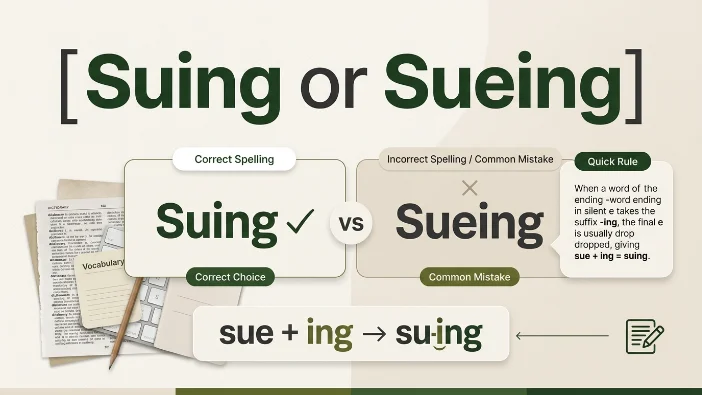
Suing is the correct spelling. It is the present participle of the verb “sue,” formed by dropping the silent “e” before adding “-ing.” Sueing is a common misspelling that breaks a basic English spelling rule. If you’re writing about taking legal action against someone, always use “suing,” never “sueing.”
You’re drafting an email to your lawyer, writing a news update, or finishing a school essay, and suddenly you freeze. Is it “I’m suing my landlord” or “I’m sueing my landlord”? This single letter mix-up trips up more writers than you’d expect, and it happens for a reasonable reason: English spelling rules aren’t always obvious, especially when a word ends in a silent “e.
The word in question comes from the verb “sue,” which means to start a legal case against a person or company, usually to recover money or demand that they stop doing something harmful. When you add “-ing” to describe the ongoing action, most people’s instinct is to keep the “e” and just tack on the ending. That instinct is wrong here, and understanding why will clear up this confusion for good.
Getting this right matters more than it might seem. A resume, a legal document, a business email, or even a viral social media post can lose credibility fast when a basic word is misspelled. In this guide, you’ll learn the exact rule behind “suing,” see real examples of how it’s used, and walk away knowing you’ll never second-guess this spelling again.
Suing or Sueing: What’s the Difference?
There is no real difference in meaning between these two spellings, because only one of them is actually a word. “Suing” is standard, dictionary-approved English. Sueing” is not recognized by any major dictionary and is simply an incorrect spelling that writers produce by accident.
“Suing” functions as the present participle (and gerund) of the verb “sue.” It’s used to describe someone currently in the process of filing or pursuing a lawsuit, or to form continuous tenses like “is suing,” “was suing,” or “has been suing.” As a gerund, it can also act like a noun, as in “Suing him won’t solve the problem.”
| Feature | Suing | Sueing |
|---|---|---|
| Meaning | Present participle of “sue,” meaning to take legal action | Not a real word |
| Part of Speech | Verb (gerund/participle) | None |
| Refers To | The ongoing act of filing or pursuing a lawsuit | N/A |
| Typical Usage | Legal writing, news, everyday conversation | Never correct |
| Example | “She is suing the company for damages.” | Incorrect in any context |
| Common Confusion | Writers assume the silent “e” should stay before “-ing” | Comes from applying the wrong spelling pattern |
To recap: only “suing” appears in dictionaries, legal documents, and edited publications. Sueing” is a spelling error that stems from a misunderstanding of a specific English rule involving silent “e” endings. Once you understand that rule, this mistake becomes very easy to avoid.
Is This a Grammar Issue, a Spelling Issue, or a Usage Issue?
This is purely a spelling issue, not a grammar or usage issue. Both “suing” and “sueing” would occupy the same grammatical role in a sentence if “sueing” were real, so the confusion isn’t about how the word functions. It’s about how the word is built.
English has a well-established spelling convention: when a verb ends in a silent “e,” you generally drop that “e” before adding a suffix that starts with a vowel, like “-ing,” “-ed,” or “-able.” Think of “make” becoming “making,” “hope” becoming “hoping,” or “dance” becoming “dancing.” “Sue” follows this exact same pattern. Drop the silent “e,” add “-ing,” and you get “suing.”
This rule applies consistently across formal English, business English, academic writing, and everyday conversation. There is no context, however casual or however formal, where “sueing” becomes acceptable. Legal briefs, news articles, text messages, and academic papers all follow the same standard: it’s always “suing.”
The practical takeaway here is simple. If you remember the silent “e” dropping rule, you’ll never misspell “suing” again, and you’ll also get similar words right, like “arguing,” “continuing,” and “pursuing.
Suing: Full Word Guide
Meaning: To bring a lawsuit against a person, business, or organization, typically to seek compensation or a legal remedy for harm or a broken agreement.
Pronunciation: SOO-ing (two syllables, rhyming with “doing”).
Part of Speech: Verb (present participle/gerund form of “sue”).
Common Collocations: suing for damages, suing over a contract, suing the company, currently suing, considering suing, worth suing.
Typical Sentence Patterns: “[Subject] + is/are + suing + [object] + for + [reason].” Example structure: “The tenant is suing the landlord for unsafe living conditions.”
Workplace Example: “HR flagged the complaint after learning a former employee was suing the department for wrongful termination.”
Academic Example: “In her thesis, she examined why small businesses often avoid suing larger corporations even when they have a strong case.”
Technology Example: “The startup is suing its former partner for allegedly stealing proprietary source code.”
Email Example: “Please be advised that our client is suing your firm for breach of the service agreement signed in March.”
Daily Conversation Example: “My neighbor is actually suing the contractor because the fence collapsed after just two months.”
One Learner Mistake: Non-native speakers sometimes write “sueing” because they apply the same pattern used for words like “seeing” or “freeing,” where the “e” stays. Unlike those words, “sue” drops its silent “e” before “-ing.”
Mini Recap: “Suing” is the only correct spelling of this word, formed by removing the silent “e” from “sue” before adding “-ing.” Use it any time you’re describing the act of filing or pursuing a lawsuit.
Sue: Full Word Guide
Meaning: To take legal action against someone, usually by filing a claim in court, in order to seek money, enforce a right, or stop a harmful action.
Pronunciation: SOO (rhymes with “zoo” and “shoe”).
Part of Speech: Verb (base form).
Common Collocations: sue for damages, sue a company, sue someone in court, threaten to sue, decide to sue, right to sue.
Typical Sentence Patterns: “[Subject] + will/might/plan to + sue + [object].” Example structure: “The customer plans to sue the airline after the flight cancellation.”
Workplace Example: “If the vendor doesn’t refund the deposit, our legal team says we can sue for breach of contract.”
Academic Example: “The case study asked students to decide whether the injured worker had enough evidence to sue his employer.”
Technology Example: “Several photographers threatened to sue the AI company for training its model on their copyrighted images.”
Email Example: “We would rather resolve this directly than sue, so let’s schedule a call this week.”
Daily Conversation Example: “Honestly, I don’t think it’s worth the stress to sue over a $200 deposit.”
One Learner Mistake: Some learners confuse “sue” with “suit,” thinking the noun form of a lawsuit and the verb “to sue” are spelled the same. They aren’t. “Suit” (as in lawsuit) is the noun; “sue” is the verb you conjugate.
Mini Recap: “Sue” is the base verb meaning to file a legal claim against someone. All its other forms, including “suing,” “sued,” and “sues,” build directly from this root word.
When Not to Use Sueing
Here are the situations where writers most often type “sueing” by mistake, along with how to fix the habit for good.
1. When texting quickly. Autocorrect doesn’t always catch this error because “sueing” looks close enough to a real word that some keyboards let it slide. Slow down when typing legal terms, since these words often carry weight.
2. When following the “seeing/freeing” pattern. Words like “see” and “free” keep their “e” before “-ing” because dropping it would create an awkward double vowel or change pronunciation. “Sue” doesn’t have that problem, so the silent “e” simply drops.
3. When writing under deadline pressure. Journalists and content writers producing fast-turnaround pieces sometimes rely on muscle memory rather than double-checking. A quick mental check, “Does this follow the silent-e rule?” solves it instantly.
4. When translating directly from another language. Non-native English speakers sometimes spell words phonetically based on how they sound in their first language. Since “sue” is pronounced with a long “oo” sound, some writers assume the “e” needs to stay to preserve that sound. It doesn’t.
5. When confusing it with unrelated words. Some writers blend “sue” with words like “shoeing” or “canoeing,” which do keep extra letters before “-ing” for pronunciation reasons. “Sue” isn’t in that category.
6. When writing legal correspondence without proofreading. This is the highest-stakes context. A misspelling in a formal legal letter can look unprofessional or even raise doubts about the writer’s attention to detail.
7. When using speech-to-text tools. Voice typing software occasionally renders “suing” incorrectly if the speaker’s pronunciation is unclear. Always review dictated text involving legal terms.
8. When writing headlines under space constraints. In a rush to keep a headline short, writers sometimes skip a final read-through, letting typos like “sueing” slip into published work.
Common Mistakes Table
| Correct Sentence | Incorrect Sentence | Explanation |
|---|---|---|
| “She is suing her former employer.” | “She is sueing her former employer.” | “Sue” drops its silent “e” before adding “-ing.” |
| “They’re considering suing the manufacturer.” | “They’re considering sueing the manufacturer.” | “Sueing” is not a recognized English word. |
| “Suing can be expensive and time-consuming.” | “Sueing can be expensive and time-consuming.” | The gerund form always follows the “suing” spelling. |
| “He threatened to sue after the accident.” | “He threatened to sueing after the accident.” | “Sue” is the base verb; “sueing” is never grammatically valid, even as a typo. |
| “The lawsuit was filed after months of suing back and forth.” | “The lawsuit was filed after months of sueing back and forth.” | Consistency matters in formal and legal writing especially. |
Decision Box
If you’re describing the base action of taking legal steps, use sue (“They plan to sue the company”).
If you’re describing the ongoing or continuous act, use suing (“They are suing the company right now”).
There is never a situation where sueing is the correct choice. If you’re tempted to write it, stop, remove the silent “e,” and write “suing” instead.
Real World Examples
Office Communication: “Legal wants a meeting before we respond, since the client is suing over the missed delivery deadline.”
Business Email: “Our records show your company has been suing multiple suppliers this year, and we’d like to avoid becoming another case.”
School or University: “The debate topic asked whether students should ever consider suing their university over a canceled program.”
Customer Support: “A customer called in furious, saying she was suing us for a refund she never received.
Technology: “Two software firms are suing each other over a disputed patent for facial recognition technology.”
Artificial Intelligence: “Authors are suing AI companies, arguing their books were used to train models without permission or payment.”
Daily Conversation: “I heard he’s suing his old roommate over unpaid rent from last year.”
Suing in Modern Technology
The word “suing” shows up constantly in coverage of artificial intelligence, software, and digital platforms, since legal disputes over data, code, and content have become common news topics.
In the world of artificial intelligence, companies and individual creators are frequently suing AI developers over claims that copyrighted material, such as books, articles, or images, was used without consent to train machine learning models. This has made “suing” one of the more searched legal terms in tech journalism over the past few years.
Virtual assistants and voice assistants, ironically, sometimes mishear or mistranscribe the word “suing” during dictation, since it can sound similar to other short words when spoken quickly. This is exactly why proofreading matters even when using voice-to-text tools.
Chatbots and AI writing tools occasionally generate the misspelling “sueing” if they’ve been trained on text containing user errors, which makes it even more important for human writers to catch and correct the mistake before publishing.
In software and business tools, legal departments use case management systems that track terms like “suing,” “sued,” and “lawsuit” for internal documentation, making spelling accuracy a practical, not just academic, concern.
Word Origin
The verb “sue” traces back to Anglo-Norman and Old French “suer” or “sivre,” related to the idea of following or pursuing something, which eventually evolved into the legal sense of pursuing a claim through court action. Over centuries of use in English legal systems, “sue” settled into its modern spelling and meaning: to formally pursue a legal claim against someone. Its participle form, “suing,” developed naturally by applying standard English spelling conventions for silent-e verbs.
Expert Insight
As a language instructor, I always tell students that the fastest way to master tricky spellings like “suing” is to memorize the rule instead of the word itself. English has dozens of silent-e verbs that behave exactly like “sue”: drop the “e,” add the suffix. Once you internalize that pattern, you stop memorizing individual exceptions and start applying a reliable system. That’s the difference between guessing and knowing.
Error Prevention Checklist
- Always use suing when describing the ongoing act of filing or pursuing a lawsuit.
- Always use sue when referring to the base verb, such as after “plan to,” “want to,” or “threaten to.”
- Never confuse them if you remember that “sueing” isn’t a real word under any circumstance.
- Quick memory tip: silent “e” verbs almost always drop the “e” before “-ing.” If it sounds like “sue” plus “-ing,” write it as one smooth word: suing.
Related Grammar Confusions
- Argueing vs. Arguing – Another silent-e verb that trips people up in exactly the same way.
- Continueing vs. Continuing – Learners often keep the “e” here too, out of habit.
- Loosing vs. Losing – A completely different type of mix-up, but equally common in casual writing.
- Advise vs. Advice – A classic noun-versus-verb confusion worth mastering alongside spelling rules.
- Affect vs. Effect – One of the most searched grammar confusions in English, useful for any serious writer.
- Its vs. It’s – A punctuation-based mix-up that causes just as many credibility issues as misspellings.
- Compliment vs. Complement – Two words that sound alike but carry very different meanings.
- Principal vs. Principle – Frequently confused in academic and business writing alike.
- Practice vs. Practise – Especially useful for writers switching between American and British English.
- Canceled vs. Cancelled – A helpful comparison for understanding regional spelling variations.
FAQs
Is “sueing” ever correct in British English?
No. “Sueing” is not the standard spelling in either British or American English. The correct form is “suing.” When the verb sue takes the ing ending, its final silent e is removed.
Why does “sue” drop the “e” while “see” doesn’t?
The two verbs follow different spelling patterns. Sue → suing drops the final silent e before adding ing. The spelling of see is different because it contains a double e as part of its standard form. So the comparison isn’t based on a single universal rule for every verb ending in a vowel.
What is the past tense of “sue”?
The past tense and past participle are “sued.” For example: “The customer sued the company last year.” Unlike suing, the past tense simply adds d to the base form rather than removing the final e.
Is “suing” a noun or a verb?
“Suing” is primarily the present participle of the verb sue. It can also function as a gerund when the action is treated as a noun. For example, “Suing a former employer can be expensive.” Here, suing refers to the act itself.
Can autocorrect fix “sueing” automatically?
Not necessarily. Although many modern spell checkers recognize “sueing” as a misspelling, automated correction isn’t completely reliable. This matters especially in legal or professional documents, where a small spelling error can make otherwise careful writing look less polished.
Is there a difference between “suit” and “sue”?
Yes. “Sue” is a verb meaning to take legal action against someone, while “suit” is a noun referring to the legal case itself. For example, you might sue a company or file a lawsuit against it. Keeping the two terms separate makes legal writing more precise.
Conclusion
The difference between “suing” and “sueing” comes down to one simple, reliable rule: English verbs ending in a silent “e” typically drop that “e” before adding “-ing.” “Sue” follows this pattern perfectly, which is why “suing” is the only correct spelling in every context, from casual texts to formal legal documents.
Next time you’re unsure, picture the rule instead of the word: silent e, gone before “-ing.” That one habit will keep your writing accurate whether you’re emailing a client, writing a news story, or just explaining a neighborhood dispute to a friend.
2 thoughts on “Suing or Sueing | Don’t Let This Spelling Trip You Up In 2026”