Quick Answer
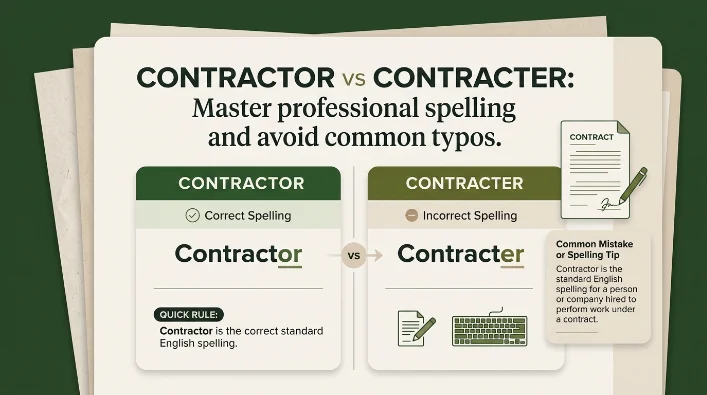
Contractor is the correct spelling for someone who works under a contract. “Contracter” is a common misspelling and is not recognized as a standard word in English dictionaries. Always use contractor when referring to a person or company that performs work under a contractual agreement.
You’re writing a business email, drafting a legal document, or updating your company website, and suddenly you hesitate. Should it be “contractor” or “contracter”? That extra “o” or missing “o” can make you second-guess yourself, and you’re not alone. This spelling confusion trips up professionals, students, and even native English speakers more often than you might think.
The difference between these two spellings is actually straightforward one is correct, and one simply isn’t. Yet the confusion persists because English spelling rules have so many exceptions that even straightforward words like contractor can suddenly look suspicious. By the end of this guide, you’ll never second-guess this word again, and more importantly, you’ll understand exactly why the correct spelling works the way it does.
Contractor vs Contracter: What’s the Difference?
The short answer is that contractor is the only correct spelling. “Contracter” is a misspelling that appears in informal writing but has no legitimate standing in standard English.
Contractor refers to a person, company, or entity that agrees to perform work or provide services under the terms of a contract. This includes construction contractors, independent contractors, government contractors, and defense contractors. The word carries legal and professional weight because it describes someone bound by a formal agreement to deliver specific results.
Contracter follows a predictable spelling pattern that seems logical you add “-er” to the verb “contract” to indicate someone who contracts. However, English doesn’t always follow its own rules, and this is one of those cases where the standard spelling requires the “-or” suffix instead.
| Feature | Contractor | Contracter |
|---|---|---|
| Status | Correct standard spelling | Common misspelling |
| Part of Speech | Noun | Not a recognized word |
| Meaning | Person or company performing work under contract | No standard definition |
| Usage Context | Legal, business, construction, professional settings | Incorrect usage in any context |
| Dictionary Recognition | Listed in all major dictionaries | Absent from standard dictionaries |
| Professional Acceptability | Fully acceptable | Unacceptable in professional writing |
The confusion between these two spellings stems from a broader uncertainty about when English words use “-er” versus “-or” to form agent nouns. While both suffixes serve similar purposes, English has established conventions that make certain spellings standard.
Is This a Grammar, Vocabulary, or Usage Issue?
This question touches on all three areas, but understanding the distinction helps you grasp why the correct spelling matters.
Grammar Classification
From a grammatical perspective, contractor is an agent noun a word that identifies someone who performs an action. The base verb “contract” means to enter into a formal agreement or to become smaller (depending on context), and the suffix “-or” transforms it into a noun describing the person performing that action. This follows a common grammatical pattern in English where verbs become nouns through suffix addition.
Vocabulary Difference
In terms of vocabulary, there’s no real comparison because only one word exists in the dictionary. Contractor belongs to the professional and legal vocabulary category, commonly appearing in business contracts, construction documents, government procurement, and employment discussions. The misspelling “contracter” doesn’t expand your vocabulary it simply reveals uncertainty about standard spelling conventions.
Usage Distinction
The usage question is where most people get confused. Because English has many words ending in both “-er” and “-or” (teacher vs. actor, writer vs. inventor), writers often guess which suffix applies. However, contractor follows a consistent pattern: words borrowed from Latin or French often take “-or,” while Germanic-origin words typically take “-er.”
Are They Interchangeable?
No, because “contracter” isn’t a recognized word. Using it in professional writing would be considered a spelling error. In formal contexts like legal documents, business proposals, or academic writing, using “contracter” could undermine your credibility or even create confusion in contractual language where precision matters.
Context Matters
| Context | Preferred Spelling |
|---|---|
| Formal English | Contractor |
| Business English | Contractor |
| Academic Writing | Contractor |
| Legal Documents | Contractor |
| Everyday Conversation | Contractor |
| Professional Email | Contractor |
| Social Media | Contractor (correct spelling preferred) |
Practical Takeaway: Always use “contractor” in every context. There is no situation where “contracter” is acceptable in standard English.
What Is a Contractor? (Full Guide)
A contractor is an individual or business entity that agrees to perform specific work, provide services, or deliver goods under the terms of a legally binding contract. This definition covers a remarkably wide range of professionals across virtually every industry.
Core Meaning
The word “contractor” derives from the verb “contract,” meaning to enter into a formal agreement. A contractor is literally “one who contracts” someone who binds themselves by agreement to deliver specific results. This legal foundation distinguishes contractors from employees, who work under different types of arrangements with distinct rights and responsibilities.
Pronunciation
US: /kənˈtræk.tər/
UK: /kənˈtræk.tə/
The stress falls on the second syllable, with the “o” in the final syllable pronounced as a schwa sound (like the “er” in “butter”). This pronunciation remains identical for both the singular and plural forms.
Part of Speech
Noun (countable). You can have one contractor or multiple contractors.
Common Collocations
Contractors frequently appear with specific descriptive words that help clarify their role or specialty:
- Independent contractor – Someone who works for themselves rather than as an employee
- General contractor – The primary contractor who oversees an entire construction project
- Subcontractor – A contractor hired by another contractor
- Government contractor – A company that provides goods or services to government agencies
- Construction contractor – A contractor specializing in building work
- Defense contractor – A company that provides military equipment or services
- Hired contractor – A contractor engaged for a specific project
- Licensed contractor – A contractor who holds required professional credentials
- Professional contractor – A contractor with recognized expertise in their field
- Freelance contractor – An independent contractor, often in creative or technical fields
Typical Sentence Patterns
Contractors appear in various sentence structures that highlight their professional role:
Pattern 1: Subject performing action
The contractor submitted the final invoice before the deadline.
Pattern 2: Identifying role
She works as an independent contractor for three different tech companies.
Pattern 3: Possession
The contractor’s insurance coverage protects both parties in case of accidents.
Pattern 4: Object of hiring action
The university hired a contractor to renovate the science building.
Pattern 5: Comparison
General contractors typically earn more than subcontractors on large projects.
Natural Workplace Example
“Our company works with a network of trusted contractors who handle everything from electrical work to custom carpentry. Every contractor must carry liability insurance and provide references before we add them to our approved vendor list.”
Academic Example
“Research suggests that independent contractors now represent approximately 36% of the U.S. workforce, a figure that has grown substantially with the expansion of the gig economy and digital platforms that facilitate freelance work arrangements.”
Technology Example
“The software development contractor delivered the beta version two weeks ahead of schedule, demonstrating why companies increasingly prefer contract workers for specialized technical projects.”
Email Example
“Subject: Contractor Onboarding
Hi Marcus,
I’m pleased to confirm that we’ve selected you as the contractor for the website redesign project. Please review the attached contract and send us your signed copy by Friday. We’ll need your contractor tax forms before we can process your first payment.”
Daily Conversation Example
“My brother works as a contractor now, so he’s always moving between different job sites. The flexibility works well for his family, but he misses having the same coworkers every day.”
One Learner Mistake
Incorrect: “We need to find a contracter for the kitchen renovation.”
Correct: “We need to find a contractor for the kitchen renovation.”
Learners often default to “-er” because it feels more natural. Remember that many words borrowed into English from Latin and French favor “-or” endings, and “contract” is one such word.
Mini Recap
Contractor is the noun for someone who works under contract. It appears in legal, business, and professional contexts. The pronunciation stresses the second syllable, and common collocations include “independent,” “general,” and “subcontractor.”
Why “Contracter” Is Incorrect
The spelling “contracter” appears occasionally in informal writing, especially online, but it has never been accepted as standard English. Here’s why it’s wrong and how to avoid the mistake.
The “-er” vs. “-or” Problem
English has two common suffixes for creating agent nouns (words describing someone who performs an action):
- -er appears in Germanic-origin words: teacher, writer, speaker, runner, swimmer
- -or appears in Latin-origin words: actor, doctor, inventor, professor, contractor
The problem arises because both suffixes sound identical when spoken. In American English, both are pronounced with the same schwa sound (/ər/). Since you can’t hear the difference, you have to memorize which spelling applies to which word.
Historical Development
“Contract” entered English from Latin through French. The Latin verb “contractus” (past participle of “contrahere,” meaning to draw together) formed the noun “contractor” in Latin. When these words migrated into English, they retained the Latin-influenced spelling with “-or” rather than adopting the Germanic “-er.”
Why People Make This Mistake
Several factors contribute to the “contracter” misspelling:
- Phonetic spelling – Since it sounds like “contracter,” people spell it the way they hear it
- Analogy with common “-er” words – Because “teacher,” “writer,” and “speaker” are so familiar, writers assume similar patterns apply
- Autocorrect reliance – Some writers have learned to depend on spell-check rather than memorizing correct spellings
- Lack of formal instruction – Many English courses don’t explicitly teach Latin-origin spelling patterns
Professional Consequences of This Mistake
Using “contracter” in professional writing carries real consequences:
- Legal documents – Misspelling in contracts could create ambiguity
- Business proposals – Errors undermine perceived professionalism
- Job applications – Mistakes suggest carelessness to potential employers
- Academic writing – Spelling errors reduce credibility
- Marketing materials – Errors can damage brand perception
Memory Tip
Remember this simple rule: “Contractors have a ‘tor’ like a motor.” Just as a motor powers a machine, the “-or” suffix powers the noun form. Or recall that “contractor” is spelled with an “O” because it’s someone who works on a prOject.
When Not to Use Each Word
Understanding when to use “contractor” is straightforward always. But understanding when you’re likely to make the mistake helps you avoid it.
Situations Where “Contracter” Commonly Appears (Incorrectly)
1. Quick Typing Situations
When you’re typing quickly, it’s easy to add “-er” out of habit. This happens most often in informal messages, social media posts, or rushed emails. The solution is to slow down when writing important business communications.
2. When Thinking About Verbs
If you’re thinking about the verb “contract,” your brain might automatically add “-er” to create the noun. Remember that not every verb follows the “verb + er” pattern. “Act” becomes “actor,” not “acter,” and “contract” follows the same rule.
3. Industry Jargon Confusion
Construction and legal industries have many specialized terms. Some use “-er” (inspector? No that’s another “-or” word!) and some use “-or.” This inconsistency creates confusion across the board.
4. Educational Settings
Students often spell “contracter” because they haven’t encountered the word in formal instruction. Teachers should explicitly teach this spelling pattern to prevent future errors.
5. Social Media and Forums
Online discussion forums, particularly in construction and freelancing communities, show a high frequency of this misspelling. Don’t follow the crowd correct spelling still matters in digital spaces.
6. Non-Native Speaker Writing
ESL students often default to “-er” because it’s more common in everyday English. Learning the Latin-origin “-or” pattern is an important step toward advanced proficiency.
How to Remember the Difference
| Mistake | Why It Happens | How to Avoid It |
|---|---|---|
| Contracter | Phonetic spelling | Memorize the “-or” pattern |
| Contracter | Analogy with “-er” words | Learn Latin-origin exceptions |
| Contracter | Typing habit | Proofread carefully |
| Contracter | Unfamiliarity | Practice using the correct spelling |
| Contracter | Following others’ mistakes | Use a dictionary or spell-check |
Common Mistakes Table
| Correct Sentence | Incorrect Sentence | Explanation |
|---|---|---|
| The contractor finished the project early. | The contracter finished the project early. | “Contractor” is the correct spelling. |
| We hired a contractor for the office expansion. | We hired a contracter for the office expansion. | Always use “contractor” in professional contexts. |
| Independent contractors often work from home. | Independent contracters often work from home. | The same rule applies to all forms and compounds. |
| The government contractor submitted a proposal. | The government contracter submitted a proposal. | Official documents require correct spelling. |
| She works as a contractor for three companies. | She works as a contracter for three companies. | Professional titles must be spelled correctly. |
| Contractors must carry liability insurance. | Contracters must carry liability insurance. | Industry terminology requires standard spelling. |
Decision Box
If you are referring to a person, company, or entity that performs work under a contract, use CONTRACTOR.
If you are using any other spelling, including “contracter,” you are making a spelling error.
Never use “contracter” in professional, academic, legal, or formal writing.
When in doubt, remember: “Contractor” is the only correct spelling for this word.
Real-World Examples
These practical examples show how “contractor” appears in authentic situations across various contexts.
Office Communication
“Please add the new contractor to our project management system so they can access the shared files. The contractor will need their login credentials before Monday’s kickoff meeting.”
Business Email
“Subject: Contractor Agreement Attached
Dear Team,
We’ve finalized the agreement with our new IT contractor. The contractor will begin work on the network upgrade project next month. Please send any relevant documentation to the contractor’s project manager by Friday.”
Academic Context
“A growing body of research examines the relationship between contractor status and worker protections. Studies indicate that independent contractors often lack access to benefits that employees receive, raising questions about labor law reform.”
Customer Support
“Thank you for contacting us about your HVAC issue. We’ve dispatched a contractor to your location and they should arrive within two hours. The contractor will call you fifteen minutes before they arrive.”
Technology
“The development contractor created an API that integrates seamlessly with our existing database. Because the contractor specializes in this specific technology, we were able to complete the integration in half the expected time.”
Artificial Intelligence
“AI-powered platforms increasingly match contractors with projects based on skill profiles and past performance. These systems help contractors find work while helping companies identify qualified professionals faster than traditional hiring methods.”
Daily Conversation
“We finally found a contractor to fix our roof after that storm last month. The contractor came highly recommended by our neighbors, and their estimate was surprisingly reasonable.”
Contractor in Modern Technology
The concept of a contractor has evolved significantly with technological advancement. Today, the term encompasses a much broader range of professionals than it did just a generation ago.
Artificial Intelligence and Automation
AI has transformed how contractors work and how they’re managed. Machine learning algorithms now help match contractors with projects, predict project timelines, and even evaluate contractor performance. Some platforms use AI to handle contractor onboarding, payment processing, and compliance verification automatically.
Virtual Assistants and Digital Platforms
The rise of digital platforms has created entirely new categories of contractors. Gig economy workers, freelance developers, and platform-based service providers all fall under the contractor umbrella, even though their work arrangements differ from traditional construction or consulting contractors.
Remote Work and Global Contractors
Technology has enabled contractors to work from anywhere, creating a global talent marketplace. Companies routinely hire contractors in different time zones, leveraging digital collaboration tools to manage distributed teams. This shift has expanded opportunities for contractors while requiring new approaches to project management and communication.
Business Tools
Modern contractors use sophisticated software for time tracking, invoicing, project management, and client communication. These tools have professionalized contractor operations, allowing independent professionals to compete with larger firms on service quality and responsiveness.
The Future of Contracting
The trend toward flexible work arrangements suggests that the contractor model will continue to grow. Companies increasingly prefer to hire contractors for specialized projects rather than maintaining large permanent staffs, while workers value the flexibility and autonomy that independent contracting provides.
Word Origin and History
Understanding the origin of “contractor” helps explain why it’s spelled with an “-or” rather than “-er.”
Latin Roots
“Contractor” traces back to the Latin verb “contrahere,” which combines “con-” (together) and “trahere” (to draw). The literal meaning was “to draw together,” which evolved to mean “to make a formal agreement.” In Latin, “contractor” referred to someone who entered into a formal agreement or undertaking.
Journey Through French
When Latin words entered English, many came through French following the Norman Conquest of 1066. French preserved the Latin “-or” spelling pattern in many cases, including “contracteur” (now “contracteur” in modern French). English adopted this spelling, retaining the “-or” suffix that distinguishes it from Germanic-origin words.
Development of the Modern Meaning
The meaning of “contractor” has broadened over time. In medieval England, a contractor was typically someone undertaking building work. By the 19th century, the term had expanded to include anyone performing work under a formal agreement. Today, it encompasses everything from construction firms to freelance graphic designers.
Why Spelling Endures
Unlike some English words that have simplified over time, “contractor” has maintained its traditional spelling. This consistency reflects the word’s legal and professional significance precision matters in contractual language, and spelling conventions support that precision.
Expert Insight
As an experienced language instructor, I’ve seen countless students struggle with “-er” versus “-or” endings. The challenge isn’t about intelligence it’s about exposure and pattern recognition. Most of us learn these spellings organically through reading, but if you’re not encountering the word regularly, the correct spelling simply doesn’t stick.
What I tell my students is this: think of these spellings as vocabulary you need to memorize, not as rules you can deduce. When you encounter a new word ending in “-er” or “-or,” make a mental note of which suffix appears. Over time, you’ll develop an instinct for these patterns.
For “contractor” specifically, I recommend connecting it to other Latin-origin professional words like “doctor,” “actor,” “professor,” and “inventor.” These all share the “-or” pattern and come from similar linguistic roots. Build a mental category of “-or” words, and you’ll never confuse them with the Germanic “-er” words like “teacher” and “writer.
Most importantly, remember that even native English speakers make spelling errors. What separates professional writers from casual writers isn’t knowing every spelling rule it’s knowing how to check your work and correct mistakes.
Error Prevention Checklist
Always use “contractor” when:
- Describing someone who performs work under a formal agreement
- Writing about construction or building professionals
- Discussing independent workers or freelancers
- Referencing government, defense, or corporate contract workers
- Using the term in legal, business, or professional documents
- Writing for academic, professional, or formal audiences
Never confuse “contractor” with:
- Contract (the noun or verb form)
- Contracted (the adjective)
- Contraction (a different word entirely)
- Contractible (describing something that can be contracted)
Quick Memory Tip:
Remember that “contractor” is spelled with an O just like “prOject” and “professional.” Contractors work on projects professionally.
Related Grammar Confusions
Similar spelling and word-choice dilemmas often confuse English learners and professionals alike. These related pairs follow similar patterns to the contractor vs. contracter confusion.
Affect vs. Effect – One of the most common grammar confusions in English. Affect” is usually a verb meaning to influence, while “effect” is typically a noun meaning result.
Compliment vs. Complement – These words sound identical but have different meanings. A compliment is praise, while something that complements completes or enhances something else.
Principal vs. Principle – A principal is a person in charge (or a sum of money), while a principle is a fundamental truth or belief.
Stationary vs. Stationery – Stationary means not moving, while stationery refers to writing paper and office supplies.
Accept vs. Except – To accept is to receive or agree, while except means excluding or other than.
Advice vs. Advise – Advice is a noun (guidance), while advise is a verb (to give guidance).
Practice vs. Practise – In US English, practice serves as both noun and verb. In UK English, practice is a noun and practise is a verb.
Ensure vs. Insure – Ensure means to guarantee, while insure refers specifically to insurance coverage.
Everyday vs. Every Day – Everyday is an adjective meaning ordinary, while every day means each day.
Who’s vs. Whose – Who’s is a contraction of who is, while whose indicates possession.
Understanding these common confusions helps build overall language confidence. Each follows similar patterns of sound similarity or spelling confusion that require attention to detail rather than complex rules.
FAQs
Is “contracter” ever acceptable in modern English?
No. “Contracter” is not recognized as a standard English word in any major dictionary. It appears occasionally in informal writing as a misspelling of “contractor,” but it has no legitimate usage in standard English. Always use “contractor” instead.
Why do some people spell it “contracter”?
The misspelling occurs because both “-er” and “-or” sound identical when spoken. People who haven’t memorized the correct spelling often default to “-er” because it’s more common in everyday English words like “teacher” and “writer.” Additionally, some writers type phonetically and don’t double-check their spelling.
Can I use “contracter” in informal writing?
While you might see this spelling in social media or casual messages, it’s still a spelling error. Using the incorrect spelling in any context can create bad habits and may lead to mistakes in professional writing. It’s better to use the correct spelling consistently, even informally.
What’s the plural form of contractor?
The plural form is “contractors.” The same spelling rules apply always use the “-or” ending. Examples: “We hired several contractors for the project” or “Local contractors submitted bids for the renovation.”
How do I remember the correct spelling?
Remember that “contractor” has an “O” like “project.” Contractors work on projects, so think “prOject” → “contractOr.” Or create a mnemonic: “A contractor is an organized professional.” The key is to connect the “-or” ending with the word’s professional meaning.
What’s the difference between a contractor and an employee?
A contractor works independently under a contract to produce specific results, while an employee works directly for an employer under an ongoing arrangement. Contractors typically control their own work methods, set their own schedules, and provide their own tools, while employees work under employer direction and receive benefits like health insurance and paid time off.
Is an independent contractor the same as a freelancer?
They’re similar but not identical. Freelancers typically work in creative or knowledge fields and often work on multiple small projects. Independent contractors encompass a broader range, including construction workers, consultants, and other professionals. Both terms emphasize self-employment and contract-based work, but “independent contractor” has specific legal and tax implications in many jurisdictions.
How is “contractor” pronounced?
In US English, it’s pronounced /kənˈtræk.tər/. In UK English, it’s /kənˈtræk.tə/. Both pronunciations stress the second syllable, and the final syllable uses the schwa sound (like the “er” in “butter”). Both spellings sound identical, which is part of why people confuse them.
Conclusion
The difference between “contractor” and “contracter” is simple: one is correct, and one isn’t. Contractor is the established, dictionary-recognized spelling for someone who performs work under a contract. “Contracter” is a common misspelling that has no place in professional, academic, or formal writing.
The confusion arises from the identical pronunciation of both spellings and uncertainty about when English uses “-er” versus “-or” for agent nouns. Remember that words with Latin or French origins, like “contractor,” typically take the “-or” suffix. Words with Germanic origins, like “teacher,” typically take “-er.”
What matters most is consistency in your professional communication. Using the correct spelling demonstrates attention to detail, respect for your readers, and professional competence. It’s a small detail that makes a significant impression.
The one rule to remember: Whenever you’re referring to someone who works under a contract, spell it contractor with an “O” in the final syllable. That single letter separates professional writing from amateur errors, and now you know exactly which one to use.