Quick Answer
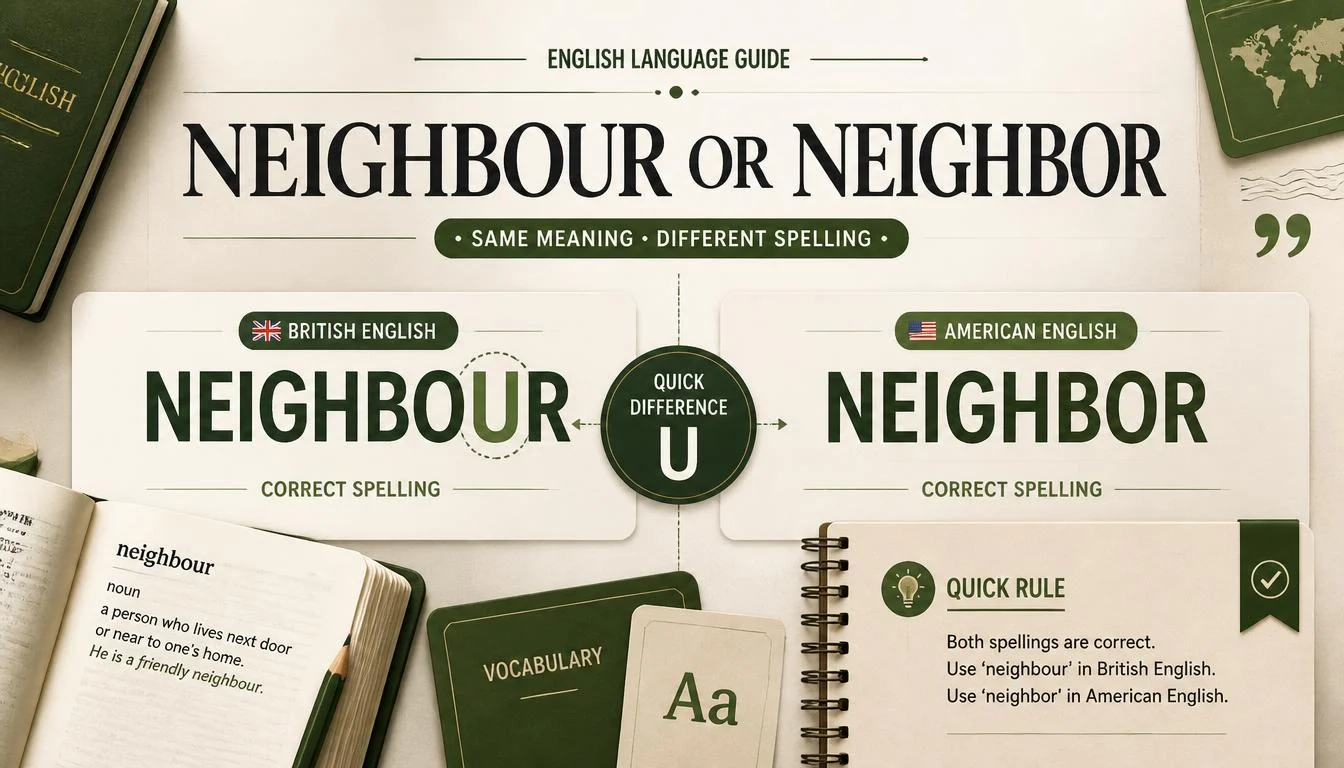
The difference between neighbour and neighbor is purely a matter of spelling convention based on regional English standards. Neighbour is the British English spelling used in the UK, Canada, Australia, and other Commonwealth nations, while neighbor is the American English spelling used in the United States. Both words share the exact same meaning and pronunciation .
If you’re wondering whether Neighbour or Neighbor is the correct spelling, both forms are correct. The difference depends mainly on which variety of English you’re using. Neighbour is standard in British English, while neighbor is preferred in American English.
Both words have the same meaning and pronunciation. In this guide, we’ll explain the difference between neighbour and neighbor, show clear examples, and help you choose the right spelling for your audience.
In this guide, we will break down exactly where and why each spelling is used. You will learn the historical reasons for the difference, see plenty of practical examples, and walk away with a clear strategy for choosing the correct form every time.
What’s the Difference Between Neighbour and Neighbor?
The core difference is straightforward: it is a matter of geography, not meaning. The word refers to a person who lives near or next door to another person. It can also refer to a nearby object, place, or even a fellow human being in a broader sense .
| Feature | Neighbour | Neighbor |
|---|---|---|
| Meaning | A person living near another; a nearby object or place; a fellow human | A person living near another; a nearby object or place; a fellow human |
| Part of Speech | Noun, verb, and adjective | Noun, verb, and adjective |
| Primary Use | British English, Australian English, Canadian English, and other Commonwealth varieties | American English |
| Typical Usage | UK, Australia, New Zealand, South Africa, Canada | United States |
| Example | “Our new neighbour brought us a cake.” | “Our new neighbor brought us a cake.” |
| Common Confusion | Spelling—whether to include the letter u | Spelling—whether to include the letter u |
To recap, both words are the same in every way except for the presence of the letter u. They sound the same when spoken, function the same in sentences, and carry the same dictionary definitions. Your choice between them should be guided entirely by your audience .
Is This a Grammar, Vocabulary, or Usage Issue?
This is primarily a spelling and usage issue, rather than a matter of grammar or vocabulary. The word itself is the same word with an alternative spelling. To understand why, it helps to examine the different categories this fits into.
Grammar Classification
Grammatically, the word functions perfectly the same way in all its forms. Whether spelled with or without the u, it acts as a noun referring to a person or thing, a verb meaning to be situated nearby, and an adjective describing a nearby entity. The rules for how it interacts with other words in a sentence are identical.
Vocabulary Difference
From a vocabulary perspective, there is no difference at all. Both spellings represent the exact same lexical entry. The core meaning—someone who lives nearby—remains constant across all English-speaking regions .
Usage Difference
The distinction lies entirely in the context of use. This belongs to the category of regional spelling differences, similar to color versus colour, or center versus centre .
Are They Interchangeable?
Yes and no. They are interchangeable in the sense that readers will understand you regardless of which spelling you use. However, in formal writing, it is important to stick to one standard throughout your document. Mixing British and American spellings can appear careless or confusing to readers .
Formal and Business English
In formal and business contexts, the choice matters. If you are writing a report for a client in London, you should use the British spelling. If your audience is based in New York, the American spelling is the correct choice.
Academic Writing
Academic writing demands consistency. Institutions typically specify which English standard they expect. For example, APA style tends to favor American English, while many humanities journals in the UK use British conventions.
Everyday Conversation
In casual writing and conversation, people are generally more forgiving. However, your preferred spelling still signals your linguistic background.
Practical Takeaway
Always consider who will read your work. The correct choice is the one that matches the English standard your audience expects.
Neighbour: The British Spelling
Neighbour is the spelling you will encounter in the United Kingdom, Ireland, Australia, New Zealand, South Africa, and Canada (though Canada is heavily influenced by American conventions as well). It is the traditional spelling that has been in use for centuries in the English-speaking world .
Pronunciation
The word is pronounced /ˈneɪ.bər/ in both British and American English. The spelling difference does not affect the sound.
Common Collocations
The word appears in several common phrases:
- Next-door neighbour
- Neighbourhood
- Neighbourly
- Neighbouring
Typical Sentence Patterns
- As a noun: “My neighbour is a doctor.”
- As a verb: “Canada neighbours the United States.”
- As an adjective: “We went to the neighbouring town.”
Practical Examples
Workplace Example
“James, our new office neighbour from the marketing team, stopped by to introduce himself today.”
Academic Example
“In examining the diplomatic relations between the two countries, the study focuses on how France interacts with its eastern neighbour, Germany.”
Email Example
“Dear Mr. Davison, my family and I would like to invite our new neighbours to a small gathering on Saturday evening.”
Daily Conversation Example
“I bumped into my neighbour at the supermarket this morning.”
One Learner Mistake
A common error is spelling the word as “neigbour,” which confuses the placement of the u and i. The correct order is neigh-bour. Remembering that the word starts with “neigh” like a horse’s sound can help you remember the spelling of the first part.
Mini Recap
Use “neighbour” when writing for a British or Commonwealth audience. It is the spelling that will look correct and natural to them.
Neighbor: The American Spelling
Neighbor is the standard spelling in the United States. It was largely popularized by Noah Webster, an American lexicographer, who sought to simplify and create a distinct American identity in the language .
Pronunciation
The pronunciation is the same as the British version: /ˈneɪ.bər/.
Common Collocations
- Next-door neighbor
- Neighborhood
- Neighborly
- Neighboring
Typical Sentence Patterns
- As a noun: “My neighbor is a doctor.”
- As a verb: “The United States neighbors Canada.”
- As an adjective: “We went to the neighboring town.”
Practical Examples
Workplace Example
“Sarah, my cubicle neighbor in the office, is organizing a potluck for next Friday.”
Academic Example
“In her thesis on border communities, she explores the dynamics of San Diego and its neighbor, Tijuana.”
Email Example
“Hi Team, please welcome our new neighbor in the office space, the accounting department. Let’s be neighborly and offer them a hand.”
Daily Conversation Example
“My neighbor helped me jump-start my car this morning.”
One Learner Mistake
A common error is forgetting to drop the u and spelling it as “neighour.” This results from confusing British and American conventions.
Mini Recap
Use “neighbor” when writing for an American audience. It is the recommended form in all official publications and standard American texts .
When Not to Use Each Word
Choosing the wrong spelling is rarely a matter of meaning, but it can still be a mistake in context. Here are some situations where writers commonly get this wrong.
When Writing for an American Publication
The Mistake: Using the British spelling in a text meant for an American publisher or audience.
Why It Happens: The writer might be accustomed to the British spelling or may not realize the specific requirement.
The Fix: Always check your audience and use the American form for American publications.
When Writing for the UK Government or a British Institution
The Mistake: Using the American spelling in a formal British context.
Why It Happens: The writer may be more exposed to American media, which dominates globally.
The Fix: Set your spell checker to British English for these situations.
In a Mix-and-Match Approach
The Mistake: Using both spellings in the same document.
Why It Happens: Lack of attention to detail or editing.
The Fix: Use the find-and-replace tool to ensure consistency in a document.
In a Job Application
The Mistake: Using the wrong regional spelling in a cover letter or CV.
Why It Happens: Failing to tailor the application to the location of the job.
The Fix: Look at the company’s website to see which English standard they use.
On a Resume
The Mistake: Spelling the word differently from other words in the document (e.g., using color but spelling neighbor).
Why It Happens: Not paying attention to a set of words that follow the same pattern.
The Fix: The “our” vs. “or” rule applies to many words, so be consistent across all of them.
In Social Media
The Mistake: This is a lower-stakes context, but choosing a spelling that does not align with your brand can confuse followers.
The Fix: Choose one standard and stick to it for your brand’s voice.
Common Mistakes Table
Quick Decision Box
If you are writing for:
- The United States: Always use neighbor.
- The United Kingdom: Always use neighbour.
- Australia, New Zealand, South Africa: Use neighbour.
- Canada: Both are accepted, but British spelling is more traditional.
- A global audience: Choose one style and remain consistent throughout the piece.
- A specific institution or company: Check their style guide or website.
Real-World Examples
Seeing the words in action can help you internalize their usage. Here are some practical scenarios across various fields.
Office Communication
“Please make sure to inform our new neighbor in the office, the legal team, about our tea schedule.” (American)
“Please make sure to inform our new neighbour in the office, the legal team, about our tea schedule.” (British)
Business Email
“Dear Ms. Chen, we value our local partnerships and are delighted to have you as a neighbor in the business park.” (American)
“Dear Ms. Chen, we value our local partnerships and are delighted to have you as a neighbour in the business park.” (British)
School or University
The university actively engages with its neighbors to support the local community.” (American)
“The university actively engages with its neighbours to support the local community.” (British)
Customer Support
“We understand your concern about the noise from the construction site, and we are in touch with the neighbor business to find a solution.” (American)
“We understand your concern about the noise from the construction site, and we are in touch with the neighbour business to find a solution.” (British)
Technology
“The tech hub is proud to have numerous innovative startups as its neighbors.” (American)
“The tech hub is proud to have numerous innovative startups as its neighbours.” (British)
Daily Conversation
“Can you ask your neighbor to turn the music down a bit?” (American)
“Can you ask your neighbour to turn the music down a bit?” (British)
Modern Technology and the Word “Neighbor/Neighbour”
The rise of technology and global communication has made understanding these spellings more relevant than ever.
Artificial Intelligence and Virtual Assistants
When using voice-to-text or dictation, AI algorithms often default to the regional spelling associated with the device’s language settings. You might find your British English speech transcribed with American spelling or vice versa, depending on your software.
Autocorrect and Spell Check
Spellcheck tools in word processors are usually set to a specific language version (e.g., “English (UK)” or “English (US)”). It is important to ensure this setting matches your intended audience. Autocorrect will often flag the “incorrect” regional spelling as an error, which can be confusing if you are not aware of the setting.
Global Software Development
For software companies with international user bases, localizing the interface for different countries often includes using the correct regional spelling for the word. This is a key part of ensuring a product feels native and professional to users in different regions.
Word Origin
The story of how this spelling difference came to be is tied to the history of the English language itself.
The word comes from the Old English word neahgebur, which is a combination of two elements: neah, meaning “near,” and gebur, meaning “dweller” or “peasant.” This effectively translates to “near-dweller,” which is exactly what the word means today.
For centuries, the spelling remained relatively stable as it passed through Middle English. The modern spelling with the “u” became the standard in British English. The American spelling without the “u” emerged as a conscious effort to simplify spelling and create a distinct American identity. This was largely driven by Noah Webster in the early 19th century. He argued for simplified spellings, and his dictionary, published in 1828, standardized many of these differences, including removing the “u” from words like honour, colour, and neighbour .
Expert Insight
As a language instructor for over a decade, I have seen many students agonize over spelling. The key is to remember that spelling rules and conventions are tools. When you are learning English, you are learning not just the language but its cultural contexts.
The difference between neighbor and neighbour is not about right or wrong, but about who you are speaking to. It is a test of your audience awareness, which is a crucial skill in effective communication. Think of it like choosing the right language in a multilingual conversation. If you are in the US, you speak American English. If you are in the UK, you speak British English. The same goes for your writing. Once you see it this way, the choice becomes logical rather than confusing.
Error Prevention Checklist
- Always use “neighbor” when: You are writing for an American audience, following US style guides, or using American English as your standard.
- Always use “neighbour” when: You are writing for a British, Australian, Canadian, or other Commonwealth audience, or following UK style guides.
- Never confuse them if: You are writing a formal document; inconsistency will make it appear unprofessional.
- Quick memory tip: Remember that the U in neighbour stands for United Kingdom.
Related Grammar Confusions
English is full of similar regional spelling variations. Learning about them can prevent future confusion.
- Color vs. Colour: Understand the same “u” rule applies to this common word.
- Center vs. Centre: Learn the difference between American and British spellings of locations.
- Organize vs. Organise: The American and British conventions for words ending with -ize or -ise.
- Theater vs. Theatre: Explore how this word’s spelling changes based on region and context.
- Traveling vs. Travelling: See how the rule for doubling the consonant differs between American and British English.
- Gray vs. Grey: Understand that this is another word with two accepted spellings.
- Defense vs. Defence: Learn how American and British spelling conventions differ for this word.
- Realize vs. Realise: A deeper look into how the -ize vs. -ise pattern works.
- Apologize vs. Apologise: A very common word where the difference appears.
- Catalog vs. Catalogue: Another example showing the difference between US and UK spelling conventions.
FAQs
What is the difference between a neighbour and a neighbor?
There is no difference in meaning between neighbour and neighbor. The only difference is the spelling. Neighbour is the standard British English spelling, while neighbor is the standard American English spelling.
Why is neighbor spelled with a u in British English?
The British spelling neighbour retains the u found in the word’s historical spelling and influenced by French. American English later simplified the spelling of many words, including neighbor, following spelling reforms associated with Noah Webster.
Is “neighbour” used in Canada?
Yes. Neighbour is widely accepted in Canadian English, which often follows British spelling conventions. However, because of Canada’s close cultural and geographic connection with the United States, neighbor is also sometimes seen.
Which spelling should I use for an international audience?
Choose either neighbour or neighbor based on your preferred English variety, and use it consistently. If your audience or organization has a specific style guide, follow that preference. For global content, consistency matters more than choosing one spelling over the other.
What is the plural of neighbor?
The plural depends on the spelling system you’re using. Neighbors is the American English plural of neighbor, while neighbours is the British English plural of neighbour.
Conclusion
The difference between neighbour and neighbor is a classic example of how the English language has evolved across different regions. It is not a matter of one being right and the other wrong; it is a question of choosing the correct standard for your audience. The American spelling, “neighbor,” drops the ‘u’, while the British spelling, “neighbour,” retains it.
Remember, the core meaning of the word is consistent everywhere in the world: it refers to someone who lives near you. The key takeaway is that consistency is crucial. Pick the spelling that fits your regional context and stick with it throughout your writing. This small act of attention to detail can make a significant difference in how professional and polished your work appears.
Read More Related Articles:
- Shiny or Shiney | Avoid This Simple Spelling Error in English In 2026
- Occasion or Ocassion | Common Mistake Explained with Real-Life Examples In 2026
- Cacoon or Cocoon | Simple Rule You’ll Never Forget In 2026

Zoe Chambers works as a content writer at synoseek.com, contributing thoughtful pieces on everyday subjects and ideas. She writes in a simple, grounded way, often drawing from real-world experiences. Her focus is on keeping content natural, clear and easy for readers to connect with.
4 thoughts on “Neighbour or Neighbor | One Word, Two English Spellings In 2026”