Quick Answer
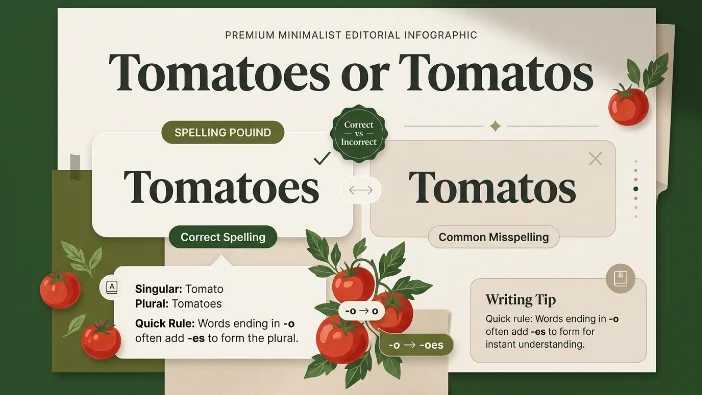
Tomatoes is the correct plural spelling, not “Tomatos.” English nouns ending in a consonant plus “o” usually take “-es” in the plural form, and tomato follows this pattern along with words like potatoes and heroes. “Tomatos” is a common misspelling that drops the required “e” before the final “s.”
You’re writing a grocery list, a recipe, or maybe a school assignment, and suddenly you freeze. Is it “I bought three tomatoes” or “I bought three tomatos”? This tiny spelling decision trips up more writers than you’d expect, including native English speakers who’ve been eating the fruit their whole lives.
The confusion isn’t random. English plurals don’t always follow one clean rule, and words ending in “o” are notorious troublemakers. Some take a simple “s” (like pianos or photos), while others demand the fuller “-es” ending (like potatoes or echoes). Tomato happens to fall into that second, trickier group, which is exactly why so many people default to the shorter, seemingly logical “tomatos.”
By the end of this guide, you’ll know exactly why “tomatoes” wins every time, how to remember the rule without memorizing a giant list of exceptions, and where this spelling mistake shows up most often in real writing, from restaurant menus to autocorrect suggestions.
Tomatoes or Tomatos: What’s the Difference?
There isn’t really a “difference” in meaning here, since only one of these two spellings is actually a word. Tomatoes” is the standard, dictionary-recognized plural of “tomato.” “Tomatos” is a spelling error, not an alternate or informal version, even though it appears constantly online, on hand-lettered signs, and in casual texts.
That said, understanding why the mistake happens is more useful than just memorizing the correct form. Here’s a side-by-side breakdown of how each one functions in real usage.
| Spelling | Status | Part of Speech | Refers To | Typical Usage | Common Confusion |
|---|---|---|---|---|---|
| Tomatoes | Correct | Noun (plural) | More than one tomato | Recipes, grocery lists, formal and informal writing | Sometimes mistakenly shortened to “tomatos” |
| Tomatos | Incorrect | Not a recognized word | Meant to represent plural tomato | Frequently seen on signage and social media | Mistaken for a valid alternate spelling |
The short version: if you’re talking about more than one tomato, “tomatoes” is the only spelling that belongs in a dictionary, a resume, an email, or a published article. “Tomatos” might get the message across in casual texting, but it will read as a mistake to anyone who notices spelling.
Is Tomatoes a Grammar Issue or a Spelling Issue?
This mix-up sits firmly in the spelling category rather than grammar. Grammar deals with sentence structure, word order, and how words function together. Spelling deals with how a single word is written. “Tomatoes” versus “tomatos” is entirely about which letters belong in the plural form of one noun.
It’s also not a matter of formal versus informal English. Unlike some word pairs where one version is acceptable in casual writing and another is required in professional documents, “tomatos” isn’t correct in any register. Business emails, academic papers, text messages to a friend, and social media captions should all use “tomatoes.” There’s no context where the shorter spelling becomes acceptable, aside from stylized branding or intentional wordplay, such as a restaurant calling itself “Tomatos” as a stylistic choice.
Practical takeaway: treat this as a spelling rule to memorize once, not a judgment call that changes based on audience or tone.
Why “Tomatoes” Is the Correct Spelling
English has a general pattern for nouns that end in a consonant followed by “o.” Many of these words add “-es” rather than just “s” when forming the plural. Tomato fits this pattern because it ends in “consonant + o,” specifically “t” followed by “o.”
Pronunciation clue: Say “tomatoes” out loud. You’ll notice the extra syllable created by the “e,” which softens the ending and matches how English speakers naturally say the word.
Common collocations: “fresh tomatoes,” “ripe tomatoes,” “canned tomatoes,” “sliced tomatoes,” “a pound of tomatoes.”
Typical sentence patterns: Tomatoes usually appear as the object of a verb related to buying, growing, cooking, or eating: “grow tomatoes,” “chop tomatoes,” “add the tomatoes.”
Here’s how this plays out across different real-world contexts:
- Workplace example: “Can you order more tomatoes for the kitchen before the weekend rush?”
- Academic example: “The study measured how greenhouse tomatoes responded to reduced watering schedules.”
- Technology example: A grocery delivery app auto-corrects a search for “tomatos” and suggests “tomatoes” instead.
- Email example: “Attached is the invoice for 200 pounds of Roma tomatoes delivered on Tuesday.”
- Daily conversation example: “These tomatoes from the farmers market taste so much better than store-bought.”
One learner mistake: Many English learners assume all nouns ending in “o” simply add “s,” based on words like “photos” or “logos.” Tomato doesn’t follow that shortcut, which is exactly where the confusion starts.
Mini recap: Tomatoes is a plural noun formed by adding “-es” to tomato, following the same pattern as potato, hero, and echo. It’s correct in every writing context, from casual to formal.
Why “Tomatos” Feels Right (But Isn’t)
If “tomatos” isn’t a real word, why does it show up so often? The answer has more to do with how English plurals generally work than with any deep confusion about the fruit itself.
The pattern most people learn first: Most plural nouns in English simply add an “s.” Cats, dogs, cars, phones. This is the default rule taught early, so it becomes the automatic instinct for nearly every new word, including tomato.
Interference from other “-o” words: Words like piano, photo, halo, and logo all take a simple “s” in the plural. Someone who recently used “photos” correctly might unconsciously apply the same logic to “tomatos,” not realizing tomato belongs to a different subgroup.
Visual and typing habits: Because “tomato” already ends in “o,” some writers assume adding a single letter is enough, without registering that an “e” needs to slide in first. This is especially common in fast typing, texting, or handwritten signs where the goal is speed rather than accuracy.
Real-world example: A produce sign reading “Fresh Tomatos $2/lb” is one of the most frequently spotted spelling errors in grocery stores and farmers markets nationwide.
One learner mistake: Assuming the “-o” ending always behaves the same way is the single biggest reason “tomatos” keeps appearing, even among fluent English speakers.
Mini recap: “Tomatos” isn’t a regional variation or informal shortcut. It’s a spelling slip that happens because English plural rules for “-o” endings aren’t consistent, and tomato falls on the less intuitive side of that inconsistency.
When Writers Commonly Get This Wrong
- Typing quickly without proofreading. Fast typing on phones often skips the extra “e,” especially since autocorrect doesn’t always catch it if “tomatos” resembles a plausible word.
- Following the pattern of similar-looking words. As mentioned, words like photos, pianos, and avocados (yes, avocados also takes “-es” in some style guides, though “avocados” with just an “s” is now widely accepted) create inconsistent expectations.
- Confusing tomato with words that do take a simple “s.” Radios, kilos, and solos all just add “s,” which reinforces the wrong instinct.
- Relying on spoken pronunciation alone. Some regional accents blend the “-oes” ending enough that writers don’t consciously register the extra syllable.
- Copying signage or menus that already contain the error. Once a misspelled sign exists in a store, other writers sometimes copy the same mistake without questioning it.
- Assuming brand names are grammatically correct. Product packaging or restaurant names sometimes use “Tomatos” stylistically, which can mislead writers into thinking it’s an accepted spelling.
- Skipping spell-check in casual writing. Texts, social captions, and quick notes rarely get the same scrutiny as formal documents, letting the error slip through repeatedly.
- Second-language interference. In some languages, plural forms are simpler or don’t require this kind of internal spelling change, so learners transfer that simplicity into English.
How to remember the difference: Picture the word “potatoes.” Almost everyone spells that one correctly because “potatos” looks obviously wrong. Tomato rhymes with potato and follows the exact same plural rule, so if you can trust one, you can trust the other.
Common Mistakes Table
| Correct Sentence | Incorrect Sentence | Explanation |
|---|---|---|
| I sliced two tomatoes for the salad. | I sliced two tomatos for the salad. | “Tomatos” drops the required “e” before the plural “s.” |
| The recipe calls for canned tomatoes. | The recipe calls for canned tomatos. | Canned goods labels should always use the correct plural form. |
| Fresh tomatoes are cheaper in summer. | Fresh tomatos are cheaper in summer. | Seasonal produce writing still follows standard spelling rules. |
| Our garden grew over fifty tomatoes this year. | Our garden grew over fifty tomatos this year. | Even casual gardening posts benefit from correct spelling. |
| She ordered a sandwich with extra tomatoes. | She ordered a sandwich with extra tomatos. | Restaurant menus should avoid this frequent typo. |
Quick Decision Box
If you’re writing about more than one tomato, the spelling is always tomatoes.
There is no situation in standard English writing where tomatos is correct, aside from an intentional stylistic brand name.
Real World Examples
Office communication: “Please remind the cafeteria staff that the salad bar is out of tomatoes again.”
Business email: “Our supplier confirmed delivery of 500 crates of tomatoes for next week’s shipment.”
School or university: A biology worksheet asks students to compare how tomatoes and potatoes grow differently underground versus above ground.
Customer support: A grocery chatbot responds, “We currently have Roma, cherry, and beefsteak tomatoes in stock.”
Technology: A recipe app’s search bar automatically corrects “tomatos” to “tomatoes” as the user types.
Artificial Intelligence: AI writing assistants and grammar checkers consistently flag “tomatos” as a spelling error and suggest “tomatoes” instead.
Daily conversation: “Can you grab some tomatoes on your way home? We’re out.”
Tomatoes in Modern Technology
Spelling accuracy matters more than ever now that so much writing passes through digital tools before it reaches a reader. Voice assistants like Siri, Alexa, and Google Assistant automatically transcribe spoken words like “tomatoes” using the standard spelling, regardless of how casually someone pronounces it.
Grammar-checking software and AI writing tools are trained on large volumes of correctly spelled text, which means they reliably flag “tomatos” as an error and recommend “tomatoes.” This has actually helped reduce the frequency of the mistake in professional writing, since fewer documents make it to publication without at least one automated review.
Search engines also play a role. Typing “tomatos” into Google typically triggers a “did you mean: tomatoes” prompt, showing just how widespread the misspelling is, while still steering users toward the correct term. E-commerce platforms and recipe databases index products under “tomatoes” specifically, so using the incorrect spelling in product listings or content can even hurt discoverability.
Word Origin
The word “tomato” entered English in the early 1600s, borrowed from the Spanish “tomate,” which itself came from the Nahuatl word “tomatl,” a language spoken by the Aztecs in central Mexico. As the word moved through Spanish and into English, it kept its final “o,” placing it into the group of English nouns that pluralize with “-es” rather than a simple “s.”
This history explains why tomato doesn’t follow the same plural pattern as newer or more streamlined loanwords like “photo,” which entered English later through different linguistic pathways and settled into the simpler “-s” plural pattern instead.
Expert Insight
As a language instructor, one thing I always tell students is that English plural rules for “-o” endings aren’t something you can fully predict through logic alone. Some words follow the “-es” pattern because of how long they’ve been part of English, while newer or borrowed words often take the simpler “-s” form. Rather than trying to memorize a rule that has exceptions, it helps to memorize a handful of common words in each category. Once “tomatoes,” “potatoes,” and “heroes” feel automatic, the correct spelling stops requiring conscious thought.
Error Prevention Checklist
- Always use tomatoes when referring to more than one tomato, in any writing context.
- Never use tomatos, even in casual texting or social captions.
- If you’re unsure about a word ending in “-o,” check whether it follows the “potato/tomato/hero” pattern or the “photo/piano/logo” pattern.
- Quick memory tip: If “potatoes” looks correct to you, “tomatoes” should too, since they follow the exact same rule.
Related Grammar Confusions Worth Learning
- Potato vs Potatos This pair follows the identical “-es” pluralization rule, making it a natural companion topic.
- Hero vs Heros Another common “-o” ending word that takes “-es” instead of a simple “s.”
- Echo vs Echoes Useful for understanding sound-related vocabulary alongside the same spelling pattern.
- Avocado vs Avocados A modern example where usage has shifted toward accepting the simpler plural form.
- Volcano vs Volcanoes Demonstrates that even scientific and geographic terms follow this same tricky rule.
- Photo vs Photoes Helps learners understand why some “-o” words break the pattern entirely.
- Effect vs Affect A completely different but equally common confusion worth mastering for clear writing.
- Its vs It’s One of the most frequent spelling mix-ups in everyday English writing.
- Fewer vs Less A grammar distinction that often trips up even confident writers.
- Who vs Whom Useful for anyone working on more formal or academic writing skills.
FAQs
Is “tomatos” ever acceptable in casual writing?
No. Tomatos is a misspelling, even in casual writing, texting, or social media. The correct plural of tomato is always tomatoes.
Why is “tomatoes” spelled with -es?
Tomato ends in a consonant followed by o, and its standard plural form adds -es. This changes tomato to tomatoes.
Does “tomato” follow the same rule as “potato”?
Yes. Both words form their plurals by adding -es: tomato → tomatoes and potato → potatoes. This makes the two words easy to remember together.
Is there a difference between American and British English?
No. Both American and British English use tomatoes as the correct plural spelling. While pronunciation may vary between regions, the spelling remains the same.
What is an easy way to remember the correct spelling?
Think of potatoes. If you remember that potato becomes potatoes, you can apply the same pattern to tomato → tomatoes.
Will spellcheck catch “tomatos”?
Usually, yes. Most modern spellcheckers recognize tomatos as a spelling error and suggest tomatoes. However, proofreading is still useful because writing tools may occasionally miss mistakes depending on the app or settings.
Conclusion
The difference between “tomatoes” and “tomatos” comes down to one small but important rule: English nouns ending in a consonant plus “o,” like tomato and potato, typically add “-es” rather than just “s” in their plural form. “Tomatoes” is correct in every writing situation, while “tomatos” is simply a misspelling that happens because English plural patterns aren’t always consistent.
Next time you’re unsure, just picture “potatoes.” If that spelling feels obviously right, trust that “tomatoes” follows the exact same rule, and you’ll never second-guess this one again.
Read More Related Articles:
- Lended or Lent | Easy Way to Remember the Difference In 2026
- Addition vs Edition | Key Difference You Need to Know In 2026
- Nosy or Nosey | Simple Guide to Getting the Spelling Right In 2026

Zoe Chambers works as a content writer at synoseek.com, contributing thoughtful pieces on everyday subjects and ideas. She writes in a simple, grounded way, often drawing from real-world experiences. Her focus is on keeping content natural, clear and easy for readers to connect with.