Quick Answer
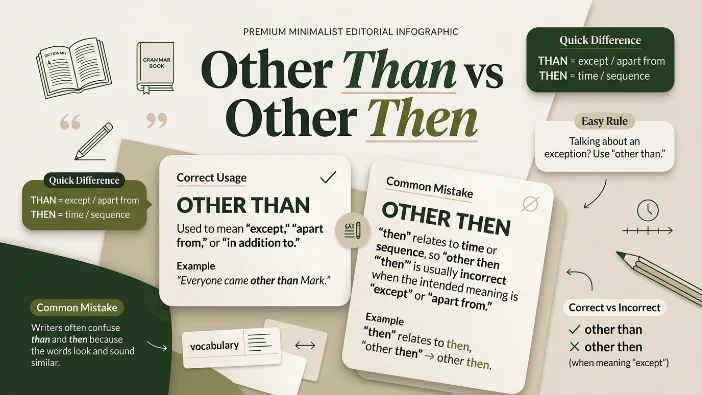
ther than is the correct phrase in almost every situation it means “except for” or “besides.” Other then is a common misspelling caused by mixing up than (comparison) with then (time). Unless you’re writing “any other, then,” you should always use other than.
You’re typing an email, and you pause halfway through the sentence: “I have no plans this weekend, other than / other then relaxing.” Which one is it? This mix-up trips up even confident writers, and it happens because than and then sound almost identical when spoken but serve completely different grammatical jobs.
Than is used for comparisons it shows a relationship between two things. Then is used for time it shows sequence or a moment that follows another. When you smash either one onto the word other, only one combination actually functions as a real phrase in English. The other one looks like a phrase, sounds like a phrase, but isn’t one at all.
Getting this wrong doesn’t just look careless in a resume, a work email, or a school essay. It can genuinely confuse a reader for a split second, because their brain expects a comparison and gets a time reference instead, or vice versa. That tiny stumble is exactly what you want to avoid in professional writing.
This isn’t just a typing slip that only shows up in text messages, either. It appears in resumes, cover letters, customer service replies, and even published articles that skipped a careful proofread. Because both words are spelled correctly on their own, the mistake hides in plain sight no red squiggly line, no obvious flag. It’s the kind of error that a careful reader notices immediately, even if they can’t always explain why it feels off.
In this guide, you’ll learn exactly why “other than” is correct, why “other then” almost never is, how to remember the difference permanently, and how to avoid the mistake even under pressure in emails, exams, and everyday conversation.
Other Than vs Other Then: What’s the Difference?
The direct answer: “other than” is a standard English phrase meaning “except for” or “apart from,” while “other then” is not a recognized phrase it’s an error that happens when then is used instead of than.
“Other than” pairs the word other with the comparative conjunction than. Together, they form a fixed expression that introduces an exception or exclusion. You use it constantly without noticing: “I don’t eat meat, other than chicken.” “There’s nothing to do here other than wait.”
“Other then,” on the other hand, tries to pair other with the time-based adverb then. But then refers to a point in time “first this happened, then that happened.” It doesn’t have a grammatical role next to other in the way than does. So when someone writes “other then,” they usually meant than but typed the wrong homophone.
| Feature | Other Than | Other Then |
|---|---|---|
| Meaning | Except for; besides | Not a standard phrase |
| Part of Speech | Preposition/conjunction phrase | Incorrect combination |
| Refers To | Exclusion or exception | Attempted time reference (misused) |
| Typical Usage | “Nothing changed, other than the price.” | Usually a typo for “other than” |
| Example | “No one called, other than my sister.” | “No one called, other then my sister.” (incorrect) |
| Common Confusion | Confused with “other then” due to sound | Confused with “other than” due to sound |
So here’s the short recap: if you’re excluding something or making an exception, you want other than. If you’re describing a sequence of events, you’d use then on its own not paired with other as in “First I finished the report, then I sent it.” There is no legitimate sentence where “other then” is the grammatically correct choice.
Is Other Than a Grammar, Vocabulary, or Usage Issue?
This is primarily a spelling and word-choice issue rooted in a grammar distinction, not a vocabulary gap. Both than and then are common, well-known words. The confusion isn’t about not knowing what they mean it’s about the words sounding alike and being typed on autopilot.
Grammatically, than functions as a conjunction used in comparisons (“bigger than,” “rather than,” “other than”). Then functions as an adverb used for sequence or consequence (“and then,” “back then,” “if this, then that”). Because other than is a comparison-adjacent phrase, only than fits.
These two words are not interchangeable in any context formal or informal. In business English, academic writing, and casual conversation, “other than” is always the phrase you want. Other then” isn’t a stylistic variant; it’s simply a typo that spellcheckers sometimes miss because then is a real, correctly spelled word just the wrong one.
Practical takeaway: If you can mentally substitute “except for” into the sentence and it still makes sense, you need than, not then.
Other Than: Meaning, Usage, and Examples
Meaning: “Other than” means “except for,” “apart from,” or “besides.” It’s used to introduce an exception to a general statement.
Part of Speech: It functions as a compound preposition or conjunction phrase, depending on what follows it.
Common Collocations: “nothing other than,” “no one other than,” “other than that,” “other than the fact that.”
Typical Sentence Pattern: [General statement] + other than + [exception].
Here’s how it shows up across different settings:
- Workplace example: “The project is on track, other than a small delay with the vendor shipment.”
- Academic example: “Other than one outlier data point, the results supported the original hypothesis.”
- Technology example: “The app runs smoothly on most devices, other than older Android models.”
- Email example: “Other than the attached invoice, there’s nothing further you need to review.”
- Daily conversation example: “I haven’t eaten anything today, other than a cup of coffee.”
One learner mistake: Non-native speakers sometimes write “other of” or “other as” when they mean “other than,” borrowing sentence structures from their first language. Remembering that “other than” always signals an exception never a comparison of degree like “bigger than” helps lock it in.
It’s also worth noting that “other than” can shift slightly depending on what follows it. Before a noun, it usually reads as a straightforward exception: “Other than the noise, the neighborhood is quiet.” Before a full clause, it often introduces a qualifier to an otherwise absolute statement: “Other than saying he’d be late, he didn’t explain much.” In both cases, the underlying job of the phrase stays the same it’s carving out one piece that doesn’t fit the general rule you just stated.
Writers sometimes wonder whether “other than” can replace “except that” in more complex sentences. It usually can, though “except that” tends to sound slightly more formal in academic or legal writing. In everyday business and conversational English, “other than” is the more natural, more commonly reached-for option, and readers rarely notice it as a stylistic choice which is exactly what makes it so useful.
Mini recap: Use “other than” whenever you’re carving out an exception to something you just said. It’s one of the most useful exception-marking phrases in English, and it works in nearly any register, from a casual text to a formal report.
Other Then: Why It’s (Almost Always) Wrong
Meaning: “Other then” has no accepted independent meaning. It’s the result of substituting then where than belongs.
Part of Speech: Because it isn’t a recognized phrase, it doesn’t carry an official grammatical classification it’s simply an error.
Where the confusion starts: Then is legitimate on its own. It means “at that time” or “next in a sequence”: “We finished dinner, and then we watched a movie.” The problem arises only when writers try to bolt then onto other, expecting it to behave the way “other than” does.
Workplace example (incorrect): “The report was fine, other then a few formatting issues.” (Should be: other than) Academic example (incorrect): “No sources were used, other then the assigned textbook.” (Should be: other than) Technology example (incorrect): “The software works well, other then occasional crashes.” (Should be: other than) Email example (incorrect): “Other then that, everything looks good to go.” (Should be: other than) Daily conversation example (incorrect): “I don’t really have hobbies, other then reading.” (Should be: other than)
One learner mistake: Writers sometimes assume “then” is safer because it “looks more common” in daily texting. In reality, “then” is common as a standalone word, not paired with other.
There’s one situation that occasionally causes real confusion, and it’s worth addressing directly: sometimes other and then do appear near each other in a correct sentence, just not as a fixed phrase. For example: “Choose any other option, then submit your answer.” Here, “other” belongs to the first clause and “then” starts a new instruction they aren’t functioning together as a unit. This is different from writing “other then submit your answer,” which would be an error. The key is whether other and then are working as a linked phrase (incorrect) or simply appearing near each other in separate parts of the sentence (perfectly fine).
Mini recap: There’s really only one reliable rule here “other then” is not a real phrase. Every single instance of it in writing should be corrected to “other than.” If you remember nothing else from this guide, remember that.
When Writers Commonly Choose the Wrong Word
1. Auto-correct doesn’t catch it. Since then is a real word, spellcheckers rarely flag it. Grammar-checking tools are more reliable here than basic spellcheck.
2. The words sound almost identical when spoken quickly. In casual speech, the vowel difference between than and then nearly disappears, so writers type what they hear rather than what’s grammatically correct.
3. Muscle memory from typing “and then.” Because “then” appears constantly in phrases like “and then,” “back then,” and “just then,” fingers default to typing then even when than is required.
4. Non-native speakers translating literally. In some languages, comparison and sequence words are closer in spelling or usage, making the than/then distinction less intuitive.
5. Fast typing under deadline pressure. Emails and quick messages get the least proofreading, and this is exactly where “other then” tends to slip through.
6. Visual similarity on the page. Both words are four letters, start with “th,” and differ by only one vowel, which makes them easy to misread even during proofreading.
7. Overcorrection from “than” mistakes elsewhere. Some writers, having been told to watch out for confusing than and then in comparisons like “taller than,” accidentally overcorrect and use then where than belongs.
8. Reading it wrong in someone else’s writing. If a writer has seen “other then” used incorrectly in emails, social media, or casual blogs, they may absorb it as acceptable without realizing it’s a mistake.
Decision Box
If you’re describing an exception or exclusion, use “other than.” If you’re describing a sequence of events, use “then” by itself never paired with “other.”
If you can replace the phrase with “except for” and the sentence still makes sense, you need than.
Common Mistakes Table
| Correct Sentence | Incorrect Sentence | Explanation |
|---|---|---|
| Nothing happened, other than a brief power outage. | Nothing happened, other then a brief power outage. | Except for” fits the meaning, so than is required. |
| No one attended, other than the organizer. | No one attended, other then the organizer. | This is an exclusion, not a time sequence. |
| I finished my coffee, and then I left. | I finished my coffee, and other than I left. | Here, then is correct on its own don’t insert “other.” |
| She has no allergies, other than pollen. | She has no allergies, other then pollen. | “Other than” signals the one exception to “no allergies.” |
| First we reviewed the budget, then we approved it. | First we reviewed the budget, other then we approved it. | This is a timeline, so then alone is correct not “other then.” |
Real World Examples
Office communication: “Other than the printer being out of toner, the office is running normally.”
Business email: “Other than a minor delay in shipping, your order is complete and ready for pickup.”
School or university: “Other than one late submission, all students met the assignment deadline.”
Customer support: “Other than restarting the router, is there anything else you’ve already tried?”
Technology: “The update installed cleanly, other than a brief lag during setup.”
Artificial Intelligence: “The chatbot answered every question correctly, other than one about pricing tiers.”
Daily conversation: “Other than the rain, it was a pretty great weekend.”
Job interviews: “Other than a short internship, I don’t have direct experience in this field, but I’m a fast learner.”
Travel planning: “Other than the flight delay, the whole trip went smoothly.”
Healthcare: “Other than mild seasonal allergies, the patient reported no ongoing health issues.”
Social media: “Other than one negative comment, the reaction to the launch was overwhelmingly positive.”
In each of these cases, notice that “other than” is doing the same job every time quietly setting aside one detail so the main statement can stand as generally true. That consistency is exactly why the phrase is so easy to overuse once you start noticing it, and exactly why getting it right matters more than it might seem at first glance.
Other Than in Modern Technology
In tech writing, “other than” shows up constantly because software documentation, release notes, and troubleshooting guides are built around exceptions. A changelog might read, “No new bugs were reported, other than a display glitch on tablets.” A support article might say, “This setting works the same across all plans, other than the free tier.
Virtual assistants and voice assistants also process “other than” as a recognizable exception marker when parsing natural language commands, such as “remind me about everything today, other than the 3 PM meeting.” Chatbots trained on customer service transcripts frequently encounter this phrase because customers naturally use it to narrow down their issue: “Nothing’s wrong, other than the app being slow.
Because “other then” isn’t standard English, AI writing assistants and grammar-checking software are increasingly good at catching and correcting it but only if the writer double-checks the suggestion rather than ignoring it.
Search engines themselves also treat the two phrases very differently. Because “other than” is the standard, widely used form, it appears constantly in high-quality, edited content news articles, official documentation, and professional blogs. “Other then” mostly shows up in unedited forum posts, casual comments, and rushed social media replies. Over time, that pattern reinforces itself: the more a phrase is used correctly across trusted, well-written sources, the more search engines associate it with authoritative, high-quality writing. Getting this small detail right, in other words, is one of many small signals that a piece of writing has been properly edited.
Word Origin
Than comes from Old English þanne, originally the same word as then the two only split into distinct spellings and functions by the late Middle English period, which explains why they still look and sound so similar today. Other traces back to Old English oþer, meaning “the second of two” or “different from the one already mentioned.” Over centuries, “other than” solidified as a fixed phrase for marking exceptions, while “then” kept its separate role marking time and sequence.
Expert Insight
Here’s how I’d explain this to a student in one sentence: whenever you’re about to write “other,” ask yourself if you’re making an exception or describing a moment in time. If it’s an exception, your hand should automatically reach for than. If it’s a moment in time, you probably don’t need the word “other” at all just then on its own does the job. Teaching this as a two-question test, rather than a spelling rule, tends to make it stick far better than memorizing “than equals comparison” in the abstract.
Error Prevention Checklist
- Always use other than when you mean “except for” or “besides.
- Always use then (without “other”) when describing what happens next in time.
- Never confuse them if you remember: than = comparison, then = time.
- Quick memory tip: “Than” has an A, like “an exception.” “Then” has an E, like “an event in time.”
Related Grammar Confusions
- Than vs Then the root confusion behind this entire article, worth mastering on its own.
- Affect vs Effect another pair mixed up because of similar sound and spelling.
- Its vs It’s a classic homophone trap in fast typing.
- Their vs There vs They’re three words, one sound, constant mix-ups.
- Farther vs Further a distinction between physical and figurative distance.
- Fewer vs Less a countable-versus-uncountable noun issue many writers overlook.
- Who vs Whom a grammar rule that trips up even advanced English speakers.
- Lie vs Lay one of the most persistently confused verb pairs in English.
- Compliment vs Complement spelled almost identically but meaning very different things.
- Rather Than vs Instead Of closely related to “other than” in function but not identical in use.
FAQs
Is “other then” ever grammatically correct?
No. “Other then” is not a standard English phrase. When you mean “except for” or “apart from,” the correct expression is “other than.” The word then should only appear separately when it refers to time or sequence.
What’s the easiest way to remember the difference?
Remember “than” for comparison or exceptions and “then” for time or sequence. Since other than introduces an exception or distinction, it always uses than, not then.
Can “other than” start a sentence?
Yes. Starting a sentence with “other than” is completely grammatical. For example: “Other than that, the presentation went smoothly.” The phrase works naturally in both conversation and formal writing.
Is “other than” formal or informal?
“Other than” works in both formal and informal English. You can use it in academic writing, business communication, emails, and everyday conversation without changing the phrase.
Why does spell-check miss “other then”?
Basic spell-checkers may not catch “other then” because then is a correctly spelled English word. The problem is the word choice, not the spelling. Grammar and context-based writing tools are more likely to identify this type of error.
Is “rather than” related to “other than”?
Yes. Both expressions use than to establish a comparison or distinction. Rather than contrasts two choices, while other than identifies an exception or alternative. Neither phrase uses then in standard English.
Conclusion
The difference between “other than” and “other then” comes down to one simple test: are you excluding something, or are you describing a sequence in time? Exceptions always call for “other than,” while time-based ideas use “then” on its own never combined with “other.”
Once this distinction clicks, you’ll stop second-guessing yourself in emails, essays, and everyday writing. The rule to keep in your back pocket is this: if “except for” fits the sentence, you need “other than” every single time.