Quick Answer
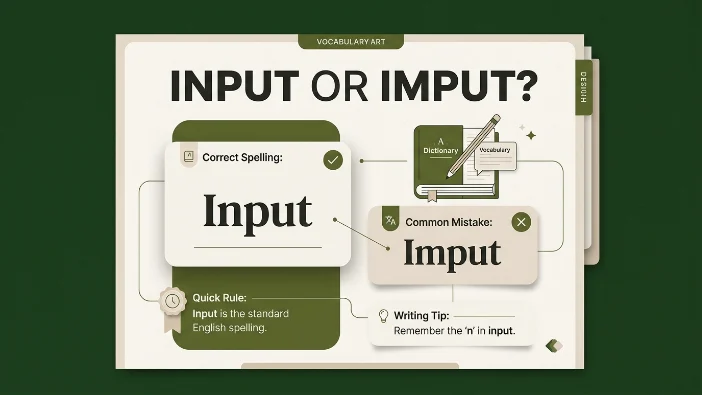
The correct spelling is input, not “imput.” “Input” is a widely used noun and verb referring to information, data, or opinions that are put into a system, process, or discussion. “Imput” is a common misspelling that should be avoided in all forms of professional and academic writing.
Have you ever found yourself hesitating between typing “input” or “imput”? You’re not alone. This confusion is so common that it frequently appears in business emails, academic papers, and even coding forums. Many people assume both versions are acceptable, but the reality is much simpler.
The word input is the only correct spelling. If you write “imput,” you’re making a spelling error that can undermine your professional credibility, especially in written communication. The confusion likely comes from the word’s pronunciation when spoken quickly, the “n” in “in” can sound like an “m” before the “p” sound (a linguistic phenomenon called nasal assimilation). But in writing, this phonetic shift does not carry over.
Choosing the wrong spelling isn’t just a minor typo; it signals a lack of attention to detail. Whether you’re entering data into a computer, asking for a colleague’s opinion, or discussing economic resources, knowing the correct spelling of this word is essential for clear and professional communication. In this guide, we’ll explain exactly what “input” means, where the misspelling comes from, and give you a simple rule to ensure you always get it right.
What’s the Difference Between “Input” and “Imput”?
There is no difference between the two because “imput” is not a real word. It does not appear in any major English dictionary, including Merriam-Webster, Oxford, or Cambridge. The core difference is simply that one is correct and the other is a spelling error.
Let’s define the correct word:
- Input (noun): Something that is put in, such as data entered into a computer, advice or opinions contributed to a discussion, or resources used in a production process.
- Input (verb): The act of putting data, information, or resources into a system, computer, or process.
Here is a quick comparison to clarify the distinction:
| Aspect | Input (Correct) | Imput (Incorrect) |
|---|---|---|
| Meaning | Information, data, or opinions put in; the act of putting in. | No definition. |
| Part of Speech | Noun and Verb | Misspelling |
| Refers To | Contribution, data entry, resources, power supply. | Nothing. |
| Typical Usage | “Please provide your input.” “Input the data.” | Never used. |
| Example | We value your input on this project. | ❌ We value your imput. |
| Common Confusion | Often confused with “impute” in academic writing. | Always a misspelling. |
Recap: The distinction between “input” and “imput” is not about usage, but about correctness. Always choose “input” to ensure your writing is accurate and professional.
Is This a Grammar, Vocabulary, or Usage Issue?
The confusion between “input” and “imput” is primarily a spelling and vocabulary issue, rather than a grammar one. Grammar involves the structural rules of language, such as verb tenses and sentence construction. While “input” has a grammatical function as both a noun and a verb, the core error here is using a non-existent word.
This makes it a vocabulary error because a reader simply will not recognize “imput” as a valid word in the English lexicon. It is a simple misspelling, similar to writing “recieve” instead of “receive.”
Are They Interchangeable?
No. They are absolutely not interchangeable, because “imput” is not a word. You should never use “imput” in any context, formal or informal.
A Note on “Impute”
This is where much of the legitimate confusion arises. There is a real word that looks and sounds similar: impute (pronounced im-PYUTE). To “impute” means to attribute or credit something (often blame or a quality) to someone or something else. For example, “The CEO imputed the company’s success to her team’s hard work.”
In academic and scientific writing, specifically in statistics, “impute” has a specialized meaning: to assign a value to missing data based on statistical models. While “input” and “impute” are both real words with distinct meanings, “imput” is simply a misspelling of “input.” The confusion likely stems from the fact that “impute” is a valid, though less common, word.
What Does “Input” Mean?
As the only correct spelling, “input” is a versatile word with several related meanings. Understanding its breadth will help you use it more effectively.
Meaning
- Advice, opinions, or ideas that are contributed to a discussion, project, or meeting. This is a very common use in the business world.
- Data or information that is entered into a computer or other electronic system for processing.
- Resources like raw materials, labor, or capital that are used in the production of goods or services.
- Energy or power supplied to a machine or system.
Part of Speech and Pronunciation
- Part of Speech: Noun and verb (transitive).
- Pronunciation: The standard US and UK pronunciation is /ˈɪn.pʊt/. Think of it as two clear syllables: IN-put.
Common Collocations and Sentence Patterns
Here are some common words that are often used with “input”:
- Adjectives: valuable input, user input, direct input, data input, audio input.
- Verbs: to provide input, to seek input, to require input, to input data, to input a command.
Examples
- Workplace Example: “The manager asked for employee input before finalizing the new policy.”
- Academic Example: “The researcher used the findings to input parameters into a predictive model.”
- Technology Example: “The software accepts input from various types of files.”
- Email Example: “I would appreciate your input on the draft report by Friday.”
- Daily Conversation Example: “I need to input the password before I can access the website.”
Common Learner Mistakes
A common mistake for learners, especially those who are new to English, is misspelling “input” as “imput.” It’s a phonetical error where the “n” sound before a “p” is misheard or pronounced as an “m.
Incorrect: Please provide your imput on the project.
Correct: Please provide your input on the project.
Mini Recap: “Input” is the correct spelling for contributions, data, and resources. Remember its meaning is literally “to put in,” which helps with spelling: in + put.
When Not to Use “Input”
While “input” is the correct word to use in a wide variety of situations, it’s not always the perfect choice. Here are situations where writers might lean towards it incorrectly, often confusing it with similar-sounding words or more specific terms.
- When You Mean “Impute” (in Statistics): If you are writing about replacing missing data in a dataset, the correct verb is “impute,” not “input.”
- When You Mean “Effect” or “Influence”: Sometimes “input” is used as a buzzword when a more precise word would be better.
- Why the mistake happens: In business, “input” is a safe, generic word.
- Correct Usage: “Her comments had a significant effect on the decision,” rather than “Her comments were a significant input on the decision.”
- When Referring to an Output of a System: Using “input” for something the system produces is logically incorrect.
- Why the mistake happens: A misunderstanding of the system’s flow.
- Correct Usage: “The computer generated an output,” not “The computer generated an input.”
- In Highly Formal Legal Writing: In legal contexts, “impute” (to ascribe responsibility) is far more common. Use the correct legal term if you are ascribing liability.
Common Mistakes with “Input” and “Imput”
The most glaring mistake is using “imput.” This table illustrates the error clearly, using simple, realistic contexts.
| Correct Sentence (Using “Input”) | Incorrect Sentence (Using “Imput”) | Explanation |
|---|---|---|
| We rely on your input to guide our company’s strategy. | We rely on your imput to guide our company’s strategy. | “Imput” is a misspelling. The word needed is “input,” meaning a contribution of ideas or advice. |
| Please input your username and password to log in. | Please imput your username and password to log in. | “Imput” is not a valid verb. The correct verb for entering data is “input.” |
| The team is seeking input from all stakeholders. | The team is seeking imput from all stakeholders. | Again, “imput” is not recognized in any dictionary and is a simple spelling error. |
| The system crashed due to an invalid input command. | The system crashed due to an invalid imput command. | The error message would be wrong. “Input command” is the standard technical term. |
Decision Box
If you mean…
- The action of entering data or information
- A contribution of advice or an opinion
- A resource used for production
…always write INPUT.
If you mean…
- To attribute blame or a quality to someone
- To assign a value to missing statistical data
…the word you’re looking for is IMPUTE.
“Imput” is never correct.
Real-World Examples
Let’s look at how “input” is used in common, practical situations. Understanding the context makes it much easier to remember the correct spelling.
- Office Communication: “The project manager requested my input on the budget proposal. She wanted to know if we had the resources for the extra work.”
- Business Email: “Hi Sarah, Do you have any input on the draft of the client presentation? I would like to finalize it by 3 PM. Thanks, John.”
- University Setting: “The professor valued the students’ input during class discussions. It was a key part of the learning process.”
- Customer Support: “To resolve your issue, the technician needs to input your account number into the system first.”
- Technology: “Modern smartphones accept voice input as well as text, allowing users to send messages without typing.”
- Artificial Intelligence: “Large Language Models require vast amounts of text-based input to train their algorithms effectively.”
- Daily Conversation: “I’ve been listening to all the music you recommended, and it’s been a great input into my playlist.”
“Input” in Modern Technology
The word “input” is foundational in the digital world, which is why its correct spelling is so critical in professional tech environments.
- Artificial Intelligence and Machine Learning: “Input” refers to the data fed into an AI model. This could be text, images, or numbers. The model processes this “input” to produce an “output” or prediction. Getting “input” wrong in a technical context can cause confusion.
- Virtual Assistants and Chatbots: In this context, an “input” is a user’s query, either typed or spoken. Voice assistants like Siri or Google Assistant rely entirely on voice “input.” Typing “imput” in a codebase can cause errors, as the program will not recognize the command.
- Software and Business Tools: In data analysis tools like Excel or programming languages like Python, the correct function is often “input.” Misspelling it as “imput” is a common syntax error.
The rise of AI has made the word even more prevalent. The technologies we use daily depend on understanding and processing human “input,” reinforcing why using the correct spelling is essential in the 21st century.
Word Origin
Understanding the history of a word can be a powerful mnemonic tool. The origin of “input” is straightforward and logical, which explains its spelling.
The word “input” comes from the simple combination of the adverb “in” and the verb “put.” According to the Online Etymology Dictionary, it literally means “to put in.”
- The noun “input” (meaning “a sum put in”) first appeared in 1753.
- Its use in the context of energy supplied to a machine emerged around 1902.
- The modern computing sense “data fed into a machine” is more recent, dating back to 1948, with the verb form gaining its computing-specific meaning in 1946.
This clear history is a powerful reminder of the correct spelling. You are literally “putting” something “in,” so the word is a perfect compound: in + put = input.
Error Prevention Checklist
- ✅ Always use “Input” when you mean entering data, providing advice, or supplying resources.
- ✅ Always use “Impute” when you mean to attribute or assign missing data.
- ✅ Never confuse them if you see the letters “m” and “p” together like “imput” – it’s a sure sign of a spelling mistake.
- ✅ Quick memory tip: Think IN + PUT = INPUT. You wouldn’t write “IMTO” instead of “INTO,” so don’t write “IMPUT” instead of “INPUT.”
Related Grammar Confusions
Here are some other common English words that are often mixed up:
- Accept vs. Except – Accept is to receive; except is to exclude.
- Affect vs. Effect – Affect is usually a verb (to influence); effect is usually a noun (a result).
- Principle vs. Principal – Principle is a rule or belief; principal is a leader or the main thing.
- Compliment vs. Complement – Compliment is praise; complement means to complete or go well with something.
- Discreet vs. Discrete – Discreet means careful or cautious; discrete means separate or distinct.
- Imply vs. Infer – Imply is to suggest; infer is to deduce or conclude.
- Stationary vs. Stationery – Stationary means not moving; stationery refers to writing paper.
- Elicit vs. Illicit – Elicit is to draw out a response; illicit means illegal.
FAQs
Is “imput” ever correct?
No, “imput” is never correct in English. It is a common misspelling of the word “input” and is not recognized in any major dictionary. You should avoid using it in all forms of writing, from emails to academic papers.
What is the difference between “input” and “impute”?
“Input” refers to data, resources, or opinions that are put into a system. “Impute” means to attribute or assign something, such as blame or responsibility, to a person or thing. In statistics, “impute” has a specific meaning of assigning values to missing data.
How can I remember the spelling of “input”?
The best way to remember the spelling is to break the word down into its component parts: in + put = input. This reflects its literal meaning of putting something in. This simple mnemonic will help you avoid the common “imput” error.
Why do people misspell “input” as “imput”?
The confusion comes from a phonetic issue called nasal assimilation. When people say “input” quickly, the “n” sound before the “p” can blend and sound more like an “m.” This auditory confusion leads to the spelling error “imput.”
Can “input” be used as a verb?
Yes, “input” is both a noun and a verb. As a verb, it means to enter data or information into a computer or system. For example, “Please input your user ID.” Both “input” and “inputted” are acceptable past-tense forms, though “input” is more common.
Conclusion
The choice between “input” and “imput” is a simple one, but one that has significant consequences for the clarity and professionalism of your writing. The correct spelling is always input.
Remember that “imput” is a non-existent word and a clear misspelling that should be avoided. While the phonetic similarity between “in” and “im” is the source of the confusion, a simple mental trick can save you: think of the word as the combination of “in” and “put.” You are literally putting something in.
Whether you are asking for a colleague’s input on a project, entering data into a database, or contributing your own thoughts to a discussion, using “input” correctly demonstrates a strong command of the English language and helps ensure your message is taken seriously.
Read More Related Articles:
- Happened or Happend | Master the Correct Usage in Minutes In 2026
- Anual or Annual | Simple Grammar Guide For Error-Free Writing In 2026
- Successfully or Succesfully | Easy Trick to Remember the Correct Spelling Forever In 2026

Lucas Mitchell is a content writer at synoseek.com. He writes simple, thoughtful pieces that focus on everyday ideas, observations and general knowledge topics. His work is shaped by a calm, realistic tone that keeps the reader engaged without overstatement.
3 thoughts on “Input or Imput | Learn the Correct Word in Seconds In 2026”