Quick Answer
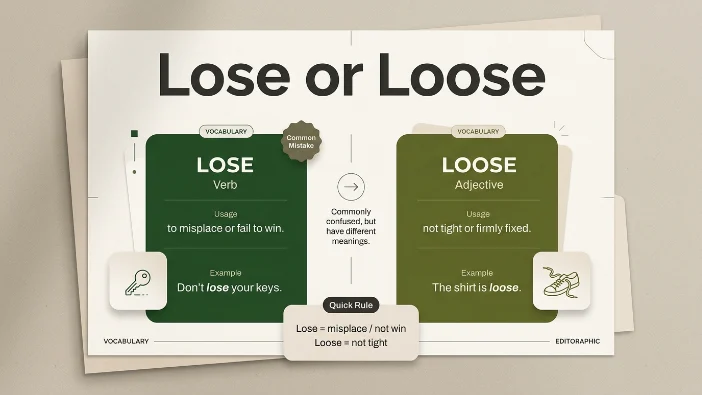
Lose is a verb meaning to misplace something or fail to win, as in “I always lose my keys.” Loose is usually an adjective meaning not tight or not attached, as in “This shirt feels loose.” The words look almost identical, but they sound different and serve completely different jobs in a sentence.
You’re typing a text message. You want to tell your friend you can’t find your phone charger again. Do you type “I lose things constantly” or “I loose things constantly”? That half-second hesitation is something almost every English speaker has felt, and it happens for a good reason.
Lose and loose differ by a single letter, yet that one letter changes the sound, the meaning, and the grammar completely. Lose rhymes with “choose” and works as an action word. Loose rhymes with “moose” and usually describes how something fits or feels. Mixing them up doesn’t just look like a typo to careful readers it can genuinely confuse the meaning of a sentence, especially in professional emails, school essays, or customer messages where precision matters.
By the end of this guide, you’ll understand exactly why these two words get confused so often, how to tell them apart instantly, and how to use each one correctly in real conversations, emails, and everyday writing. We’ll also look at common sentence patterns, workplace examples, and a few tricks that make the difference stick in your memory for good.
Lose vs Loose: What’s the Difference?
The core difference is simple: lose is a verb that describes an action, while loose is mostly an adjective that describes a condition or quality.
When you lose something, you no longer have it, or you fail at a contest or competition. Think of losing a game, losing your patience, or losing weight. It’s always about something happening an action taking place.
Loose describes a state of being. A loose knot isn’t tied tightly. A loose schedule isn’t strict. A loose tooth isn’t firmly attached. Loose can also work as a verb in rare, more formal or old-fashioned contexts (like “to loose an arrow”), but in everyday English, you’ll almost always meet it as a descriptive word.
Here’s a side-by-side breakdown that makes the distinction easier to hold onto:
| Meaning | Part of Speech | Refers To | Typical Usage | Example | Common Confusion |
|---|---|---|---|---|---|
| To no longer have something, or fail to win | Verb | An action or event | Everyday speech, sports, relationships, objects | “Don’t lose your ticket.” | Often misspelled as “loose” |
| Not tight, not attached, not strict | Adjective | A physical or abstract state | Clothing, objects, rules, plans | “The rope is loose.” | Often misspelled as “lose” |
So the pattern is: if something is happening (an action), you want lose. If you’re describing how something feels, fits, or behaves, you want loose. That one question “am I describing an action or a condition?” solves nearly every mix-up before it happens.
Is Lose or Loose a Grammar, Vocabulary, or Usage Issue?
This confusion sits mostly in the vocabulary and spelling category, not grammar rules. Both words are spelled correctly on their own the mistake happens because writers pick the wrong one for the sentence, usually because the words look so similar on paper.
Grammatically, lose behaves like any regular verb: it changes form depending on tense (lose, loses, lost, losing). Loose, on the other hand, mostly stays the same regardless of tense because it’s describing a quality, not performing an action.
The two words are not interchangeable in any context. Swapping one for the other changes the sentence’s meaning entirely, or makes it grammatically incorrect. In formal writing business reports, academic essays, official emails this mistake stands out immediately to an editor or teacher, because it signals a lack of proofreading rather than a stylistic choice. In casual texting or social media, people often let it slide, but it’s still worth getting right, especially if you’re writing professionally or learning English as a second language.
The practical takeaway: whenever you’re unsure, silently swap in a synonym. If “misplace” or “fail to win” fits, you need lose. If “not tight” or “not attached” fits, you need loose.
Lose: Meaning, Usage, and Examples
Lose is pronounced like “looz,” rhyming with choose, news, and shoes. It’s an irregular verb, meaning its past tense doesn’t just add “-ed.” The forms are lose, loses, lost, and losing.
Common collocations: lose weight, lose your temper, lose track, lose interest, lose a game, lose your job, lose touch, lose your voice.
Typical sentence pattern: subject + lose/loses/lost + object. For example, “She lost her wallet on the train.”
Workplace example: “If we don’t finalize the budget by Friday, we might lose the client.”
Academic example: “Students who fall behind early in the semester often lose confidence in the subject.”
Technology example: “Make sure to save your work often, or you could lose your progress if the app crashes.”
Email example: “I wanted to follow up before we lose this opportunity to the competitor.”
Daily conversation example: “I always lose my umbrella whenever it stops raining.”
One learner mistake: Many English learners write “I don’t want to loose you” when they mean “I don’t want to lose you.” This particular error is extremely common in messages and social media captions, largely because the emotional weight of the sentence makes writers rush past the spelling.
Mini recap: Lose is an action verb. It happens to something or someone you lose an object, a game, a feeling, or an opportunity. If your sentence has a subject doing something, lose is almost certainly your word.
Loose: Meaning, Usage, and Examples
Loose is pronounced like “loos,” rhyming with moose, goose, and juice. As an adjective, it doesn’t change form based on tense, which makes it a little more predictable once you know its job in a sentence.
Common collocations: loose clothes, loose change, loose ends, loose grip, loose schedule, loose translation, loose skin, loose thread.
Typical sentence pattern: noun + is/are + loose, or loose + noun. For example, “The dog’s collar is loose” or “She wore a loose sweater.”
Workplace example: “We’re working with a fairly loose deadline this quarter, so there’s room to adjust.”
Academic example: “The professor gave a loose outline for the essay, letting students choose their own structure.”
Technology example: “A loose cable connection is often the reason your monitor keeps flickering.”
Email example: “There are still a few loose ends to tie up before we can close the project.”
Daily conversation example: “These jeans feel loose after I lost a bit of weight.”
One learner mistake: A very common error looks like this: “My tooth is lose” instead of “My tooth is loose.” Because the adjective form is less familiar to some learners than the verb, writers sometimes default to the shorter-looking spelling without realizing it changes the meaning entirely.
Mini recap: Loose describes a state something that isn’t tight, isn’t fixed, or isn’t strict. If your sentence is describing how something fits, feels, or behaves rather than an action taking place, loose is your word.
When Not to Use Each Word
Even after learning the definitions, certain situations still trip writers up. Here are the most frequent trouble spots and how to handle them.
Talking about weight loss. Writers often type “loose weight” when they mean “lose weight.” Remember: losing weight is an action, something you do over time, so it needs the verb lose.
Describing a game or competition. “We might loose the match” should be “We might lose the match.” Competitions involve an outcome winning or losing which is always a verb situation.
Describing clothing fit. This is one place people usually get it right, but it’s worth confirming: “loose jeans” is correct because you’re describing how the jeans fit, not an action.
Talking about emotional control. “Don’t loose your temper” is incorrect. Losing your temper is something that happens to you, so it takes the verb lose.
Referring to a physical object coming undone. “The screw is lose” is wrong; it should be “The screw is loose,” since you’re describing its current condition.
Discussing missing data or files. “I don’t want to loose this document” should be “I don’t want to lose this document,” because losing a file is an action of misplacing it.
Talking about relationships or connections. “We lost loose touch” writers sometimes accidentally combine both words. The correct phrase is simply “we lost touch,” using lose in its past tense form.
Describing schedules or rules. “A lose schedule” is incorrect. A flexible, non-strict schedule is a “loose schedule.”
A quick way to remember which mistake you’re prone to making: read your sentence aloud. If the word sounds like “looz” and involves an action, you want lose. If it sounds like “loos” and describes a condition, you want loose.
Common Mistakes Table
| Correct Sentence | Incorrect Sentence | Explanation |
|---|---|---|
| I don’t want to lose you. | I don’t want to loose you. | Losing someone is an action, not a description. |
| These pants are too loose. | These pants are too lose. | Describes how the pants fit, so it needs the adjective. |
| We might lose the account. | We might loose the account. | Losing a client or account is an outcome, a verb. |
| The dog slipped its loose collar. | The dog slipped its lose collar. | Describes the collar’s condition, not an action. |
| I always lose my keys. | I always loose my keys. | Misplacing keys is an action performed by the subject. |
| The knot came loose overnight. | The knot came lose overnight. | Describes the current state of the knot. |
Decision Box
If you mean an action losing an object, a game, or a feeling use Lose. If you mean a description something not tight, not attached, or not strict use Loose.
Say the sentence out loud. If it rhymes with “choose,” you want lose. If it rhymes with “moose,” you want loose.
Lose or Loose in Real-World Situations
Office communication: A manager might write in a team chat, “We can’t afford to lose momentum before the launch,” using lose because momentum is something that can be lost through inaction.
Business email: A sales rep might send a client, “I wanted to check in before we lose this window to lock in the current pricing,” where lose again marks an action tied to a deadline.
School or university: A professor might tell a class, “Late submissions lose ten points per day,” clearly describing a consequence, an action-based penalty.
Customer support: A support agent might type, “I understand how frustrating it is to lose access to your account. Let’s get this fixed,” where lose describes the customer’s experience of losing something (access).
Technology: A troubleshooting guide might note, “A loose HDMI cable is one of the most common reasons for a blank screen,” describing the physical condition of the cable.
Daily conversation: A friend might say, “I keep losing my train of thought when I’m tired,” a very natural, action-based use of lose in everyday speech.
Notice how in every example, the choice comes down to the same underlying test: is something happening (lose), or is something in a certain condition (loose)?
Lose and Loose in Modern Technology
Technology writing runs into both words fairly often, and getting them right matters for clarity in instructions, help articles, and product descriptions.
In discussions about artificial intelligence and virtual assistants, lose typically shows up when talking about losing data, losing context in a conversation, or an AI model losing accuracy over time. For example, “The chatbot may lose context if the conversation runs too long” describes something happening to the AI’s performance.
Voice assistants and software tools more commonly use loose when describing settings or connections rather than actions. For instance, “Check for a loose Wi-Fi router antenna if your voice assistant keeps disconnecting” describes a physical or configuration issue.
In business tools, you’ll often see lose paired with productivity language, such as “Teams that skip daily standups tend to lose alignment on priorities.” Loose, meanwhile, tends to appear in phrases about flexible systems, like “a loose integration between two apps,” meaning the connection isn’t tightly automated.
Neither word is exclusive to tech writing, but understanding this pattern helps when you’re drafting documentation, product copy, or support tickets and want to sound precise.
Where Lose and Loose Come From
Both words trace back to Old English, though through slightly different paths. Lose developed from the Old English word “losian,” meaning to perish or be lost, which itself connects to the older Germanic root for loss and destruction. Over centuries, its meaning narrowed into the more everyday sense we use now: failing to keep or win something.
Loose comes from Old Norse “lauss,” meaning free or untied, brought into English usage during the medieval period. Its core meaning free from restraint or attachment has stayed remarkably consistent for centuries, which is part of why the adjective form feels so stable today compared to the more flexible, tense-shifting verb lose.
Knowing this history isn’t essential for using the words correctly, but it does explain why they behave so differently in a sentence: one was born to describe action and disappearance, the other to describe freedom and looseness of attachment.
Expert Insight
As a language instructor, I tell students to stop thinking about spelling first and start thinking about function first. Before you write either word, ask yourself: “Is my sentence about something happening, or something’s condition?” That question does more to prevent this mistake than memorizing spelling rules ever will. Most learners already know the difference in meaning the mix-up usually comes from typing quickly and letting muscle memory pick the shorter-looking word, which happens to be loose more often than people expect.
Error Prevention Checklist
- Always use Lose when you’re describing an action: losing an object, a game, weight, or a feeling.
- Always use Loose when you’re describing a condition: not tight, not attached, not strict.
- Never confuse them if you remember that lose has one “o” and describes something disappearing, while loose has two “o’s” just like something loose has more room, more space, more slack.
- Quick memory tip: “Loose” has an extra “o,” and something loose has extra room to move.
Related Grammar Confusions
Then vs. Than one signals time or sequence, the other makes a comparison, and mixing them changes the logic of a sentence entirely.
Affect vs. Effect a classic verb-versus-noun mix-up that trips up even experienced writers in professional reports.
Its vs. It’s a possessive pronoun versus a contraction, one of the most searched grammar questions online.
Their, There, and They’re three homophones with three completely different jobs in a sentence.
Your vs. You’re another possessive-versus-contraction pair that’s easy to type wrong when writing quickly.
Accept vs. Except one means to receive, the other means to exclude, and they sound almost identical in casual speech.
Complement vs. Compliment a subtle spelling difference that changes whether you’re praising something or completing it.
Farther vs. Further a distinction between physical distance and figurative or additional progress.
Advice vs. Advise a noun-and-verb pair that follows a similar pattern to lose and loose in terms of function.
Principal vs. Principle one refers to a person or main idea, the other to a rule or belief, and both show up often in academic writing.
FAQs
Is it “lose weight” or “loose weight”?
The correct phrase is “lose weight.” Here, lose is the verb meaning to become lighter or no longer have something. Loose is an adjective meaning not tight, so “loose weight” is incorrect.
How can I remember the difference between “lose” and “loose”?
Think of the extra o in loose as representing extra space. Something loose has room to move or isn’t tightly secured. Lose, with one o, means to misplace something, fail to keep it, or no longer have it.
Can “loose” be used as a verb?
Yes, although this use is uncommon. As a verb, loose means to release or set free. For example, “The archer loosed an arrow.” In everyday English, however, loose is much more commonly used as an adjective.
Why do people confuse “lose” and “loose”?
The words look and sound similar, and they differ by only one letter. Because loose contains the familiar double o, writers sometimes add an extra o to lose by mistake, particularly when typing quickly.
Is “loosing” a real word?
Yes. Loosing is the present participle of the verb loose, meaning releasing or setting free. It is different from losing, which is the present participle of lose. For example, “He is losing his keys” is different from “The hunter is loosing the arrow.”
What’s the easiest way to choose between “lose” and “loose”?
Check the meaning. If you mean misplace, no longer have, or fail to win, use lose. If you mean not tight, free, or released, use loose. A quick substitution test can also help: if “not tight” fits, choose loose; otherwise, lose may be the word you need.
Conclusion
The difference between lose and loose comes down to one clear test: lose is about action, loose is about condition. Whenever you catch yourself hesitating, ask what’s actually happening in your sentence is something being misplaced or lost, or is something simply not tight or not attached?
Keep this rule close: loose has an extra “o” for extra room, while lose has one “o” for one thing slipping away. Once that image sticks in your memory, you’ll stop second-guessing yourself in emails, essays, and everyday messages for good.