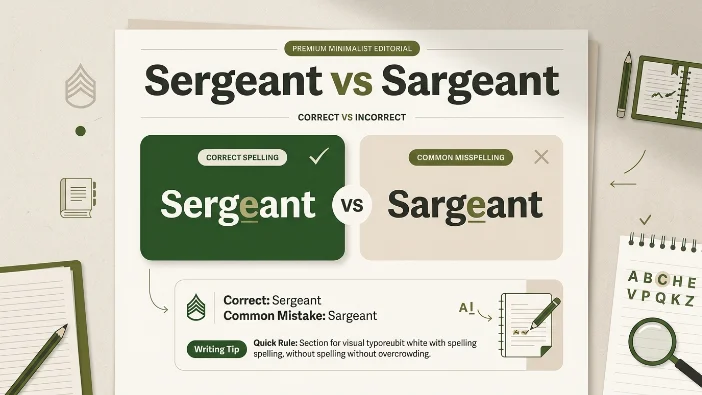
Quick Answer:
“Sergeant” is the correct spelling for the military and police rank, referring to a non-commissioned officer who supervises lower-ranking members. “Sargeant” is a common misspelling, though it does survive as a legitimate English surname. If you’re writing about the rank, always choose sergeant.
Confused about Sergeant vs Sargeant? You’re not alone. These spellings look very similar, but only one is the standard spelling used in modern English.
In this guide, we’ll explain the difference between Sergeant and Sargeant, show you which spelling is correct, and provide simple examples. Whether you’re writing professionally or studying English, this quick comparison will help you avoid the common spelling mistake.
Why This Word Trips So Many People Up
You’ve probably typed this word, paused, and stared at it until it stopped looking like a real word at all. That’s not a coincidence. Sergeant is one of those English words where the spelling doesn’t match the way we say it, and your brain naturally wants to “fix” it into something more phonetic which is exactly how sargeant sneaks in.
Here’s the core issue. Sergeant is the only accepted spelling when you’re referring to the police or military rank, the job title, or the person holding that title. Sargeant, on the other hand, isn’t a recognized alternative spelling of the rank at all. It shows up so often in emails, reports, and casual writing that people assume it must be acceptable somewhere. It isn’t, at least not for the rank. Where sargeant does have a legitimate life is as a family surname, which is a completely different situation from spelling a job title incorrectly.
By the end of this guide, you’ll know exactly why the confusion happens, how to spell the word correctly every single time, and how to explain the difference to someone else without sounding like you just memorized a rule you don’t understand.
Sergeant vs Sargeant: What’s the Difference?
The direct answer is this: sergeant is a real English word with a fixed spelling, while sargeant is essentially a misspelling of that word, kept alive mostly by pronunciation habits and its separate existence as a surname.
Sergeant comes from Old French and Latin roots tied to the idea of “serving” or “attending.” It functions as a noun, and it names a specific rank used in the military, police forces, and even in some ceremonial government roles like “sergeant-at-arms.” The spelling has stayed remarkably stable for centuries, which is part of why dictionaries and style guides treat it as non-negotiable.
Sargeant doesn’t carry that same weight. It isn’t listed in Merriam-Webster, Cambridge Dictionary, or Oxford Dictionary as an accepted variant of the rank. Where you will find “Sargeant” is in phone books, family trees, and business names, because it developed independently as a surname over generations. Someone named John Sargeant is spelling their own name correctly. Someone writing “the sargeant gave the order” is not.
| Feature | Sergeant | Sargeant |
|---|---|---|
| Meaning | Military/police rank; non-commissioned officer | Primarily a surname; not a recognized spelling of the rank |
| Part of Speech | Noun | Proper noun (as a surname) |
| Refers To | A job title or rank | A person’s family name |
| Typical Usage | Reports, military writing, news, everyday speech | Names, family history, business names |
| Common Confusion | Misspelled as “sargeant” due to pronunciation | Mistaken for a valid spelling of the rank |
Once you separate these two uses, the confusion mostly disappears. If you’re talking about someone’s rank, you want sergeant. If you’re referring to a specific person’s last name and you know that’s how they spell it, sargeant is simply correct for that individua not because it’s an alternate spelling of the job, but because names don’t follow the same rules as common words.
Is Sergeant a Spelling, Vocabulary, or Pronunciation Issue?
This one is almost entirely a spelling issue, not a grammar or vocabulary problem. There’s only one word here with an accepted dictionary meaning tied to the rank sergeant. Sargeant isn’t a separate vocabulary item competing for the same meaning; it’s a spelling error that happens to look like a plausible word.
The root of the trouble is pronunciation. Sergeant is pronounced “SAR-junt,” and English speakers naturally reach for spellings that match sound. Since we hear “sar,” writing “sar-geant” feels intuitive even though it’s wrong. This is the same pattern behind other commonly misspelled words where sound and spelling drift apart, like “definitely” being misspelled as “definately.
In formal English, business writing, academic papers, government documents, and journalism, sergeant is the only acceptable spelling. There’s no context formal or informal where sargeant is treated as correct for the rank. The only exception is proper names, and even then, you’re not choosing a spelling; you’re simply spelling someone’s name the way they spell it.
Practical takeaway: if you’re ever unsure, sound it out slower “SER-jent” and remember that the first syllable is spelled with an “e,” not an “a.”
Sergeant: Meaning, Usage, and Real Examples
Sergeant refers to a rank held in the military, police, and some other organized forces, typically ranking above a private or officer-in-training but below a lieutenant or higher command position. It’s pronounced “SAR-junt,” which is exactly why the spelling feels counterintuitive at first glance.
As a noun, sergeant commonly pairs with words like “sergeant major,” “staff sergeant,” “sergeant-at-arms,” and “drill sergeant.” It also appears as a title directly before a name, such as “Sergeant Rivera,” where it’s capitalized because it functions as part of a formal title.
Workplace example: The security team reported directly to Sergeant Owens during the night shift.
Academic example: The history professor explained how the sergeant’s role expanded significantly during World War I.
Technology example: The precinct’s new scheduling software automatically flags when a sergeant is overdue for shift review.
Email example: “Please copy Sergeant Diaz on all incident reports going forward.”
Daily conversation example: My uncle retired as a sergeant after eighteen years in the Army.
The most common learner mistake isn’t mispronouncing the word it’s dropping the “e” and writing “sargeant” because that’s closer to how the word sounds out loud. A quick mental trick: sergeant contains the word “serge,” like the fabric, even though that’s not where the word originates. That small visual anchor helps many writers lock in the spelling.
Mini recap: Sergeant is the only correct spelling for the rank, it’s a noun, and it’s most often confused because English pronunciation doesn’t match English spelling here.
Sargeant: Meaning, Usage, and Real Examples
Sargeant isn’t a word with its own dictionary definition tied to rank or duty. Instead, it exists almost entirely as a surname a family name passed down through generations, much like Baker, Cooper, or Carpenter started as occupational names before becoming last names.
Because it’s a proper noun, sargeant follows different rules than common nouns. You wouldn’t “correct” someone’s last name to match dictionary spelling, the same way you wouldn’t tell someone named Smyth that they’re spelling “Smith” wrong. If a person’s legal name is Sargeant, that spelling is entirely correct for them.
Workplace example: The email was sent by Amanda Sargeant, the new account manager.
Academic example: The research paper cited findings from Dr. Sargeant’s 2014 study on urban planning.
Technology example: The contact card in the CRM system lists the client as Michael Sargeant.
Email example: “Please forward this to Mr. Sargeant in the finance department.”
Daily conversation example: Did you know the actor John Sargeant used to work in radio before television?
The mistake here runs in the opposite direction from the rank confusion. Writers sometimes assume “Sargeant” must be a valid alternate spelling of the job title, especially after seeing it used correctly as someone’s last name. It’s worth remembering that a surname spelling has nothing to do with whether a common word is spelled correctly.
Mini recap: Sargeant is a legitimate surname, not a valid spelling for the rank, and confusing the two usually comes from seeing both spellings used in different, unrelated contexts.
When Not to Use Each Spelling
Mistake 1: Writing “sargeant” when referring to rank. This happens because pronunciation guides the spelling in the writer’s head. The correct word is always sergeant when you mean the job title.
Mistake 2: Assuming sargeant is a regional or British variant. It isn’t. British English and American English both use sergeant for the rank; the spelling doesn’t change across dialects the way “colour” and “color” do.
Mistake 3: Auto-correcting someone’s surname to “Sergeant.” If a real person’s last name is spelled Sargeant, changing it to match the common word is actually the error, not the fix.
Mistake 4: Assuming military abbreviations use the same misspelling. Ranks like “Sgt.” are abbreviated from sergeant, never from sargeant, in every official military and police style guide.
Mistake 5: Trusting spellcheck blindly. Some spellcheck tools won’t flag “sargeant” if it appears elsewhere as a recognized surname in their dictionary, which can give writers false confidence.
Mistake 6: Mixing up sergeant with similar-sounding ranks. Words like “sarge” (an informal shortened form of sergeant) are correct, but they sometimes get blended incorrectly into “sargeant” by writers trying to sound more formal.
Mistake 7: Assuming historical documents used “sargeant” as an older spelling. While very old English texts did use inconsistent spelling, modern usage anything after standardized dictionaries emerged recognizes only sergeant.
Mistake 8: Forgetting the double role of the word in formal titles. Writers sometimes lowercase “sergeant” even when it’s used as a direct title before a name, like “sergeant Owens,” when it should be capitalized as “Sergeant Owens.”
Common Mistakes Table
| Correct Sentence | Incorrect Sentence | Explanation |
|---|---|---|
| The sergeant reviewed the incident report. | The sargeant reviewed the incident report. | Sergeant is the only correct spelling for the rank. |
| She was promoted to staff sergeant last year. | She was promoted to staff sargeant last year. | Compound rank titles still use “sergeant,” never “sargeant.” |
| Sergeant Lopez briefed the new recruits. | Sergeant lopez briefed the new recruits. | The title should be capitalized when used directly before a name. |
| Mr. Sargeant confirmed the delivery date. | Mr. Sergeant confirmed the delivery date. | If it’s someone’s actual surname spelled “Sargeant,” don’t alter it to match the common word. |
| The abbreviation for sergeant is Sgt. | The abbreviation for sargeant is Sgt. | Official abbreviations are built from the correct spelling only. |
Quick Decision Box
If you’re talking about the military or police rank, always use sergeant.
If you’re writing someone’s actual last name and they spell it Sargeant, keep it exactly as they spell it.
There is no situation where sargeant is a correct alternative spelling of the rank not in formal writing, casual writing, or any regional dialect.
Sergeant and Sargeant in Real-World Situations
Office communication: A manager drafting an internal memo about a new security hire needs to spell the rank correctly, since job titles often appear in official personnel files and public-facing bios.
Business email: Sales teams working with government or law enforcement clients frequently address messages to a “Sergeant,” and a misspelled title in a first email can come across as careless.
School or university: Students writing about military history, criminal justice programs, or ROTC coursework run into this word constantly, and professors do mark it down when it’s spelled incorrectly.
Customer support: Support agents at companies serving public safety departments sometimes need to log tickets under a customer’s rank and name, where getting both right matters for record accuracy.
Technology: Scheduling and dispatch software used by police departments often auto-populates rank fields, but manual entries still require the writer to know the correct spelling.
Artificial intelligence: AI transcription tools that convert police radio communication to text sometimes default to phonetic spelling, occasionally outputting “sargeant” and requiring a human editor to correct it.
Daily conversation: Even in casual talk about a relative’s military career, getting the spelling right in a text message or social media post keeps the story accurate and easy to search later.
Sergeant in Modern Technology
Voice assistants and AI transcription systems are part of why this confusion persists today. When someone dictates a message using speech-to-text software, the tool is working purely from sound, and “SAR-junt” can easily be transcribed as “sargeant” if the system’s dictionary weights common surname spellings too heavily.
Chatbots and customer service AI trained on large text datasets usually get the spelling right because sergeant appears far more frequently than sargeant in professional writing. However, business tools that auto-suggest names from a contact list can sometimes blur the line, especially if a client’s surname really is spelled Sargeant and the system suggests it as a “correction” for the rank.
For anyone building or using AI writing tools, a simple habit helps: always do a manual check on titles and ranks before publishing, since automated systems optimize for common patterns, not perfect accuracy on every proper noun and job title.
Word Origin
Sergeant traces back to the Old French word “sergent,” which itself came from the Latin “serviens,” meaning “one who serves.” Over centuries, English absorbed the French spelling largely intact, even as pronunciation shifted in ways that no longer match the written form.
That mismatch between old spelling and modern pronunciation is common in English, especially for words borrowed from French during and after the Norman Conquest. Sergeant simply never got “modernized” to match how it sounds, which is exactly why it still trips people up today.
Expert Insight
As a language instructor, I always tell students that sergeant belongs to a small group of English words where memorization beats logic. You can’t sound this one out and expect to land on the right spelling, so the better strategy is building a visual habit noticing the “ser” at the start rather than trusting your ear. Once that visual pattern sticks, the correct spelling becomes automatic, even in fast typing or under pressure.
Error Prevention Checklist
- Always use sergeant when referring to the military or police rank.
- Always use Sargeant only when it’s someone’s actual, confirmed surname.
- Never confuse the two if you remember that only one has a dictionary definition tied to rank.
- Quick memory tip: sergeant starts with “ser,” just like “serve” and sergeants serve in a rank-based role.
Related Grammar Confusions Worth Learning
Affect vs Effect One of the most common grammar mix-ups in everyday writing, and mastering it instantly improves clarity.
Lieutenant vs Lieutenent Another military rank with a spelling that doesn’t match its pronunciation, especially in American English.
Colonel vs Kernel A classic example of a word where sound and spelling diverge dramatically.
Principal vs Principle A pair that trips up even experienced writers in professional documents.
Definitely vs Definately A spelling error driven by the same phonetic instinct that creates “sargeant.”
Sergeant vs Sargent Worth knowing separately, since “Sargent” (without the second “e”) is also a distinct surname, made famous by painter John Singer Sargent.
Corporal vs Corpral Another rank-related spelling that benefits from the same memorization strategy.
Judgment vs Judgement A useful comparison for anyone writing in both American and British English contexts.
Occurred vs Occured A doubling-rule mistake that shows up constantly in professional writing.
Personnel vs Personal Two words that look almost identical but mean completely different things.
FAQs
Is “sargeant” ever correct in British English?
No. Sergeant is the standard spelling in both British and American English. Sargeant is not an accepted regional spelling of the military or police rank.
Why does sergeant sound different from how it’s spelled?
The spelling sergeant comes from Old French and ultimately has Latin roots. Its pronunciation changed over time while the traditional spelling remained, creating the noticeable difference between how the word looks and sounds.
Is Sargeant a real last name?
Yes. Sargeant is a legitimate surname. However, its use as a family name does not make it a correct spelling of the rank sergeant.
How do you abbreviate sergeant correctly?
The standard abbreviation is Sgt. For example, you might write Sgt. Brown. The abbreviation is based on the standard spelling sergeant, not the incorrect form sargeant.
Does spellcheck always catch “sargeant” as wrong?
Not necessarily. Some spellcheckers may recognize Sargeant as a surname or proper name and therefore fail to flag it. Because of this, context and manual proofreading are still important when checking the spelling of the rank.
What’s an easy way to remember the correct spelling?
Remember the beginning as ser, not sar: sergeant. You can also associate it with words such as serve, which may help you remember that the correct spelling starts with ser.
Conclusion
The difference between sergeant and sargeant really comes down to one simple fact: only sergeant carries an actual dictionary meaning tied to rank, while sargeant survives solely as a surname with no connection to that meaning. Once you separate “job title” from “person’s last name” in your mind, the confusion clears up almost instantly.
If you remember nothing else from this guide, remember this rule: when in doubt, spell it sergeant, and only use sargeant if you’re certain you’re writing someone’s actual name.
Read More Related Articles:
- Shiny or Shiney | Avoid This Simple Spelling Error in English In 2026
- Occasion or Ocassion | Common Mistake Explained with Real-Life Examples In 2026
- Cacoon or Cocoon | Simple Rule You’ll Never Forget In 2026

Zoe Chambers works as a content writer at synoseek.com, contributing thoughtful pieces on everyday subjects and ideas. She writes in a simple, grounded way, often drawing from real-world experiences. Her focus is on keeping content natural, clear and easy for readers to connect with.