Quick Answer
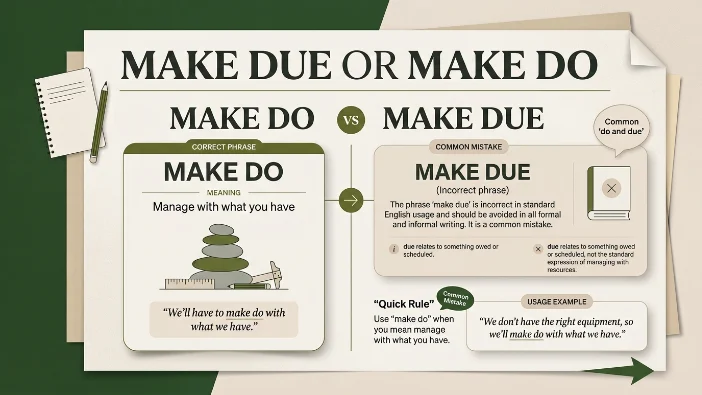
The correct phrase is “make do,” meaning to manage with less than ideal resources. “Make due” is an incorrect spelling that many people mistakenly use. The confusion arises because “do” and “due” sound similar in casual speech, but “make due” has no legitimate meaning in standard English usage.
Have you ever caught yourself typing “make due” in an email and wondering if it looks wrong? You’re not alone. This tiny spelling confusion trips up native English speakers and language learners alike, creating an embarrassing error that can undermine professional credibility in written communication.
Here’s the straightforward truth: The correct expression is always “make do.” You never need “make due” in any formal or informal context. Understanding why this phrase works the way it does will help you remember it permanently, so you can write with confidence and never second-guess yourself again.
In this comprehensive guide, you’ll learn the exact meaning of “make do,” why people mistakenly write “make due,” how to use the phrase correctly in various contexts, and simple memory tricks to ensure you always choose the right spelling.
What’s the Difference Between “Make Do” and “Make Due”?
The difference between “make do” and “make due” is simple. One is a standard English phrase with a clear meaning. The other is a spelling error that has no valid usage.
The correct phrase “make do” means to manage with limited resources, to get by with what’s available, or to accept something less than perfect because better options aren’t accessible. It suggests resourcefulness and adaptability in less-than-ideal circumstances.
The incorrect version “make due” combines the verb “make” with the adjective “due,” which creates a grammatically nonsensical construction. Due” means expected, owed, or appropriate. You can’t “make” something that’s already owed or expected.
| Aspect | Make Do | Make Due |
|---|---|---|
| Meaning | Manage with limited resources; use what’s available | No legitimate meaning (spelling error) |
| Part of Speech | Verb phrase (idiomatic expression) | Non-standard spelling error |
| Refers To | Coping, adapting, surviving with constraints | Nothing in standard English |
| Typical Usage | “We’ll have to make do with what we have” | Never used correctly |
| Example | “I made do with a smaller office” | “I made due with a smaller office” (incorrect) |
| Common Confusion | None when spelled correctly | Mistaken for correct phrase due to similar pronunciation |
After looking at the comparison, you can see that “make do” is the only legitimate choice. The word “do” functions as a verb in this phrase, essentially meaning “to manage” or “to suffice.” When you say “we’ll make do,” you’re saying “we’ll manage” even though resources are limited.
Is “Make Do” a Grammar, Vocabulary, or Usage Issue?
Make do” sits at the intersection of grammar, vocabulary, and usage in English, and understanding this helps clarify why the phrase works the way it does.
From a grammar perspective, “make do” is a verb phrase where “make” is the main verb and “do” is functioning as a noun meaning “adequate performance” or “sufficient action.” This creates a grammatical structure similar to “make believe” or “make shift” where the second word functions as a noun complement.
In vocabulary terms, the phrase represents a fixed idiomatic expression. Like many English idioms, its meaning isn’t directly derived from its individual words. You can’t understand “make do” by looking at “make” and “do” separately. The phrase has acquired its own meaning through common usage over generations.
The usage aspect involves how and when native speakers deploy this expression in real situations. You’ll encounter “make do” far more often in spoken English and informal writing than in academic papers or formal legal documents. It belongs to the category of everyday expressions that make English sound natural and conversational.
Key Usage Points
- In formal writing, you can use “make do” but you might prefer alternatives like “manage with,” “use available resources,” or “work within constraints.”
- In business English, “make do” appears in contexts like “We’ll have to make do with the current budget.”
- In academic writing, you might see “make do” in case studies about resource-limited situations, but it’s generally casual.
- In everyday conversation, “make do” is common and completely natural. Nobody will think twice about hearing “I guess we’ll just make do.”
Practical Takeaway: Never use “make due.” Always use “make do” when you mean managing with limited resources, and consider more formal alternatives in academic or high-stakes professional writing.
How to Use “Make Do” Correctly
“Make do” follows a consistent pattern in English sentences. Understanding these patterns will help you use it naturally and correctly in any context.
Meaning of “Make Do”
The phrase “make do” means to manage with what’s available, to accept less than ideal circumstances, or to get by without everything you need or want. It implies resourcefulness and adaptation.
Pronunciation
“Make do” is pronounced as /meɪk duː/. The emphasis falls evenly on both words, though some speakers slightly emphasize “do” for clarity.
Part of Speech
“Make do” functions as a verb phrase or idiom. The phrase acts as a single unit of meaning, similar to other English idioms like “make sense” or “make believe.
Common Collocations
- Make do with
- Make do without
- Have to make do
- Will make do
- Manage to make do
- Make do and mend
Typical Sentence Patterns
- Subject + make do + with/without + object
- Subject + have/has to make do
- Subject + will make do
Natural Workplace Example
“We didn’t get approval for new laptops, so we’ll make do with our current equipment for another quarter.”
Academic Example
“Researchers in developing regions often make do with limited laboratory facilities while still producing valuable work.”
Technology Example
“The legacy system can’t support the new features, but we’ll make do with temporary workarounds until the upgrade arrives.”
Email Example
“I understand the conference room isn’t available, but we can make do with the smaller meeting space.”
Daily Conversation Example
“There’s only one chair, so I guess we’ll just make do.”
Common Learner Mistake
Many English learners mistakenly write “make due” because they hear the phrase spoken and assume the spelling matches the adjective “due.” Remember: If you can substitute “manage” or “cope” in the sentence, you need “do,” not “due.
Mini Recap
Make do” always means managing with limited resources. It requires the word “do,” never “due.” When you’re unsure, think “do” as in “take action” or “manage.” The phrase is about doing something with what you have.
When Not to Use “Make Do”
Writers often choose “make due” incorrectly in several situations. Recognizing these common mistakes will help you avoid them.
1. Professional Emails
Mistake: “We’ll have to make due with the current software.”
Correct: “We’ll have to make do with the current software.”
Why: “Make do” is the correct phrase for managing with limited resources. “Make due” is always incorrect.
2. Project Documentation
Mistake: “The team made due with reduced staffing.”
Correct: “The team made do with reduced staffing.”
Why: This is a classic misuse of the phrase in professional contexts.
3. Personal Notes
Mistake: “We made due with what we had.”
Correct: “We made do with what we had.”
Why: Even in informal writing, “make due” is a spelling error.
4. Resume Writing
Mistake: “Made due with limited resources to complete projects.”
Correct: “Made do with limited resources to complete projects.”
Why: This error can make a resume look unprofessional and poorly edited.
5. Academic Papers
Mistake: “The study made due with a small sample size.”
Correct: “The study made do with a small sample size.”
Why: Academic writing requires precision in vocabulary and spelling.
6. Business Proposals
Mistake: “We can make due with the existing budget.”
Correct: “We can make do with the existing budget.”
Why: Spelling errors in business proposals undermine credibility.
7. Social Media Posts
Mistake: “We made due with what we had 💪”
Correct: “We made do with what we had 💪”
Why: Even casual content benefits from correct spelling.
8. Job Interviews
Mistake: “I’ve always been able to make due with limited resources.”
Correct: “I’ve always been able to make do with limited resources.”
Why: Verbal errors in interviews can create negative impressions.
Common Mistakes Table
| Correct Sentence | Incorrect Sentence | Explanation |
|---|---|---|
| I’ll make do with my old phone. | I’ll make due with my old phone. | “Due” is incorrect; “do” expresses managing with limited resources. |
| We made do without a dishwasher. | We made due without a dishwasher. | “Due” is wrong; “do” indicates coping without something. |
| Can you make do with less coffee? | Can you make due with less coffee? | “Due” is a spelling error; “do” is the verb for managing. |
| The team made do with existing tools. | The team made due with existing tools. | “Due” isn’t used in this phrase; always use “do.” |
| She makes do with basic equipment. | She makes due with basic equipment. | “Due” has no place in this expression; “do” is correct. |
| We’ll have to make do somehow. | We’ll have to make due somehow. | “Due” is wrong; the phrase requires “do” as the complement verb. |
| They made do during difficult times. | They made due during difficult times. | Always use “do” when meaning to manage or cope. |
| He makes do with limited information. | He makes due with limited information. | “Due” can’t follow “make” in this construction; “do” is correct. |
Decision Box
If you mean managing with what’s available → Use make do
If you mean something owed or expected → Use due (but never after “make”)
If you’re unsure which word to use → Replace the phrase with “manage” or “cope.” If either works, you need make do
Remember this rule → You can do something, but you can’t due something. “Due” is an adjective. “Do” is a verb.
Real-World Examples
Office Communication
“The printer is broken, but we can make do with the one in the other department for now.”
Business Email
“Since the project budget was cut, we’ll need to make do with fewer freelance resources.”
School or University
“The chemistry lab had outdated equipment, but students learned to make do and still achieved excellent results.”
Customer Support
“I know the app doesn’t have all the features you want, but most users make do with the basic version.”
Technology
“The development team had to make do with an older framework because the new one wasn’t stable yet.”
Artificial Intelligence
“Early AI systems had to make do with limited training data compared to today’s models.”
Daily Conversation
“We forgot the tent poles, but we’ll make do with some sticks and rope.”
“Make Do” in Modern Technology
The phrase “make do” appears frequently in discussions about technology, especially in contexts involving resource constraints. Understanding these modern applications helps you see how the phrase remains relevant today.
In artificial intelligence and machine learning, “making do” often means training models with limited computational resources, small datasets, or budget constraints. Researchers frequently discuss how to make do with available computing power to achieve meaningful results.
In virtual assistants and chatbots, “make do” can describe how these systems handle imperfect user input. For example, a voice assistant might need to make do with background noise or partial commands to understand user intent.
In business software and enterprise tools, “make do” often appears in discussions about system limitations and workarounds. Teams constantly make do with existing software capabilities while waiting for upgrades or alternative solutions.
In product development, “make do” reflects the reality that teams rarely have unlimited resources. Successful developers learn to make do with available tools, time, and talent to ship functional products.
Word Origin and History
The phrase “make do” has a fascinating history that explains its current meaning and usage.
Make do” emerged in British English during the late 19th century, though similar expressions existed earlier. The phrase gained significant prominence during World War I and World War II when resource scarcity forced people to manage with limited supplies.
The expression “make do and mend” became particularly popular in Britain during World War II as a government campaign encouraging citizens to repair and reuse clothing rather than buying new items. This phrase embodies the resourceful spirit behind “make do.”
Linguistically, “make do” follows a pattern where “make” combines with a second word to create a new meaning. This pattern appears in other English idioms like “make believe” (pretend) and “make shift” (temporary solution).
The confusion with “due” likely arises from the similarity between “do” and “due” in casual speech and the frequent use of “due” in other common expressions like “due to” and “in due time.
Expert Insight
The most common grammar errors aren’t about obscure rules. They’re about everyday phrases we use constantly but never stop to think about. “Make do” is a perfect example. Every time you write “make due,” you’re telling your reader that you haven’t internalized the basic mechanics of an expression you’ve probably encountered hundreds of times.
The fix is simple. Treat “make do” as a set phrase like “make believe” or “make shift.” In all these expressions, the second word functions as a noun or complement, not an adjective. You can’t “make” an adjective. You can only “make” a noun or verb.
Error Prevention Checklist
- ✅ Always use “make do” when you mean managing with limited resources
- ✅ Never use “make due” in any context
- ✅ Substitute “manage” or “cope” to check if “make do” is appropriate
- ✅ Remember: “Due” means expected or owed; you can’t “make” something that’s already owed
- ✅ Quick memory tip: You can do something about a situation. You can’t due something.
- ✅ In formal writing, consider alternatives like “manage with” or “work within constraints”
- ✅ When speaking, pronounce “do” clearly to avoid confusing it with “due
- ✅ Proofread emails and documents specifically for this common error
Related Grammar Confusions
- Then vs. Than: Time comparison vs. comparison between items
- Your vs. You’re: Possession vs. contraction of “you are”
- Its vs. It’s: Possession vs. contraction of “it is”
- There vs. Their vs. They’re: Location vs. possession vs. contraction
- Effect vs. Affect: Noun (result) vs. verb (influence)
- To vs. Too vs. Two: Direction vs. excess vs. number
- Who vs. Whom: Subject vs. object
- Which vs. That: Restrictive vs. non-restrictive clauses
- Lay vs. Lie: Transitive vs. intransitive verbs
- More than vs. Over: Formal distinction in usage
FAQs
What is the difference between “make do” and “make due”?
“Make do” is the correct phrase meaning to manage with limited resources. Make due” is an incorrect spelling that has no legitimate meaning in standard English. The confusion arises because “do” and “due” sound similar in casual speech.
Why do people say “make do”?
People say “make do” to express that they will manage or cope with limited resources. The phrase communicates resourcefulness, adaptation, and acceptance of less-than-ideal circumstances without complaining.
Is “make do” proper English?
Yes, “make do” is proper English and has been used for over a century. It’s a standard idiomatic expression found in major dictionaries including Merriam-Webster, Oxford, and Cambridge.
Can I use “make do” in formal writing?
Yes, you can use “make do” in formal writing, though alternatives like “manage with,” “utilize available resources,” or “work within constraints” may be more appropriate in academic or legal contexts.
What is the origin of “make do”?
“Make do” emerged in British English during the late 19th century and gained prominence during World War I and World War II. The related phrase “make do and mend” was a government campaign in Britain during World War II encouraging resource conservation.
Is “make due” ever acceptable in English?
No, “make due” is never acceptable in standard English. It’s a spelling error that has no correct usage. Always use “make do” instead.
Conclusion
The choice between “make do” and “make due” is actually no choice at all. “Make do” is the only correct phrase, carrying a rich meaning about resourcefulness and adaptation in less-than-ideal situations. It has served English speakers well for over a century, helping them express resilience and practicality.
Make due” is simply a spelling error that you can easily avoid by remembering one simple rule: You can do something, but you can’t due something. “Due” is an adjective describing what’s owed or expected, while “do” is the verb you need when you’re talking about taking action.
The next time you find yourself writing this phrase, pause and ask: Am I describing how to manage with limited resources? If so, you need “make do.” Your writing will be clearer, more professional, and absolutely correct.