Quick Answer
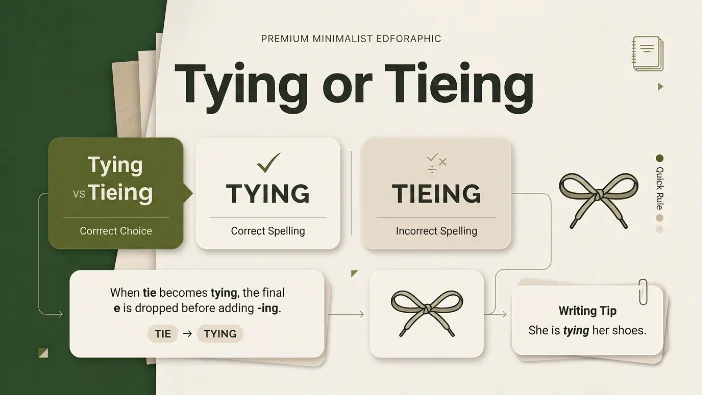
The correct spelling is tying, not tieing. Tying is the present participle of the verb “to tie” and follows the standard English rule of changing “-ie” to “-y” before adding “-ing.” This spelling applies in all contexts whether you’re tying your shoes, tying a knot, or tying up loose ends in a project.
If you’ve ever paused mid-sentence, staring at your screen wondering whether to type “tying” or “tieing,” you’re not alone. This common spelling dilemma trips up even native English speakers, especially when they’re writing quickly and relying on instinct rather than grammatical rules. The confusion makes sense after all, the base word is “tie,” so adding “-ing” should logically give us “tieing,” right?
Wrong. The correct spelling is “tying,” and this seemingly small difference can make your writing appear polished and professional or distractingly amateurish. Whether you’re drafting a business email, writing a student paper, or creating content for your website, mastering this spelling rule demonstrates attention to detail that readers notice even if subconsciously. In this comprehensive guide, we’ll explain exactly why “tying” is correct, why “tieing” is a common error, and how to remember the rule so you never hesitate again.
What’s the Difference?
The short answer is that there’s no meaningful difference in meaning or usage between these two spellings only one is correct, and the other is a misspelling. “Tying” is the standard spelling, while “tieing” is considered incorrect in all modern forms of English, whether you’re writing in the United States, the United Kingdom, Australia, or any other English-speaking region.
The core difference lies in spelling and the application of English orthographic rules, not in any semantic distinction.
| Aspect | Tying | Tieing |
|---|---|---|
| Part of Speech | Present participle/gerund of “tie” | Misspelling of the same form |
| Meaning | The act of fastening, securing, or binding with a rope, string, or similar item | Same meaning but not a recognized spelling |
| Typical Usage | All contexts: “tying shoes,” “tying knots,” “tying documents together” | Incorrect in all contexts |
| Example | “She was tying her shoelaces when the phone rang.” | ❌ “She was tieing her shoelaces…” |
So why do people continue to make this mistake? The confusion stems from a few sources. First, native speakers typically form present participles by simply adding “-ing” to the base verb: “play” becomes “playing,” “read” becomes “reading,” and “talk” becomes “talking.” When we encounter a verb ending in “-ie,” like “tie,” it’s tempting to follow the same pattern and write “tieing.” Second, common spell-checkers often don’t flag “tieing” because some dictionary databases include it as an alternative spelling, although this is increasingly outdated and incorrect.
The truth is, English has a specific rule governing verbs ending in “-ie,” and understanding this rule will help you avoid the “tieing” error every time.
Grammar and Usage
Is This a Grammar, Vocabulary, or Usage Issue?
This is primarily a spelling and usage issue, though it has grammatical implications because it involves the formation of verb tenses. When we create the present participle (the “-ing” form) of verbs ending in “-ie,” English spelling rules require us to change the “-ie” to “-y” before adding “-ing.” This places “tying” firmly in the domain of orthographic conventions rather than vocabulary meaning or syntactic grammar.
From a vocabulary perspective, “tie” functions as both a noun and a verb. As a verb, it means to fasten, bind, or connect, while as a noun, it refers to the fastener itself, a connection, a necktie, or a draw in a competition. The spelling change when adding “-ing” doesn’t affect the word’s meaning or its classification it’s purely a matter of correct spelling.
Are the Words Interchangeable?
In terms of meaning, “tying” and “tieing” would be interchangeable if both were correct spellings. However, since “tieing” is considered an error, they are not interchangeable in any formal, academic, or professional writing context. You should always choose “tying.”
Formal English Contexts
- Academic Writing: Always use “tying.” Professors, editors, and reviewers expect standard spelling conventions.
- Business Writing: Use “tying” in emails, reports, and professional correspondence.
- Everyday Conversation: While “tieing” might appear occasionally in informal texting or social media posts, it’s still a misspelling that undermines credibility.
Tying: The Correct Spelling
Meaning and Definition
Tying is the present participle and gerund form of the verb “tie.” It refers to the continuous or ongoing action of fastening, securing, or binding something with a cord, rope, string, or similar material. It can also refer to creating a connection, equivalence, or restriction.
Pronunciation
Tying is pronounced as /ˈtaɪ.ɪŋ/ two syllables rhyming with “dying” and “lying.” The stress falls on the first syllable, and the vowel sound is a long “i” as in “eye.”
Common Collocations and Patterns
| Collocation | Meaning | Example |
|---|---|---|
| Tying shoes | Fastening shoelaces | “The toddler is learning to tie her shoes.” |
| Tying a knot | Creating a knot | “He was tying a knot in the rope.” |
| Tying up loose ends | Completing unfinished tasks | “Before the holidays, I’m tying up loose ends at work.” |
| Tying the knot | Getting married (informal) | “They’re tying the knot next June.” |
| Tying records | Matching a previous achievement | “The athlete is tying the world record.” |
| Tying something together | Unifying or connecting elements | “Her speech was tying together themes from the conference.” |
Real-World Examples
Workplace Example:
“I’m currently tying up the final details on the quarterly report before submitting it to the executive team. I should have everything ready by noon.”
Academic Example:
“The researcher is tying together findings from three different studies to support her hypothesis about language acquisition patterns in bilingual children.”
Technology Example:
“The system is tying together multiple data sources to generate a comprehensive user profile, which will improve personalization across our platforms.”
Email Example:
“Subject: Project Update I’m tying off the final tasks on the website redesign and expect to launch the new homepage by Friday afternoon. Please review the attached preview before the end of the day.”
Daily Conversation Example:
“Can you wait a moment? I’m tying my shoelaces and then we can leave for the park.”
Learner Mistake to Avoid:
❌ “I was tieing my hair back when the phone rang.”
✓ “I was tying my hair back when the phone rang.”
Mini Recap: When you need the “-ing” form of “tie,” always write “tying.” This is the standard spelling in every English-speaking country and all formal contexts. The transformation follows a consistent English spelling rule that you can apply to other “-ie” verbs as well.
Why “Tieing” Is Incorrect
The Spelling Rule
The error of writing “tieing” stems from a straightforward misunderstanding of English spelling conventions. When adding “-ing” to verbs ending in “ie,” we drop the “e” and change the “i” to “y” before adding “-ing.”
Here’s the transformation:
- tie → remove “e” → ti → change “i” to “y” → ty → add “-ing” → tying
Other verbs that follow this same pattern include:
- die → dying
- lie (meaning to recline) → lying
- vie → vying
Common Mistakes with “Tieing”
The “tieing” error typically occurs in several contexts:
1. When writing the continuous tenses:
❌ “I was tieing my shoes.”
✓ “I was tying my shoes.”
2. When using the present participle as an adjective:
❌ “The tieing mechanism was broken.”
✓ “The tying mechanism was broken.”
3. When using the gerund form:
❌ “Tieing your shoes tightly prevents blisters.”
✓ “Tying your shoes tightly prevents blisters.”
Why the Mistake Happens
There are several psychological and linguistic reasons for this error:
Analogical Reasoning: English speakers often assume that the “-ing” form simply adds “-ing” to the base word. Since “tie” looks like it would become “tieing” under this assumption, it’s a natural but incorrect inference.
Spell-Checker Inconsistencies: Some older or less comprehensive spell-checkers accept “tieing” as a variant spelling, leading to user confusion. This acceptance sometimes appears in non-American English settings, but even these references are increasingly acknowledging “tying” as the sole correct form.
Visual Memory: People who see the word “tieing” in their own or others’ writing may begin to believe it’s an acceptable alternative. This is a classic example of the “if I’ve seen it, it must be correct” fallacy.
When Not to Use Each Word
Situations Where Writers Choose “Tieing” Incorrectly
1. Fastening Actions
People often write “tieing” when describing the action of fastening shoelaces, neckties, packages, or any kind of knot. In every instance, “tying” is the correct choice.
- ❌ “He was tieing his bow tie in the mirror.”
- ✓ “He was tying his bow tie in the mirror.”
2. Connecting or Unifying
When describing the act of connecting ideas, concepts, or people, some writers mistakenly use “tieing.”
- ❌ “The documentary is tieing together multiple storylines.”
- ✓ “The documentary is tying together multiple storylines.”
3. Reaching a Draw or Equivalence
In sports and competitions, when describing matching scores or records:
- ❌ “The team is tieing for first place.”
- ✓ “The team is tying for first place.”
4. Marital Contexts
In informal references to marriage (“tying the knot”), writers sometimes erroneously use “tieing.”
- ❌ “They’re tieing the knot this weekend.”
- ✓ “They’re tying the knot this weekend.”
5. Restricting or Binding
When describing metaphorical restrictions or commitments:
- ❌ “The contract is tieing him to the company for five years.”
- ✓ “The contract is tying him to the company for five years.”
6. Finalizing or Completing
When wrapping up tasks or projects:
- ❌ “I’m tieing up the final details.”
- ✓ “I’m tying up the final details.”
How to Remember the Difference
The simplest memory aid is this: “Tie” ends in “ie,” and when you add “-ing,” the “ie” becomes “y” just like “die” becomes “dying” and “lie” becomes “lying.” Think of it as the “ie-to-y” rule: if you can remember that “die” changes to “dying,” you can remember that “tie” changes to “tying.”
Another helpful technique is to think of the word “tie” as having a “silent e” that disappears when you add “-ing.” This isn’t technically accurate (the “e” isn’t silent, it’s part of the “ie” ending), but it’s a useful mental shortcut.
Common Mistakes Table
| Correct Sentence | Incorrect Sentence | Explanation |
|---|---|---|
| “She is tying her hair back before the meeting.” | “She is tieing her hair back before the meeting.” | The “-ing” form of “tie” requires the “ie” to change to “y” before adding “-ing.” |
| “The judge is tying the scores from both rounds.” | “The judge is tieing the scores from both rounds.” | Verbs ending in “-ie” drop the “e” and change the “i” to “y” when forming the present participle. |
| “I’m tying up the final chapters of my thesis.” | “I’m tieing up the final chapters of my thesis.” | The same spelling rule applies in all contexts, whether physical or metaphorical. |
| “They’re tying the knot at a small ceremony.” | “They’re tieing the knot at a small ceremony.” | In informal idioms, the standard spelling rule still applies. |
| “The software is tying together multiple data streams.” | “The software is tieing together multiple data streams.” | In technology contexts, “tying” remains the only correct spelling. |
| “He spends every morning tying his bow tie.” | “He spends every morning tieing his bow tie.” | The transformation applies consistently the context doesn’t alter the spelling rule. |
Decision Box
If you’re describing the continuous or ongoing action of fastening, securing, connecting, or binding something whether physically or metaphorically use “tying.”
If you’re tempted to write “tieing,” stop and remember: “tie” follows the same pattern as “die” (dying) and “lie” (lying). The “-ie” becomes “-y” before adding “-ing.”
In short: Always choose “tying.”
Real-World Examples
Office Communication
“I’m tying together the quarterly projections with the actual performance data from Q1 and Q2. The preliminary analysis suggests we’re on track to meet our annual targets.”
Business Email
Subject: Project Update
“I’m currently tying off the remaining action items from our last sprint. The team has completed the front-end revisions, and we’re now tying the back-end integration into the existing infrastructure. I’ll share the final timeline tomorrow morning.”
School or University
“In my literature paper, I’m tying the themes of isolation and community across three different novels from the Victorian era. It’s challenging to avoid repetition while tying these seemingly separate works together.”
Customer Support
“I see you’re tying to connect your account with multiple devices simultaneously. We support up to five devices, and I can help you tying them all to the same profile if you’d like.”
Technology Context
“The API is tying together our CRM, email marketing platform, and analytics dashboard. This integration allows for real-time data synchronization without manually tying each system together every morning.”
Artificial Intelligence
“The neural network is tying together various features voice patterns, sentiment analysis, and visual cues to determine the speaker’s emotional state. It’s effectively tying these modalities into a single interpretation.”
Daily Conversation
“Give me two minutes. I’m tying my son’s shoes and then we’re heading out. He’s still learning, so it takes a bit longer than usual when I’m tying them for him.”
Modern Technology
Artificial Intelligence and Assistants
The word “tying” appears frequently in discussions of AI integration and system connectivity. Developers and product teams often describe AI systems as “tying together” various data sources, APIs, and user inputs to create cohesive experiences.
Example in Practice:
“Our AI assistant is tying together your calendar, email, task list, and meeting preferences to suggest optimal schedules. By tying these systems together, we reduce the cognitive load of daily planning.”
Voice Assistants
When voice assistants process commands, they’re constantly “tying” natural language inputs to appropriate actions. A user might say, “Book a restaurant for Friday,” and the system is tying that instruction to the availability, location, and cuisine preferences stored in the user’s profile.
Chatbots
Customer service chatbots excel at tying multiple conversation threads together, ensuring that context carries across exchanges. When a user jumps between topics, the system is tying these disjointed statements into a coherent understanding of the customer’s needs.
Business Software
Modern business platforms emphasize “tying” disparate tools into unified workflows. This represents both a technological achievement and a frequent topic in software documentation: “This feature allows you to customize your dashboard by tying together widgets from different modules.”
Word Origin
The verb “tie” comes from Old English “tīgan” or “tēogan,” which meant “to pull, draw, or tug.” The word evolved through Middle English as “tien” or “tegen” before settling into modern usage.
This etymological journey explains the vowel sound and spelling patterns that have persisted for centuries. The spelling transformation from “tie” to “tying” is a relatively modern orthographic convention, but it aligns with a broader pattern in English for verbs ending in “-ie.”
Interestingly, the noun form of “tie” entered English through various cultural contexts, including neckwear fashion in the 17th century, where the necktie became associated with Croatian soldiers and their distinctive scarves.
Understanding the history of “tie” and its spelling variations helps contextualize why the “-ing” form has evolved to become “tying” rather than “tieing.” English spelling often reflects historical pronunciation patterns that have since changed, and “tying” maintains a visual representation of the pronunciation more accurately than “tieing” would.
Expert Insight
As an experienced writing instructor, I’ve encountered the “tying vs. tieing” confusion in countless student papers, professional documents, and even published materials that somehow slipped past editors. What strikes me most is how this particular error seems to affect people who otherwise have excellent spelling skills.
The reason is simple: our brains naturally default to the most common pattern. Most verbs simply add “-ing,” so our mental spell-checker accepts “tieing” as a plausible form. The solution isn’t to memorize endless spelling exceptions but to understand why certain patterns exist. When you recognize that “tie” belongs to a small family of verbs ending in “-ie” that follow a consistent rule, you’re equipping yourself to handle any similar word that comes along.
I always tell my students: “When you’re tying something together, remember that the word itself is tying itself together differently.” It’s a visual trick seeing the “y” instead of “ie” before “-ing” signals to readers that you know the rules.
Error Prevention Checklist
- ✅ Always use “tying” when forming the present participle of “tie”
- ✅ Never use “tieing” in formal, academic, or professional writing
- ✅ Remember the “ie-to-y” rule: when verbs ending in “-ie” need “-ing,” change the “-ie” to “-y” first
- ✅ Think of other examples: “die” becomes “dying,” “lie” becomes “lying,” “vie” becomes “vying”
- ✅ Double-check if you’re unsure: when in doubt, look it up in a trusted dictionary
- ✅ Use spell-checker wisely: many spell-checkers accept “tieing” as an alternative, but trusted references confirm it’s incorrect
Related Grammar Confusions
- Dying vs. Dieing: “Dieing” is a common error when forming the present participle of “die,” which should be “dying.” The same “-ie” rule applies.
- Lying vs. Lieing: “Lieing” is incorrect; the present participle of “lie” (meaning to recline or deceive) is “lying.”
- Vying vs. Vying: “Vie” follows the same pattern, becoming “vying.”
- Drying vs. Dry: “Dry” becomes “drying” by adding “-ing” directly, showing how base forms ending in “y” behave differently.
- Tied vs. Tyed: The past tense of “tie” is “tied,” sometimes confused with the present participle.
- Quiet vs. Quite: These commonly confused words have different meanings and pronunciations.
- Affect vs. Effect: A classic usage error with distinct grammatical roles.
- Your vs. You’re: Contraction vs. possessive a persistent challenge for many writers.
- It’s vs. Its: Another contraction vs. possessive distinction that trips up both learners and native speakers.
- Compliment vs. Complement: These homophones have different meanings and are frequently confused.
- Principal vs. Principle: Two words with different meanings but similar spellings.
- Stationary vs. Stationery: One means still, the other refers to writing paper.
FAQs
Is “tieing” accepted in British English?
No. “Tieing” is considered incorrect in all forms of English, including British, American, Australian, and Canadian English. Both Oxford and Cambridge dictionaries confirm “tying” as the only standard spelling for the present participle of “tie.”
Why do some spell-checkers accept “tieing”?
Some older or incomplete spell-checkers include “tieing” as a variant spelling, but this acceptance is increasingly outdated. The vast majority of style guides, dictionaries, and editors consider “tieing” an error. Always rely on authoritative sources like Oxford or Cambridge dictionaries rather than built-in spell-checkers for definitive guidance.
Can “tieing” ever be correct in any context?
No. There is no standard English context where “tieing” is considered correct spelling. Any usage is a misspelling and should be corrected to “tying.
What is the past tense of “tie”?
The past tense and past participle of “tie” is “tied.” This remains consistent and is not affected by the spelling confusion surrounding the present participle.
How do I remember when to use “tying”?
Remember that “tie” follows the same pattern as “die” and “lie.” Just as “die” becomes “dying” and “lie” becomes “lying,” “tie” becomes “tying.” Whenever you need the “-ing” form, think of this family of words and apply the “ie-to-y” rule.
Is the “tie” in “bow tie” spelled differently when adding “-ing”?
No. Whether the verb “tie” refers to a necktie, shoelaces, or any other object, the spelling remains “tying” for the present participle. The specific type of tie doesn’t affect spelling.
Does “tying” have any other meanings?
Yes. “Tying” can refer to:
- Fastening or binding something
- Creating a connection, association, or relationship
- Reaching a draw or equality in a competition
- The construction of a bow or knot
- Using a necktie
The context determines the precise meaning, but the spelling remains consistent.
Conclusion
The difference between “tying” and “tieing” is straightforward but important: “tying” is correct, and “tieing” is not. While both would mean the same thing if both existed as standard spellings, only one is recognized by dictionaries and accepted in professional writing.
By remembering the “ie-to-y” rule changing the “-ie” ending to “-y” before adding “-ing” you’ll never hesitate when writing the continuous form of “tie.” This rule applies consistently to “die” (dying), “lie” (lying), and “vie” (vying), making it a reliable pattern to internalize.
Whether you’re tying your shoes, tying together ideas in an essay, or tying up loose ends at work, using the correct spelling signals professionalism and attention to detail. It’s a small difference that makes a significant impression on readers, colleagues, and editors.
The next time you’re about to type “tieing,” pause. Remember that your word choice reflects your command of language and “tying” is always the right choice.
1 thought on “Tying or Tieing | Learn the Spelling Rule That Makes It Clear In 2026”