Quick Answer
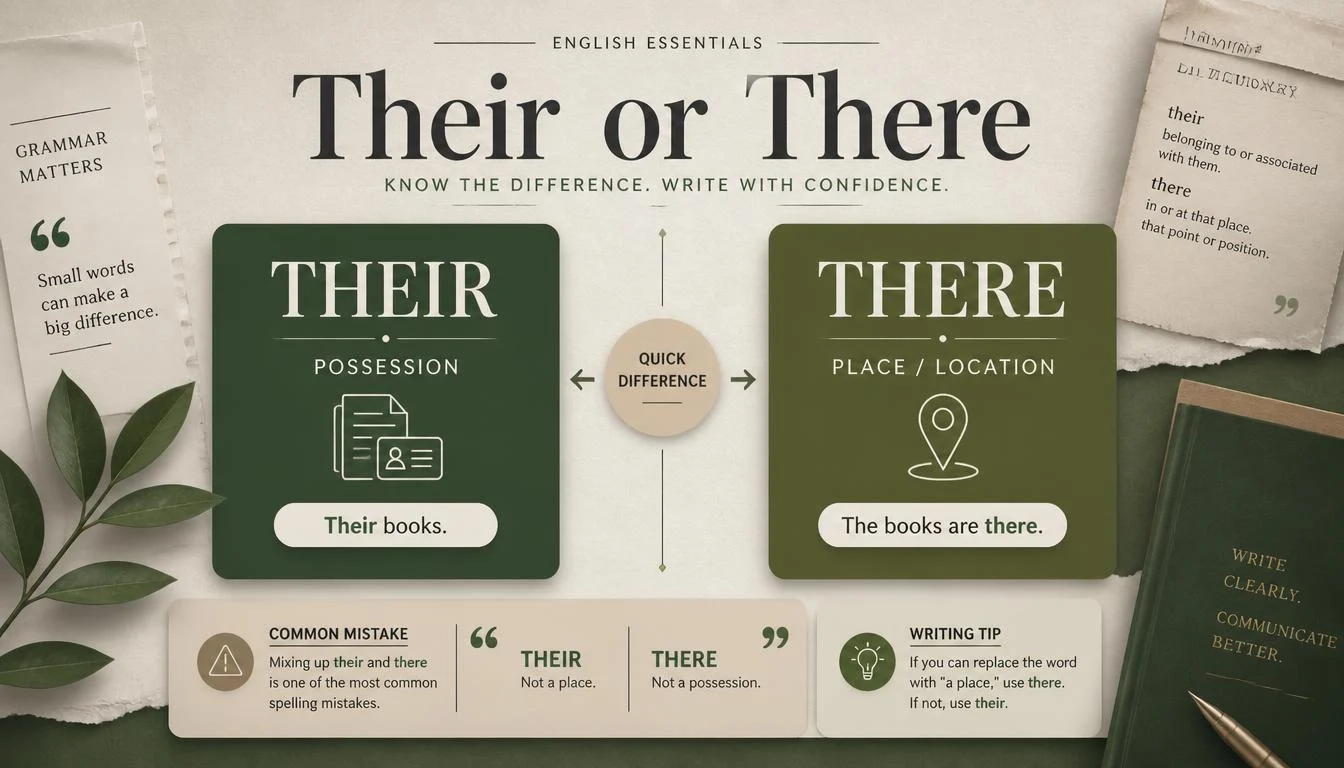
“Their” indicates possession (belonging to them), while “there” refers to a place or introduces the existence of something. Choosing the right word is crucial as they are homophones sounding identical but having completely different meanings. Using them incorrectly is a common grammatical error that can confuse readers and undermine your writing’s clarity.
It happens to everyone. You’re writing an email, a report, or even a simple text message, and you pause. Your cursor blinks over the same three letters, and a small wave of doubt creeps in. Which one is it their or there? You’re not alone; this is one of the most common stumbling blocks in English.
It is easy to get these words confused because they are homophones, meaning they sound exactly the same when you say them aloud. However, while their pronunciation is identical, their meanings are completely different. This confusion is a top-tier “grammar trap” that can distract from your message, whether you are a student, a professional, or a casual writer. Using the wrong word can signal a lack of attention to detail in a business proposal or cost you marks on an academic paper.
In this guide, we will strip away the confusion for good. We will move beyond the simple definitions and explore how to use their and there with confidence in any context. By the end of this article, you will have a clear, practical understanding that will make this error a thing of the past.
What’s the Difference?
At its core, the difference between their and there is a matter of purpose and function within a sentence. One is about ownership, while the other is about location or existence. Let’s break down the specific rules for each.
| Feature | Their | There |
|---|---|---|
| Meaning | Belonging to or relating to them. | In, at, or to that place; also used to introduce a fact. |
| Part of Speech | Possessive determiner (adjective). | Adverb or pronoun. |
| Refers To | Ownership or possession by a group of people or things. | A location, a point in a process, or the existence of something. |
| Typical Usage | Before a noun to show who it belongs to. | To point to a place, or before “is/are” to say something exists. |
| Example | They are proud of their achievements. | Put the books over there. There is a solution for that. |
| Common Confusion | Used for location (“Their is a cat…”). | Used for possession (“That is there car…”). |
In short, you can use a simple mental check. Ask yourself: Does this sentence show that someone owns something? If yes, use their. Does it describe a place or state that something exists? If yes, use there. Once you identify the core meaning you want to express, the choice becomes clear.
Is This a Grammar, Vocabulary, or Usage Issue?
This is primarily a usage issue, stemming from a vocabulary difference. Grammatically, both words are correct in their own contexts. The problem occurs when one is used in place of the other, violating the rules of English grammar and confusing the reader. Therefore, learning how to use these two words is not about learning a difficult grammar rule, but about expanding your vocabulary to accurately distinguish between two different words with distinct purposes. They are not interchangeable, and using them incorrectly is a major sign of a developing writer.
Formal vs. Informal Contexts
Both their and there are used in all forms of English, from everyday conversation to the most formal legal documents. The distinction never changes. While contractions like “they’re” might be avoided in formal writing, “their” and “there” are always acceptable when used correctly.
A Practical Takeaway
Mastering the their vs. there distinction is a quick win for your writing. It demonstrates command over a common stumbling block and adds polish to your communication.
The Ins and Outs of “Their”
Meaning and Pronunciation
Their is a possessive determiner. It is used to show that something belongs to or is associated with “them” a group of people, animals, or things previously mentioned. It is pronounced /ðɛr/, exactly like “there.”
Common Collocations and Patterns
Their is almost always followed by a noun. It answers the question “Whose?”
- Basic Pattern: Their + [Noun]
- Everyday Example: The children took their seats.
- Workplace Example: The team celebrated their victory.
- Technology Example: Users must verify their email addresses.
- Email Example: Attached is their signed contract.
- Conversation Example: I love their new album!
Common Mistake
A common mistake is using “their” when referring back to a singular, indefinite pronoun like “someone” or “everyone.” While historically “his” was used, the singular “their” is now widely accepted and preferred for its inclusivity.
- Incorrect: Everyone should bring his own lunch.
- Correct: Everyone should bring their own lunch.
Mini Recap
Use their to show ownership. It is the possessive form of “they.”
The Role of “There”
Meaning and Pronunciation
There is far more versatile than their. Its primary uses are to act as an adverb to indicate a place (the opposite of “here”) or as a pronoun to introduce the existence of something. Like their, it is pronounced /ðɛr/.
Common Collocations and Patterns
There” has two main patterns you need to know.
1. As an Adverb (Place)
- Basic Pattern: [Verb] + [Preposition] + there.
- Example: She is standing over there.
- Example: We drove to London and stayed there for a week.
2. As a Pronoun (Existence)
- Basic Pattern: There + [form of “to be”] + [Subject].
- Example: There is a fly in my soup.
- Example: There are many reasons to be optimistic.
Common Mistake
By far, the most common error with “there” is using it in place of “their” or “they’re,” especially when introducing existence.
- Incorrect: Their is no way to know.
- Correct: There is no way to know.
Mini Recap
Use there to talk about a physical place, a point in a conversation, or to state that something exists (“there is/are”).
When Not to Use “Their” and “There”
Writers often trip up in specific situations. Here’s a quick guide to ensure you choose correctly.
| Context | Why the Mistake Happens | Correct Word |
|---|---|---|
| Showing Ownership | You are talking about a location or existence, but the word should be possessive. Example: “The group made there decision.” | Their (the decision belongs to the group). |
| Indicating Location | The word “there” feels like a place, but you are mistakenly using it to show ownership. Example: “Is this there office?” | Their (the office belongs to them). |
| Introducing a Fact | You are stating that something exists (There is/are) but use “their” instead. Example: “Their are many options.” | There (introduces the existence of options). |
| Pointing to a Place | You want to point at something, but get confused by the spelling. Example: “Put it over their.” | There (indicates a location). |
| Using “They’re” Incorrectly | You are confusing the contraction for “they are” with a possessive. Example: “Their going to win.” | They’re (short for “they are”). |
Common Mistakes: A Table of Examples
Here are some of the most common mistakes, side-by-side with the corrections, to illustrate the rules in action.
Decision Box: Which One to Use?
This quick decision box is designed to help you decide between their and there in less than ten seconds.
- If you mean “belonging to them,” choose THEIR.
- Try this test: Can you replace it with “our”? (“The team celebrated our victory.”) If yes, their is correct.
- If you mean “in or at that place,” choose THERE.
- Try this test: Can you replace it with “here”? (“I left my keys right here.”) If yes, there is correct.
- If you are introducing a fact or the existence of something, choose THERE.
- Try this test: Does the phrase start with “There is” or “There are” to declare something exists? If yes, there is correct.
Real-World Examples
Understanding how to use these words in realistic contexts is the final step in mastering them. Here’s how they look in a variety of everyday situations.
Office Communication
“Employees should ensure their personal belongings are stored in lockers. A charging station is available over there for your convenience.”
Business Email
“Dear Team, I want to extend my congratulations on their successful launch. I believe there is a significant opportunity for us to build on this momentum.”
Academic Context
“The researchers published their findings in a peer-reviewed journal. However, there are still several unanswered questions regarding the long-term effects.”
Technology & AI
“Users must often personalize their AI assistants. However, there is still a significant gap in how these tools handle nuanced requests.”
Daily Conversation
“Hey, have you seen John and Sarah? Their car is parked outside, so they must be there somewhere.”
Modern Technology
The digital age, with its focus on speed and informality, has made common grammatical errors like misusing their and there more visible than ever. In the world of artificial intelligence and virtual assistants, the stakes are even higher.
When you type “Their is a new update” into a chatbot, its programming will quickly understand what you mean, but the error undermines your credibility. Meanwhile, voice assistants like Siri or Alexa rely on proper pronunciation and context to understand “there” and “their” as they sound identical. While they can often figure out which one you meant from the context of the sentence, a human reader won’t always be so forgiving.
In business tools, from project management software to advanced AI platforms, clear communication is essential. A simple typo can create confusion in a team. For example, “Their are errors in the data” is a jarring mistake in a professional report. Writing with precision, even in fast-paced digital environments, remains a key indicator of professionalism and attention to detail.
Expert Insight
“I always tell my students that their and there are not just words you memorize from a textbook; they are tools for clear thinking. A mistake usually happens because you are not sure what you are trying to say. Is it about an item belonging to a group, or is it about a location? If you can answer that question in your head before you even start typing, you will almost never get it wrong.
Don’t try to think of it as a grammar rule, but as a small logic puzzle. If you’re talking about who owns something, you need ‘their.’ If you’re talking about where something is or whether it exists, you need ‘there.’ This process of thinking about your own meaning will automatically lead you to the correct spelling.”
Error Prevention Checklist
Before you hit send on that email or publish that report, run through this quick checklist in your head.
- Ownership? If the answer is yes, use [Their] .
- Location? If the answer is yes, use [There] .
- Stating “There is/are”? If your sentence starts with “There is” or “There are” to show something exists, use [There] .
- Can it be “They are”? If the sentence is about a group and an action (“They are going to the store”), you are looking for the contraction [They’re] .
Quick Memory Tip: The word here is hidden inside “there.” Use it when you’re talking about a place, just like “here.” The word heir is inside “their.” Use it when you’re talking about what someone owns.
Related Grammar Confusions
If you found this guide helpful, you might want to explore these other common grammar challenges that writers face:
- Your vs. You’re: Another classic homophone error. “Your” shows possession; “You’re” is a contraction for “you are.”
- Its vs. It’s: “Its” shows possession; “It’s” is a contraction for “it is.”
- To vs. Too vs. Two: “To” is a preposition; “Too” means “also”; “Two” is the number 2.
- Affect vs. Effect: “Affect” is usually a verb meaning to influence; “Effect” is usually a noun meaning a result.
- Accept vs. Except: “Accept” means to receive; “Except” means to exclude.
- Then vs. Than: “Then” relates to time; “Than” is used for comparisons.
- Who’s vs. Whose: “Who’s” is a contraction for “who is”; “Whose” shows possession.
- Loose vs. Lose: “Loose” means not tight; “Lose” means to misplace or not win.
- Principal vs. Principle: “Principal” means main or a school head; “Principle” means a fundamental rule.
- Stationary vs. Stationery: “Stationary” means not moving; “Stationery” refers to writing materials.
FAQs
Are “their” and “there” considered homophones?
Yes, they are classic examples of homophones. They are pronounced exactly the same, but have different spellings and meanings. The word “they’re” is also a homophone of these two.
What is the difference between “there,” “their,” and “they’re”?
“There” refers to a place or is used with “is/are” to show existence. “Their” is a possessive word meaning “belonging to them.” “They’re” is a contraction that means “they are”.
What is a simple way to remember when to use “their” vs. “there”?
A simple trick is to look at the spelling. The word “there” has “here” inside it use it for a place, like “here.” The word “their” has “heir” inside it use it for possession, as an heir inherits something.
Can I use “there” to talk about a person?
Yes, “there” can be used as a pronoun to introduce a person. For example, “There is someone at the door.” It is also used in greetings like “Hello, there!”.
Is “their” always plural?
Historically, “their” was used only for plural subjects. However, it is now widely accepted as a singular, gender-neutral pronoun for indefinite subjects like “someone,” “everyone,” or “a person,” which makes it very common in modern English.
Conclusion
Mastering the distinction between their and there is a powerful, quick win for any writer. It’s about recognizing that while these words sound identical, they serve entirely different purposes: their is for ownership, and there is for location or existence. By focusing on what you intend to say, you can bypass the confusion and write with new clarity.
To put it in the simplest terms, remember this practical rule: if you can swap the word for “our” or “my,” you need their. If you can swap it for “here,” you need there. Write with that rule in mind, and one of the most common traps in English grammar will be a problem you never have to face again.
Read More Related Articles
- Happened or Happend | Master the Correct Usage in Minutes In 2026
- Anual or Annual | Simple Grammar Guide For Error-Free Writing In 2026
- Successfully or Succesfully | Easy Trick to Remember the Correct Spelling Forever In 2026

Zoe Chambers works as a content writer at synoseek.com, contributing thoughtful pieces on everyday subjects and ideas. She writes in a simple, grounded way, often drawing from real-world experiences. Her focus is on keeping content natural, clear and easy for readers to connect with.
4 thoughts on “Their or There | Clear Guide for Everyday Writing In 2026”