Quick Answer
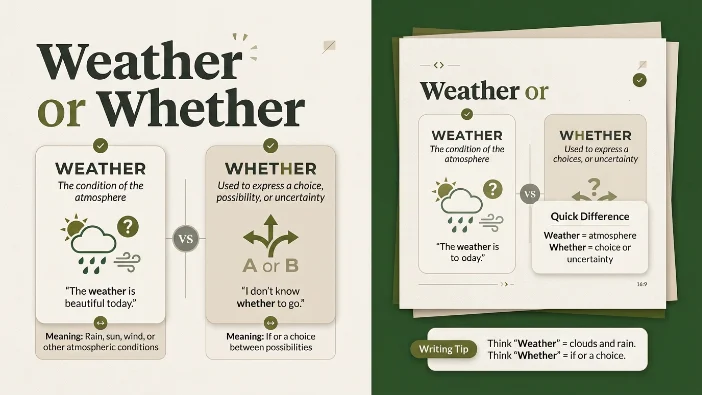
The difference between weather and whether comes down to meaning and function: weather refers to atmospheric conditions like rain, sun, and temperature, while whether is a conjunction used to introduce choices or alternatives. Use “weather” when discussing climate and “whether” when presenting options or uncertainty.
If you’ve ever paused mid-sentence, your fingers hovering over the keyboard, wondering if you should type “weather” or “whether,” you’re not alone. This pair of homophones creates confusion for native English speakers and language learners alike because they sound identical but serve completely different purposes.
The mistake might seem minor, but using the wrong word can change your entire meaning or make your writing look unprofessional. Imagine writing “I’m not sure weather to attend the meeting” when you meant “whether” – the reader will understand what you meant, but they’ll also notice the error.
In this guide, you’ll learn exactly when to use each word, why people confuse them, how to remember the difference, and practical strategies for using them correctly in any situation.
What’s the Difference Between Weather and Whether?
The core difference between weather and whether is simple: one is a noun describing atmospheric conditions, and the other is a conjunction introducing alternatives or uncertainty. They belong to entirely different parts of speech, which means they function differently in sentences.
Here’s a quick comparison:
| Aspect | Weather | Whether |
|---|---|---|
| Meaning | Atmospheric conditions (temperature, rain, sun, wind) | Expresses doubt, choice, or alternatives |
| Part of Speech | Noun (occasionally verb) | Conjunction |
| Refers To | Climate, outdoors, meteorology | Options, decisions, uncertainty |
| Typical Usage | “The weather is nice today.” | “I don’t know whether to go.” |
| Example | “Let’s check the weather before heading out.” | “She asked whether I preferred coffee or tea.” |
| Common Confusion | The word sounds exactly like “whether” | The word sounds exactly like “weather” |
The most important takeaway: weather deals with what’s happening outside, while whether deals with choices and possibilities. Once you understand this fundamental distinction, you’re already halfway to mastering the difference.
Is Weather vs Whether a Grammar, Vocabulary, or Usage Issue?
This confusion sits at the intersection of vocabulary, usage, and pronunciation. Here’s how each aspect plays a role:
Vocabulary distinction: These are completely different words with unrelated meanings. Weather belongs to the semantic field of climate and meteorology. Whether belongs to the semantic field of decision-making, alternatives, and uncertainty.
Grammar classification: Weather functions primarily as a noun (though it can be a verb meaning “to withstand”). Whether functions exclusively as a conjunction that introduces indirect questions or alternative possibilities.
Usage difference: The words are never interchangeable because they serve different grammatical roles. You cannot substitute one for the other without breaking the sentence’s meaning or structure.
Formal vs informal settings: Both words appear in all contexts everyday conversation, business writing, and academic work. The distinction remains exactly the same across all registers.
The practical takeaway: Since these words aren’t interchangeable, memorizing their meanings and functions is the only solution. Unlike usage debates (like “less” vs “fewer” or “who” vs “whom”), this isn’t about style preferences. It’s about using the right tool for the right job.
Understanding Weather: Meaning and Usage
Weather refers to the state of the atmosphere at a particular place and time. It includes factors like temperature, humidity, precipitation, wind, and cloud cover.
Pronunciation: WEH-ther (two syllables, rhymes with “leather” or “feather”)
Part of speech: Primarily a noun, occasionally a verb
Common collocations (words that naturally pair with weather):
- Severe weather
- Weather forecast
- Weather conditions
- Weather report
- Nice weather
- Bad weather
- Weather pattern
- Weather radar
Typical sentence patterns:
- “The weather is [adjective] today.”
- “We’re expecting [type of weather] later.”
- “The weather forecast predicts [condition].”
- “I checked the weather before [activity].”
Natural workplace example: “The weather has been unpredictable this month, so we’re moving the outdoor team-building event indoors.”
Academic example: “Weather patterns in the Pacific Northwest have shifted significantly over the past decade, according to climate researchers at the University of Washington.”
Technology example: “The new smartphone app pulls real-time weather data from satellites and provides hyperlocal forecasts.”
Email example: “Due to the expected severe weather tomorrow afternoon, I recommend that team members who can work remotely do so.”
Daily conversation example: “I heard the weather might be rough this weekend. Should we cancel the hike?”
One learner mistake: “I don’t know weather I should bring an umbrella.” (Should be “whether”)
Mini recap: Weather is about the sky, temperature, and outdoor conditions. If you’re talking about rain, snow, sunshine, wind, or heat, you’re using the right word.
Understanding Whether: Meaning and Usage
Whether introduces indirect questions and presents alternatives or possibilities. It expresses uncertainty, choice, or doubt about what will happen or what someone prefers.
Pronunciation: WEH-ther (identical to “weather”)
Part of speech: Conjunction
Common collocations:
- Whether or not
- Whether to [verb]
- Whether it’s [noun] or [noun]
- Decide whether
- Determine whether
- Question whether
- Uncertain whether
Typical sentence patterns:
- “I don’t know whether [statement] or [alternative].”
- “She asked whether [statement].”
- “We need to decide whether [action].”
- “It’s unclear whether [condition].”
Natural workplace example: “The project manager needs to determine whether we should extend the deadline or allocate additional resources.”
Academic example: “Researchers are investigating whether early language exposure significantly affects cognitive development in bilingual children.”
Technology example: “The algorithm will analyze the data to decide whether the user’s behavior indicates potential interest in purchasing the product.”
Email example: “Could you confirm whether you’re available for the 2 PM meeting or if we should reschedule for tomorrow?”
Daily conversation example: “I can’t decide whether to order pizza or Chinese food tonight.”
One learner mistake: “I’ll go to the park, weather it rains or not.” (Should be “whether”)
Mini recap: Whether presents choices, possibilities, or uncertainty. If you’re deciding between options, introducing alternatives, or expressing doubt, this is your word.
When Not to Use Each Word
These common mistakes happen because both words sound identical, and many writers type quickly without thinking about meaning.
Using “weather” when “whether” is correct
- Mistake: “I’m not sure weather I should accept the offer.”
- Correction: “I’m not sure whether I should accept the offer.”
- Why it happens: The writer is expressing uncertainty about a choice. Since they heard “WEH-ther” in their head, they guessed the spelling.
- Memory trick: Ask yourself: “Am I uncertain about something?” If yes, use whether.
- Mistake: “The decision depends on weather the client approves the budget.”
- Correction: “The decision depends on whether the client approves the budget.”
- Why it happens: The writer confused the conjunction with the noun.
- Memory trick: Replace the word with “if” or “whether or not.” If the sentence still makes sense, use whether.
- Mistake: “Please inform me weather you’ll be attending the conference.”
- Correction: “Please inform me whether you’ll be attending the conference.”
- Why it happens: The writer needs a conjunction to introduce an indirect question.
- Memory trick: Are you asking about someone’s choice? Use whether.
- Mistake: “Let’s see weather the new software works.”
- Correction: “Let’s see whether the new software works.”
- Why it happens: The writer is expressing uncertainty about an outcome.
- Memory trick: Can you replace it with “if”? Then use whether.
Using “whether” when “weather” is correct
- Mistake: “The whether forecast says it will rain tomorrow.”
- Correction: “The weather forecast says it will rain tomorrow.”
- Why it happens: The writer is discussing atmospheric conditions but used the conjunction.
- Memory trick: Are you talking about rain, sun, or temperature? Use weather.
- Mistake: “Cold whether always makes my joints ache.”
- Correction: “Cold weather always makes my joints ache.”
- Why it happens: The writer meant atmospheric conditions but chose the wrong homophone.
- Memory trick: Add an adjective like “rainy,” “sunny,” or “cold.” If it describes climate, use weather.
- Mistake: “The local whether has been unusually mild this winter.”
- Correction: “The local weather has been unusually mild this winter.”
- Why it happens: The writer is describing climate patterns.
- Memory trick: Is the word modified by “local,” “severe,” or “nice”? Use weather.
- Mistake: “We can’t control the whether, but we can prepare for it.”
- Correction: “We can’t control the weather, but we can prepare for it.”
- Why it happens: The writer is discussing something beyond human control.
- Memory trick: Can you see it, feel it, or experience it outside? Use weather.
Common Mistakes: Correct vs Incorrect Sentences
| Correct Sentence | Incorrect Sentence | Explanation |
|---|---|---|
| “I need to decide whether to accept the job offer.” | “I need to decide weather to accept the job offer.” | The sentence expresses uncertainty about a choice, which requires whether. |
| “The weather today is perfect for a picnic.” | “The whether today is perfect for a picnic.” | The sentence describes outdoor conditions, which requires weather. |
| “She asked whether I had completed the report.” | “She asked weather I had completed the report.” | The sentence introduces an indirect question, which requires whether. |
| “The weather forecast calls for heavy rain.” | “The whether forecast calls for heavy rain.” | A forecast predicts atmospheric conditions, which requires weather. |
| “We’re uncertain whether the deadline is flexible.” | “We’re uncertain weather the deadline is flexible.” | The sentence expresses doubt about a possibility, which requires whether. |
| “Cold weather makes it harder to start the car.” | “Cold whether makes it harder to start the car.” | The sentence describes a temperature condition, which requires weather. |
Decision Box: Weather or Whether in 10 Seconds
| If you mean... | Use this word |
|---|---|
| Rain, sun, snow, wind, temperature, or any atmospheric condition | Weather |
| A choice, an alternative, uncertainty, or an indirect question | Whether |
| To withstand or survive something (as a verb) | Weather |
Quick test: Try replacing the word with “if” or “if not.” If the sentence still makes sense, you need whether. If you’re describing the sky or climate, you need weather.
Real-World Examples
Office communication
“We’re waiting to see whether the client responds by Friday before finalizing the project scope.” – The manager is expressing uncertainty about the client’s decision.
Business email
“Please let me know whether you prefer a morning or afternoon session for the training workshop.” – The writer offers two alternatives and asks for a choice.
School or university
“Students often ask whether participation in extracurricular activities affects their grades.” – The professor discusses uncertainty about a correlation.
Customer support
“The technician needs to determine whether the issue is hardware-related or caused by software conflict.” – The support agent needs to identify which option applies.
Technology
“The AI system will analyze user behavior to decide whether to show the promotional offer or the standard content.” – The system chooses between two alternatives.
Artificial Intelligence
“Modern language models can determine whether a text was written by a human or generated by AI with remarkable accuracy.” – The model assesses a binary possibility.
Daily conversation
“I know the weather looks terrible right now, but I’m not sure whether we should cancel the trip entirely or just delay it by a few hours.” – One word describes outdoor conditions, the other introduces choices.
Weather vs Whether in Modern Technology
In the world of technology, both words appear frequently but in completely different contexts.
Weather technology: Weather apps, meteorological software, climate modeling tools, and weather APIs all use the term in its traditional atmospheric sense. You’ll see it in phrases like “weather data,” “weather analytics,” and “weather visualization.”
Whether in tech context: When discussing artificial intelligence, decision-making algorithms, and user choices, “whether” appears in conditional statements and branching logic. For example: “The algorithm determines whether the user is a new visitor or returning customer before displaying content.”
Voice assistants: When you ask “Do I need an umbrella today?” you’re asking about weather. When you ask “Should I take the train or drive?” you’re asking a question that involves whether.
Written commands: You’ll often see “whether” in user interface text: “Select whether you want to receive email notifications” or “Decide whether to save your changes before closing.
Word Origin: Where Do These Words Come From?
Weather comes from Old English “weder,” meaning “air, sky, breeze, storm, tempest.” This traces back to Proto-Germanic “wedran” and ultimately Proto-Indo-European “wedh,” meaning “to blow.” The word has referred to atmospheric conditions for more than a thousand years.
Whether comes from Old English “hwæðer,” which meant “which of two.” It derives from Proto-Germanic “hwaþaraz” and shares roots with “which” and “what.” The conjunction form has been used to introduce alternatives since the 12th century.
Understanding the history helps explain the difference: weather has always been about the physical world, while whether has always been about choice and alternatives.
Expert Insight: A Teaching Approach That Works
As an ESL instructor, I’ve found that the most effective way to teach the weather versus whether distinction is through contextual association rather than rote memorization. Weather connects to your physical senses you can see rain, feel cold, and hear thunder. Whether connects to mental processes decisions, questions, and alternatives.
When students ask for a foolproof method, I recommend this: if you can step outside and experience the concept, use “weather.” If you’re making a decision inside your head, use “whether.” This sensory approach works because it attaches the word to a physical or cognitive experience rather than an abstract rule.
Error Prevention Checklist
- Use “weather” when: You’re discussing atmospheric conditions, climate, or outdoor conditions
- Use “whether” when: You’re introducing alternatives, choices, or expressing uncertainty
- Never confuse them if: You remember that weather is outside (starts with “we” as in “we go outside”) and whether is inside your head (starts with “wh” as in “what to choose”)
- Quick memory tip: “WHEther = Which? HEre?” when you’re choosing between options, ask which one here, and you’ll know to use whether. “WEather = WE go outside” when you’re talking about outdoor conditions, think about going outside.
Related Grammar Confusions Worth Learning
- Affect vs Effect: Understanding whether something influences or results from something else
- Its vs It’s: Distinguishing possession from contraction
- There vs Their vs They’re: Understanding location, possession, and contraction
- To vs Too vs Two: Mastering direction, degree, and number
- Your vs You’re: Differentiating possession from “you are”
- Accept vs Except: Understanding receipt versus exclusion
- Than vs Then: Comparing versus sequencing
- Principle vs Principal: Understanding rules versus primary people or amounts
- Complement vs Compliment: Mastering completion versus praise
- Advice vs Advise: Differentiating the noun from the verb
Each of these pairs causes similar confusion and learning them together reinforces your understanding of common English word pairs.
FAQs
What is the easiest way to remember “weather” vs. “whether”?
A simple trick is to connect weather with rain, wind, and sunshine. Both weather and wear relate to outdoor conditions in different ways, so picture the weather outside.
For whether, think of a choice or uncertainty. If your sentence involves two possibilities, such as whether to go or stay, whether is the correct word.
Can “weather” and “whether” ever be used interchangeably?
No. Although they sound the same, weather and whether have completely different meanings and grammatical roles. Weather usually refers to atmospheric conditions, while whether is used when discussing choices, alternatives, or uncertainty.
Is “whether or not” grammatically correct?
Yes. Whether or not is grammatically correct and is often used to emphasize two possible outcomes. However, in many sentences, or not is unnecessary because the idea of uncertainty is already included in whether.
For example, “I don’t know whether she’s coming” is usually enough.
Is “weather” always a noun?
No. Weather is most commonly used as a noun, but it can also be a verb. As a verb, it can mean to survive or endure a difficult situation, as in “The company weathered the financial crisis.”
It can also describe something becoming worn or changed through exposure to natural conditions.
Do British and American English use these words differently?
No. The distinction between weather and whether is the same in both British and American English. Their meanings, spelling, and grammatical uses do not change by region, and the two words remain homophones in standard pronunciation.
What’s the difference between “whether” and “if”?
Both words can sometimes express uncertainty, but they are not always interchangeable. Whether is used when discussing alternatives or possibilities, while if commonly introduces a condition.
For example, “I don’t know whether she’ll come” expresses uncertainty, while “I’ll go if she comes” means that her coming is a condition for your decision.
Conclusion
The weather versus whether distinction ultimately comes down to a simple question: are you talking about the sky or making a choice? Weather describes the atmospheric conditions you experience outside the rain, sun, snow, and temperature that determine what you wear and what you do. Whether introduces uncertainty, alternatives, and decisions the mental process of choosing between possibilities.
Keep this practical rule in mind: if you’re stepping outside, you’re dealing with weather. If you’re thinking inside your head, you’re dealing with whether. Once this distinction becomes automatic, you’ll never hesitate again when choosing between these commonly confused words.
Read More Related Articles:
- Momma or Mama | Sweet Difference Between These Two Words In 2026
- Baton vs Batten | Learn the Difference in Minutes In 2026
- Since vs Sense | Complete Grammar Guide to Never Confuse These Words Again In 2026

Caleb Dawson is a content writer at synoseek.com, where he works on simple, reader-focused articles across a range of everyday topics. His writing style is practical and grounded, aiming to present information in a clear and relatable way without unnecessary complexity.
3 thoughts on “Weather or Whether | Complete Grammar Guide to Never Confuse Them Again In 2026”