Quick Answer
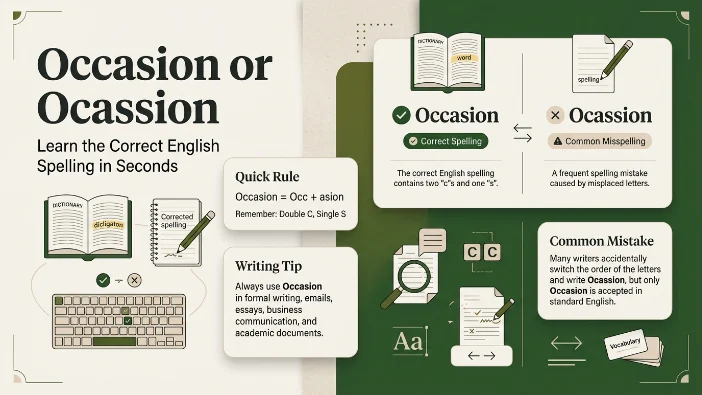
The correct spelling is occasion, with a double “c” and a single “s”. The spelling ocassion is a common misspelling and is always incorrect. This confusion often occurs because of the word’s pronunciation and the common tendency to double consonants incorrectly in English.
You’re writing a formal email, a social media post, or an important document, and you need to use the word “occasion.” But you pause. Is it spelled with one ‘c’ and two ‘s’s, or two ‘c’s and one ‘s’? The spelling “occasion or ocassion” is one of the most frequent conundrums for English writers of all levels. It’s not a question of meaning, but of a single, crucial letter that can make the difference between polished, professional writing and an embarrassing typo.
This common spelling mistake happens because the word’s pronunciation doesn’t give clear clues about its spelling. Many people hear the /s/ sound and logically add the extra ‘s’, but the correct spelling is actually “occasion” . In this guide, we will clarify the correct spelling, explain why it’s so commonly misspelled, and provide you with practical rules and memory tricks to ensure you always get it right. Learning the correct spelling of “occasion” is a small but significant step toward more accurate and credible writing, as spelling errors can undermine your authority, especially in professional settings . This guide is designed to clear up the confusion once and for all, helping you master a word that is used frequently in both formal and informal contexts.
What’s the Difference Between Occasion and Ocassion?
The core difference between “occasion” and “ocassion” is simple: correctness. “Occasion” is the only correct spelling, while “ocassion” is a common error. There is no difference in meaning, pronunciation, or usage between the two because one form is simply a misspelling of the other . The word “occasion” has a specific, established spelling that must be followed for clear and professional communication.
To help clarify, here is a comparison of the two spellings:
In short: You should always use “occasion.” The word “ocassion” is not a real word and should be avoided in all forms of writing, from academic papers to casual text messages .
Grammar and Usage: Is It a Grammar, Vocabulary, or Usage Issue?
The confusion between “occasion” and “ocassion” is strictly a spelling or orthography issue. It is not a grammatical, vocabulary, or usage error in the traditional sense. Here’s how it breaks down:
- Not a Grammar Issue: Grammar involves the structure and rules of a language, such as sentence construction and verb conjugation. The word “occasion” functions as a noun and a verb , and its grammatical role does not change whether it is spelled correctly or not. The error is not grammatical.
- Not a Vocabulary Issue: Vocabulary refers to the meaning of words. There is only one correct word with the meaning of “a special event or time,” and that word is “occasion” . “Ocassion” is not an alternative vocabulary word with a different meaning; it is a misspelling.
- A Usage Issue: While “usage” can sometimes refer to how words are used in context, in this case, the issue is about the correct form of the word. If you use “ocassion,” you are not using a wrong word but an incorrectly spelled word. This impacts the clarity and professionalism of your writing .
The key takeaway is that “occasion” is the single correct form. The problem arises from phonetic guessing, where writers spell the word how they think it sounds, leading to the misspelling “ocassion” . This mistake can be particularly detrimental in business and academic writing, where attention to detail is crucial.
The Correct Spelling: Occasion
Meaning
“Occasion” is a noun that primarily refers to a specific time or instance of an event, often a significant or noteworthy one . It can also mean:
- A special event, ceremony, or celebration .
- A favorable or appropriate opportunity or time .
- A reason or cause for an action .
Less commonly, “occasion” can be used as a verb meaning “to cause or bring about” .
Pronunciation
The correct pronunciation is /əˈkeɪ.ʒən/ (US and UK) . It breaks down into three syllables:
- uh- (a schwa sound, like the ‘a’ in “about”)
- KAY- (stressed, rhymes with “say”)
- -zhun (like the ‘s’ in “measure” or the ‘g’ in “genre”)
One of the main reasons “occasion” is misspelled as “ocassion” is that the second ‘c’ is pronounced as a hard /k/, and the ‘s’ is pronounced as the softer /ʒ/ sound. This mismatch between the spelling and pronunciation often confuses writers, leading them to overcorrect by doubling the ‘s’ .
Part of Speech
- Noun (Most common): “The party was a joyous occasion.”
- Verb (Less common): “His behavior occasioned much concern.”
Common Collocations
Collocations are words that frequently appear together. Using these will make your English sound more natural:
- Special occasion : “I wear this suit only for special occasions.”
- On occasion: “I like to have a glass of wine on occasion.”
- Rise to the occasion: “She really rose to the occasion during the presentation.”
- Previous/several occasions: “We’ve had to do this on several occasions.”
- Formal occasion: “Please ensure your attire is appropriate for a formal occasion.”
- Occasion arises/warrants: “We’ll address the issue if the occasion arises.”
Typical Sentence Patterns
- S + V + (prepositional phrase) + occasion: “We met on many occasions.”
- There + be + occasion + for/to: “There is no occasion for alarm.”
- It + be + a/an + adjective + occasion: “It was a sad occasion.”
- The + noun + occasioned + noun: “The news occasioned great joy.”
Real-World Examples
Workplace Example:
“At the end of the project, we had a small celebration to mark the occasion.”
Academic Example:
“The conference was a significant occasion for scholars in the field of linguistics.”
Technology Example:
“The application sends a notification to the user on every occasion a software update is available.”
Email Example:
“Dear Team, I would like to thank you all for your hard work on this account. On this special occasion of hitting our annual target, I invite you to a celebratory lunch next Friday.”
Daily Conversation Example:
“Is this the occasion where we’re supposed to bring a gift?”
One Learner Mistake
A common mistake is using “occasion” to mean “often.” Incorrect: “I visit my family on many occasions.” (This is acceptable, but “often” or “frequently” is usually more natural.) Correct: “I visit my family often.” The phrase “on occasion” already means “sometimes” or “occasionally” . Using “on many occasions” emphasizes the number of times, while “often” emphasizes the frequency. Both are grammatically correct, but understanding the nuance is key to sounding native.
Mini Recap: “Occasion” is the correct, standard spelling. It refers to an event, time, or reason. Its pronunciation can be tricky, which is a primary cause of the common misspelling.
The Incorrect Spelling: Ocassion
Meaning
“Ocassion” has no meaning in the English language. It is a common typographical error and a misspelling of the word “occasion” . Using it will make your writing appear unprofessional and careless .
Why Is It Incorrect?
The error arises from a misunderstanding of the word’s origins and spelling rules. It is a phonetic mistake—the word is often misspelled because the single ‘s’ can be misheard as a double consonant when the word is pronounced, especially when spoken quickly . Additionally, some writers apply a false pattern. They see other words with a double ‘s’ at the end (like discussion or possession) and assume “occasion” follows the same structure . However, as we’ll explore in the next section, “occasion” has a distinct history that dictates its single ‘s’.
Common Misspellings of Occasion
“Ocassion” is the most frequent mistake, but other common typos include:
- Occassion (Double ‘c’, double ‘s’)
- Ocasion (Single ‘c’, single ‘s’)
- Ocation (Missing the second ‘c’)
- Occation (Double ‘c’, missing ‘s’)
A quick note: “Ocassion” is often the most common misspelling, with some sources reporting it as a very frequent error .
When Not to Use Each Word
You should never use the misspelling “ocassion.” There is no situation, whether in formal writing, text messaging, or casual conversation, where it is acceptable. Here are common pitfalls to watch out for:
- In a Professional Email: A misspelling like “ocassion” in an email to a client or employer can create a negative impression of your attention to detail. Always use “occasion.”
- In an Academic Paper: In academic writing, spelling errors are penalized and can weaken the credibility of your argument. Always use “occasion.”
- On Social Media: While social media is more relaxed, consistent spelling mistakes can make you seem less credible or less educated. Always use “occasion.”
- In a Formal Invitation: A formal event deserves formal language. Spell the word correctly: “You are cordially invited to celebrate the occasion.
- When Using Autocorrect: Don’t just rely on autocorrect. It might not always flag “ocassion” as an error, especially if you’ve misspelled it many times and it’s in your dictionary . Always double-check the spelling manually.
Common Mistakes Table
| Correct Sentence | Incorrect Sentence | Explanation |
|---|---|---|
| “This is a special occasion.” | “This is a special ocassion.” | The most common error: swapping the single ‘s’ for a double ‘s. |
| “We saw him on several occasions.” | “We saw him on several occassions.” | The error of adding a double ‘s’ while also having a double ‘c’. |
| “I felt it was an occasion to celebrate.” | “I felt it was an ocasion to celebrate.” | The error of missing the second ‘c’. |
| “On occasion, I like to go for a walk.” | “On ocassion, I like to go for a walk.” | The misspelling of “occasion” in the phrase “on occasion.” |
Decision Box
If you mean an event, a time, an opportunity, or a reason: Always use “occasion.”
If you are about to type “ocassion,” stop. You have made a spelling error. The correct spelling is “occasion.”
Real-World Examples
To fully understand the usage, let’s see “occasion” in various real-world contexts:
Office Communication:
“Marks & Spencer’s recent strategy update was a significant occasion for its shareholders.” (Illustrating a formal business event)
Business Email:
“Subject: Review Meeting. Dear all, Please find attached the agenda for the upcoming review. On this occasion, we will focus on Q2 performance metrics. Regards, Sarah.”
School or University:
“Graduation day is an important occasion for students and their families, often seen as the culmination of years of hard work.”
Customer Support:
“Dear Mr. Jones, Thank you for your patience. On this occasion, we will waive the late fee as a gesture of goodwill.” (Used to describe a specific instance)
Technology and Artificial Intelligence:
“Modern voice assistants like Siri and Alexa are designed to learn from user interactions, providing a better experience on each occasion.”
“The software uses machine learning to improve its responses, a process that is refined on every occasion a user provides feedback.”
Daily Conversation:
“I don’t eat much dessert, but I’ll make an exception on a special occasion like a birthday party.”
Modern Technology: “Occasion” in the Digital Age
The word “occasion” might seem old-fashioned, but it finds modern relevance in technology, particularly in the context of Artificial Intelligence and user experience. AI systems, such as virtual assistants (like Siri and Alexa) and chatbots, are often described as learning and adapting “on occasion” or “on every occasion” . This phrasing emphasizes that the system improves and personalizes its responses based on user interactions that occur at specific, recurring times.
This use highlights the core meaning of “occasion” as a specific instance or occurrence. For example, a software developer might say, “The AI model is trained to identify a user’s intent on each occasion, refining its accuracy with every new query.” While the technology is advanced, the language used to describe its learning process is grounded in this classic, correctly spelled word.
Word Origin
Understanding the origin of “occasion” can help you remember its tricky spelling. The word comes from the Latin word occasio, meaning “a favorable opportunity” or “a falling down” . This Latin root contains the prefix *ob-* (meaning “toward” or “down”) and the verb cadere (meaning “to fall”) . So, occasio literally means “a falling down,” which evolved into the idea of something that falls into one’s path, i.e., an opportunity or event.
This origin is crucial for the spelling. The word entered English through Old French (occasion) in the 14th century . Crucially, the Latin root features a double ‘c’ (oc-ca-) and a single ‘s’, a structure that was preserved as the word evolved into English. The spelling “ocassion” with a double ‘s’ is a departure from this historical and etymological pattern, highlighting why it is an error.
Expert Insight
The real challenge with spelling “occasion” comes down to a battle between our ears and our eyes. We hear the “zhun” sound at the end and instinctively want to write a double ‘s’, following patterns we see in other words. However, to master English spelling, we sometimes have to rely on the word’s history, not just its sound. The Latin root occasio gives us the key: a double ‘c’ (like in “occur”) and a single ‘s’ (like in “rise”).
Think of it as an opportunity to be precise. When you write “occasion,” you’re not just writing a word; you’re connecting to centuries of linguistic history and showing a command of the details that define a professional writer. This small act of care reflects a broader attention to detail that is valued in all forms of communication.
Error Prevention Checklist
- Always use “occasion”: This is the one and only correct spelling.
- Never use “ocassion”: This is a common misspelling and should be considered a typo.
- Double-check the double ‘c’: The word has a double ‘c’. It starts with “occa-“.
- Check for the single ‘s’: Remember the pattern: double ‘c’, single ‘s’.
- Quick Memory Tip: Think: One ‘c’ for “Certain”, and one ‘s’ for “Special” . Better yet: The word “occupy” shares the same double ‘c’ pattern. If you can spell “occupy,” you can spell “occasion.” “Occasion” has one ‘c’ at the start, but wait… actually, the first syllable is “occ” just like “occupy”. The correct spelling is Occasion: “Oc” (like in “Occupy”) + “casion”. Another powerful mnemonic: The word has two “C’s” and one “S”. It’s the opposite of “necessary” which has a single ‘c’ and a double ‘s’ . This simple rule can prevent a spelling mistake that can ruin an otherwise perfect document.
Related Grammar Confusions
The English language is full of common misspellings and word confusions. Here are some closely related issues you might find helpful:
- Advise vs. Advice: “Advise” is the verb (to offer guidance), while “advice” is the noun (the guidance itself). Knowing the difference is crucial for clear communication.
- Affect vs. Effect: A classic. Affect” is usually a verb meaning “to influence,” while “effect” is usually a noun meaning “a result.
- Accept vs. Except: “Accept” means “to receive,” while “except” means “to exclude.
- Compliment vs. Complement: A “compliment” is a nice remark, while a “complement” is something that completes or enhances something else.
- Discreet vs. Discrete: “Discreet” means careful or modest, while “discrete” means separate or distinct.
- Its vs. It’s: “Its” is the possessive form (“the cat licked its paw”), while “it’s” is a contraction of “it is” (“it’s raining”).
- Principal vs. Principle: A “principal” is a head of a school or a sum of money, while a “principle” is a rule or belief.
- Stationary vs. Stationery: “Stationary” means not moving, while “stationery” refers to writing materials like paper and pens.
- Complementary vs. Complimentary: “Complementary” means completing each other, while “complimentary” means expressing praise or given for free.
FAQs
1. Is “ocassion” a word in the dictionary?
No, “ocassion” is not a recognized word in any standard English dictionary . It is simply a common misspelling of “occasion.” You should always use the correctly spelled “occasion” in your writing to maintain professionalism and credibility .
2. Why do so many people misspell “occasion” as “ocassion”?
The misspelling “ocassion” is most often due to phonetics. The word’s pronunciation, specifically the /ʒən/ sound at the end, can lead people to think it should be spelled with a double ‘s’ . Additionally, people often apply false patterns from other words like “possession” or “discussion,” which do have a double ‘s’, incorrectly assuming the rule applies to “occasion” . The correct spelling, with a double ‘c’ and a single ‘s’, is a result of its Latin origins, not its current pronunciation .
3. How do I remember the correct spelling of “occasion”?
A helpful memory trick is to focus on the double ‘c’ and single ‘s’. You can remember the phrase: “One Certain, Special Situation” to recall that there is one ‘c’ and two ‘s’s. Or simply remember the rule: It has two ‘C’s and one ‘S’ . Comparing it to another double ‘c’ word like “occupy” or “occur” can also reinforce the pattern .
4. Does the spelling of “occasion” change in US English vs. UK English?
No, the correct spelling of “occasion” is the same in both American and British English . While there are regional differences in spelling for some words (like “color” vs. “colour”), “occasion” is universally spelled with a double ‘c’ and a single ‘s’ in all major English-speaking countries. This consistency makes it an important rule to learn correctly .
5. What is the meaning of “on occasion” and how is it used?
The phrase “on occasion” means “sometimes” or “occasionally” . It is used to describe an action or event that happens infrequently, but from time to time. For example: “I enjoy a walk in the park on occasion.” It means you do this sometimes, but not regularly. It is a more formal and stylistic alternative to saying “sometimes” .
6. What does “rise to the occasion” mean?
The idiom “rise to the occasion” means to perform well in a difficult or demanding situation . It’s used when someone successfully handles a challenge, showing their ability and skill. For example: “When the company’s data was lost, our IT team rose to the occasion and recovered everything.” It means they successfully dealt with the unexpected problem.
7. What are the common collocations for “occasion”?
Common collocations with “occasion” include:
- Special occasion: “I bought this dress for a special occasion.”
- On occasion: “We go out to dinner on occasion.”
- Rise to the occasion: “It was a tough moment, but he rose to the occasion.”
- On several occasions: “She’s proven her skills on several occasions.”
- Mark the occasion: “They had a party to mark the occasion.”
- Formal occasion: “A tuxedo is required for this formal occasion.”
Conclusion
The confusion between “occasion” and “ocassion” is a common spelling dilemma, but it has a straightforward solution. The word “occasion” is the only correct spelling. It has a double ‘c’ and a single ‘s’, a pattern that stems directly from its Latin roots and is consistent in all forms of English, from business writing to casual conversation. The spelling “ocassion” is an error, typically born from phonetic confusion or a misapplication of spelling rules from other words .
Mastering this spelling is a simple but powerful way to enhance your writing’s professionalism and credibility. By understanding its origin, practicing its correct usage, and applying easy memory tricks, you can banish this common mistake from your vocabulary forever. Remember, when you think of a special event, a specific time, or an opportunity, you are thinking of an “occasion,” so spell it with two C’s and one S.
12 thoughts on “Occasion or Ocassion | Common Mistake Explained with Real-Life Examples In 2026”