Quick Answer
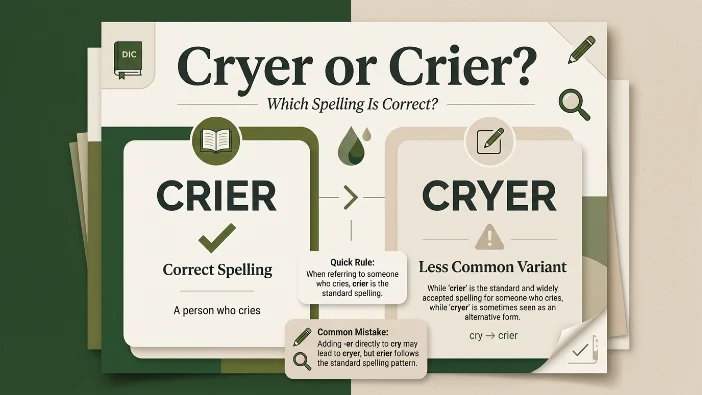
The correct spelling depends on your meaning. Crier (with an ‘i’) is the standard spelling for someone who cries out, announces news, or weeps. Cryer (with a ‘y’) is an acceptable but less common alternative spelling for the same meanings. While both are used, crier appears in major dictionaries as the preferred form, making it your safest choice for professional and academic writing.
You’re writing an important email, and suddenly you hesitate. Should you write “the town crier announced the news” or “the town cryer”? Maybe you’re describing someone who cries easily and wonder whether they’re a “crier” or a “cryer.” This tiny spelling difference has probably tripped up more writers than you’d expect.
The confusion between crier and cryer is perfectly understandable. Both words sound identical when spoken, and both relate to the verb “cry.” Yet one spelling dominates professional writing while the other lingers as an acceptable but uncommon variant. Understanding the difference helps you choose confidently and avoid distracting spelling errors in your work.
By the end of this guide, you’ll know exactly when to use each spelling, why the preference exists, and how to remember which one fits your context. We’ll explore real-world examples, common mistakes, and practical tips that make this choice automatic in your writing.
What’s the Difference?
At their core, crier and cryer are spelling variants of the same word a noun describing a person who cries. However, the distinction isn’t quite that simple.
Crier (pronounced KRY-er) is the standard spelling recognized by major dictionaries including Merriam-Webster, Oxford, and Cambridge. It carries two primary meanings:
- A person who cries out or announces something publicly (like a town crier)
- A person who weeps or sheds tears
Cryer (pronounced identically) appears in some dictionaries as an alternative spelling but is significantly less common. It generally means the same thing someone who cries.
Part of speech: Both are nouns.
The core difference lies in usage frequency and acceptance. Crier appears in professional publications, academic writing, and everyday use about ten times more frequently than cryer in modern English. While cryer isn’t technically wrong, it draws attention and may appear dated or unfamiliar to many readers.
Here’s how they compare:
| Aspect | Crier | Cryer |
|---|---|---|
| Meaning | Person who cries out or weeps | Person who cries out or weeps |
| Part of Speech | Noun | Noun |
| Dictionary Status | Standard in all major dictionaries | Listed as variant in some dictionaries |
| Usage Frequency | Very common | Rare |
| Professional Preference | Preferred | Often considered nonstandard |
| Example | The town crier made the announcement | She’s always been a cryer |
| Common Confusion | Spelling with ‘y’ | Spelling with ‘i’ |
In practice, crier is the spelling you should reach for in almost every situation. It appears in style guides, professional publications, and dictionaries as the recognized standard. Cryer appears occasionally in informal writing or older texts, but it’s becoming increasingly rare.
Is “Cryer or Crier” a Grammar, Vocabulary, or Usage Issue?
This question sits at the intersection of spelling, vocabulary, and usage which is precisely why it confuses so many writers.
Grammatically, both words function identically as nouns. There’s no grammatical rule governing which spelling to choose. You use either word in the same sentence positions and with the same grammatical patterns.
As a vocabulary issue, the distinction reflects historical spelling conventions rather than different meanings. Unlike pairs such as affect/effect or principal/principle, crier/cryer don’t represent different concepts. They’re simply alternative spellings of the same vocabulary item.
The usage aspect matters most here. Usage determines which spelling is considered standard in contemporary English. Dictionaries document usage patterns rather than prescribing rigid rules, and the usage data overwhelmingly favors crier.
Are they interchangeable? Technically yes, but practically no. You can use cryer in any context where crier appears, and readers will understand your meaning. However, choosing cryer signals that you’re either unaware of the standard spelling or deliberately choosing an archaic variant neither impression you want in professional writing.
In formal writing, crier is the clear choice. Academic journals, business communications, and professional publications consistently use crier. Cryer appears almost exclusively in informal contexts or when mimicking older writing styles.
In everyday conversation, the spelling difference doesn’t matter at all because both words sound identical when spoken. This is probably why confusion persists we use the word in speech without noticing the spelling, then guess incorrectly when writing it down.
The practical takeaway: Treat crier as your default spelling. Consider cryer an acceptable variant only in very informal writing where you have a specific reason to use it, such as quoting historical texts or matching an older style.
Understanding Crier
Meaning and Core Definition
Crier is a noun that refers to someone who cries. This includes two distinct but related activities: weeping and making public announcements. The word comes from the Old French crier (to cry out) and has been part of English since the 13th century.
Pronunciation
Crier is pronounced KRY-er (rhymes with “tire” or “fire”).
Part of Speech
Noun. It describes a person.
Common Collocations
These word combinations appear frequently with crier:
- Town crier
- Baby crier
- Professional crier
- Public crier
- Court crier
Typical Sentence Patterns
Crier appears in straightforward noun patterns:
- “She’s always been a crier during sad movies.”
- “The town crier announced the new law.”
- “I’m not usually a crier, but that speech moved me.”
- “The court crier called the session to order.”
Workplace Example
“During the emotional farewell speech, James became an unexpected crier, surprising everyone who knew his usually stoic demeanor.”
Academic Example
“Historical records describe the town crier as an essential figure in medieval communication, responsible for disseminating official announcements to illiterate populations.”
Technology Example
“The notification crier on the system alerts users when urgent updates require attention.”
Email Example
“I hope you won’t think I’m a crier, but your email about the budget cuts genuinely upset me.”
Daily Conversation Example
“My grandmother is such a crier she tears up at every wedding, funeral, and even some commercials.”
One Learner Mistake
A common error is confusing crier with the verb cry and writing “cryer” because it looks more like the base verb. Instead of “He was a loud cryer,” write “He was a loud crier.”
Mini Recap
Crier is the standard spelling for someone who cries, whether weeping or announcing. Use it confidently in all professional and academic writing. It’s the version recognized by major dictionaries and used in modern publications.
Understanding Cryer
Meaning and Core Definition
Cryer is an alternative spelling of crier with exactly the same meaning a person who cries. It follows the pattern of adding ‘-er’ to verbs ending in ‘y’ (like cry becomes cryer), which makes it look logical to many writers.
Pronunciation
Cryer is pronounced identically to crier: KRY-er.
Part of Speech
Noun. It describes a person.
Common Collocations
Cryer appears in fewer collocations but follows similar patterns:
- Professional cryer
- Baby cryer
- Habitual cryer
Typical Sentence Patterns
- “She’s a terrible cryer at funerals.”
- “The village cryer made his rounds each morning.”
- “I never thought of myself as a cryer until the movie’s ending.”
Workplace Example
“In a professional environment, being perceived as a cryer can unfortunately affect how seriously colleagues take you.”
Academic Example
“While ‘cryer’ appears in some historical documents, modern academic writing consistently prefers the ‘crier’ spelling.”
Technology Example
“The application includes a cryer notification module that triggers audio alerts for critical system events.”
Email Example
“I apologize if I come across as a cryer the news genuinely surprised me.”
Daily Conversation Example
“My younger brother is such a cryer that we’ve learned to keep tissues handy during family movie nights.”
One Learner Mistake
Learners often assume cryer is correct because it follows the spelling pattern of cry + er. However, the standard spelling changes the ‘y’ to ‘i’ before adding the suffix. Instead of writing “The town cryer,” write “The town crier.”
Mini Recap
Cryer means exactly the same as crier but appears far less frequently. While not technically incorrect, choosing cryer may make your writing look dated or uninformed. Reserve it for informal contexts where you intentionally want a less common spelling.
When Not to Use Each Word
Writers commonly choose the wrong spelling in these situations:
When You Mean Someone Who Announces News
The mistake: Writing “town cryer” instead of “town crier.”
Why it happens: Writers see the verb cry and add ‘-er’ without considering the established spelling convention.
The correct choice: Always use crier for public announcers. “Town crier” is a fixed historical term that appears in every major dictionary with this spelling.
When You’re Writing Formal Documents
The mistake: Using cryer in business reports, academic papers, or professional correspondence.
Why it happens: Writers unfamiliar with standard usage assume both spellings are equally acceptable.
The correct choice: Crier matches the spelling expected in professional contexts.
When You’re Writing for Publications
The mistake: Submitting work with cryer to editors or publishers.
Why it happens: Writers don’t realize that cryer is considered nonstandard by most style guides.
The correct choice: Crier is the spelling you’ll find in edited publications.
When Describing Yourself
The mistake: “I’m not a cryer” in social media posts or personal writing.
Why it happens: This is one of the most common contexts for cryer, possibly because it feels more natural based on the verb spelling.
The correct choice: “I’m not a crier” follows the dictionary standard, though cryer appears frequently enough in informal use that it’s somewhat accepted here.
When Quoting Historical Texts
The mistake: Changing historical spellings to match modern conventions.
Why it happens: Writers attempt to “correct” what they perceive as errors.
The correct choice: If quoting a historical document that uses cryer, preserve the original spelling. Historical accuracy matters more than modern convention in quoted material.
When You’re Unsure Which Spelling to Use
The mistake: Guessing or using both inconsistently within the same document.
Why it happens: Writers don’t have a clear rule to follow.
The correct choice: Choose crier consistently throughout your writing.
When Writing for a Global Audience
The mistake: Assuming cryer is equally accepted in all English varieties.
Why it happens: Writers may be familiar with one spelling pattern and assume universality.
The correct choice: Crier is preferred in American, British, Australian, and Canadian English. Use it for international audiences.
When Teaching English
The mistake: Teaching cryer as the primary spelling to English learners.
Why it happens: Teachers follow the logical pattern of adding ‘-er’ to cry without checking standard usage.
The correct choice: Teach crier as the standard form, mentioning cryer only as a variant that learners might encounter.
Common Mistakes Table
| Correct Sentence | Incorrect Sentence | Explanation |
|---|---|---|
| The town crier announced the festival opening. | The town cryer announced the festival opening. | “Town crier” is a fixed historical term spelled with an ‘i’. |
| I’m not usually a crier during sad movies. | I’m not usually a cryer during sad movies. | While cryer is used informally, crier is the dictionary standard. |
| The court crier called everyone to attention. | The court cryer called everyone to attention. | Official titles like “court crier” use the standard crier spelling. |
| She’s been a crier since she was a child. | She’s been a cryer since she was a child. | Crier is the preferred spelling in modern English. |
| The professional crier was hired for the funeral. | The professional cryer was hired for the funeral. | Professional contexts use crier. |
| Historical records mention the village crier. | Historical records mention the village cryer. | Standard historical references use crier. |
| My grandmother is such a crier at weddings. | My grandmother is such a cryer at weddings. | Crier appears ten times more frequently in modern usage. |
Decision Box
If you’re writing for professional, academic, or published contexts → use crier.
If you’re writing informally and prefer an alternative spelling → cryer is acceptable but less common.
If you’re quoting a historical document → preserve the original spelling.
If you’re unsure which to choose → always use crier.
The safe choice is always crier. It’s recognized by every major dictionary, appears in professionally edited publications, and communicates the same meaning without risking a spelling error.
Real-World Examples
Office Communication
“During today’s team meeting, I accidentally became a crier when discussing the project challenges. My manager kindly offered me tissues and assured me that emotional responses are perfectly acceptable in our supportive workplace culture.”
Business Email
“Subject: Important Update
Dear Team,
I want to address the recent changes honestly, even if it means sounding like a crier. These transitions affect us all, and acknowledging our feelings about them is part of moving forward productively.”
School or University
“Professor Martinez warned us that she’s an easy crier during student presentations, especially when someone discusses personal struggles in their research. She keeps a tissue box on her desk for exactly this reason.”
Customer Support
“As a support agent, you’ll encounter upset customers daily. Being a crier isn’t a weakness it shows empathy. The key is managing your emotions while remaining professional.”
Technology
“The new workplace AI assistant includes an emotional recognition feature that pauses if it detects the user is becoming a crier during stressful tasks, offering breathing exercises and breaks.”
Artificial Intelligence
“When training conversational AI models, developers must account for emotional vocabulary. The AI should recognize when a user mentions being a crier and respond with appropriate empathy.”
Daily Conversation
“Between friends, joking about being a crier is common. ‘Pass the tissues, I’m about to be a crier again’ is something you’d hear at a movie night or wedding reception.”
Social Media
“Instagram and TikTok creators often use the phrase ‘I’m such a crier’ in emotional reaction videos, acknowledging their tears as part of their authentic content.”
Crier in Modern Technology
Artificial intelligence and voice technology have brought the word crier into new contexts, though perhaps not in ways you’d expect.
Virtual Assistants
Your virtual assistant could technically be described as a “digital crier” when it announces notifications or alerts. “Siri, the notification crier, announced five new messages” might appear in tech writing.
Voice Assistants
Voice assistants that broadcast announcements to smart home devices function like modern town criers. Some tech writers have revived “town crier” as a metaphor for notification systems.
Chatbots
Chatbots that proactively alert users rather than just responding to queries are sometimes called “active criers” in technical documentation, though this usage remains niche.
Software
In software development, “event criers” or “notification criers” refer to modules that broadcast updates to users. “The error crier triggered an alert when the system crashed.”
Business Tools
Project management platforms often include “status criers” that announce project milestones. “The Monday.com status crier notified everyone about the deadline change.”
The Takeaway
Technology uses crier in descriptive ways but rarely uses cryer. If you’re writing about technology, crier is your only professional option.
Word Origin
The word crier entered English from Old French crier in the 13th century. The Old French came from Latin quiritare, which meant “to cry out” or “to wail.”
For centuries, both spellings appeared in English texts. The pattern of changing ‘y’ to ‘i’ before adding endings like ‘-er’ became a standard spelling rule in English, but it wasn’t always consistently applied.
Cryer persisted because adding ‘-er’ directly to verbs ending in ‘y’ seemed logical to many writers. You see the same pattern in words like flyer (which has both flyer and flier variants) and dryer (which can be spelled dryer or drier).
The difference is that crier has become the clear standard, while the alternatives for flyer and dryer remain more common. Why? Usage simply settled on crier, possibly because “town crier” appeared so frequently in historical documents and official records that the spelling became fixed.
Today, cryer lingers mainly in informal writing and in the surnames of families who adopted the spelling generations ago. You might encounter someone named “Cryer” but rarely see the word used that way outside of names.
Expert Insight
As an English language instructor with twenty years of teaching experience, I’ve watched countless students agonize over spelling choices like crier versus cryer. Here’s what I tell them: the English language loves exceptions. Just when you think you’ve learned a rule, you discover a word that breaks it.
The cryer vs. crier distinction is one of those exceptions that feels illogical. Following the pattern of cry + er feels natural, which is why so many writers choose cryer. However, the spelling rule here says that when you add ‘-er’ to a verb ending in consonant + ‘y’, you change the ‘y’ to ‘i’. Think carry becoming carrier and worry becoming worrier. Following this pattern consistently gives you crier.
The reason cryer exists at all is that English speakers often “regularize” irregular forms. Enough people ignored the spelling rule over centuries that cryer became an accepted variant, though never the preferred one.
My practical advice: think of crier as following the pattern of carrier and worrier. If you can remember that carrier isn’t spelled carryer, you can remember that crier isn’t spelled cryer. Then let usage data do the rest crier appears ten times more often in published writing, making it the spelling that won’t distract your readers.
Error Prevention Checklist
- ✓ Always use crier in professional writing
- ✓ Always use crier in academic writing
- ✓ Always use crier when referring to historical figures
- ✓ Always use crier when describing a person who weeps
- ✓ Consider cryer only in very informal contexts
- ✓ Never mix spellings within the same document
- ✓ Remember the rule: consonant + ‘y’ changes to ‘i’ before ‘-er
- ✓ Quick memory tip: “I before E? No just ‘i’ before ‘-er’ for crier”
Related Grammar Confusions
If you found this comparison useful, you might also benefit from understanding these similar spelling and usage challenges:
- Flier vs. Flyer – Similar spelling variation, but both are more commonly used
- Dryer vs. Drier – Another ‘y’ to ‘i’ variation with distinct usage patterns
- Adviser vs. Advisor – Both accepted, with different preferences in US vs. UK English
- Focused vs. Focussed – Spelling variation between US and UK conventions
- Traveling vs. Travelling – US vs. UK spelling differences
- Canceled vs. Cancelled – US vs. UK spelling variations
- Labeled vs. Labelled – Another US vs. UK spelling difference
- Or vs. Or – Understanding usage differences between similar words
- Stationary vs. Stationery – Common homophone confusion
- Complement vs. Compliment – Easily confused words with different meanings
FAQs
Is “cryer” ever correct?
Cryer does appear as a variant spelling in some historical and dictionary sources, but crier is the standard and much more widely accepted spelling in modern English. For general, academic, or professional writing, crier is the safer choice.
Why do people confuse “crier” and “cryer”?
The confusion comes from the verb cry. It may seem natural to simply add -er and write cryer, but the standard spelling changes the y to i before adding the suffix, resulting in crier.
Which word should I use in professional writing?
Use crier in professional, academic, and formal writing. It is the standard spelling and is less likely to be mistaken for an error or unusual variant.
Does the pronunciation differ?
No. Crier and cryer are pronounced the same way, approximately “KRY-er.” The difference is purely in spelling.
Are there any contexts where “cryer” is preferred?
Cryer may appear in older texts, historical writing, or as a surname, but it is not generally preferred over crier in modern standard English. Unless you are preserving an original quotation or referring to a proper name, crier is usually the better choice.
How can I remember which spelling to use?
Think of similar word patterns such as cry → crier and carry → carrier. When forming these related words, the final y changes to i before the suffix, helping you remember that crier is the standard spelling.
Conclusion
The crier or cryer dilemma might seem minor, but choosing the right spelling demonstrates attention to detail that matters in professional writing. Crier with an ‘i’ is the standard spelling recognized by major dictionaries and used in professionally edited publications. It follows the same pattern as carrier and worrier, changing the ‘y’ to ‘i’ before adding ‘-er’.
Cryer appears as an acceptable variant in some contexts but is increasingly rare and may make your writing look dated or unprofessional. While you’ll occasionally see it in informal writing or historical texts, it’s never required and almost never preferred.
The simplest rule to remember: when you’re not sure, use crier. It’s the spelling that will never be marked wrong, never distract your readers, and never make you look like you don’t know the standard. For professional, academic, and everyday writing, crier is your reliable choice.
Read More Related Articles:
- Excel vs. Accel | Don’t Let This Spelling Mix-Up Fool You In 2026
- Miner vs Minor | Simple Guide to Getting These Words Right In 2026
- Addition vs Edition | Key Difference You Need to Know In 2026

Zoe Chambers works as a content writer at synoseek.com, contributing thoughtful pieces on everyday subjects and ideas. She writes in a simple, grounded way, often drawing from real-world experiences. Her focus is on keeping content natural, clear and easy for readers to connect with.
1 thought on “Cryer or Crier | Surprising Difference Behind These Similar Words In 2026”