Quick Answer
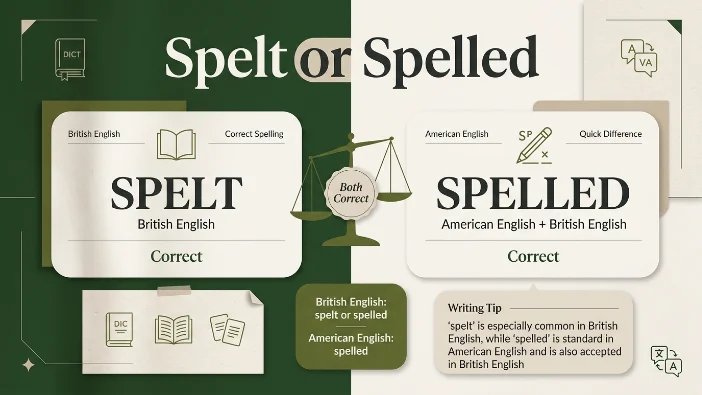
The difference between spelt and spelled is primarily regional. Both are correct past tense and past participle forms of the verb spell. In American English, spelled is the standard and preferred form. In British English, both spelt and spelled are acceptable, though spelt is more common . The choice affects how your writing is perceived by different audiences.
Have you ever typed a sentence only to pause and wonder, “Is it spelt or spelled?” You are not alone. This common grammatical dilemma trips up English learners and native speakers alike. The two words look similar and mean the same thing, yet choosing the wrong one can make your writing seem out of place or even incorrect depending on who is reading it.
This confusion stems from a key difference between American and British English conventions. For a language that is globally spoken, these regional preferences matter. Using spelled in a London office might earn you a gentle eye-roll, while using spelt in a New York business proposal could be flagged as a mistake by your editor. In this guide, we will demystify the spelt or spelled question once and for all, providing clear rules, practical examples, and insights to ensure you communicate with confidence every time.
What’s the Difference Between Spelt and Spelled?
The core difference is not about meaning both words are used to describe the act of arranging letters to form a word in the past tense. Instead, the difference is primarily about geography.
- Meaning: Both are past tenses of the verb “to spell.”
- Part of Speech: Both are verbs (past tense and past participle).
- Core Difference: The key distinction is regional preference. In American English, “spelled” is the accepted standard. In British English, “spelt” is also common .
| Feature | Spelled | Spelt |
|---|---|---|
| Meaning | Past tense of “to spell” | Past tense of “to spell” (or a type of grain) |
| Part of Speech | Verb (past tense/past participle) | Verb (past tense/past participle) |
| Refers To | The act of writing or naming letters to form a word | The same act, but also an ancient grain |
| Typical Usage | Standard in the United States and Canada | Common in the United Kingdom, Australia, and other Commonwealth nations |
| Example | “You spelled my name wrong.” | “You spelt my name wrong.” |
| Common Confusion | Usually not confused with anything else. | Sometimes confused with the grain “spelt.” |
To put it simply: “spelled” is the regular past tense form (adding -ed), while “spelt” is the irregular form (changing the ending to -t). Many verbs in English have similar irregular forms, such as “burned/burnt” and “learned/learnt” .
Is Spelt or Spelled a Grammar, Vocabulary, or Usage Issue?
This question is best classified as a usage issue. It is not a matter of grammatical correctness in the sense of “right” vs. “wrong,” nor is it strictly a vocabulary problem, as they have the same definition. It is about the conventions of language use.
- Grammar: The grammar is correct in both cases; they are properly conjugated verbs.
- Vocabulary: They are synonyms, so vocabulary doesn’t help you choose one over the other.
- Usage: The difference is a matter of usage. This depends entirely on your audience .
In formal writing, it is crucial to adhere to the conventions of your specific dialect. For example, the Chicago Manual of Style and AP Style, commonly used in the US, would recommend “spelled.” Conversely, writing for a British publication, the Oxford Style Guide would accept “spelt.”
Here is a practical takeaway: In professional and academic settings, always default to the convention of the primary English dialect you are using. For an American resume, “spelled” is mandatory. For a UK university essay, both are acceptable.
Understanding “Spelled” (American English)
In American English, “spelled” is the clear winner . It is the standard past tense and past participle form of the verb “spell.” When you write for an American audience, this is the form you should use to maintain a professional and accurate tone.
Common Collocations and Sentence Patterns
“Spelled” frequently appears with adverbs like “correctly,” “incorrectly,” “wrong,” “out,” and with words like “name,” “word,” or “trouble.
- Pattern: Subject + spelled + object + (adverb).
- Pattern: Subject + spelled + object + out.
Natural Examples in Context
- Workplace Example: “The client specifically asked for their name to be spelled with a ‘K,’ not a ‘C.'”
- Academic Example: “The student spelled every word on the spelling list correctly, earning a perfect score.
- Technology Example: “The software update had spelled disaster for our system’s compatibility.”
- Email Example: “I realized I spelled the attachment wrong and had to re-send the email.
- Daily Conversation: “You spelled ‘restaurant’ wrong, but I know exactly what you meant.”
One Learner Mistake: Many learners, influenced by other languages, want to use the “regular” -ed form but see “spelt” and think it’s a past tense of a different verb. It is not. Both forms are correct for the same verb to spell.
Mini Recap: In the US, “spelled” is king. Use it in all contexts to be safe.
Understanding “Spelt” (British and Commonwealth English)
In British English, “spelt” is a perfectly acceptable and common past tense form of “spell.” It is used interchangeably with “spelled” . It is a traditional form that has been used for centuries, and its usage in the UK makes a writer sound perfectly natural.
Pronunciation
“Spelt” is pronounced with a short “e” sound, rhyming with “belt” or “melt.”
Common Collocations
Like “spelled,” it appears with adverbs like “incorrectly,” “wrong,” and the phrase “spelt out.” However, one notable difference in British vs. American usage is in phrases like “spelt trouble.” In the US, “spelled trouble” is more common, while in the UK, “spelt trouble” is also widely used .
Natural Examples in Context
- Workplace Example (UK): “The manager spelt out the new procedure to ensure everyone understood.”
- Academic Example (UK): “The word ‘colour’ is always spelt with a ‘u’ in British English.”
- Technology Example: “This error has spelt the end for the company’s venture into the AI market.”
- Email Example: “Apologies, I spelt your surname incorrectly on the form.”
- Daily Conversation: “He spelt his name aloud for the receptionist.”
One Learner Mistake: A common error is using “spelt” in an American context and being marked incorrect. The reverse is also a problem: using “spelled” in the UK is not technically wrong, but it may sound slightly formal or Americanized.
Mini Recap: In the UK, Australia, New Zealand, and South Africa, “spelt” is a natural and common choice. It is not a mistake; it is a regional preference.
When NOT to Use Each Word
Choosing the wrong word often comes down to misunderstanding your audience or confusing “spelt” with the grain. Here are six common mistakes:
- Mistake: Using “spelt” in formal American writing.
- Why it happens: Exposure to British media or global content.
- Which is correct: “Spelled”
- Remember: Think “American + -ed.” American English prefers the regular -ed ending.
- Mistake: Using “spelled” in a sentence where you are talking about a type of wheat.
- Mistake: Trying to use “spelt” as the present tense.
- Why it happens: Confusion over irregular verb forms.
- Which is correct: “Spell” is present. “Spelt” is past.
- Remember: You spell today; you spelt yesterday.
- Mistake: Inconsistency within a single document.
- Why it happens: Forgetting which version of English you are using.
- Which is correct: Pick one style (American or British) and stick to it.
- Remember: Consistency is key to professionalism.
- Mistake: Assuming “spelled” is “more modern” and better in all cases.
- Why it happens: A common misconception from a globalized world.
- Which is correct: Both forms are modern and correct in their respective regions.
- Remember: “Spelt” is not archaic; it’s just the British preference.
- Mistake: Using “spelt” when you mean to indicate that letters were written down, not spoken.
Common Mistakes Table
| Correct Sentence | Incorrect Sentence | Explanation |
|---|---|---|
| In the US, they always use spelled. | In the US, they always use spelt. | American English standardizes “spelled” . |
| My American teacher spelled my name correctly. | My American teacher spelt my name correctly. | This would be marked as a spelling error in an American classroom. |
| In the UK, it is often spelt “colour.” | In the UK, it is often spelled “colour.” | Not necessarily incorrect, but “spelt” is more common in British writing. |
| The recipe called for spelt flour. | The recipe called for spelled flour. | Here “spelt” is a noun, not a verb, referring to a type of ancient wheat . |
Quick Decision Box
If you mean the action of forming words with letters in the past tense:
- Is your audience mostly American? Use Spelled.
- Is your audience mostly British or Commonwealth? Use either Spelt or Spelled, but Spelt sounds more natural.
If you are referring to a type of grain:
- Use Spelt.
Real-World Examples
Understanding the difference is best achieved through seeing these words in action. Here are some practical situations:
Office Communication (US)
“Please ensure your name is spelled exactly as it appears on your passport for the flight booking.”
Business Email (UK)
“In the attached document, the CEO’s name was spelt with a double ‘r,’ which I have now corrected.”
University
“The professor had a strict rule: any word spelled incorrectly would result in a 1-point deduction.”
Customer Support
“I can see your address in our system; I want to confirm it is spelled correctly before shipping.”
Technology / AI
The autocorrect feature on my phone had spelt the word as ‘teh’ instead of ‘the,’ causing confusion.”
Daily Conversation
“I know how to pronounce your name, but I’m not sure how it’s spelt is there a silent ‘h’?”
Modern Technology and Global English
In our globalized, digitally connected world, the line between American and British English is blurring. The default spell-check on many US-based platforms uses American English, often flagging “spelt” as incorrect . This can create confusion, especially for non-native speakers. Meanwhile, AI tools like ChatGPT may generate responses with a mix of both dialects, reflecting their training data.
For writers, this means being conscious of your audience. If you are writing for an international blog, you might choose “spelled” simply because it is the most universally recognized and accepted form, reducing the chance of it being flagged as an error . For SEO purposes, consider your target market. If you’re targeting UK users, using “spelt” may improve local relevance.
Word Origin
The verb “to spell” comes from the Old French word “espeller” and the Germanic root “spel-,” meaning “to say aloud” or “to recite” . The irregular -t ending, like “spelt,” was once more common across various dialects of English. As the language evolved and American English standardized in the 19th century, the regular -ed form became the norm in the US, while the older -t form persisted in Britain. This is why we have these regional differences today.
Expert Insight
The key to understanding the difference between these two words is not grammatical complexity but audience awareness. It is a perfect example of how language standards can diverge across regions. The best writing always considers the reader first.
Error Prevention Checklist
- ✅ Always use “spelled” when writing for an American audience or using US English.
- ✅ Always use either “spelt” or “spelled” when writing for a British audience.
- ✅ Never confuse them if you are referring to a type of wheat; that is always “spelt.”
- ✅ Never mix them in a single document. Be consistent.
- Quick Memory Tip: American + -ed. British + -t.
Related Grammar Confusions
If you found this comparison helpful, you might also want to explore these related topics:
- Learned vs. Learnt: Another classic “ed vs. t” regional difference.
- Burned vs. Burnt: Same rule applies to the verb “to burn.”
- Dreamed vs. Dreamt: A similar irregular past tense pair.
- Smelled vs. Smelt: The past tense of “smell” also follows this pattern.
- Hanged vs. Hung: A difference in meaning, not just region.
- Who vs. Whom: A common pronoun confusion.
- Lie vs. Lay: A tricky verb pair with different meanings.
- Affect vs. Effect: Another common and persistent grammatical challenge.
- Bring vs. Take: A difference in perspective.
FAQs
Is “spelt” grammatically correct?
Yes. Spelt is a correct past tense and past participle of spell, particularly in British English and several other varieties of English. It is a regional preference rather than a grammatical mistake.
Why does my computer spellcheck say “spelt” is wrong?
Your spellchecker may be set to English (US), where spelled is generally preferred. If you’re writing in British English, changing the language setting to English (UK) can prevent spelt from being flagged.
Can I use “spelled” in British English?
Yes. Spelled is also accepted in British English, although spelt remains a traditional and widely used form. British English therefore allows both forms, with usage varying by writer, publication, and context.
What is the difference between “misspelt” and “misspelled”?
They have the same meaning and differ mainly by regional preference. Misspelt is more traditional in British English, while misspelled is the standard form in American English. Both are understood in either variety.
Does “spelt” always refer to a type of grain in American English?
No. Spelt can refer to the grain, but it is also the verb form of spell in varieties of English where spelt is used. In standard American English, however, spelled is the usual past tense and past participle of spell.
Which form is better for international business writing?
Both forms are widely understood, but spelled may be the safer choice for a broad international audience because it is the standard form in American English and is also accepted in British English. If your organization follows British English, spelt is perfectly appropriate.
Conclusion
The choice between spelt and spelled comes down to one simple question: Who is your audience? If you are writing in the United States, always use spelled. If you are writing in the United Kingdom or for a Commonwealth audience, you can confidently use spelt (or spelled), though spelt is the more traditional choice. The grammar is correct either way, so your decision should be about aligning your writing with the reader’s expectations.
Remember this rule: American = -ed, British = -t. By keeping this simple guideline in mind, you can avoid this common pitfall and write with authority.