Quick Answer
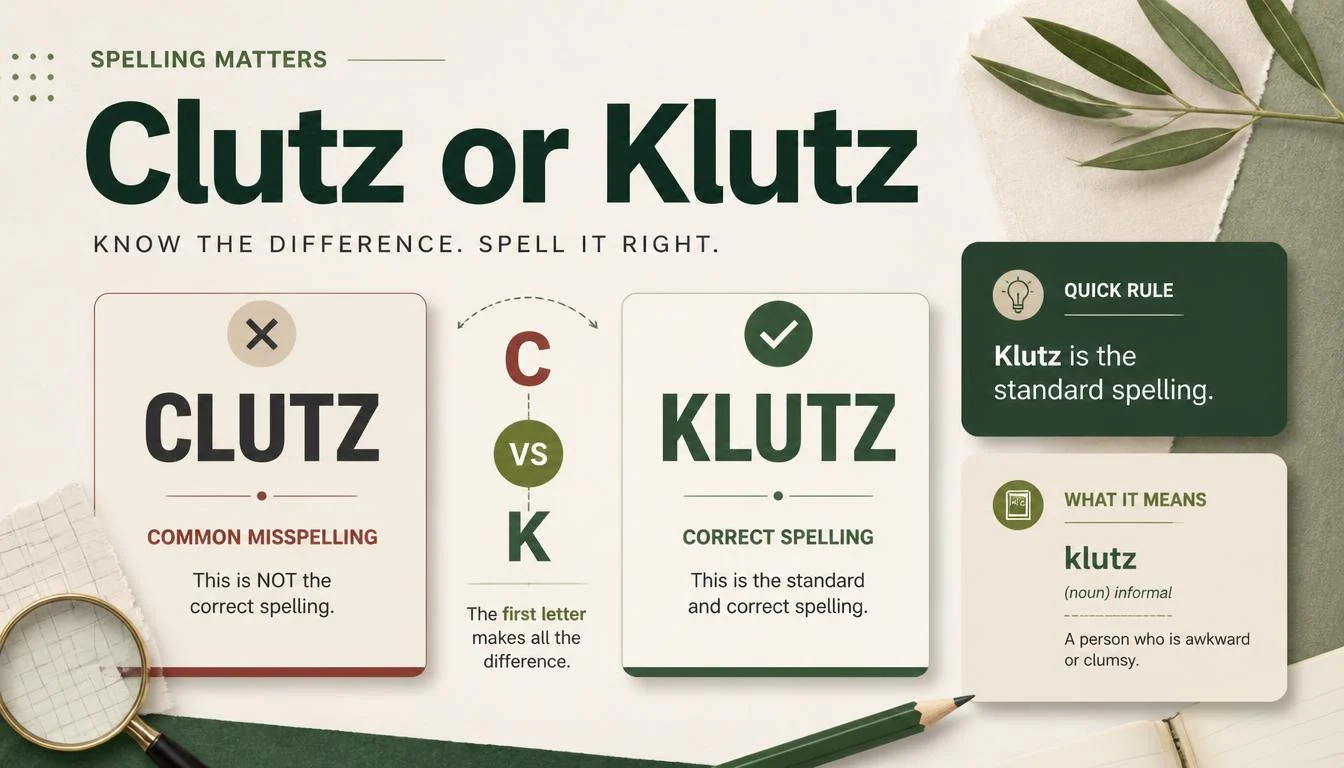
The correct spelling is klutz, referring to a clumsy or awkward person. “Clutz” is a common misspelling, not an accepted variant. While some sources note rare usage, standard dictionaries like Merriam-Webster, Cambridge, and Collins only recognize “klutz” as correct. Always use “klutz” in professional and academic writing .
Ever tripped over your own feet, knocked over a glass of water, or dropped your phone for the third time this week? You might have called yourself a “klutz.” But when you went to write it down, you paused is it spelled with a “K” or a “C”? You’re not alone. This tiny spelling difference has tripped up countless English learners and native speakers alike.
The confusion between “klutz” and “clutz” isn’t about grammar rules or regional variations. It’s simply a matter of correct spelling versus a common error. While both look similar and sound identical when spoken, only one is recognized by authoritative dictionaries. Using the wrong spelling in emails, reports, or academic papers can undermine your credibility even if the reader understands your meaning .
In this guide, we’ll clear up the confusion once and for all. You’ll learn the correct spelling, understand why “clutz” appears so often, and discover practical tips to remember the difference. By the end, you’ll never second-guess yourself when writing this word again.
What’s the Difference Between Klutz and Clutz?
The short answer: there is no meaningful difference in meaning but there is a crucial difference in correctness.
Klutz is the only standard spelling accepted by major English dictionaries. It’s a noun that describes someone who is clumsy, awkward, or accident-prone . “Clutz,” on the other hand, is a misspelling that has gained some visibility through informal usage but isn’t recognized in formal English.
Comparison Table
| Aspect | Klutz | Clutz |
|---|---|---|
| Spelling Status | Correct (standard) | Incorrect (misspelling) |
| Dictionary Recognition | Yes (Merriam-Webster, Cambridge, Collins, Oxford) | No (not accepted in major dictionaries) |
| Part of Speech | Noun | Noun (same usage, misspelled) |
| Meaning | A clumsy, awkward, or inept person | Same meaning, but misspelled |
| Typical Usage | “I’m such a klutz I broke another glass” | Sometimes appears in informal writing as a variant |
| Common Confusion | None it’s standard | Mistakenly thought to be a British variant or alternate spelling |
Some sources online suggest that “clutz” is a British spelling or an accepted variant, but this is incorrect. Dictionaries like Collins and Cambridge clearly list “klutz” as the only correct spelling, used in both American and British English . The confusion likely stems from the fact that both spellings sound identical when spoken.
Is Klutz a Grammar, Vocabulary, or Usage Issue?
The “klutz vs. clutz” question is primarily a vocabulary and spelling issue, not a grammar problem.
- Vocabulary dimension: “Klutz” is an informal noun borrowed from Yiddish. It belongs to the category of slang or informal vocabulary, similar to words like “goof” or “oaf” .
- Spelling dimension: The question is entirely about correct spelling. Since both words are pronounced the same way, the error happens only in writing.
- Usage dimension: “Klutz” is used in informal contexts casual conversation, personal writing, and some journalism. It rarely appears in formal business, academic, or legal documents .
Are the two words interchangeable? No because “clutz” isn’t a recognized word. You wouldn’t say they’re interchangeable any more than you’d say “definately” and “definitely” are interchangeable. One is correct; the other isn’t.
Formal vs. informal English: “Klutz” belongs firmly in the informal register. In a job application or academic paper, you’d avoid it entirely and use words like “clumsy,” “awkward,” or “inept” instead.
Practical takeaway: When writing, always use “klutz.” When speaking, it doesn’t matter they sound identical. But in any written context, “klutz” is the only option.
Klutz (The Correct Spelling)
Meaning and Definition
Klutz” (pronounced kluhts, rhyming with “puts”) is a noun that means:
- A clumsy, awkward person who frequently drops things, trips, or has accidents .
- An ignorant or foolish person; a blockhead (less common usage) .
Part of speech: Noun (countable plural: klutzes)
Common Collocations and Sentence Patterns
You’ll often see “klutz” paired with these words:
- “Such a klutz”: “I’m such a klutz I spilled coffee on my shirt.”
- “Total klutz”: “He’s a total klutz when it comes to sports.”
- “Bit of a klutz”: “She’s a bit of a klutz in the kitchen.”
Natural Examples
Workplace example:
“I knocked over the entire stack of files again. I’m such a klutz today.”
Academic example:
“Despite being a klutz in lab settings he once broke three beakers in one session his research was brilliant.”
Technology example:
“If you’re a klutz with your phone, get a heavy-duty case. You’ll thank me later.”
Email example:
“Sorry about the broken mug I’m a total klutz this morning!”
Daily conversation example:
“Don’t hand me anything fragile. I’m a klutz. It won’t end well.”
Learner Mistake to Avoid
Common error: Writing “clutz” in any formal or informal written context.
How to avoid it: Think of the “K” as standing for “Known correct spelling.” If you remember that the correct word starts with “K,” you’ll never reach for a “C” again.
Mini Recap
“Klutz” is the only correct spelling. It means a clumsy or awkward person and is used in informal contexts. The “K” spelling is standard across all English varieties.
Clutz (The Common Misspelling)
What “Clutz” Means (and Why It’s Wrong)
Clutz” carries the exact same meaning as “klutz” it describes a clumsy or awkward person. However, it’s a misspelling, not a legitimate variant. While you might see it online, in social media posts, or even in some informal publications, no major dictionary recognizes it as correct English .
Some sources claim “clutz” is a British or Canadian variant, but this isn’t supported by evidence from authoritative dictionaries. Collins, Cambridge, and Merriam-Webster all list “klutz” as the standard spelling in both American and British English .
Why Do People Write “Clutz”?
The error is understandable “clutz” looks like it “should” be spelled with a “C” because:
- The word is pronounced with a hard “K” sound and in English, that sound can be spelled with either “K” or “C” (think “cat” vs. “kite”).
- The Yiddish origin is unfamiliar most people don’t know the word comes from Yiddish klots (wooden beam), so they guess the spelling .
- “Clutz” looks more English words beginning with “kl” are rare in native English vocabulary, while “cl” words are common (clumsy, clatter, clod).
Is “Clutz” Ever Acceptable?
In formal writing: never. In informal contexts: still not recommended. Even in texts, social media posts, or casual emails, using “clutz” signals that you’re unfamiliar with the standard spelling. It’s like writing “definately” instead of “definitely” everyone will understand you, but they’ll also notice the error.
Examples of Incorrect Usage
❌ “I’m such a clutz I dropped my keys in the sewer.”
✅ “I’m such a klutz I dropped my keys in the sewer.”
❌ “He’s a clutz with tools; he broke the drill on his first try.”
✅ “He’s a klutz with tools; he broke the drill on his first try.”
Learner Mistake to Avoid
Common error: Assuming “clutz” is a British variant and using it in writing.
How to avoid it: Remember that “klutz” is borrowed from Yiddish, and Yiddish words almost always start with “K” in English transliteration (kibbutz, kosher, klutz).
When Not to Use Klutz (or Clutz)
Even though “klutz” is the correct spelling, there are many situations where you shouldn’t use it at all. Here’s what to avoid:
1. Formal Business Writing
In professional reports, client communications, or official documents, “klutz” is too informal. Use professional alternatives like “clumsy,” “awkward,” or “uncoordinated.”
2. Academic Papers
No professor wants to read “the klutz’s experiment failed” in a research paper. Stick to formal vocabulary.
3. Job Applications
Never describe yourself as a “klutz” in a résumé or cover letter even self-deprecating humor rarely works in job applications.
4. Apologizing to Someone
Calling someone a “klutz” to their face even jokingly can come across as rude or dismissive. It’s often perceived as an insult .
5. Medical or Professional Settings
If you’re describing a condition that causes clumsiness (like a neurological issue or injury), use precise, clinical language instead of informal slang.
6. Self-Descriptions in Professional Settings
Even in casual office banter, calling yourself a “klutz” repeatedly can subtly undermine how colleagues perceive your competence.
7. Written Instructions or Manuals
If you’re writing safety guidelines or instructions, the word “klutz” is inappropriate. Stick to neutral language.
8. Formal Speeches or Presentations
Avoid slang in formal public speaking unless you’re deliberately aiming for a conversational tone.
Quick Decision Guide
If you’re in a formal, professional, or academic context, don’t use “klutz” at all. Use:
- Clumsy
- Awkward
- Uncoordinated
- Inept (in appropriate contexts)
If you’re in an informal, casual context, use “klutz” but always spell it with a “K.”
Common Mistakes Table
Here are real mistakes people make with “klutz” and “clutz” and how to fix them.
| Correct Sentence | Incorrect Sentence | Explanation |
|---|---|---|
| I’m such a klutz I dropped my phone again. | I’m such a clutz I dropped my phone again. | “Clutz” is a misspelling. Use “klutz.” |
| She’s a klutz when it comes to dancing. | She’s a cluts when it comes to dancing. | “Cluts” is another common misspelling. Always use “klutz.” |
| He’s a total klutz in the kitchen. | He’s a total clutz in the kitchen. | Same error “c” should be “k.” |
| Don’t be such a klutz about it. | Don’t be such a klutz (misspelling of klutz). | Even when used correctly, “klutz” is informal. Avoid it in formal writing. |
Real-World Examples
Office Communication
“I spilled coffee on the quarterly report. I’m a klutz can you print another copy?”
Business Email
“Sorry about the broken monitor. I’m a total klutz today. I’ll cover the replacement.”
School or University
“During the chemistry lab, I dropped a beaker. My lab partner called me a klutz.”
Customer Support
“I accidentally dropped my laptop. I know I’m a klutz, but is it still under warranty?”
Technology
“If you’re a klutz like me, get a screen protector immediately.”
Artificial Intelligence
“Even the smartest AI can’t prevent human error. If a klutz is using the device, accidents will happen.”
Daily Conversation
“I tripped over the curb and dropped my groceries. What a klutz!”
Expert Insight
What experienced English teachers know:
Here’s a teaching technique that works. When students ask about “klutz” vs. “clutz,” I ask them to say the word out loud. They always say “kluhts” with a hard “K” sound. Then I ask: “What letter makes a hard ‘K’ sound?” They answer “C” or “K.” And that’s where the confusion starts.
The solution? I tell them: “Think of the word ‘clumsy.’ It starts with a ‘C,’ but we spell it with a ‘K’ because it’s from Yiddish, not English.” Most Yiddish loanwords that start with a “K” sound are spelled with a “K” kibbutz, kosher, kugel, klutz. Once students see the pattern, they rarely make the mistake again .
Also, note that “klutz” is a noun. People often confuse it with “clumsy” (an adjective). You can say “I’m clumsy” or “I’m a klutz” but never “I’m klutz” or “I’m klutzy” without proper grammar.
Error Prevention Checklist
- ☑ Always use “klutz” when writing never “clutz.”
- ☑ Remember it starts with “K” Yiddish loanwords often do.
- ☑ Use it only in informal contexts avoid it in formal writing.
- ☑ Never call someone a “klutz” to their face it’s often seen as rude.
- ☑ Think of “clumsy” but spell it with “K” that’s your memory hook.
- ☑ If you’re unsure, use “clumsy” instead it’s always correct.
Quick memory tip:
“Klutz starts with K, just like clumsy starts with C but it’s spelled with K. ‘Clutz’ with a C is a clutz of a mistake.”
Related Grammar Confusions
If you find “klutz vs. clutz” confusing, you might also want to explore these related topics:
- Alot vs. A lot – One of the most common spelling mistakes in English.
- Definately vs. Definitely – Another “C” vs. “K” confusion.
- Accommodate – The most misspelled word in English.
- Its vs. It’s – A classic grammar confusion.
- Your vs. You’re – A common apostrophe mistake.
- There vs. Their vs. They’re – A three-way confusion.
- Affect vs. Effect – A vocabulary and usage issue.
- Accept vs. Except – A pronunciation and meaning confusion.
- Then vs. Than – A common usage error.
- Lose vs. Loose – A spelling and meaning confusion.
FAQs
Is “clutz” a word?
No, “clutz” is not recognized as a correct spelling by major dictionaries like Merriam-Webster, Cambridge, or Collins. It is a common misspelling of “klutz.”
Why do people spell it “clutz”?
People often spell it “clutz” because it sounds like it should start with a “C.” Since “clumsy” starts with a “C” and has a similar meaning, many people assume “clutz” follows the same pattern.
Is “klutz” British or American?
“Klutz” is used in both American and British English, although it originated in the United States from Yiddish. It remains an informal word in both varieties of English.
What does “klutz” mean?
“Klutz” means a clumsy or awkward person who tends to drop things, bump into objects, or trip easily. It can also refer to a foolish person, although that meaning is less common today.
Is “klutz” a bad word?
“Klutz” is not a curse word, but it can sound rude or dismissive when used directly about someone. Because it is informal, use it carefully depending on the context and your relationship with the person.
Can I use “klutz” in formal writing?
Generally, no. “Klutz” is informal and is better suited to casual conversation or writing. In professional or academic contexts, words such as “clumsy,” “awkward,” or “uncoordinated” are more appropriate.
How do you pronounce “klutz”?
“Klutz” is pronounced kluhts, with the “K” pronounced clearly and the final “tz” sounding like “ts.” It rhymes closely with words such as “puts.”
What’s the plural of “klutz”?
The plural of “klutz” is “klutzes.” For example: “The two klutzes accidentally knocked over the display.”
Conclusion
The difference between “clutz” and “klutz” comes down to one simple fact: “klutz” is correct, and “clutz” is a misspelling. While both sound identical and carry the same meaning in speech, only “klutz” appears in standard dictionaries and is accepted in professional writing .
Remember that “klutz” is Yiddish in origin, and Yiddish loanwords almost always keep their “K” spelling in English. The next time you’re about to type “clutz,” stop and think would you write “clutzy” or “klutzy”? If you know the adjective is “klutzy” (with a K), you can easily remember the noun follows the same pattern.
If you’re ever unsure, the safest option is to avoid the word entirely in formal contexts and use “clumsy” or “awkward” instead. In informal settings, go ahead and use “klutz” but always spell it with a K. Your readers will notice the difference, and so will your spellchecker.
Read More Related Articles:
- Gist or Jist | Stop Making This Common Spelling Mistake In 2026
- Staring or Starring | Grammar Guide to Never Confusing Them Again In 2026
- Cryer or Crier | Surprising Difference Behind These Similar Words In 2026

Lucas Mitchell is a content writer at synoseek.com. He writes simple, thoughtful pieces that focus on everyday ideas, observations and general knowledge topics. His work is shaped by a calm, realistic tone that keeps the reader engaged without overstatement.
2 thoughts on “Clutz or Klutz | Clear Up This Common Spelling Confusion In 2026”