Quick Answer
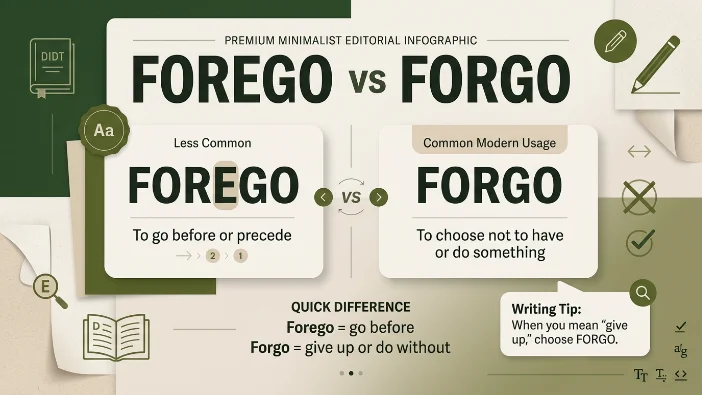
Forgo means to give something up or go without it, as in “forgo dessert.” Forego means to go before or precede something, as in “the aforementioned rules.” Most writers mean forgo, but autocorrect and habit often push them toward the wrong spelling of forego.
You’re writing an email, and you want to say you’re skipping your morning coffee to save money. Your fingers type “forego,” but something feels off. Is that even a word? Should it have two O’s or one? If you’ve ever paused mid-sentence over this exact problem, you’re in good company. Thousands of writers hit this same wall every single day, because English decided to give us two nearly identical words that mean almost opposite things.
Forgo means to voluntarily skip or give something up. Forego means to come before, as in “the foregoing paragraph” or “a foregone conclusion.” The confusion happens because these words sound identical when spoken, they’re spelled almost the same, and one of them (forego) has quietly become an accepted variant spelling of the other in casual use. That last part is exactly why so many people get it wrong, even careful writers who double-check everything else.
Here’s what makes this mistake costly: using “forego” when you mean “forgo” in a formal report, resume, or academic paper can make a document look less polished, even if a reader can’t quite explain why. By the end of this guide, you’ll know exactly which word fits which sentence, why the mix-up happens in the first place, and how to remember the difference permanently.
Forgo vs Forego: What’s the Difference?
The direct answer is this: forgo means to abstain from or skip something, while forego means to go before or precede something in time or order. They are two separate verbs with two separate meanings, even though they’re often treated as if they were the same word.
Forgo is the verb you want almost every time you’re talking about giving something up. If you’re skipping a vacation to save money, declining a promotion, or passing on a second slice of cake, forgo is your word. It’s built from “go” plus the prefix “for-,” which in this case carries a sense of abstaining or doing without.
Forego, on the other hand, comes from “go” plus a different historical prefix meaning “before.” It shows up almost exclusively in a few fixed phrases: “foregoing,” “foregone conclusion,” and occasionally “forewent” as the past tense. You’ll rarely use forego in everyday writing unless you’re referring to something that came earlier in a document or conversation.
| Meaning | Part of Speech | Refers To | Typical Usage | Example | Common Confusion |
|---|---|---|---|---|---|
| To give up or skip | Verb | An action, choice, or item | Everyday writing, business, casual speech | She decided to forgo the bonus this year. | Spelled with an extra “e” by mistake |
| To come before | Verb | Time, order, or sequence | Legal writing, formal documents | The foregoing statement is accurate. | Used when “forgo” was intended |
So here’s the recap: if your sentence is about choosing not to do something, reach for forgo. If your sentence is about something that happened earlier or came first in a list, forego is technically correct, though even that usage is fading from modern English. When in doubt, ask yourself whether you’re describing an earlier point or a personal sacrifice. That single question solves the mix-up almost every time.
Is Forgo a Grammar Issue, a Vocabulary Issue, or a Usage Issue?
This confusion sits mostly in the vocabulary and usage category rather than pure grammar. Both words are grammatically valid verbs that conjugate correctly in a sentence, so there’s no rule being broken structurally. The real issue is that writers pick the wrong word for the meaning they intend.
From a vocabulary standpoint, forgo and forego are two distinct lexical items with different Latin and Old English roots, even though they’ve drifted close together in spelling over centuries. Dictionaries like Merriam-Webster still list them separately, though many now note that “forego” is frequently used as a variant spelling of “forgo” in informal contexts.
In formal English, academic writing, and business communication, the distinction matters. A resume that says “I foregoed overtime pay” instead of “I forwent overtime pay” (or, more naturally, “I gave up overtime pay”) signals a lack of attention to detail. In everyday conversation and casual texting, almost nobody notices or cares, and the words are treated as interchangeable.
The practical takeaway: if you’re writing something that needs to look professional, stick with forgo for the “give up” meaning and reserve forego strictly for referring to something that came before.
Forgo: Meaning, Usage, and Examples
Forgo means to voluntarily do without something or to decline an opportunity. It’s pronounced “for-GO,” with the stress on the second syllable, and it functions as a transitive verb, meaning it needs a direct object.
Common collocations include “forgo the opportunity,” “forgo a raise,” “forgo dinner,” and “forgo comfort.” The typical sentence pattern places forgo before a noun or gerund: “forgo something” or “forgo doing something.”
- In a workplace setting, you might hear a manager say, “We’ll need to forgo the team offsite this quarter due to budget cuts.”
- In an academic paper, a student might write, “Researchers chose to forgo a control group due to ethical concerns.”
- In a tech context, a product team might decide to “forgo additional testing to meet the launch deadline.”
- In an email, someone could write, “I’d like to forgo the extended warranty on this purchase.”
- In daily conversation, a friend might say, “I’m going to forgo Netflix tonight and actually go to bed early.
The most common learner mistake is spelling it “forego” out of habit, since that spelling looks more familiar from seeing it in phrases like “foregone conclusion.” Quick recap: forgo equals give up, skip, or decline, and it’s spelled with just one O.
Forego: Meaning, Usage, and Examples
Forego means to precede or come before, both in time and in position within a document. It’s also pronounced “for-GO,” which is a big part of why the two words get tangled together so easily. Like forgo, it’s a transitive verb, though it appears far less often in modern writing.
You’ll mostly encounter forego in its participial form, “foregoing,” which means “previously mentioned” or “coming before.” It also survives in the fixed phrase “a foregone conclusion,” meaning an outcome that was obvious or inevitable from the start.
A lawyer drafting a contract might write, “The foregoing terms apply to all parties involved.” In an academic thesis, a writer might reference “the foregoing analysis” to point back to an earlier section. In a technology manual, you might read, “Refer to the foregoing instructions before proceeding.” An email closing out a long thread might say, “Based on the foregoing discussion, we’ll move forward with option two.” And in conversation, someone might casually remark, “Given his track record, his promotion was pretty much a foregone conclusion.
The most common mistake here is the reverse of the forgo error: writers sometimes use “forego” when they actually mean “forgo,” especially in phrases like “forego the chance” when they mean “give up the chance.” Mini recap: forego means to come before, and outside of a handful of fixed legal or formal phrases, you’ll rarely need it.
When Not to Use Each Word
There are several specific situations where writers reliably pick the wrong option, and understanding why helps you avoid repeating the pattern.
First, don’t use “forego” when describing giving something up, like skipping a meal or declining an offer. This happens because forego simply looks more common in memory, thanks to phrases like “foregone conclusion” that most people have heard before. The correct word is forgo, and remembering that “forgo” is the shorter, plainer spelling can help it stick.
Second, don’t use “forgo” when you mean something came before in a document or timeline. Writers sometimes type “the forgoing paragraph” when they mean “the foregoing paragraph.” Since forego relates to going before, picture the extra “e” as standing for “earlier.”
Third, avoid using either word when a simpler synonym would communicate more clearly to a general audience. In casual writing, “skip,” “give up,” or “pass on” often reads more naturally than forgo, especially for readers who aren’t confident with either spelling.
Fourth, don’t assume spell-check will catch this error. Both forgo and forego are correctly spelled words on their own, so a spell-checker won’t flag a wrong choice between them, only a grammar checker tuned for word confusion pairs will catch it.
Fifth, be careful with past tense forms. The past tense of forgo is “forwent,” and the past participle is “forgone.” The past tense of forego is “forewent,” with past participle “foregone.” These four forms look so similar that writers frequently swap them without noticing.
Sixth, avoid overusing forego in formal writing just because it sounds more sophisticated. Reaching for “foregoing” instead of a plainer word like “previous” or “earlier” can make writing feel stiff and dated rather than professional.
Seventh, don’t use “foregone” when you mean “forgone.” “A foregone conclusion” is correct and idiomatic. I have foregone dessert” is technically using the wrong word if you mean you skipped it, since the correct form there is “forgone.
Eighth, resist the urge to treat these as fully interchangeable just because casual usage sometimes blurs the line. In professional writing, the distinction still signals credibility.
Common Mistakes Table
| Correct Sentence | Incorrect Sentence | Explanation |
|---|---|---|
| She chose to forgo the extra dessert. | She chose to forego the extra dessert. | “Forgo” means to give something up; “forego” means to come before. |
| Based on the foregoing evidence, the court ruled in her favor. | Based on the forgoing evidence, the court ruled in her favor. | “Foregoing” refers to something mentioned earlier, not something skipped. |
| His retirement was a foregone conclusion. | His retirement was a forgone conclusion. | “Foregone conclusion” is a fixed idiom and always uses the “e.” |
| They had to forgo the annual bonus this year. | They had to forego the annual bonus this year. | Skipping a bonus requires “forgo,” not “forego.” |
| I forwent my lunch break to finish the report. | I forewent my lunch break to finish the report. | “Forwent” is the past tense of “forgo”; “forewent” belongs to “forego.” |
Decision Box
If you mean giving something up, skipping it, or doing without it, use forgo.
If you mean something that came before or was mentioned earlier, use forego.
Still unsure? Try replacing the word with “skip.” If the sentence still makes sense, you need forgo.
Forgo and Forego in Real World Situations
In office communication, a project manager might email the team saying, “Let’s forgo the weekly status call this Friday since everyone’s traveling.” That single sentence captures exactly how forgo functions in professional settings, signaling a deliberate choice to skip something routine.
In a business proposal, a company might write, “Given the foregoing analysis, we recommend proceeding with Vendor B.” This shows forego doing its real job, pointing back to information already presented.
In a school setting, a professor might tell students, “You may forgo the final exam if your project grade exceeds ninety percent.” Meanwhile, a syllabus might state, “The foregoing grading policy applies to all sections of this course.”
- In customer support, an agent might write, “We understand you’d like to forgo the extended service plan, and that’s completely fine.”
- In a technology context, a software update note might read, “Users can forgo manual updates by enabling automatic installation.”
- In daily conversation, someone might simply say, “I think I’ll forgo the gym today and just walk instead.
Forgo and Forego in Modern Technology
Modern technology writing leans almost entirely on forgo rather than forego, because most tech content is about choices users make, not about referencing earlier material. In artificial intelligence documentation, you might see, “Users can forgo manual data labeling by enabling the AI-assisted tagging feature.” Virtual assistants and voice assistants are frequently described in terms of what they let users skip: “This voice assistant lets you forgo typing entirely.”
Chatbots often generate customer-facing text like, “You can forgo the standard shipping fee by selecting in-store pickup.” Software release notes might state, “This version allows administrators to forgo the manual approval step for trusted devices.” Business tools built for automation are almost always described using forgo, since automation is fundamentally about letting people skip manual work.
Forego shows up far less in tech writing, mostly confined to legal disclaimers or terms of service documents that reference “the foregoing terms and conditions.”
Word Origin
Both words trace back to Old English, and their shared root explains the ongoing confusion. Forgo comes from the Old English “forgan,” combining “for-” (a prefix indicating negation or exclusion) with “gan” (to go), essentially meaning “to go without.” Forego comes from “foregan,” combining a different sense of “fore-” meaning “before” with the same root “gan,” meaning “to go before.”
Over centuries, spelling conventions shifted, and the distinction between “for-” and “fore-” blurred in everyday use. This is precisely why dictionaries today often list “forego” as an acceptable variant spelling of “forgo,” even though careful, formal writing still treats them as separate words with separate jobs.
Expert Insight
Here’s something worth remembering as a language instructor would explain it to a class: the safest habit is to default to “forgo” whenever you’re talking about giving something up, and only reach for “forego” when you’re explicitly pointing back to something already stated. If you’re ever unsure which one fits, try the substitution test. Swap in “skip” or “give up.” If the sentence still makes sense, forgo is correct. If instead you’d naturally say “previous” or “earlier,” forego is the right choice. This one habit resolves the vast majority of real-world confusion between these two words.
Error Prevention Checklist
Always use forgo when you mean to give up, skip, or decline something.
Always use forego when you mean something came before or was previously mentioned.
Never confuse them if you remember that forgo has one O and pairs with “go without,” while forego has the extra “e” that echoes “before.”
Quick memory tip: “Forgo” is short, like the sacrifice it describes. “Forego” has an extra letter, just like it points to something extra, something that came earlier.
Related Grammar Confusions
Its vs It’s one of the most common apostrophe mix-ups in English, worth mastering early since it appears in nearly every type of writing.
Affect vs Effect a classic verb-versus-noun confusion that trips up even experienced writers in professional emails.
Then vs Than these two get swapped constantly because they sound similar but serve completely different grammatical roles.
Complement vs Compliment understanding this pair prevents awkward misunderstandings in workplace communication.
Lose vs Loose a spelling mix-up that changes meaning entirely, from misplacing something to a lack of tightness.
Farther vs Further useful for writers who want to distinguish physical distance from figurative progress.
Principal vs Principle essential for anyone writing in academic or leadership contexts where both words appear often.
Discreet vs Discrete a subtle distinction that matters a great deal in technical and formal writing.
Assure vs Ensure vs Insure three words that sound related but serve very different purposes in business writing.
Elicit vs Illicit a pair that looks similar on paper but couldn’t mean more different things.
FAQs
Is “forego” a real word?
Yes. Forego is a legitimate word meaning to come before or precede. For example, the foregoing paragraph refers to a paragraph that appeared earlier. It is different from forgo, which means to give up or do without something.
Which is more common, forgo or forego?
Forgo is much more common in everyday writing because it means to give something up or choose not to have it. Forego is less common and is mainly used when referring to something that comes before, particularly in formal or legal contexts.
What is the past tense of forgo?
The past tense of forgo is forwent, and its past participle is forgone. For example, She forwent dessert and He has forgone the opportunity. These forms should not be confused with forego, whose past tense is forewent.
Can forego and forgo be used interchangeably?
No. Although the two words are sometimes confused in informal writing, they have different meanings. Forgo means to give up or do without, while forego means to precede or come before. In formal writing, choosing the correct word is important.
Why don’t spell-checkers catch this mistake?
Both forgo and forego are correctly spelled English words. Basic spell-checkers usually identify misspelled words rather than incorrect word choices, so they may not recognize that the wrong word has been used. Context and proofreading are needed to catch the error.
Is “foregone conclusion” spelled with one O or two?
The correct phrase is “foregone conclusion,” with the e in foregone. It comes from forego in the sense of something that came before or was already determined. “Forgone conclusion” is not the standard spelling of this established expression.
Conclusion
The difference between forgo and forego comes down to one simple test: are you talking about giving something up, or are you referring to something that came before? Forgo means to skip, decline, or do without, while forego means to precede or come earlier in a sequence.
Most everyday writing calls for forgo, and forego is reserved for a small handful of formal phrases like “foregoing” and “foregone conclusion.” Remember this simple rule: if you can replace the word with “skip,” you need forgo. If you can replace it with “earlier” or “previous,” you need forego. Keep that test in mind, and you’ll never second-guess this word pair again.
Read More Related Articles:
- Pronounciation vs Pronunciation | Common Error You Can Avoid In 2026
- Privilege vs Priviledge | Learn the Correct Word Fast In 2026
- Suing or Sueing | Don’t Let This Spelling Trip You Up In 2026

Lucas Mitchell is a content writer at synoseek.com. He writes simple, thoughtful pieces that focus on everyday ideas, observations and general knowledge topics. His work is shaped by a calm, realistic tone that keeps the reader engaged without overstatement.