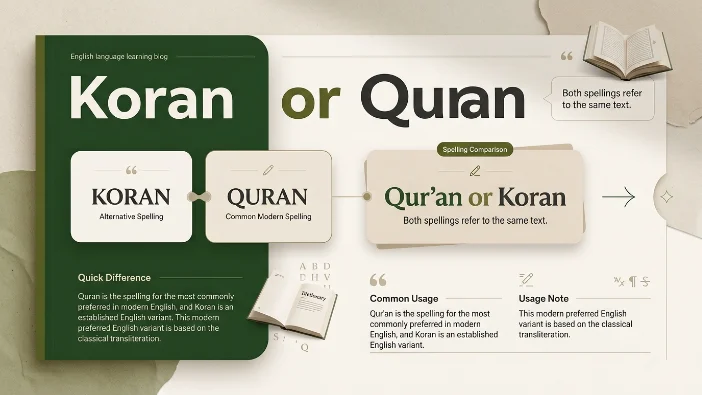
Quick Answer
Both “Koran” and “Quran” refer to the same Islamic holy scripture, but “Quran” is the more accurate transliteration of the Arabic word القرآن. “Koran” is the older, anglicized spelling that was standard in English for centuries, while “Quran” (or “Qur’an”) more closely represents the original pronunciation and is now the preferred spelling in academic, journalistic, and Muslim communities.
If you have ever found yourself pausing mid-sentence over whether to write “Koran” or “Quran,” you are not alone. The question is more common than you might think. Writers, students, and journalists frequently struggle with this spelling choice, often wondering if one version is more correct or respectful than the other.
The confusion is entirely understandable. Both spellings are widely used, and neither is technically “wrong” in the sense that readers would misunderstand which book you mean. However, the choice between “Koran” and “Quran” carries important implications. The spelling you choose signals something about your audience awareness, your familiarity with Arabic transliteration, and your sensitivity to cultural preferences. This article explains why both spellings exist, which one is preferred in different contexts, and how to choose the right spelling for your writing.
What’s the Difference Between Koran and Quran?
The difference between “Koran” and “Quran” is not a difference in meaning, but a difference in transliteration. Both words refer to exactly the same book: the central religious text of Islam. The Arabic word is القرآن, which simply means “the recitation” .
The core distinction lies in how Arabic sounds are rendered in English letters. Arabic uses a different alphabet system, so transliteration is the process of converting Arabic script into English characters. There is no single “correct” transliteration system, which is why multiple spellings exist .
Here is a quick comparison:
| Feature | Koran | Quran / Qur’an |
|---|---|---|
| Meaning | The Islamic holy scripture | The Islamic holy scripture |
| Part of Speech | Proper noun | Proper noun |
| Origin | Older anglicized spelling from the 17th century | More recent direct transliteration |
| Typical Usage | Traditional English publications; older texts | Academic writing; Muslim communities; modern journalism |
| Pronunciation | kuh-RAN (emphasis on second syllable) | koor-AHN (closer to Arabic pronunciation) |
| Common Confusion | Believed to be incorrect or outdated | May confuse readers unfamiliar with Arabic transliteration |
The key takeaway is simple: if you mean the holy book of Islam, both spellings are acceptable, but “Quran” is increasingly preferred .
Is This a Grammar, Vocabulary, or Usage Issue?
The Koran vs. Quran question is primarily a usage issue rather than a grammar or vocabulary problem. Both words function as proper nouns and have the same grammatical behavior. You would use either spelling in exactly the same way: “I read the Koran” or “I read the Quran.
The issue is fundamentally about transliteration conventions. When a word from a language with a different writing system enters English, there is often a period of spelling variation. This is what happened with “Koran” and “Quran.” Over time, a preferred spelling usually emerges.
In formal English, academic writing, and business contexts, “Quran” is now the more widely accepted spelling. Major style guides and institutions have shifted toward “Quran” because it more accurately reflects the Arabic pronunciation and demonstrates cultural sensitivity .
In everyday conversation and informal writing, however, you might still encounter “Koran” more often, particularly among older generations or in regions where the traditional spelling remains common.
The practical takeaway is that “Quran” is the safer choice in professional and academic writing, while both forms are understood in casual contexts.
Understanding Quran (or Qur’an)
Meaning and Definition
“Quran” (also written as “Qur’an”) is the proper name for the sacred scripture of Islam. Muslims believe the Quran is the literal word of God (Allah) as revealed to the Prophet Muhammad through the angel Gabriel. The word itself means “the recitation,” reflecting the importance of oral recitation in Islamic tradition .
The Quran is composed of 114 chapters, known as “suras,” and is written in Arabic. Translations exist in many languages, but they are generally considered interpretations rather than the actual Quran itself .
Pronunciation
In Arabic, the word is pronounced roughly as “koor-AHN.” The first syllable is short, the second syllable is stressed, and there is a distinct glottal stop at the end. English speakers often pronounce it as kuh-RAN or kuh-RAHN, with the emphasis on the second syllable. This is a reasonable approximation for non-Arabic speakers .
Part of Speech
“Quran” is a proper noun and is always capitalized. It is used with the definite article “the” when referring to the specific scripture: “the Quran.”
Common Collocations
Here are typical phrases you will encounter with “Quran”:
- Recite the Quran
- Quranic verses (using the adjectival form)
- Memorize the Quran
- Interpret the Quran
- The Holy Quran
Typical Sentence Patterns
Everyday conversation:
“My grandfather has memorized the entire Quran.”
Academic context:
“The Quran presents a sophisticated theological framework that scholars continue to study.”
Workplace example:
“During Ramadan, many of my colleagues read the Quran during their lunch breaks.”
Email example:
“I have attached the article on Quranic calligraphy you requested.”
Technology context:
“There are now many apps available for reading the Quran with audio recitations.”
Daily conversation:
“Which translation of the Quran do you recommend for English readers?”
Common learner mistake:
Incorrect: “The Qurans are kept on the top shelf.”
Correct: “The Quran is kept on the top shelf.”
Mini recap: “Quran” is the preferred modern spelling, used primarily in academic, religious, and professional contexts. It is closer to the original Arabic pronunciation and demonstrates cultural awareness.
Understanding Koran
Meaning and Definition
Koran” means exactly the same thing as “Quran”: the Islamic holy book. It is simply an older, more anglicized spelling that was the standard in English for centuries .
Pronunciation
In English, “Koran” is typically pronounced as kuh-RAN, with the stress on the second syllable. The first syllable is usually a schwa sound (like the “a” in “about”). Some older British pronunciations may also say koh-RAN .
Part of Speech
Like “Quran,” “Koran” is a proper noun and is always capitalized. It also requires the definite article: “the Koran.”
Common Collocations
You might encounter these phrases with “Koran”:
- The Holy Koran
- The Koran states
- According to the Koran
- Koran translations
Typical Sentence Patterns
Everyday conversation:
“My grandmother has an old copy of the Koran.”
Academic context:
“Comparative religious studies often reference both the Bible and the Koran.”
Workplace example:
“The company’s diversity training mentioned the Koran as an example of sacred texts.”
Email example:
“Please find the research paper on the history of the Koran attached.”
Technology context:
“The digital Koran project aims to preserve historical manuscripts.”
Daily conversation:
“I found a beautiful edition of the Koran at the bookstore.”
Common learner mistake:
Incorrect: “The Koran’s are all different translations.”
Correct: “The Koran has many different translations.”
Mini recap: “Koran” is the traditional English spelling. While it is still understood and used, it is increasingly considered outdated, particularly in academic and Muslim communities.
When Not to Use Each Word
Many writers struggle with choosing between “Koran” and “Quran.” Here are common situations where one spelling may be more appropriate than the other:
When to Use “Koran”
- When quoting older sources. If you are citing a book or article published before the 2000s, the author likely used “Koran.” Preserve their original spelling.
- When writing for an older audience. In some contexts, particularly in the United States, older readers may be more familiar with “Koran.”
- When a publication’s style guide requires it. Some established newspapers and organizations continue to use “Koran” as their house style.
When to Use “Quran”
- In academic writing. Scholars and academic institutions overwhelmingly prefer “Quran” or “Qur’an.”
- When writing about or for Muslim communities. “Quran” is the preferred spelling among Muslims and demonstrates respect and cultural awareness.
- In modern journalism. Most major news outlets have transitioned to “Quran,” including the Associated Press, which changed its style in 2000.
Where Writers Typically Make Mistakes
The most common mistake is not checking the style guide of your publication or institution. Some organizations have a specific preference, and using the wrong version can look careless.
Another frequent error is mixing spellings inconsistently within the same document. Choose one version and stick with it.
Finally, some writers mistakenly believe that “Koran” is an entirely different book. It is not. Both spellings refer to the same scripture.
Common Mistakes Table
| Correct Sentence | Incorrect Sentence | Explanation |
|---|---|---|
| “The Quran is the central religious text of Islam.” | “The Quran is the central religious text of Islam.” | Many misspell it as “Qu’ran” or “Qur’an” with the apostrophe incorrectly placed. |
| “Scholars have translated the Koran into many languages.” | “Scholars have translated the Koran into many languages.” | This is a common misspelling, often written as “Kuran” or “Quran” when a different spelling was intended. |
| “She reads the Quran daily.” | “She reads the Quran daily.” | A common typo is to write “Qura’n” instead of “Quran.” |
Decision Box
If you mean the Islamic holy scripture, choose your spelling based on your context:
- Academic writing: Use Quran (or Qur’an with an apostrophe).
- Writing for a Muslim audience: Use Quran.
- Modern journalism: Use Quran.
- Historical writing quoting older sources: Use Koran.
- General audience where readability is key: Either is acceptable, but Quran is the safer modern choice.
Real-World Examples
Office communication:
“Could you please send me the reference guide for citing the Quran in APA style?”
Business email:
“Regarding the article on religious diversity, we should use the spelling ‘Quran’ for consistency with AP style.”
School or university:
“In this course, we will explore the historical context of the Quran and its influence on Arabic literature.”
Customer support:
“One of our products includes an audio recitation of the Quran; we want to ensure the label displays the preferred spelling.”
Technology:
“The latest update to the Quran app includes more interactive features.”
Artificial Intelligence:
“AI-powered tools are now being used to create more accurate translations of the Quran.”
Daily conversation:
“I’ve heard people use both spellings. Which one is more accurate? The ‘Quran’ is closer to the Arabic.”
The Spelling in Modern Technology
In modern technology, particularly in the field of Artificial Intelligence, the spelling “Quran” has become the standard. This is due to the international nature of tech and the global audience of apps, software, and digital resources.
For example, “Quran” is the most common spelling in app stores for Quran apps. Major search engines use “Quran” as the primary spelling. This shift is driven by the global community and the desire for accurate transliteration. As AI becomes more embedded in language and translation tools, the influence of its data sets will likely make “Quran” even more dominant.
Word Origin
The word “Quran” comes from the Arabic root *q-r-’*, which means “to recite.” The word is derived from the verb qara’a (قرأ), which means “he recited.” “Quran” itself means “the recitation” .
The spelling “Koran” developed as an anglicized version of this word, entering the English language in the 17th century. The “K” sound was used because in older forms of English, the letter “Q” was often reserved for words of French origin, and “K” seemed like a natural representation of the Arabic sound .
Expert Insight
As an experienced English language instructor, I often see students assume that one spelling is correct and the other is wrong. The truth is more nuanced. The English language has a long history of adapting words from other languages, and this often results in multiple spellings. The key is understanding the context. The “Koran” is a part of our linguistic history, while “Quran” is the spelling that bridges the gap between English and Arabic. If you want to be safe, use “Quran.” It is the more accurate and respectful choice for a modern audience.
Error Prevention Checklist
- Always use “Quran” when:
- Writing for a scholarly audience.
- Writing for a Muslim publication or community.
- Following modern style guides like AP or MLA.
- Citing the text in a contemporary context.
- Always use “Koran” when:
- Quoting a text or source that uses that spelling.
- Writing in a historical context.
- Following a style guide that specifically mandates it.
- Never confuse them if:
- You are referring to the same book; they are not different works.
- Quick memory tip:
- “Q” for “Quality” or the “Q” sound in Arabic.
- “K” for the older, more familiar English version.
Related Grammar Confusions
Here are some other frequently confused terms in English:
- Affect vs. Effect: Understanding the difference between a verb and a noun can dramatically improve your writing clarity.
- Principal vs. Principle: One is a person or a primary thing, the other is a rule or belief.
- Stationary vs. Stationery: If it’s not moving, it’s “stationary”; if it’s paper, it’s “stationery.”
- Compliment vs. Complement: One is praise; the other completes something.
- Discreet vs. Discrete: One is careful or unobtrusive; the other is separate or distinct.
- Farther vs. Further: One is for physical distance; the other is for metaphorical distance.
- Loath vs. Loathe: One is reluctant; the other is to hate.
- Proscribe vs. Prescribe: One is to ban; the other is to recommend.
- Allusion vs. Illusion: One is an indirect reference; the other is a false perception.
- Eminent vs. Imminent: One is famous or respected; the other is about to happen.
FAQs
Is “Koran” a misspelling?
No, “Koran” is not a misspelling; it is an older, anglicized spelling of the same word. While “Quran” is now more commonly used, “Koran” is still found in older texts and some publications. It is important to be aware of your audience and context when choosing which spelling to use .
Which spelling is more accurate in English?
The spelling “Quran” is more accurate because it more closely follows the transliteration of the Arabic pronunciation. It is preferred in academic and Muslim communities, as it reflects the original word more faithfully. “Koran” is an anglicized version that became standard over time .
Why do some people use the spelling “Qur’an”?
The apostrophe in “Qur’an” represents a glottal stop, which is a distinct sound in Arabic. This is the most technical and linguistically precise transliteration. It is often used in academic writing and by Muslims to accurately represent the Arabic pronunciation .
Is there a difference in meaning between “Koran” and “Quran”?
No, there is absolutely no difference in meaning. Both words refer to the same holy book of Islam. The difference is purely in how the Arabic word is transliterated into the English alphabet .
What does “Quran” mean in Arabic?
“Quran” comes from the Arabic verb “qara’a,” which means “he recited.” Therefore, the word “Quran” means “the recitation.” It is so named because it is meant to be recited aloud .
Is it offensive to use “Koran”?
It is generally not considered offensive, but many Muslims and scholars prefer “Quran” as it is a more accurate transliteration. Using “Koran” may be seen as outdated or less culturally aware. For modern writing, “Quran” is the better choice to show respect and accuracy .
Conclusion
The choice between “Koran” and “Quran” boils down to a choice between tradition and accuracy. “Koran” is the older, more anglicized version that has a long history in the English language. “Quran” is the more modern and linguistically precise spelling that closely reflects the original Arabic pronunciation.
While both spellings are widely understood, the trend across academic, journalistic, and religious contexts is clear: “Quran” is increasingly the preferred spelling. It demonstrates cultural sensitivity, a commitment to accurate transliteration, and an awareness of current standards. When you write, consider your audience and the context, but when in doubt, choose “Quran.” It is the more accurate and respectful way to refer to this important scripture.
Read More Related Articles:
- Excel vs. Accel | Don’t Let This Spelling Mix-Up Fool You In 2026
- Miner vs Minor | Simple Guide to Getting These Words Right In 2026
- Addition vs Edition | Key Difference You Need to Know In 2026

Caleb Dawson is a content writer at synoseek.com, where he works on simple, reader-focused articles across a range of everyday topics. His writing style is practical and grounded, aiming to present information in a clear and relatable way without unnecessary complexity.