Quick Answer:
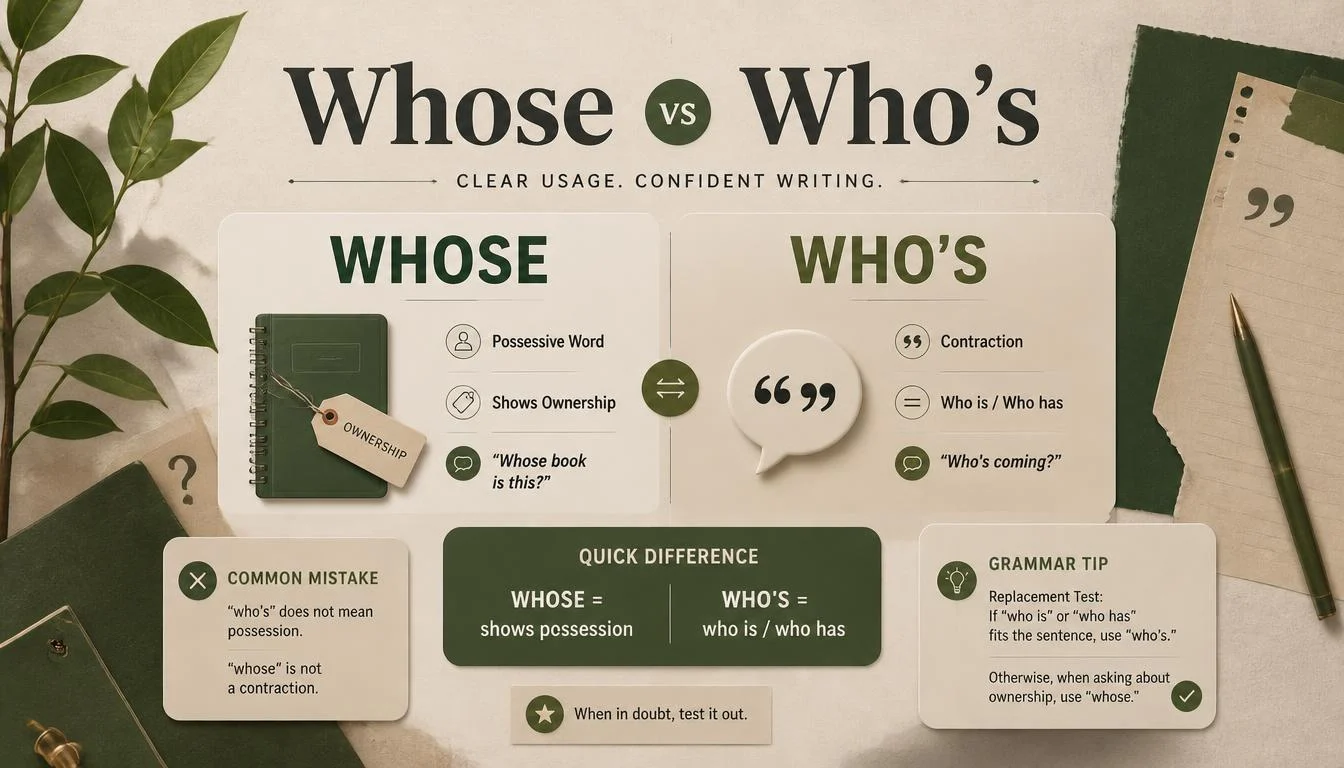
Whose vs who’s confuses even confident writers because the two words sound identical but work completely differently. Whose shows possession, asking who something belongs to. Who’s is simply a contraction of “who is” or “who has.” If you can replace the word with “who is” and the sentence still makes sense, you need who’s.
Confused about Whose vs Who’s? You’re not alone. These two words sound exactly alike, but they have different meanings and grammatical uses. Knowing when to use whose for possession and who’s as a contraction can help you avoid common writing mistakes.
In this guide, we’ll explain Whose vs Who’s in simple terms with clear examples. Whether you’re writing an email, completing an assignment, or polishing your everyday English, you’ll learn an easy way to tell these commonly confused words apart.
Why This Mix-Up Happens to Almost Everyone
You’re typing a quick email, moving fast, and you type “who’s” when you meant “whose” or the other way around. It happens to native speakers just as often as it happens to English learners, and honestly, spellcheck doesn’t always catch it because both words are spelled correctly. The problem isn’t that one of them is wrong. The problem is that your keyboard doesn’t know which meaning you intended.
Here’s the thing that trips people up: these two words sound exactly the same when spoken out loud. There’s no audio clue to help you pick the right one. You have to rely on grammar logic instead of your ear, and that’s a skill most of us were never taught clearly in school.
Getting whose and who’s mixed up isn’t just a minor typo either. In a business email, it can make a sentence confusing or even change its meaning entirely. A misplaced apostrophe on a resume, a client proposal, or a school essay can quietly signal carelessness, even if the rest of your writing is sharp. By the end of this guide, you’ll have a foolproof way to choose the right word every single time, without having to memorize a rule you’ll forget in a week.
Whose vs Who’s: What’s the Difference?
The core difference comes down to one thing: whose shows ownership, while who’s is short for “who is” or “who has.” Once that clicks, everything else falls into place.
Whose is a possessive pronoun. It asks or tells you who owns, has, or is connected to something. Think of it in the same family as “his,” “her,” or “their” words that show belonging without needing an apostrophe. You’d say “his book,” not “hi’s book,” and the same logic protects whose from ever needing one.
Who’s, on the other hand, is a contraction. The apostrophe isn’t decorative it’s standing in for missing letters, exactly like it does in “it’s” (it is) or “she’s” (she is). Whenever you see who’s, mentally expand it back to “who is” or “who has” and check if the sentence still makes sense.
| Meaning | Part of Speech | Refers To | Typical Usage | Example | Common Confusion |
|---|---|---|---|---|---|
| Belonging to whom | Possessive pronoun | Ownership or connection | Before a noun | “Whose laptop is this?” | Mistaken for a contraction |
| Who is / who has | Contraction | An action or state | Before a verb or past participle | “Who’s coming to the meeting?” | Mistaken for possession |
So the recap is simple: no apostrophe, no action whose just sits quietly in front of a noun to show ownership. An apostrophe means something is missing, and that something is always a form of “is” or “has” hiding inside who’s.
Is Whose vs Who’s a Grammar, Vocabulary, or Usage Issue?
This is purely a grammar issue, not a vocabulary problem. Both words exist for entirely different grammatical jobs, and neither one is optional or old-fashioned they’re just easy to swap by accident.
Whose functions as a possessive determiner, meaning it always needs a noun sitting right after it. You’ll never see whose standing alone at the end of a sentence with nothing to modify. Who’s, meanwhile, is a contraction built from a pronoun and a verb, so it needs to be followed by a verb form, an adjective, or a present participle (an -ing word).
The two words are never interchangeable, in any register. This holds true in formal English, business writing, academic papers, and casual texting alike. Where the stakes shift is tone: in a formal report or academic essay, style guides generally recommend spelling out “who is” instead of using the contraction who’s at all, since contractions can feel slightly informal in serious writing. Casual conversation and everyday messaging, however, use who’s constantly without any issue.
The practical takeaway: if formality matters, lean on whose for possession as always, but consider writing out “who is” or “who has” in full rather than reaching for the contraction.
Whose: The Complete Guide
Whose means “belonging to whom” and shows a connection between a person (or sometimes a thing) and something they own, control, or are associated with.
It’s a possessive pronoun, and pronunciation-wise it rhymes with “shoes” a small memory hook some learners find helpful since both words end in that same “-ooze” sound.
Common collocations include “whose fault,” “whose idea,” “whose turn,” and “whose responsibility.” Notice the pattern: whose is almost always glued directly to a noun. The typical sentence structure is Whose + Noun + Verb, like “Whose car is parked outside?”
Workplace example: “I need to find out whose signature is missing from this contract before we can send it to the client.”
Academic example: “The professor asked whose research methodology was more reliable for measuring long-term memory retention.”
Technology example: “Whose device is connected to the office Wi-Fi right now? It’s slowing everything down.”
Email example: “Could you confirm whose approval we still need before the budget gets finalized?”
Daily conversation example: “Whose turn is it to pick the restaurant tonight?”
A common learner mistake is writing “who’s” when trying to ask about ownership, like typing “Who’s phone is this?” instead of “Whose phone is this?” Since the sentence isn’t asking “who is phone,” the possessive whose is the only correct choice.
Quick recap: if you’re asking who something belongs to, and a noun comes right after the word, you want whose.
Who’s: The Complete Guide
Who’s is a contraction that always means either “who is” or “who has,” and it’s built for speed in everyday spoken and written English.
There’s no unique pronunciation to worry about here it sounds identical to “whose,” which is exactly why the confusion exists in the first place. The apostrophe is invisible in speech but critical in writing.
Grammatically, who’s is a pronoun-verb contraction, similar in structure to “she’s” or “he’s.” Common patterns include “who’s coming,” “who’s ready,” “who’s responsible,” and “who’s been working.” Whenever who’s shows up, it’s almost always followed by a verb, an adjective, or a location.
Workplace example: “Who’s leading the client call this afternoon?”
Academic example: “Who’s presenting their thesis first at tomorrow’s seminar?”
Technology example: “Who’s been testing the new app update? I’m getting a bug report.”
Email example: “Who’s available for a quick sync before the deadline tomorrow?”
Daily conversation example: “Who’s driving to the game tonight?”
A frequent learner mistake looks like this: “Who’s dog barked all night?” This should be “Whose dog barked all night?” because the sentence isn’t saying “who is dog barked” it’s asking who owns the dog.
Quick recap: if the sentence still makes complete sense after mentally swapping in “who is” or “who has,” who’s is correct.
When Not to Use Each Word
Even confident writers slip up in specific, predictable situations. Here are the most common traps and how to sidestep them.
Mistake 1: Using “who’s” before a noun. This happens because writers rush and don’t pause to check what follows the word. If a noun comes next like “book,” “car,” or “opinion” whose is almost always correct, since “who’s” needs a verb afterward, not a thing.
Mistake 2: Using “whose” in a question about identity plus action. Questions like “Whose going to the party?” feel natural to type quickly, but they’re incorrect. The sentence means “who is going,” so it needs who’s. Remembering that whose never directly precedes a verb form like “going” or “coming” solves this instantly.
Mistake 3: Autocorrect switching your choice. Phone keyboards sometimes “correct” one word to the other based on frequency, not context. Always glance back at what you typed in sensitive messages like emails or reports.
Mistake 4: Overthinking simple sentences. Some writers second-guess themselves so much they freeze on short sentences like “Who’s there?” Trust the “who is” substitution test rather than trying to remember an abstract rule under pressure.
Mistake 5: Formal writing habits bleeding into contractions. Writers sometimes force who’s into academic papers out of habit from texting, when the fuller “who is” or “who has” reads more polished in that context.
Mistake 6: Mixing up whose with “who’s” in indirect questions. Sentences like “I wonder whose turn it is” get flipped to “I wonder who’s turn it is” by mistake. Since “turn” is a noun right after the word, whose is required.
Mistake 7: Assuming whose only applies to people. Some learners think whose can’t refer to objects or organizations, so they avoid it in sentences like “The company whose logo was redesigned last year.” It absolutely can whose comfortably applies to things, not just people.
Mistake 8: Skipping the substitution test under time pressure. In fast-paced writing like customer support chats, people just guess. Slowing down for two seconds to mentally expand “who is” saves you from an easy, avoidable error.
Common Mistakes Table
| Correct Sentence | Incorrect Sentence | Explanation |
|---|---|---|
| Whose umbrella is this? | Who’s umbrella is this? | A noun (“umbrella”) follows, so possession is meant, not “who is.” |
| Who’s coming to dinner tonight? | Whose coming to dinner tonight? | “Coming” is a verb, meaning the sentence needs “who is.” |
| I don’t know whose idea this was. | I don’t know who’s idea this was. | “Idea” is a noun showing ownership, requiring whose. |
| Who’s responsible for this account? | Whose responsible for this account? | “Responsible” follows the missing “is,” so who’s is correct. |
| The employee whose badge was lost called security. | The employee who’s badge was lost called security. | “Badge” belongs to the employee, so possession requires whose. |
| Who’s got the keys to the storage room? | Whose got the keys to the storage room? | “Got” is a verb form standing in for “has,” requiring who’s. |
Decision Box: Ten-Second Fix
If you mean the action of asking who is or who has done something, use who’s.
If you mean the ownership of a thing, use whose.
Try this test right now: replace the word with “who is.” If the sentence still makes sense, keep who’s. If it sounds broken or nonsensical, switch to whose.
Whose vs Who’s in Real Life
Office communication: A manager writes, “Whose desk is this stack of files sitting on?” while a coworker replies, “Who’s around to help me move them?” Both sentences live in the same conversation but need completely different words.
Business email: “Please let me know who’s attending the vendor meeting, and whose department will be covering the travel costs.”
School or university: A teacher announces, “Whose essay hasn’t been submitted yet?” while a student asks, “Who’s grading our midterms this semester?”
Customer support: A support agent types, “Who’s the account holder listed on this order?” and later clarifies, “We just need to confirm whose card was used for the transaction.”
Technology: A developer notes in a bug report, “Who’s assigned to fix this login issue, and whose commit introduced the bug?”
Artificial Intelligence: A user asks a chatbot, “Whose data trains this model?” while another types, “Who’s actually responding right now, a person or an AI?”
Daily conversation: “Whose jacket is on the couch?” followed by “Who’s coming over later to grab it?”
Whose vs Who’s in Modern Technology
Voice assistants like Siri, Alexa, and Google Assistant process spoken language, so they never have to worry about the whose vs who’s spelling problem they only hear sound, not spelling. But once that speech gets transcribed into text, whether in a chatbot log, a voicemail transcript, or an AI-generated caption, the software has to guess which word you meant based on context.
This is actually a great real-world example of why grammar still matters even in an AI-driven world. Speech-to-text tools and chatbots analyze surrounding words to decide between whose and who’s, and they sometimes get it wrong in the same way humans do, especially in short or ambiguous phrases. Business tools that auto-generate meeting summaries or customer service transcripts can misfire here too, which means a human editor checking for whose vs who’s errors is still valuable, even with advanced AI writing assistants in the mix.
Where These Words Come From
Whose traces back to Old English “hwæs,” the possessive form of “hwā” (who), and it’s kept that possessive job for well over a thousand years without much change. Who’s, by contrast, is a much newer construction a modern contraction formed simply by fusing “who” and “is” or “who” and “has,” the same pattern used to build “it’s,” “she’s,” and “he’s.” Interestingly, whose is one of the only possessive pronouns in English that doesn’t end in an apostrophe-S, which is exactly why it looks like it should belong to a contraction family it never actually joined.
Expert Insight
Here’s a mental shortcut that tends to stick long after grammar rules fade: possessive pronouns like “his,” “hers,” “theirs,” and “whose” never use apostrophes to show ownership. If you can remember that one fact, you’ll never second-guess whose again, because it’s simply following the same family pattern as every other possessive pronoun in English. Apostrophes in this pair only ever mean one thing something is missing, and that something is “is” or “has.”
Error Prevention Checklist
- Always use whose when a noun follows and you’re asking about ownership or connection.
- Always use who’s when you can substitute “who is” or “who has” and the sentence still works.
- Never confuse them if you run the substitution test before hitting send.
- Quick memory tip: Whose rhymes with “shoes” and shows what’s “yours” no apostrophe needed, just like “his” or “hers.”
Related Grammar Confusions Worth Learning
- Its vs It’s another possessive-versus-contraction pair that trips people up in nearly identical ways.
- Your vs You’re a classic mix-up between possession and the contraction of “you are.”
- Their vs They’re vs There three words, one sound, and three completely different jobs.
- Affect vs Effect a vocabulary distinction that changes meaning between a verb and a noun.
- Whom vs Who useful once you’ve mastered whose vs who’s, since both deal with the same pronoun family.
- Lose vs Loose a spelling confusion rather than a grammar one, but just as common in fast typing.
- Then vs Than a comparison word versus a time word that’s easy to swap without noticing.
- Complement vs Compliment near-identical spelling with meanings that rarely overlap.
- Whose vs Who’s in Formal Writing a deeper dive into contraction etiquette in professional documents.
- Apostrophe Rules for Possessives understanding the broader system behind words like whose clarifies plenty of related confusions.
FAQs
Is “whose” only used for people? No, whose can refer to things, animals, and organizations too, not just people. For example, “The company whose stock rose sharply” is completely correct, even though a company isn’t a person.
Can “who’s” ever mean possession? No, who’s never shows possession under any circumstance. It only ever stands in for “who is” or “who has,” so if you’re describing ownership, whose is the word you need.
Why do native speakers get whose vs who’s wrong too? Because the words are homophones, meaning they sound completely identical when spoken. Native speakers often rely on habit or speed rather than actively checking grammar, which is exactly how the mistake slips through.
Does autocorrect fix whose vs who’s mistakes automatically? Not reliably. Autocorrect tools check spelling, not meaning, so they usually accept whichever word you typed since both are technically spelled correctly.
Is it “whose is it” or “who’s is it”? Neither phrase is standard English. The natural way to ask this is “Whose is it?” on its own, since whose can stand alone here as a possessive pronoun without needing an extra noun.
Should I avoid “who’s” in formal essays? It’s generally safer to write out “who is” or “who has” in formal academic or business writing, since contractions can read as slightly informal, even though who’s is grammatically correct in any context.
Conclusion
The whose vs who’s confusion really comes down to one clean test: does the sentence still make sense with “who is” or “who has” in place of the word? If yes, you need who’s. If no, and there’s a noun sitting right after showing ownership, you need whose.
Once that substitution trick becomes second nature, you’ll stop hesitating over these two words entirely, whether you’re writing a quick text or a formal report. Remember the simplest version of the rule: no apostrophe means ownership, an apostrophe means something’s missing and that something is always “is” or “has.”
Read More Related Articles:
- Totaling or Totalling | American vs British English In 2026
- Hoodie or Hoody | Easy Way to Remember the Difference In 2026
- Truly or Truely | Simple Guide to Getting It Right In 2026

Caleb Dawson is a content writer at synoseek.com, where he works on simple, reader-focused articles across a range of everyday topics. His writing style is practical and grounded, aiming to present information in a clear and relatable way without unnecessary complexity.
3 thoughts on “Whose vs Who’s | Simple Trick That Ends the Confusion for Good In 2026”