Quick Answer
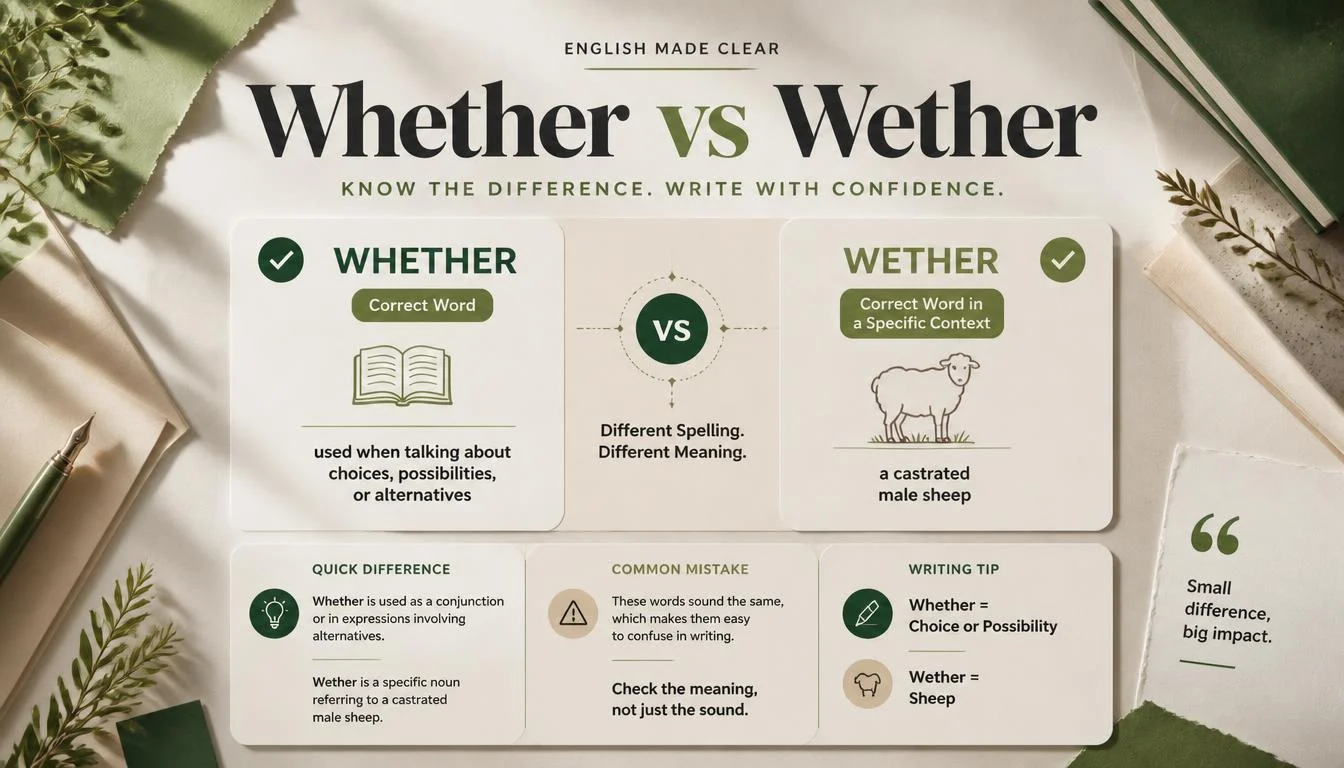
The main difference is that whether is a conjunction used to introduce choices or alternatives, while wether is a noun referring to a castrated male sheep or goat. Use whether when deciding between options (I don’t know whether to go) and wether only if you’re discussing farm animals. The vast majority of the time, the word you need is whether .
Confused about Whether or Wether? You’re not alone. These words look and sound similar, but they have completely different meanings and uses in English.
Understanding Whether or Wether can help you avoid common spelling mistakes in emails, essays, and everyday writing. This guide explains the difference in simple terms with clear examples.
What’s the Difference Between Whether and Wether?
The core difference between whether and wether is their part of speech and meaning. One is a workhorse of English grammar used every day, while the other is an obscure term from the agricultural world.
The table below summarizes their key distinctions:
| Feature | Whether | Wether |
|---|---|---|
| Part of Speech | Conjunction | Noun |
| Meaning | Introduces a choice or alternative between two or more possibilities | A male sheep or goat that has been castrated |
| Typical Usage | “I need to decide whether to stay or go.” | “The farmer sold the wether at the market.” |
| Common Confusion | Confused with weather, the term for atmospheric conditions. | Almost always confused as a misspelling of whether or weather. |
The most important takeaway is that whether is about decision-making and alternatives. It’s a common word you will use all the time. Wether, on the other hand, is a specialist term. Unless you’re writing about animal husbandry, it’s almost certainly the wrong choice.
Is This a Grammar, Vocabulary, or Usage Issue?
This is primarily a vocabulary and usage issue with serious grammar consequences. The confusion stems from homophones—words that sound the same but have different meanings and spellings. While it’s often described as a grammar problem, the root of the mistake is a vocabulary mix-up.
- Grammar Classification: Grammatically, whether is a subordinating conjunction used to connect clauses .
- The Problem: The problem arises when a writer intends to use the conjunction whether to introduce a choice but accidentally uses the noun wether because they sound identical. This is a spelling error rooted in a vocabulary misunderstanding.
Are they interchangeable? Absolutely not. These words are not interchangeable and serve entirely different functions in a sentence. Using wether when you mean whether is always a serious error that will confuse your reader and damage your credibility.
Whether: Meaning, Usage, and Examples
The word whether is your go-to word for presenting options or expressing doubt. It often appears alongside the word “or” but can also be used when the “or” is implied.
- Pronunciation: In US English, “whether” is pronounced /ˈwɛð.ɚ/ .
- Part of Speech: Subordinating conjunction .
- Meaning: Expressing a doubt or choice between alternatives .
- Common Collocations: “whether or not,” “whether to,” “decide whether,” “know whether.”
Sentence Patterns
- Alternatives with “or”: “I don’t know whether I should buy the red dress or the blue one.”
- Single Alternative with “whether or not”: “The event will happen, whether we are ready or not” .
- Before an infinitive: “She is unsure whether to accept the job offer” .
- In indirect questions: “He asked whether she had arrived” .
Real-World Examples
- Workplace: “We need to decide whether to invest in new software this quarter.”
- Academic: “The study examined whether students who study in groups perform better.”
- Technology: “The program will check whether a new update is available.”
- Email: “Could you please confirm whether you can attend the meeting on Friday?”
- Daily Conversation: “I’m still thinking about whether to get coffee or tea.”
One Learner Mistake
❌ Incorrect: “I’m not sure weather I can go.”
✅ Correct: “I’m not sure whether I can go.” (We are introducing an alternative: going or not going.)
Mini Recap: Use whether to introduce a choice. If you’re asking yourself “which one?” or “if or not?”, you need whether .
Wether: Meaning, Usage, and Examples
The word wether is a specific term that you will rarely need to use. It refers specifically to a male sheep or goat that was castrated before reaching sexual maturity .
- Pronunciation: In US English, “wether” is pronounced /ˈwɛð.ɚ/, the same as “weather” and “whether.”
- Part of Speech: Noun .
- Meaning: A castrated male sheep or goat .
- Common Collocations: “bellwether,” “flock,” “shepherd,” “ram,” “goat.”
Sentence Patterns
- Subject of a sentence: “The wether was the leader of the flock.”
- Object of a sentence: “The shepherd bought a new wether from the market” .
Real-World Examples
- Agriculture: “The farmer separated the wethers from the rams to keep them from fighting.”
- Farming Report: “The price of wethers has increased this season.”
One Learner Mistake
❌ Incorrect: “The teacher asked wether we had finished our homework.”
✅ Correct: “The teacher asked whether we had finished our homework.” (The teacher is not asking about a sheep.)
A Note on the Word “Bellwether”
You are much more likely to see the word wether inside the term bellwether. A bellwether is the lead sheep of a flock, which historically wore a bell around its neck to help shepherds find the herd. Today, the term is used metaphorically to describe something that is a leading indicator or a trendsetter, such as a “bellwether state” in politics or a “bellwether stock” in the financial world . Just remember that even in this common word, it’s spelled with an ‘e’ and refers to its sheep origins.
Mini Recap: Unless you are working in agriculture or discussing the animal origins of the word “bellwether,” you can safely avoid using the word wether.
When Not to Use Each Word
The most common mistake is using wether or weather when you mean the conjunction whether. Here are the key situations to watch out for.
- When you are presenting a choice: Avoid wether.
- ❌ We must decide wether to go or stay.
- ✅ We must decide whether to go or stay.
- When you are indicating an indirect question: Avoid wether.
- ❌ I asked wether the package arrived.
- ✅ I asked whether the package arrived.
- When you are unsure about something: Avoid wether.
- ❌ I’m not sure wether this is correct.
- ✅ I’m not sure whether this is correct.
- When you are discussing the weather: Avoid whether or wether.
- ❌ The whether is beautiful today.
- ✅ The weather is beautiful today.
- When you are describing “withstanding” something: Avoid whether or wether.
- ❌ The ship had to wether the storm.
- ✅ The ship had to weather the storm.
- When you are talking about a farm animal: Only use wether.
- ✅ The wether was chosen for the exhibition.
Common Mistakes Table
Decision Box
If you are discussing animal husbandry, the word is WETHER. A wether is a male sheep or goat .
If you are introducing a choice or a question, the word is WHETHER. Think “whether or not” .
Readers will understand the difference immediately if you apply this simple test: can you replace the word with “if”? If yes, use whether. Are you talking about the sky, rain, or the outdoors? Use weather. Are you talking about a sheep? Use wether.
Modern Technology
The importance of using these words correctly has become more pronounced in the age of modern technology, particularly with Artificial Intelligence. AI-powered tools like virtual assistants, chatbots, and grammar checkers rely on natural language processing. If you accidentally type “wether” when you mean “whether,” many of these systems might not recognize the error as a simple typo if the rest of the sentence is correct.
While advanced tools are getting better at understanding context, using the correct word ensures your message is clear to both human readers and AI systems. Moreover, when searching for information, using the correct spelling—like “whether AI is helpful”—will provide significantly better and more accurate search results than misspelling the word. It is a fundamental part of clear, professional digital communication.
Expert Insight
As an English language instructor, I’ve seen hundreds of students trip over this exact word trio. The key to mastering them isn’t to memorize dictionary definitions but to understand their purpose. Imagine your sentence as a pathway. If you’re at a fork in the road, you need the word whether to ponder your options. If you’re standing in a field, you might see a wether walking with its flock. The rest of your sentence always provides the clue. Are you deciding? Or are you describing? Let the context be your guide, and you’ll never confuse them again.
Error Prevention Checklist
- Always use WETHER when: You are writing about a castrated male sheep or goat.
- Always use WHETHER when: You are introducing a choice, an alternative, or a doubt; or when you can substitute the word “if” .
- Never confuse them if: You remember that a wether is an animal, and whether is a word about a question or a choice.
- Quick memory tip: Think “WH” for What’s tHe choice? (Whether has an “h”). Think “EA” for ExtrA animal? (The spellings are not perfect, but the key is to associate whether with a question and wether with a creature).
Related Grammar Confusions
- Affect vs. Effect: Another common pair of words that are frequently confused due to their similar sounds and meanings.
- Who vs. Whom: A classic grammar dilemma about the subject and object of a sentence.
- There, Their, and They’re: Another trio of homophones that cause regular confusion.
- Your vs. You’re: The classic contraction vs. possessive pronoun mix-up.
- Its vs. It’s: A common spelling error where the apostrophe is misused.
- To vs. Too vs. Two: Three very different words that sound the same.
- Then vs. Than: Often confused in conditional and comparative sentences.
- Lose vs. Loose: A spelling mistake that can change the meaning of a sentence.
FAQs
Is it “whether” or “wether” in a sentence?
In almost every sentence, the word you are looking for is whether. This conjunction introduces a choice or alternative. Only use wether if you are specifically writing about a castrated male sheep or goat, which is a very rare context outside of agriculture .
When to use weather vs whether?
Use weather when discussing atmospheric conditions like rain, sun, or temperature. Use whether when you are expressing a choice or doubt, especially when the word “or” is present or implied. A quick test: replace the word with “if” or “the climate.” If “if” fits, use whether; if “the climate” fits, use weather .
Does “whether” mean “if”?
Yes, “whether” can often mean “if,” especially in indirect questions. For example, “I don’t know whether he is coming” can also be written as “I don’t know if he is coming.” However, “whether” is preferred when a direct choice between alternatives is stated, as in “I don’t know whether to go or stay” .
Is it “whether or not” or “wether or not”?
The correct phrase is whether or not. This common expression means “regardless of whether.” It is used to indicate that something will happen in either case. For instance, “We will go to the park, whether or not it rains.” The word “wether” is never used in this context .
What is an example of a “wether” in a sentence?
A “wether” is a castrated male sheep or goat. An example sentence would be: “The shepherd selected a healthy wether from the flock to sell at the market.” This usage is limited to farming and agricultural contexts .
Conclusion
Mastering the difference between whether and wether is a sign of a careful and effective writer. While they sound the same, their meanings and functions are worlds apart. The word whether is essential for conveying choice and uncertainty, and you’ll use it constantly. Wether, meanwhile, is a near-forgotten noun from the farming world. The risk of using the wrong word might not be high, but the impact on your professional image can be significant.
To remember the difference, keep this simple rule in mind: Whether has an “h” for “Has a choice,” while wether has no “h” and is just an animal. By following the guidance in this article, you can communicate with confidence, knowing your readers will understand exactly what you mean.
Read More Related Articles:
- Usage vs Useage | Stop Making This Spelling Mistake in Your Writing In 2026
- Losing vs Loosing | How One Extra “O” Changes the Entire Meaning In 2026
- Successfully or Succesfully | Easy Trick to Remember the Correct Spelling Forever In 2026

Caleb Dawson is a content writer at synoseek.com, where he works on simple, reader-focused articles across a range of everyday topics. His writing style is practical and grounded, aiming to present information in a clear and relatable way without unnecessary complexity.