Quick Answer
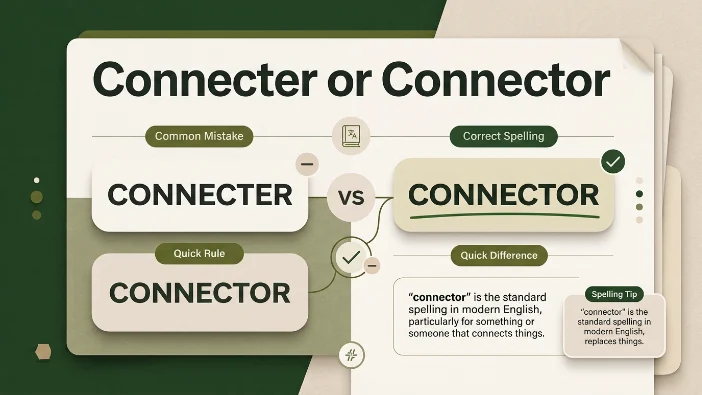
Connector is the correct and standard spelling in modern English. “Connecter” appears in some older dictionaries and technical contexts, but it’s considered a rare variant today. If you’re writing anything for work, school, or the web, connector is the safe, widely accepted choice every time.
You’re typing an email, describing a cable, or labeling a diagram, and suddenly your fingers freeze. Is it a “connecter” or a “connector”? Spell check hasn’t flagged either one, and now you’re second-guessing a word you’ve probably typed a hundred times without thinking twice. That hesitation is more common than you’d expect, and it happens because English lets us build nouns from verbs using two different endings: “-er” and “-or.” Both endings mean roughly the same thing someone or something that performs an action which is exactly why the confusion sticks around.
The word comes from the verb “connect,” meaning to join two things together. Add “-or” and you get connector, a noun describing a person, part, or device that connects. Add “-er” instead and you get connecter, which technically follows the same logic but never became the accepted standard. This isn’t just a spelling quirk. Getting it wrong in a technical manual, a resume, or a product listing can make writing look careless, and in industries like electronics or plumbing, an inconsistent term can even cause confusion about which part you actually need.
By the end of this guide, you’ll know exactly which spelling to use, why English ended up with two competing forms in the first place, and how to avoid similar mix-ups with other “-er” versus “-or” words down the road.
Connector vs Connecter: What’s the Difference?
The short answer is that connector is standard English, while connecter is a rarely used variant that shows up mostly in older texts or informal writing. Both words point to the same idea something that links or joins two parts but only one of them has been adopted by dictionaries, style guides, and professional writing as the correct form.
The difference isn’t about meaning. It’s about which spelling has become the accepted norm. English has a long history of forming agent nouns (words describing “the thing that does something”) using either “-er” or “-or.” Usually, one version wins out over time and becomes the default, while the other fades into obscurity or survives only in niche contexts. That’s exactly what happened here. Connector became the everyday spelling used in engineering, technology, grammar references, and general writing, while connecter mostly disappeared from common use.
Both words function as nouns. Both describe something with a connecting purpose, whether that’s a physical part like a cable end, a person who introduces two people, or an abstract idea that links two concepts together. The primary purpose of the word doesn’t change based on spelling. What changes is how a reader perceives your writing. Using connector signals that you know the accepted convention. Using connecter, in most contexts, reads as a typo.
| Feature | Connector | Connecter |
|---|---|---|
| Meaning | Something or someone that connects two things | Same meaning, rarely used variant |
| Part of Speech | Noun | Noun |
| Refers To | Cables, plugs, people, ideas, systems | Same, but far less common usage |
| Typical Usage | Standard in tech, grammar, and everyday writing | Occasionally found in older or niche texts |
| Example | “Check the USB connector before plugging it in.” | “He acted as a connecter between the two teams.” (nonstandard) |
| Common Confusion | Assumed to have two equally valid spellings | Mistaken as an accepted alternative to connector |
To recap: connector wins in nearly every situation you’ll encounter, from technical documentation to casual conversation. Connecter isn’t grammatically “wrong” in the sense of breaking a hard rule, but it’s not the word dictionaries recognize as standard, and most editors would flag it. If you remember nothing else from this section, remember this when in doubt, the “-or” spelling is your safest bet.
Is Connector a Grammar, Vocabulary, or Usage Issue?
This is primarily a usage and vocabulary issue, not a strict grammar rule. Grammar governs sentence structure how words fit together to form correct phrases and clauses. Spelling variants like connector and connecter don’t break any grammar rule when used in a sentence; both would occupy the same position and function the same way structurally. The real issue is which spelling has been standardized by dictionaries and style authorities.
Vocabulary-wise, this falls into a small group of English words where two suffix options technically exist, but usage has settled almost entirely on one. Words like “advisor/adviser” or “professor” (never “professer”) follow similar patterns, where convention rather than strict rule decides the winner.
The two spellings are not truly interchangeable in professional or academic writing. In formal English, business writing, technical documentation, and academic papers, connector is the only version you should use. Style guides such as Merriam-Webster and Oxford Dictionary list connector as the primary entry, while connecter is either absent or listed as a minor variant. In everyday conversation or casual texting, nobody will misunderstand you if you type connecter, but it still reads as an error to anyone paying attention.
The practical takeaway here is simple: treat this as a spelling convention to memorize, not a flexible grammar choice. There’s no context formal or informal where connecter is actually preferred over connector.
Connector: Meaning, Usage, and Examples
Connector means a person, object, or system that joins two or more things together, whether that connection is physical, electrical, or conceptual. It comes from “connect” plus the suffix “-or,” which forms nouns describing the doer of an action, similar to “actor,” “inventor,” or “director.”
As a noun, connector is pronounced kuh-NEK-tur, with stress on the second syllable. It shows up constantly in technical and everyday English, often paired with words like “cable connector,” “USB connector,” “power connector,” “network connector,” or “connector piece.” In grammar and linguistics, you’ll also hear “logical connector” or “sentence connector,” referring to words like “however,” “therefore,” or “meanwhile” that link ideas within writing.
Here’s how connector shows up across different real-world contexts:
Workplace example: “The IT technician replaced the faulty connector on the server rack before the meeting started.”
Academic example: “In her essay, the professor asked students to use stronger connectors between paragraphs instead of starting every sentence with ‘also.'”
Technology example: “Make sure you’re using the correct connector type USB-C and micro-USB are not interchangeable.”
Email example: “Attached is the updated diagram showing where the new connector should be installed on the panel.”
Daily conversation example: “Can you grab the connector for the phone charger? I think it’s in the kitchen drawer.”
One common mistake learners make is assuming connector only refers to physical hardware, like cables or plugs. In reality, the word applies just as often to abstract or interpersonal connections a “connector” can be a person who links two networks of people, or a transitional word that links two sentences. Limiting the word to tech contexts alone will make your writing sound narrower than it needs to be.
Mini recap: Connector is the standard spelling for anything or anyone that joins two parts, ideas, or systems, and it applies across technical, academic, and everyday English without exception.
Connecter: Meaning, Usage, and Examples
Connecter carries the exact same intended meaning as connector something that joins two things but it’s the nonstandard spelling that dictionaries either omit or list as a rare variant. It follows the “-er” agent noun pattern instead of “-or,” similar to how “worker” or “teacher” are formed.
Pronunciation is identical to connector: kuh-NEK-tur. The spelling difference doesn’t change how the word sounds, which is part of why the mix-up happens so often. People hear the word spoken and default to whichever spelling feels more familiar when writing it down.
You’ll occasionally spot connecter in older engineering manuals, some patents, and informal writing where the author simply defaulted to the “-er” pattern without checking. It’s not entirely extinct, but it’s inconsistent and unreliable across sources, which is exactly why professional writing avoids it.
Here’s what it looks like when people mistakenly use connecter in the same contexts:
Workplace example (incorrect): “The technician replaced the faulty connecter on the panel.” Should be “connector.”
Academic example (incorrect): “Students should use transition connecters between ideas.” Should be “connectors.”
Technology example (incorrect): “This charger uses a USB-C connecter.” Should be “connector.”
Email example (incorrect): “Please order a new connecter for the printer cable.” Should be “connector.”
Daily conversation example (incorrect): “Do you have a connecter for this outlet?” Should be “connector.”
The single most common mistake with this word isn’t intentional it’s autocorrect skipping over it, or a writer assuming both spellings are equally valid because they sound identical when spoken aloud. Since spell-check tools sometimes fail to flag connecter as an error (depending on the dictionary they reference), the mistake can slip through unnoticed for years in someone’s writing.
Mini recap: Connecter is a rarely used, nonstandard variant of connector. It’s not officially wrong in every dictionary, but it’s inconsistent, uncommon, and best avoided in any writing you want to look polished.
When Not to Use Each Word
Never use connecter in professional documents. Resumes, business proposals, and formal reports should always use connector. A hiring manager or client noticing “connecter” may assume it’s a typo, which creates an unnecessary distraction from your actual content.
Avoid connecter in technical manuals or product descriptions. If you’re writing instructions for assembling furniture, wiring electronics, or describing a product on an e-commerce site, connector is the term customers expect to see. Using connecter can make a listing look unprofessional or even untrustworthy.
Don’t use connecter in academic writing. Essays, research papers, and grammar assignments should stick to connector, especially since instructors are likely to mark connecter as a spelling error.
Skip connecter when writing for SEO or web content. Search engines and readers alike expect connector. Using the nonstandard spelling can hurt both readability and how your content matches common search queries.
Avoid connecter in legal or contractual language. Precision matters in these documents, and consistency with standard dictionary spelling protects clarity and professionalism.
Don’t rely on autocorrect to catch this one. Some spell-checkers don’t flag connecter as incorrect because it does technically exist in a handful of older dictionaries. Manually double-check this word rather than assuming your software will catch it.
Never mix both spellings within the same document. Even if you occasionally see connecter used elsewhere, pick connector and use it consistently throughout your writing. Switching between the two mid-document looks like carelessness rather than stylistic choice.
Avoid connecter when quoting technical specifications. Manufacturer datasheets, wiring diagrams, and industry standards almost universally use connector, so matching that language avoids confusion when cross-referencing sources.
The pattern across all of these situations is the same: connecter creates doubt, while connector creates clarity. When you’re not sure which one to use, defaulting to connector will be correct in essentially every scenario you’re likely to face.
Common Mistakes Table
| Correct Sentence | Incorrect Sentence | Explanation |
|---|---|---|
| “I need a new HDMI connector for my TV.” | “I need a new HDMI connecter for my TV.” | Connector is the standard spelling for cable and hardware parts. |
| “She acted as the connector between the marketing and sales teams.” | “She acted as the connecter between the marketing and sales teams.” | Connector also applies to people who link groups or ideas, not just objects. |
| “Use a connector word like ‘therefore’ to link your ideas.” | “Use a connecter word like ‘therefore’ to link your ideas.” | In grammar contexts, connector is the accepted term for linking words. |
| “The plumber tightened the pipe connector under the sink.” | “The plumber tightened the pipe connecter under the sink.” | Trade and technical writing consistently favors connector. |
| “This adapter includes a universal connector.” | “This adapter includes a universal connecter.” | Product descriptions should always use the standard spelling. |
Quick Decision Box
If you’re describing something or someone that joins two things together, use connector every time, in every context.
If you’re tempted to write “connecter” because it “looks right” or matches how you’ve seen it written somewhere before, double-check your source. It’s very likely outdated or simply incorrect.
There’s no scenario in modern English where connecter is the preferred or recommended spelling over connector.
Connector and Connecter in Real-World Situations
Office communication: A facilities manager emailing IT about a broken cable will write, “The monitor connector seems loose can someone take a look?” Using connector here keeps the message clear and professional.
Business email: A vendor confirming a shipment might write, “Your order includes three USB-C connectors and one adapter cable,” reinforcing that connector is the expected term in commercial correspondence.
School or university: A writing instructor grading essays will often note, “Use stronger connectors between paragraphs,” referring to transitional phrases that guide readers through an argument.
Customer support: A support agent troubleshooting a printer issue might ask, “Is the power connector fully inserted into the outlet?” Precise terminology here helps resolve the issue faster.
Technology: A product spec sheet for headphones will list “connector type: USB-C” as a standard field, never “connecter type.”
Artificial Intelligence: Developers building voice assistants often describe “connector modules” that link an AI system to third-party apps, allowing commands to trigger actions across platforms.
Daily conversation: A friend helping you set up a new speaker might casually say, “That connector doesn’t match this port you’ll need a different one.”
Across every one of these situations, connector remains the term people actually use and expect to see. Consistency here isn’t just about correctness; it’s about making sure your message lands without unnecessary friction.
Connector in Modern Technology
The word connector plays a bigger role in modern technology than most people realize. Beyond physical cables and plugs, it’s become a core term in software and AI development.
In artificial intelligence, “connectors” often refer to integrations that link an AI model to external tools, databases, or apps allowing a chatbot, for instance, to pull data from a calendar or a project management platform. When people talk about connecting an AI assistant to third-party services, they’re usually referring to these software connectors.
Virtual assistants and voice assistants rely on connectors to bridge user commands with real-world actions, like adjusting smart home devices or scheduling appointments. Without a properly functioning connector, the assistant simply can’t communicate with the external system it needs to control.
Chatbots built for customer service often use connectors to link conversations with CRM systems, ticketing platforms, or order databases, allowing them to pull relevant customer information in real time.
In software development more broadly, a “connector” can refer to an API integration, a plugin, or a piece of middleware that allows two separate programs to exchange data smoothly.
Business tools like project management platforms or spreadsheet software frequently advertise “connectors” as a selling point, emphasizing how easily their product integrates with other tools a company already uses.
None of these technology-specific meanings change the spelling. Whether you’re talking about a physical USB connector or a software integration connector, the word stays the same: connector, never connecter.
Word Origin
Connector traces back to the Latin verb “connectere,” meaning “to bind together,” formed from “com-” (together) and “nectere” (to bind or tie). English absorbed this root through French and Latin influence, eventually forming “connect” as a verb.
The “-or” suffix used to build connector comes from Latin agent-noun endings, commonly used to describe someone or something performing an action the same pattern behind words like “inventor,” “director,” and “actor.” Over time, English speakers largely settled on “-or” for words with Latin roots like this one, while “-er” became more common for native English or Germanic-rooted verbs, like “worker” or “teacher.” Connecter likely emerged as a natural but ultimately unadopted variation, following the more common English pattern instead of the Latin-influenced one.
Expert Insight
As a language instructor, I always tell students that word endings like “-er” and “-or” rarely follow a single, memorizable rule English borrowed these patterns from different languages at different points in history, and the result is a set of exceptions rather than a clean system. The most reliable approach isn’t trying to guess based on logic; it’s checking which spelling has actually become standard through consistent dictionary and professional usage. Connector has won that battle decisively, so when students ask me which one to use, my answer is always the same: use connector, and don’t overthink the exception you might have seen somewhere once.
Error Prevention Checklist
- Always use connector when writing about cables, plugs, adapters, or hardware parts.
- Always use connector when referring to people or ideas that link two things together.
- Never confuse them if you remember that dictionaries list connector as standard and connecter as rare or absent.
- Quick memory tip: Think of “-or” words borrowed from Latin, like “inventor” and “director” connector follows that same family.
Related Grammar Confusions
Adviser vs Advisor Another “-er” versus “-or” pair where both spellings are technically accepted, but usage varies by region and context.
Practice vs Practise A spelling distinction that shifts depending on whether you’re using American or British English.
Affect vs Effect One of the most common confusion pairs in English, involving both meaning and part of speech.
Compliment vs Complement Two words that sound identical but carry completely different meanings.
Principal vs Principle A classic homophone mix-up that trips up even experienced writers.
Council vs Counsel Words that sound alike but refer to very different concepts, from governing bodies to advice.
Stationary vs Stationery A spelling distinction worth mastering for anyone writing business correspondence.
Its vs It’s A small but critical difference that affects grammatical correctness in nearly every type of writing.
Fewer vs Less A usage rule tied to countable versus uncountable nouns that many writers get backward.
Farther vs Further A distinction between physical distance and figurative or metaphorical distance.
FAQs
Is “connecter” ever correct to use?
“Connecter” does appear in some older or specialized dictionaries, so it is not completely unknown in English. However, it is uncommon in modern usage. “Connector” is the standard and widely preferred spelling in professional, academic, technical, and everyday writing.
Why do spell-checkers sometimes miss “connecter” as an error?
Some spell-checking tools use extensive dictionaries that include uncommon, historical, or specialized words. As a result, “connecter” may not always be flagged, even though “connector” is the preferred modern spelling.
Is “connector” spelled differently in British and American English?
No. “Connector” is the standard spelling in both British and American English. Unlike words such as colour and color, there is no major regional spelling difference for this word.
Can “connector” refer to a person?
Yes. “Connector” can describe a person who brings people, groups, ideas, or organizations together. For example, someone who regularly introduces business contacts or connects different teams may be described as a connector.
What is the difference between a connector and an adapter?
A connector generally joins two compatible parts, while an adapter modifies or converts a connection so that different or incompatible parts can work together. In technology, the distinction often depends on what the device is designed to do.
Is “connector” used in both grammar and technology?
Yes. The basic idea is the same: something that connects or links elements together. In grammar, a connector can link words, phrases, or ideas, while in technology, a connector joins physical or electronic components.
Conclusion
The difference between connector and connecter ultimately comes down to standard usage versus a rarely accepted variant. Connector is the spelling recognized by dictionaries, style guides, and virtually every professional context you’ll encounter, while connecter lingers only in scattered older texts and occasional typos.
If you take one rule away from this guide, let it be this: when a word can join two things together whether that’s a cable, a person, or an idea spell it connector. It’s the version readers expect, the version search engines recognize, and the version that will never make your writing look like a mistake.