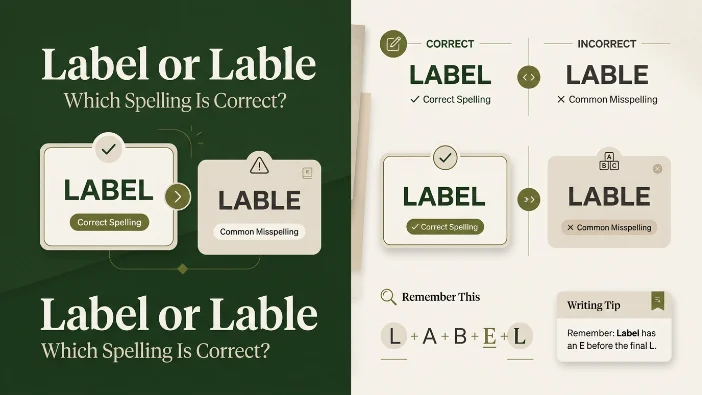
Quick Answer:
Label is the only correct spelling in English. Lable is a common misspelling that results from mixing up the vowel order or from mishearing the word’s pronunciation. Whether you’re writing a product tag, a diagram note, or a shipping form, always write label, never lable.
Is it Label or Lable? These two spellings may look similar, but only one is correct in standard English. The confusion often happens because the word is used frequently as both a noun and a verb.
In this guide to Label or Lable, you’ll learn the correct spelling, its meaning, proper usage, and examples. We’ll also share a simple spelling tip to help you remember the right form every time.
Why This Simple Word Trips Up So Many Writers
If you’ve ever paused halfway through typing “label” and wondered whether the “a” and “e” belong in that order, you’re not alone. This is one of those words that looks deceptively simple until you’re actually writing it under pressure filling out a form, labeling a spreadsheet column, or writing product packaging copy and suddenly the spelling feels unfamiliar.
The confusion between label and lable usually comes down to sound. English vowels don’t always match their spelling in predictable ways, and when people sound out this word quickly, the “a” and “e” can seem interchangeable. Add in the fact that autocorrect doesn’t always catch it in casual typing, and you get a spelling mistake that spreads through emails, social captions, and even some published content.
This guide clears up the confusion for good. You’ll learn exactly why label is correct, why lable is never acceptable in standard English, how the word is pronounced, where it came from, and how to make sure you never second-guess yourself again even when you’re typing fast.
Label or Lable: What’s the Real Difference?
There isn’t actually a difference in meaning, because only one of these is a real English word. Label is a standard noun and verb used constantly in everyday language, business writing, and technical fields. Lable carries no meaning at all it’s simply a misspelling that doesn’t appear in any dictionary.
That distinction matters more than it might seem. Some word pairs genuinely have two valid spellings (think “color” versus “colour” in American versus British English), but this isn’t one of those cases. There’s no regional variant, no historical alternate spelling, and no accepted use for “lable” anywhere in formal or informal writing.
| Feature | Label | Lable |
|---|---|---|
| Meaning | A tag, name, or descriptive marker attached to something | No meaning; not a recognized word |
| Part of Speech | Noun and verb | None |
| Dictionary Status | Listed in Merriam-Webster, Oxford, and Cambridge dictionaries | Not found in any standard dictionary |
| Typical Usage | Product tags, categories, forms, coding, shipping | Never correct in any context |
| Common Confusion | Mixed up due to pronunciation or fast typing | Often typed by accident or through unfamiliarity with the correct spelling |
To put it simply: if you’re choosing between these two spellings, you’re not really choosing between two words you’re choosing between the correct word and a typo.
Is This a Spelling Issue, a Grammar Issue, or Both?
This is purely a spelling issue, not a grammar problem. Grammar concerns how words function in a sentence verb tense, subject-verb agreement, word order. Spelling concerns how a word is written. Since “lable” isn’t a recognized word at all, it doesn’t have grammar rules of its own; it simply needs to be corrected to “label” wherever it appears.
That said, once you’re using the correct spelling, “label” does follow specific grammar patterns worth knowing. As a noun, it refers to a tag or descriptive marker: “The label fell off the jar.” As a verb, it means to attach a tag or to categorize something: “Please label each folder by department.
When “label” functions as a verb, its forms change depending on tense: labeled (or labelled in British English), labeling (or labelling), and labels. American English typically uses a single “l” before adding “-ed” or “-ing,” while British and Canadian English often double the “l.” Neither of these variations has anything to do with “lable” they’re simply regional differences in how the correct word is conjugated.
In formal writing, academic papers, business communication, and technical documentation, “label” is the only acceptable spelling. There’s no context casual texting included where “lable” becomes correct. The practical takeaway is simple: memorize “label” once, and you’ll never need to think about this again.
Understanding “Label”: Meaning, Use, and Pronunciation
Label is pronounced “LAY-buhl,” with the stress on the first syllable. The “a” carries a long vowel sound, similar to the “a” in “table” or “cable.” This pronunciation pattern is actually the easiest way to remember the spelling if you can spell “table” correctly, you already know the vowel order for “label.
As a noun, a label is any tag, sticker, or marker that identifies, describes, or categorizes something. As a verb, to label something means to attach that kind of identifying information, or more broadly, to classify or describe someone or something in a particular way.
Common collocations include: warning label, price label, mailing label, food label, record label, label maker, and label something as (used when categorizing ideas, people, or behavior).
Typical sentence patterns follow a straightforward subject-verb-object structure: “She labeled the boxes before the move.” “The nutrition label lists all the ingredients.” “Don’t label people based on first impressions.”
Here’s how the word shows up across different real-world settings:
Workplace example: “Can you label these files by project name before you send them to the client?”
Academic example: “Students were asked to label each part of the diagram using the correct scientific terms.”
Technology example: “The app automatically labels each photo based on the location where it was taken.”
Email example: “I’ve labeled the attached spreadsheet with today’s date so we can track version history.”
Daily conversation example: “I always label my leftovers in the fridge so I don’t forget what’s inside.”
A common learner mistake is dropping the second “l” when conjugating the verb in American English, writing “labelling” instead of “labeling,” or vice versa in British English. This isn’t the same mistake as writing “lable,” but it’s a related spelling stumble worth knowing about.
Mini recap: Label is a noun and verb referring to identifying tags or the act of tagging something. It’s pronounced “LAY-buhl,” and its spelling never changes to “lable,” regardless of context.
Why “Lable” Isn’t a Word And Why People Still Type It
Lable doesn’t appear in any major dictionary because it has never been an accepted spelling in the English language. It’s not an old form of the word, a regional variation, or a stylistic choice. It’s a straightforward transposition error swapping the position of the “a” and the “e.”
So why does it happen so often? A few patterns explain most cases.
First, fast typing is a major culprit. When people type quickly, especially on phone keyboards, the fingers sometimes hit letters slightly out of order, and “label” becomes “lable” without the writer noticing.
Second, phonetic guessing plays a role. Some non-native English speakers, or younger writers still building spelling skills, try to sound out the word and land on a plausible-looking but incorrect arrangement of letters.
Third, visual similarity to other words can create confusion. Words like “table,” “cable,” and “fable” all follow a consistent “-able” pattern, and a writer who’s momentarily unsure might accidentally reorder the vowels while trying to match that familiar pattern.
None of these explanations make “lable” correct they just explain why the mistake is so common. Recognizing your own pattern (rushed typing versus genuine uncertainty about spelling) is the fastest way to stop making it.
When Writers Commonly Get This Wrong
Here are the situations where “lable” tends to slip through, along with how to catch it before it does.
1. Typing quickly in emails or chat messages. Speed is the enemy of accuracy here. Slowing down for just this one word, especially in professional emails, prevents an easy mistake from looking unprofessional.
2. Writing product descriptions or packaging copy. Because this word appears constantly in retail and e-commerce writing, a single typo can end up printed, published, or repeated across dozens of product listings before anyone notices.
3. Filling out digital forms without spell-check. Many form fields, especially in older software or government portals, don’t run spell-check automatically, so an incorrect spelling can go live without any red squiggly line to flag it.
4. Writing under time pressure, like during exams or timed assignments. Students rushing to finish an answer sometimes revert to a phonetic guess instead of the spelling they actually know.
5. Translating from another language. Writers translating from languages where vowel order works differently sometimes carry that instinct into English spelling, leading to unintentional letter swaps.
6. Relying on autocorrect that doesn’t catch the error. Not every spellchecker flags “lable” as wrong, especially in apps with limited dictionaries, which means the mistake can survive multiple rounds of editing.
7. Copying text from handwritten notes. When transcribing quick handwritten notes into a digital document, small transposition errors like this one are easy to introduce without noticing.
8. Second-guessing a word you actually know. Sometimes writers know the correct spelling but pause, doubt themselves, and second-guess into the wrong version a classic case of overthinking a simple word.
The fix in every case is the same: pause on this specific word, mentally connect it to “table” or “cable,” and trust the “a-then-e” order.
Common Mistakes Table
| Correct Sentence | Incorrect Sentence | Explanation |
|---|---|---|
| Please label the boxes before shipping. | Please lable the boxes before shipping. | “Lable” is a transposition error; the correct spelling is “label.” |
| The warning label is printed on the back. | The warning lable is printed on the back. | “Lable” doesn’t exist in any dictionary; use “label” instead. |
| I need to relabel this folder. | I need to relable this folder. | The prefix “re-” attaches to “label,” never to “lable.” |
| Her research paper was labeled a groundbreaking study. | Her research paper was lableed a groundbreaking study. | “Lableed” isn’t even a real word form; the correct verb form is “labeled.” |
| The nutrition label lists calories and fat content. | The nutrition lable lists calories and fat content. | Only “label” is recognized in food and packaging terminology. |
Quick Decision Box
If you’re ever unsure which spelling to use, remember this: there is no decision to make. Label is always correct. Lable is never correct, in any sentence, in any context, in any form of English.
If you can spell “table,” you can spell “label” just swap the first letter and keep the same vowel pattern.
Real-World Examples Across Different Situations
Office communication: “Can everyone label their shared files with the project code before Friday’s meeting?”
Business email: “Attached is the updated invoice, labeled with this month’s reference number for easy tracking.”
School or university: “Your assignment asks you to label the diagram of the human heart with the correct anatomical terms.”
Customer support: “If the package arrives without a shipping label, please contact our support team immediately.”
Technology: “The photo app lets you label images with custom tags so you can search for them later.”
Artificial intelligence: “Machine learning models rely on labeled data to learn how to recognize patterns accurately.”
Daily conversation: “I labeled the spice jars so I could finally tell the cumin from the paprika.”
Each of these examples uses the same correct spelling, reinforcing just how frequently this word appears across completely different areas of life.
Label in Modern Technology
In the world of artificial intelligence and software, the word “label” has become especially important. Machine learning depends heavily on labeled data information that has been tagged with the correct answer so an algorithm can learn from it. A dataset of photos, for example, might be labeled “cat” or “dog” so the AI model learns to distinguish between them. Without accurate labeling, machine learning systems simply can’t learn effectively.
Voice assistants and chatbots also use labels internally to categorize user intent, sort conversation topics, and organize responses. When a virtual assistant identifies whether you’re asking for the weather or setting a reminder, it’s essentially applying an internal label to your request before deciding how to respond.
Business software follows the same logic on a smaller scale. Project management tools let users label tasks by priority or department. Email platforms let you label messages instead of sorting them into folders. Even spreadsheet software depends on labeled columns and rows to keep data organized and readable.
In every one of these technical contexts, only the correct spelling “label” appears in official documentation, interface design, and coding conventions. A misspelled variable name like “lable” would actually cause errors in programming, since computers require exact spelling to recognize commands and functions.
Where the Word “Label” Comes From
“Label” entered English from Old French, where “label” or “lambel” referred to a strip or band, often used to describe a decorative ribbon or a narrow strip of cloth or paper. That root traces further back to Germanic origins connected to the idea of a hanging strip or flap.
Over centuries, the meaning shifted from a physical strip of material to the broader modern sense: any tag, marker, or piece of information attached to something for identification. This shift makes sense when you think about it early labels were literally small strips of paper or fabric tied onto goods to identify them, which naturally evolved into the packaging and tagging systems we use today.
Understanding this origin helps explain why the correct spelling has stayed remarkably stable. Since “label” came directly from a French root with a fixed spelling pattern, English never developed an alternate version which is part of why “lable” has always been an error rather than a legitimate historical variant.
Expert Insight
As a language instructor, I always tell students that transposition errors like “label” versus “lable” are some of the easiest mistakes to permanently fix, precisely because they don’t involve confusing grammar rules or tricky exceptions. The word itself never changes meaning or spelling depending on context, so once you commit the correct order to memory often by linking it to a familiar word like “table” the mistake tends to disappear for good. The real skill isn’t memorizing spelling rules; it’s building the habit of pausing for half a second on words you type automatically, especially the ones you’ve mistyped before.
Error Prevention Checklist
- Always use label when referring to a tag, marker, or the act of tagging something there is no alternative spelling.
- Never use lable in any sentence, document, or message; it isn’t a recognized English word.
- If you’re unsure, mentally compare it to “table” or “cable” same vowel pattern, different first letter.
- Quick memory tip: “La-BEL” rhymes with “ta-BLE.” If you know one, you know the other.
Related Grammar Confusions Worth Learning
- Affect or Effect One is usually a verb and the other a noun, and mixing them up is one of the most common grammar errors in English.
- Its or It’s A single apostrophe changes this word from possessive to a contraction, and the mix-up appears constantly in professional writing.
- Their, There, or They’re Three homophones that sound identical but serve completely different grammatical roles.
- Advice or Advise Similar spelling but different parts of speech, much like other noun-verb pairs in English.
- Complement or Compliment Two words that sound nearly the same but carry very different meanings.
- Practice or Practise A spelling distinction that shifts depending on American versus British English.
- Principal or Principle Frequently confused in academic and workplace writing due to their similar spelling.
- Stationary or Stationery One means “not moving,” the other means “paper supplies,” and the spelling difference is easy to forget.
- Lose or Loose A single letter changes the entire meaning, and it’s one of the most searched grammar confusions online.
- Accept or Except Two words that sound alike but function in opposite ways within a sentence.
FAQs
Is “lable” ever correct in British English?
No. Lable is not a recognized spelling in British, American, Canadian, or Australian English. The correct spelling is label in all standard varieties of English.
Why do people confuse label and lable so often?
The confusion usually comes from fast typing, phonetic guessing, or accidentally transposing letters. Because label is such a familiar word, this kind of small spelling mistake can easily go unnoticed during quick writing.
What is the plural form of label?
The plural of label is labels. Simply add -s to the singular form, whether you’re referring to physical tags, product labels, or digital labels.
How do I remember the correct spelling permanently?
A useful trick is to remember the -bel ending in label. You can also connect it visually with words such as table and cable, which may help reinforce the correct letter pattern.
Is “labeled” or “labelled” correct?
Both are correct, depending on the variety of English. Labeled is standard in American English, while labelled is commonly used in British and Canadian English. Neither spelling supports lable, which is always incorrect.
Can spell-check always catch this mistake?
Not necessarily. Most modern spell-checkers will flag lable, but some basic tools, older software, or disabled spell-check settings may not. Manual proofreading is still useful, especially for professional and published writing.
Conclusion
The difference between label and lable ultimately isn’t a difference in meaning at all it’s the difference between a real, widely used English word and a simple spelling slip. Every dictionary, style guide, and professional writing standard confirms that “label” is the only correct form, whether you’re writing a product tag, a technical document, or a casual text message.
Once you connect the spelling to a familiar word like “table,” the mistake becomes easy to avoid permanently. The rule to remember is simple: if you wouldn’t misspell “table,” don’t misspell “label” either they follow the exact same pattern.
Read More Related Articles:
- Potatoes or Potatos | Don’t Let This Simple Spelling Error Hold You Back In 2026
- Challenge or Challange | Learn the Right Spelling Once and for All In 2026
- Forty or Fourty | Right Way to Spell the Number 40 In 2026

Zoe Chambers works as a content writer at synoseek.com, contributing thoughtful pieces on everyday subjects and ideas. She writes in a simple, grounded way, often drawing from real-world experiences. Her focus is on keeping content natural, clear and easy for readers to connect with.
1 thought on “Label or Lable | Simple Answer Every Writer Needs In 2026”