Quick Answer
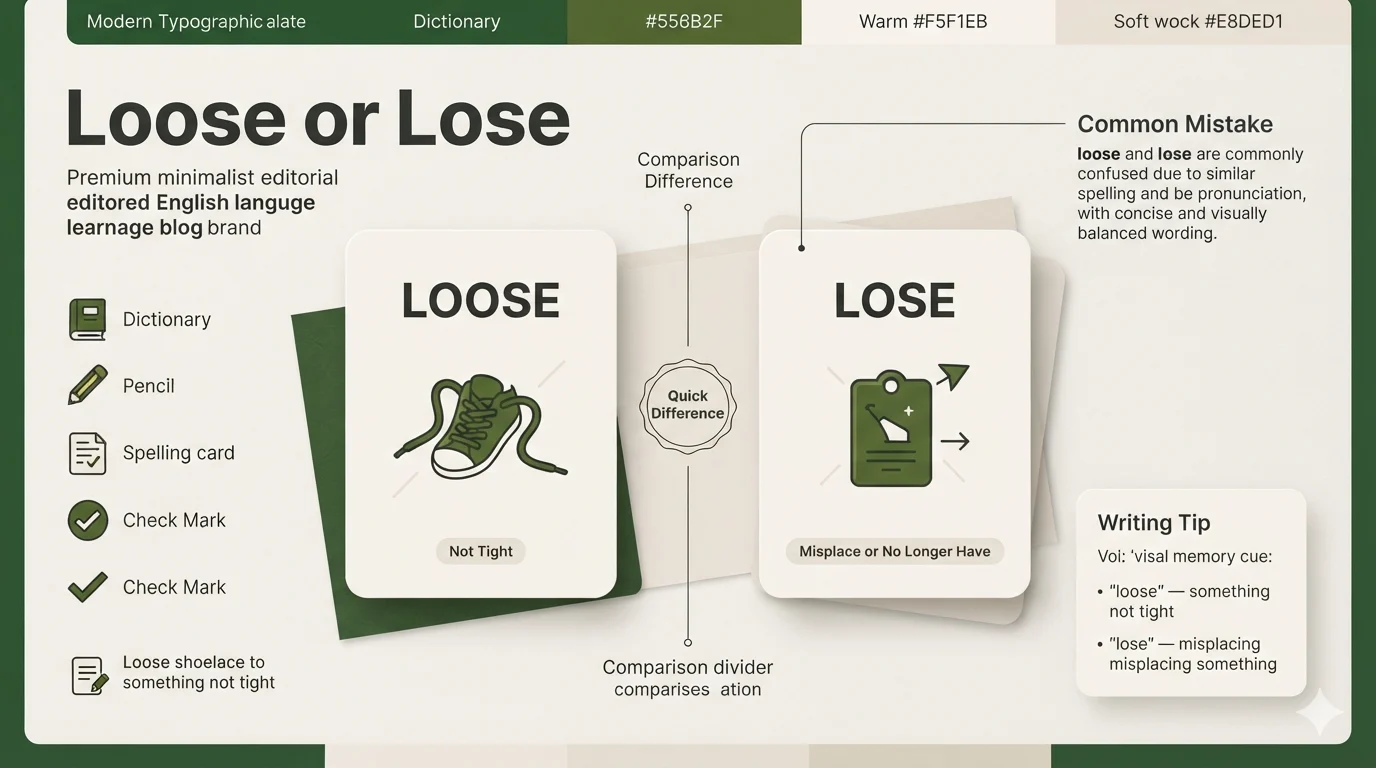
The difference between “loose” and “lose” is simple: “Loose” (rhymes with goose) is an adjective meaning not tight or free, while “lose” (rhymes with shoes) is a verb meaning to misplace, fail to win, or be deprived of something. Remember: “loose” has the extra “o” because it’s “too loose” with space, while “lose” lost an “o” because that’s what happens when you lose something.
Have you ever stared at a sentence, wondering whether to type “loose” or “lose,” only to guess and hope for the best? You’re not alone. This pairing consistently ranks among the most troublesome word pairs in English, tripping up everyone from students to experienced professionals. The confusion makes sense, though these words look nearly identical and sound similar enough that even native speakers frequently swap them in emails, reports, and social media posts.
The good news? Once you understand the core difference between “loose” and “lose,” you’ll never mix them up again. This guide breaks down exactly when to use each word, why people get confused, and how to remember the correct choice every time. Whether you’re writing a business proposal, completing an academic assignment, or simply want to improve your everyday writing, mastering this distinction will instantly elevate your communication.
What’s the Difference Between Loose and Lose?
The fundamental difference between “loose” and “lose” comes down to their parts of speech and core meanings. “Loose” functions primarily as an adjective describing something that isn’t tight, confined, or firmly attached. “Lose” works as a verb describing the action of misplacing something, failing to win, or being deprived of something valuable.
Comparison Table
| Aspect | Loose | Lose |
|---|---|---|
| Meaning | Not tight, free, unattached | To misplace, fail to win, be deprived of |
| Part of Speech | Adjective (primarily), Verb (rarely) | Verb |
| Refers To | Physical states, clothing, animals, rules | Actions, outcomes, possession |
| Typical Usage | “My pants are loose.” | “I might lose my wallet.” |
| Example | The dog broke loose from its leash. | Did you lose your keys again? |
| Common Confusion | Spelling and pronunciation with “lose” | Spelling and pronunciation with “loose” |
A Closer Look at the Difference
The distinction becomes clearer when you consider what each word actually does in a sentence. “Loose” describes a state or condition it tells you something about the quality of a noun. Think of it as an observation rather than an action. When you say someone’s clothing is loose, you’re describing how it fits. When you mention that an animal is loose, you’re reporting its current state of freedom.
“Lose,” on the other hand, describes an action or event. Something happens when you lose you misplace an object, fail to win a competition, or experience a loss of some kind. This action-oriented nature makes “lose” a dynamic verb that drives the narrative of your sentence forward.
The spelling difference actually reflects their different functions. “Loose” contains the extra “o” as if to suggest there’s extra space just like the word itself has extra room. Meanwhile, “lose” has lost its extra “o,” which serves as a helpful mnemonic: when something is lost, it’s missing, just like that missing “o.”
Is This a Grammar, Vocabulary, or Usage Issue?
Grammar Perspective
From a grammatical standpoint, the “loose” versus “lose” confusion represents a lexical error rather than a structural grammar mistake. You’re not breaking any grammar rules by choosing the wrong word, but you are creating a semantic error that changes your sentence’s meaning. This places the issue firmly in the vocabulary and usage category, though it has grammar implications because choosing the wrong part of speech (adjective versus verb) can make your sentence grammatically incomplete or nonsensical.
Vocabulary Distinction
As a vocabulary issue, this pair belongs to the category of commonly confused words. English contains hundreds of these sound-alike or look-alike terms, and mastering them requires memorization combined with practice. Unlike synonyms, which offer choices with similar meanings, “loose” and “lose” have completely different meanings, making their correct usage essential for clear communication.
Usage Across Different Contexts
Formal English: In professional writing, choosing the correct word demonstrates attention to detail and linguistic competence. An executive who writes “We may loose market share” appears careless, while one who writes “We may lose market share” maintains professional credibility.
Business Writing: The stakes are higher in business contexts because your word choice reflects on your professionalism. Contracts, proposals, and client communications all demand precision. Imagine writing “Our company stands to loose valuable contracts” versus “Our company stands to lose valuable contracts.” The error undermines your message’s authority.
Academic Writing: Scholars and students must demonstrate mastery of academic English conventions. In research papers, essays, and theses, mixing up “loose” and “lose” creates unnecessary errors that distract from your arguments and lower your grades.
Everyday Conversation: In casual speech, pronunciation differences help distinguish these words, but in writing, the distinction becomes visual. Social media posts, text messages, and informal emails all benefit from correct usage, as clear writing helps you communicate more effectively with friends, family, and colleagues.
Are They Interchangeable?
No, absolutely not. “Loose” and “lose” are never interchangeable because they serve different grammatical functions and convey different meanings. Using “loose” when you need “lose” creates an adjective where a verb should be, while using “lose” when you need “loose” produces a verb where an adjective is required.
The Practical Takeaway
Think of this as a vocabulary precision issue rather than a grammar rule you need to memorize. Once you understand that “loose” describes a state and “lose” describes an action, you’ve solved the underlying confusion. The rest is simply remembering which spelling matches which meaning.
Loose: Meaning, Usage, and Examples
Meaning and Pronunciation
“Loose” (pronounced /luːs/, rhyming with “goose”) functions primarily as an adjective describing something that isn’t tightly fixed, confined, or attached. It indicates freedom from constraint, lack of tightness, or the absence of a secure connection.
Part of Speech
- Adjective (primary): Describes nouns
- Verb (rare): Means to release or set free (e.g., “The police had to loose the dog from its trap”)
Common Collocations
- Loose clothing (clothes that fit loosely)
- Loose ends (unfinished details or tasks)
- Loose change (coins not in a wallet or purse)
- Loose cannon (an unpredictable person)
- Loose lips (tendency to reveal secrets)
- Loose leash (a slack dog leash)
- Loose fitting (describing comfortable garments)
- Break loose (escape from restraint)
- Cut loose (become free or unconstrained)
- Let loose (release or allow freedom)
Typical Sentence Patterns
When used as an adjective, “loose” typically appears:
- Before a noun: “She wore a loose dress.”
- After a linking verb: “The handle felt loose.”
- With adverbs: “The dog was completely loose in the yard.”
- In comparative forms: “His jeans were looser than mine.”
Examples Across Contexts
Natural Workplace Example
“During the casual Friday policy, employees can wear loose, comfortable clothing, but they still need to maintain a professional appearance for client meetings.”
Academic Example
“After centuries of strict grammatical rules, modern linguists take a looser approach to language evolution, recognizing that popular usage often shapes official standards.”
Technology Example
“Ensure all cable connections remain secure; a loose USB connection can cause data transfer errors and device recognition issues.”
Email Example
“Subject: Quick reminder about tomorrow’s meeting
Hi everyone, please remember to tie up any loose ends on your current projects before the quarterly review meeting at 10 AM. We’ll be presenting our findings to the executive team.”
Daily Conversation Example
“Could you check the screws on this bookshelf? One of them feels loose, and I’m worried about it collapsing with all these heavy books.”
One Learner Mistake
Incorrect: “The manager decided to loose the company’s dress code policy.”
Correct: “The manager decided to loosen the company’s dress code policy.”
This error occurs when learners confuse “loose” (meaning not tight) with “loosen” (the verb meaning to make less tight). Remember: “loose” describes a state, while “loosen” describes an action.
Mini Recap
“Loose” describes something that isn’t tight or constrained. It’s an adjective that observes a quality or state. The double “o” in “loose” can help you remember it like a loose tooth, there’s extra space.
Lose: Meaning, Usage, and Examples
Meaning and Pronunciation
“Lose” (pronounced /luːz/, rhyming with “shoes”) functions as a transitive verb meaning to fail to keep, maintain, or obtain something. It covers situations where you misplace something physically, fail to win a competition, suffer a loss, or become deprived of something valuable.
Part of Speech
Verb (transitive): Always requires an object
- Present: lose
- Past: lost
- Past Participle: lost
- Present Participle: losing
Common Collocations
- Lose weight (reduce body mass)
- Lose the game (fail to win)
- Lose your keys (misplace objects)
- Lose your temper (become angry)
- Lose track (lose awareness of time or location)
- Lose interest (no longer find something engaging)
- Lose the battle (fail in an effort)
- Lose sight (no longer see something)
- Lose money (suffer financial loss)
- Lose your way (become directionless)
Typical Sentence Patterns
“Lose” follows standard verb patterns:
- Subject + lose + object: “I lose my patience sometimes.”
- Subject + lose + to + competitor: “Our team lost to the champions.”
- With modal verbs: “We might lose the contract.”
- In progressive forms: “The company is losing customers.”
- In passive voice: “The game was lost in the final minutes.”
Examples Across Contexts
Natural Workplace Example
“Companies that fail to adapt to digital transformation risk losing their competitive advantage to more innovative startups.”
Academic Example
“Students who consistently lose their study materials often struggle to maintain consistent academic performance throughout the semester.”
Technology Example
“Make sure to save your work every few minutes; if your computer crashes without saving, you could lose hours of progress.”
Email Example
“Subject: Project deadline concerns
Hi team, we’re at risk of losing our momentum on the Q3 initiative if we don’t resolve these resource allocation issues by next week. Let’s schedule an emergency planning session.”
Daily Conversation Example
“I always seem to lose my sunglasses, so I’ve started buying inexpensive pairs so it doesn’t matter as much when they disappear.”
One Learner Mistake
Incorrect: “I’m worried I’ll loose my job if I make another mistake.”
Correct: “I’m worried I’ll lose my job if I make another mistake.”
This classic error occurs because “loose” and “lose” look similar and both contain the “oo” spelling pattern. The key difference lies in pronunciation and meaning. Remember the mnemonic: the word for misplacing things has lost its extra “o.”
Mini Recap
“Lose” describes the action of misplacing, failing, or being deprived of something. It’s a verb, so it needs an object to act upon. The single “o” in “lose” can help you remember: when something is lost, something has gone missing just like that missing “o.”
When Not to Use Each Word: Common Confusion Situations
Situation 1: Describing Physical Fit
Common Error: “These shoes feel too lose on my feet.”
Why It Happens: People hear the /s/ sound and think of the word ending in “se” without understanding the spelling difference.
Correct Choice: “These shoes feel too loose on my feet.”
How to Remember: If it’s about fit or freedom, it’s “loose” with the extra “o” for extra room.
Situation 2: Misplacing Objects
Common Error: “Did you loose your phone somewhere?”
Why It Happens: The similar spelling pattern confuses writers who default to the “se” ending.
Correct Choice: “Did you lose your phone somewhere?”
How to Remember: When something is missing, that “o” is missing too.
Situation 3: Business Communication
Common Error: “We cannot loose valuable customers to competitors.”
Why It Happens: Spoken English reduces the pronunciation difference, making spelling harder to remember.
Correct Choice: “We cannot lose valuable customers to competitors.”
How to Remember: You’re describing an action (failing to keep something), so you need the verb “lose.”
Situation 4: Describing Freedom from Restraint
Common Error: “The prisoners were set lose after the investigation.”
Why It Happens: Confusion between “loose” (free) and “loosen” (to make free).
Correct Choice: “The prisoners were set loose after the investigation.” or “The prisoners were released.”
How to Remember: Setting someone free describes their state, so use the adjective “loose.”
Situation 5: After the Word “Play”
Common Error: “He plays too lose with company safety protocols.”
Why It Happens: The phrase “play loose with” sounds correct to people who don’t know the specific expression.
Correct Choice: “He plays too loose with company safety protocols.”
How to Remember: This common expression refers to a relaxed or free approach, so “loose” describes the manner.
Situation 6: Discussing Financial Outcomes
Common Error: “The investment fund could loose its entire value.”
Why It Happens: Financial language creates anxiety, and people rush through writing without double-checking homophones.
Correct Choice: “The investment fund could lose its entire value.”
How to Remember: Financial loss is an action, a verb, so “lose” is your word.
Situation 7: Comparing Options
Common Error: “Which option will make us loose the most money?”
Why It Happens: The word “most” triggers an adjective comparison pattern, but “lose” isn’t an adjective.
Correct Choice: “Which option will make us lose the most money?”
How to Remember: You’re asking about the action of losing money, so you need the verb.
Situation 8: Expressing Time or Opportunity
Common Error: “Don’t loose this opportunity to advance your career.”
Why It Happens: The word “opportunity” often pairs with “lose” in speech, but the spelling gets confused.
Correct Choice: “Don’t lose this opportunity to advance your career.”
How to Remember: Opportunities are things you can fail to secure that’s a verb action.
Common Mistakes Table
| Correct Sentence | Incorrect Sentence | Explanation |
|---|---|---|
| Please don’t lose my favorite pen. | Please don’t loose my favorite pen. | Misplacing something is a verb action, so “lose” is correct. |
| Your shoelaces are loose again. | Your shoelaces are lose again. | Describing the state of shoelaces requires the adjective “loose.” |
| We might lose the championship game. | We might loose the championship game. | Failing to win is an action, making “lose” the right choice. |
| The dog got loose from its leash. | The dog got lose from its leash. | Freedom from restraint describes a state, so “loose” fits. |
| If you lose your passport, contact the embassy. | If you loose your passport, contact the embassy. | This action involves misplacing something, requiring the verb “lose.” |
| She wears loose, comfortable clothing. | She wears lose, comfortable clothing. | Describing clothing fit needs the adjective “loose.” |
| I always lose my keys in the morning. | I always loose my keys in the morning. | Morning panic about misplacing keys is an action, so “lose” works. |
| The budget cuts might loose their grip on funding. | The budget cuts might lose their grip on funding. | This phrase describes a state or condition, so use “loose” for grip quality. |
Quick Decision Guide
If you mean the state of being not tight or free → Use Loose
If you mean the action of misplacing, failing, or losing → Use Lose
If it describes a noun → Use Loose
If it describes an action with an object → Use Lose
If you can replace it with “not tight” → Use Loose
If you can replace it with “fail to keep” → Use Lose
Quick Memory Check:
- The belt is too loose (it has extra room like that extra “o”)
- Did you lose your keys? (the missing “o” shows something is gone)
Real World Examples of Loose and Lose in Context
Office Communication
Setting: A team meeting about productivity
Discussion: “We’ve been operating with fairly loose guidelines on remote work attendance, but we’re starting to lose track of employee availability. We need to tighten our procedures without losing the flexibility that makes our culture attractive.”
Setting: A manager’s feedback to an employee
Feedback: “Your research shows solid effort, but your conclusions are a bit loose they lack the rigor we need. I don’t want to lose your enthusiasm, but I need you to refine your analytical approach.”
Business Email
Subject: Urgent: Project Deadline Concerns
Message: “I’m worried we’ll lose our competitive edge if we miss this launch window. Our current timeline seems too loose with some deliverables, and I think we’re losing critical momentum. Please confirm you can tighten your team’s schedule.”
School or University
Setting: Professor addressing students about exam preparation
Instruction: “Many students lose marks because they use loose reasoning in their essays. Your arguments must be tight and evidence-based. Remember that you lose points for vague assertions, so avoid loose generalizations.”
Setting: Student discussing study habits
Conversation: “I always lose motivation when studying seems pointless. I need to adopt looser study methods that don’t feel so restrictive maybe moving around more instead of sitting at a desk.”
Customer Support
Scenario: A customer calls about a product issue
Response: “I’m sorry the screws in your device came loose. Don’t worry you won’t lose your warranty coverage for this issue. We’ll send a replacement part immediately.”
Scenario: Following up after resolving an issue
Message: “To avoid future problems, make sure you don’t lose the hardware that comes with your replacement. Also, check that all connections remain tight none should feel loose.”
Technology
Setting: Software developer explaining to a client
Explanation: “Our code has some loose coupling between modules, which means you won’t lose functionality if we need to update specific components. This architecture prevents losing performance as we scale.”
Setting: IT support troubleshooting
Guidance: “The error message suggests you might lose connectivity when the cable connection is loose. Try a different USB port and see if the drive appears.”
Artificial Intelligence Context
Setting: AI ethics discussion
Explanation: “We cannot lose sight of ethical constraints even as we implement loose development guidelines. While flexibility is important, we must avoid losing our moral compass in rapid innovation.”
Setting: Training AI models
Practice: “If your training data has loose quality controls, you’ll lose model accuracy over time. You might also lose user trust if the AI produces unreliable results.”
Daily Conversation
Scenario: Friends meeting for coffee
Dialogue: “I always lose my phone in my oversized bag. It’s so loose I can never find anything!”
Scenario: Family dinner discussion
Conversation: “We can’t lose our family traditions just because we’re busy. But we should keep the schedule loose enough for everyone to participate.”
Loose and Lose in Modern Technology
The distinction between “loose” and “lose” has become increasingly relevant in technology contexts, particularly as we discuss artificial intelligence, software development, and digital communications.
Artificial Intelligence and Machine Learning
In AI discussions, “loose” often appears when describing flexible approaches or general constraints. For instance, “loose coupling” describes systems that maintain independence while interacting. AI developers might discuss “loose guidelines” for ethical AI development, meaning flexible principles rather than rigid rules.
“Lose,” conversely, appears in technology contexts to describe negative outcomes. AI systems can “lose accuracy” when training data quality declines. Companies might “lose user trust” when AI makes errors. Machine learning models “lose predictive power” as data shifts.
Virtual Assistants and Voice Technology
Voice assistants like Siri, Alexa, and Google Assistant present interesting usage challenges. A user might ask their assistant “Did I lose my calendar event?” but would never ask “Did I loose my calendar event?” Meanwhile, someone describing speech recognition might note that “the assistant’s interpretation of words becomes loose when background noise interferes.”
Software Development
Developers frequently discuss “loose coupling” (components with minimal dependencies) versus “tight coupling” (strongly interdependent components). They also worry about “losing commits” when version control systems malfunction or “losing users” when applications become unreliable.
Business Tools and Platforms
Project management tools often create “loose timelines” for initial planning and “tight deadlines” for deliverables. Business owners fear “losing data” during migrations and “losing clients” through poor service.
Practical Implications
Understanding which word to use in technology contexts matters because technical writing demands precision. A developer documenting “loose binding” (flexible connections) versus “lose binding” (destroying connections) conveys completely different information. Similarly, privacy policies that mention “loose data controls” suggest different security arrangements than “lose data controls.”
Word Origin: The History Behind Loose and Lose
Understanding the historical development of these words can make their current meanings more memorable.
Loose: A Journey from Freedom
“Loose” entered English from Old Norse “lauss,” meaning free, empty, or light. The word shares roots with the Old English “los” (loss) and the Proto-Germanic “lausaz.” The connection to freedom and lack of constraint has remained remarkably consistent over centuries. In Middle English, “loose” appeared as “los” or “loose,” maintaining its meaning of “not bound.”
Lose: From Destruction to Misplacement
“Lose” traces back to Old English “losian” (to be lost or perish), which derives from the Proto-Germanic “lauson.” Initially, “lose” carried stronger connotations of destruction, doom, or perishing rather than simple misplacement. Over time, the word softened to include less dramatic meanings like “fail to retain” or “misplace.”
Divergent Evolution
These words share a common linguistic ancestry but evolved along different paths. The double “o” in “loose” emerged partly through spelling standardization, while the single “o” in “lose” reflects its pronunciation and a different stress pattern. Their shared origin explains why they look similar, while their distinct applications explain their different meanings today.
Why Understanding Origins Matters
Knowing that “loose” comes from words meaning “free” and “lose” comes from words meaning “perish” helps reinforce their core meanings. This historical knowledge provides context for their modern usage patterns. When you use “loose” to describe something free from constraint, you’re using the word exactly as speakers have for centuries. When you use “lose” to describe misplacing something, you’re drawing on a long tradition of describing loss and perishing.
Expert Insight: From a Language Instructor’s Perspective
Here’s something most grammar guides won’t tell you: the “loose” versus “lose” confusion isn’t primarily a problem of ignorance. It’s a problem of mental mapping. Your brain stores thousands of words by sound, and when you hear the /s/ or /z/ sound, it retrieves words ending in “se” before you consciously choose. This is why the error happens to native speakers almost as often as learners.
The most effective solution isn’t memorizing rules it’s creating stronger mental associations. I recommend my students create a personal story for each word. One of my students kept mixing them up until she imagined the letter “o” as an object. She visualized a loose tooth with extra space (the extra “o” in “loose”) and a lost item with something missing (the missing “o” in “lose”). The visual image stuck, and she never made the mistake again.
Another approach that works well: practice replacing each word in your sentence. If you’re unsure whether to use “loose” or “lose,” try substituting “not tight” or “failed to keep.” If “not tight” makes sense, use “loose.” If “failed to keep” makes sense, use “lose.” This substitution technique bypasses the spelling confusion and focuses on meaning.
The key insight is that this isn’t a grammar rule you need to memorize it’s a vocabulary distinction you need to internalize. Once you’ve created strong mental connections between the word and its meaning, the correct choice becomes automatic.
Error Prevention Checklist
Always Use “Loose” When:
- Describing clothing that fits without restriction
- Referring to freedom from physical restraint
- Discussing flexible or relaxed rules, policies, or guidelines
- Describing a state of being untied, unbound, or unattached
- Referring to something that isn’t held tightly or securely
- Using “break loose,” “cut loose,” or “let loose”
- Describing general or not-specific items (loose ends)
Always Use “Lose” When:
- Talking about misplacing or not finding physical objects
- Discussing failing to win competitions or contests
- Referring to financial losses or financial failure
- Expressing failure to maintain possession or ownership
- Describing failure to maintain qualities or traits
- Discussing being deprived of rights or privileges
- Referring to failure to retain contact or visibility
- Expressing time wastage (losing time)
- Discussing failure to maintain focus, interest, or momentum
Never Confuse Them If:
- You always check for the “o” pattern extra “o” means extra room (loose), missing “o” means something’s missing (lose)
- You ask yourself: “Am I describing a state or an action?”
- You mentally substitute “not tight” or “failed to keep”
- You pronounce the words differently in your head (loose rhymes with goose, lose rhymes with shoes)
Quick Memory Tip
“The tooth was loose, so I didn’t lose it.”
This sentence uses both words correctly and reminds you of the meaning difference. The tooth (with extra space) is loose, but you still have it (you didn’t lose it). Think of the “o” in “loose” as the extra space, and the missing “o” in “lose” as something that’s gone.
Related Grammar Confusions to Master
Understanding the “loose” versus “lose” distinction opens the door to mastering other commonly confused word pairs. These comparisons follow similar patterns and will strengthen your overall writing precision.
- Affect vs. Effect – Learn the verb/noun distinction that trips up even experienced writers.
- Its vs. It’s – Master the apostrophe rule that marks possession versus contraction.
- Your vs. You’re – Distinguish between possessive and contraction forms in everyday writing.
- There vs. Their vs. They’re – Tackle the three-way confusion that creates the most common errors.
- To vs. Too vs. Two – Navigate the preposition, adverb, and number distinctions with confidence.
- Then vs. Than – Differentiate between time sequence and comparison in your writing.
- Who vs. Whom – Understand the subject/object pronoun distinction for formal writing.
- Complement vs. Compliment – Learn the subtle difference between completing and praising.
- Principal vs. Principle – Distinguish between a person in authority and a fundamental truth.
- Stationary vs. Stationery – Keep straight whether you’re standing still or writing letters.
Each of these pairs follows similar patterns of confusion, and mastering them will make you a more precise and confident writer. The skills you’ve developed distinguishing “loose” from “lose” checking part of speech, substituting meanings, and creating memory aids transfer directly to these other commonly confused words.
FAQs
Is “loose” a verb or an adjective?
“Loose” is primarily an adjective used to describe things that aren’t tight or are free from restriction. While it can sometimes function as a verb meaning “to release,” this usage is rare and less common than using “loosen.” In everyday writing, you’ll almost always encounter “loose” as an adjective.
Why do people confuse “loose” and “lose”?
The confusion stems from their similar spelling and pronunciation. Both words have an “oo” sound, and in rapid speech, the subtle pronunciation difference (loose with a /s/ sound vs. lose with a /z/ sound) becomes less noticeable. The visual similarity also creates mental associations that make writers second-guess themselves.
What’s the easiest way to remember which word to use?
Remember this simple phrase: “A loose tooth doesn’t fall out, but you can lose your keys.” This connects “loose” with physical freedom or space (the extra “o”) and “lose” with misplacing something. Another effective mnemonic: “loose” has extra space (extra “o”), while “lose” has lost something (missing “o”).
Is it “loose weight” or “lose weight”?
It’s “lose weight.” You’re describing the action of losing body mass, not describing how weight fits or feels. Think of it as an action verb: you’re losing something (excess weight) through diet and exercise. The phrase “loose weight” would mean weight that’s not tight, which makes no logical sense.
Can “loose” and “lose” be used interchangeably in any context?
No, these words are never interchangeable. Their different parts of speech (adjective vs. verb) and distinct meanings mean they can’t substitute for each other in any context. Using the wrong word always results in an error that changes or obscures your intended meaning.
How do native speakers learn to distinguish these words?
Native speakers typically learn through exposure and practice, picking up the distinction through reading, writing, and receiving corrections. However, many native speakers still struggle with this pair because their similar pronunciation makes spelling difficult. The most successful learners focus on the meaning difference rather than trying to memorize spelling rules.
What’s the plural form of “lose”?
“Lose” is a verb, so it doesn’t have a plural form. It conjugates according to tense: lose (present), loses (third person singular), losing (present participle), and lost (past/past participle). The word “loss” serves as the noun form, and “losses” is its plural.
Conclusion
The difference between “loose” and “lose” ultimately comes down to one simple distinction: “loose” describes a state of being not tight or free, while “lose” describes the action of misplacing, failing, or being deprived of something. By understanding this core distinction and remembering their different parts of speech, you can eliminate this common error from your writing.
Keep this practical rule in mind: if you’re describing something, choose “loose” with its extra “o” for extra room; if you’re describing an action, choose “lose” with its missing “o” for something missing. When you’re uncertain, ask yourself whether you can substitute “not tight” or “failed to keep” in your sentence. The correct choice will become clear.
Mastering this distinction demonstrates attention to detail and language precision that will serve you well in professional, academic, and personal writing. Like any skill, it becomes easier with practice, and soon choosing between “loose” and “lose” will become automatic. Remember: the belt is loose, but you might lose your keys. Keep that image in mind, and you’ll never confuse these words again.
Read More Related Articles:
- Usage vs Useage | Stop Making This Spelling Mistake in Your Writing In 2026
- Losing vs Loosing | How One Extra “O” Changes the Entire Meaning In 2026
- Successfully or Succesfully | Easy Trick to Remember the Correct Spelling Forever In 2026

Zoe Chambers works as a content writer at synoseek.com, contributing thoughtful pieces on everyday subjects and ideas. She writes in a simple, grounded way, often drawing from real-world experiences. Her focus is on keeping content natural, clear and easy for readers to connect with.