Quick Answer
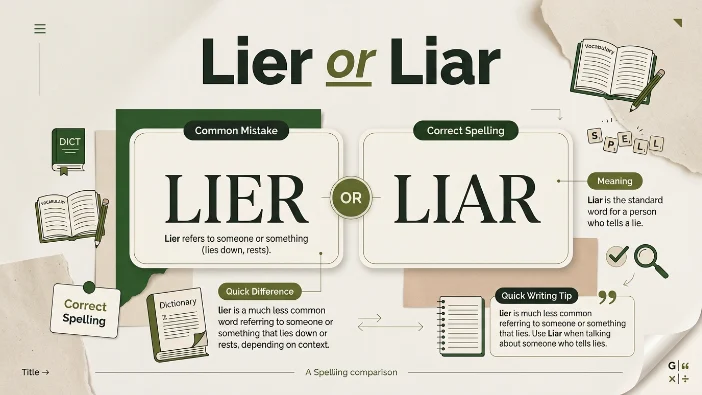
The correct term for someone who tells falsehoods is “liar,” not “lier.” “Liar” refers to a person who deliberately deceives others through untruthful statements. “Lier” is a rarely used word for someone or something that reclines or lies down. Most writers should use “liar” in everyday communication.
Have you ever paused mid-sentence, unsure whether to type “lier” or “liar” when describing someone who isn’t telling the truth? You’re not alone. This spelling confusion trips up countless English learners, students, and even experienced writers. The problem stems from both words sounding nearly identical in conversation, yet their meanings couldn’t be more different.
Here’s the straightforward reality: when you mean someone who tells untruths, you almost certainly want “liar.” The other spelling “lier” refers to someone who lies down, and you’ll rarely need it in everyday writing. By the time you finish this guide, you’ll understand exactly why these words get confused, how to use each correctly, and why choosing the right term can save you from embarrassing communication mistakes in emails, academic papers, and professional writing.
What’s the Difference Between Lier and Liar?
The core distinction between “lier” and “liar” lies entirely in their meanings, despite their identical pronunciation in most American English dialects. “Liar” is a noun describing someone who makes false statements with intent to deceive. “Lier” is an uncommon noun referring to a person or object that lies down or reclines.
Here’s a comparison table to clarify the differences:
| Aspect | Liar | Lier |
|---|---|---|
| Meaning | Someone who tells untruths | Someone or something that reclines or lies down |
| Part of Speech | Noun | Noun |
| Refers To | A person (always) | A person, animal, or thing |
| Typical Usage | Accusations, legal contexts, everyday conversation | Technical or uncommon descriptions |
| Example | “He is a liar who fabricated the report.” | “The weary lier rested on the bench.” |
| Common Confusion | Frequently misspelled as “lier” | Rarely used; often mistaken for “liar” |
These words belong to different semantic fields entirely. “Liar” connects to deception, honesty, and truthfulness. “Lier” relates to physical positioning and rest. The confusion arises purely from spelling and pronunciation similarity, not from any overlap in meaning.
Is Lier or Liar a Grammar, Vocabulary, or Usage Issue?
This distinction falls primarily under vocabulary and usage rather than strict grammar rules. Both words function as nouns, so the grammatical framework remains identical you’d use either word in the same sentence positions. The real challenge is vocabulary selection and word choice.
In formal English, using “lier” when you mean “liar” represents a vocabulary error rather than a grammatical mistake. The sentence structure would be correct, but the word choice would be wrong. This classification matters because it affects how you learn to avoid the error. Rather than studying complex grammar rules, you simply need to memorize which word corresponds to which meaning.
Business English, academic writing, and everyday conversation almost always require “liar” when discussing dishonesty. Lier” appears so infrequently that most professional writers never need it. In fact, style guides generally recommend avoiding “lier” altogether unless you have a specific technical reason to use it.
Here’s your practical takeaway: unless you’re writing about someone reclining (which happens rarely), choose “liar.” This simple rule covers 99% of real-world usage situations.
Liar: Meaning and Usage
The word “liar” has a straightforward definition that’s been stable for centuries. It refers to someone who tells lies, makes false statements, or deceives others intentionally. Unlike “lier,” this term always carries negative connotations and moral judgment.
Pronunciation: In American English, “liar” is pronounced as /ˈlaɪ.ɚ/, with two syllables. The first syllable sounds like “lie,” and the second is a soft “er” sound.
Part of Speech: “Liar” is a noun. It can function as the subject of a sentence, the object of a verb, or the object of a preposition.
Common Collocations:
- Pathological liar
- Compulsive liar
- Terrible liar
- Bad liar
- Known liar
Typical Sentence Patterns:
- [Subject] is a liar.
- [Subject] called [someone] a liar.
- I caught him lying; he’s a liar.
- She has a reputation as a liar.
Workplace Example
“The candidate claimed five years of experience, but his references revealed he had only six months. The hiring manager flagged him as a liar and withdrew the job offer.”
Academic Example
“Researchers found that participants who scored high on the personality assessment were more likely to exhibit behaviors consistent with a compulsive liar.”
Technology Example
“The software flagged suspicious activity patterns that a human liar would overlook, identifying deception through micro-expression analysis.”
Email Example
“To: Legal Team
Subject: Employee MisconductAfter reviewing the evidence, it appears the employee has been submitting falsified expense reports. I don’t use this word lightly, but we’re dealing with a liar who has cost the company thousands.”
Daily Conversation Example
“I should have trusted my gut instead of listening to him. He’s a liar, and I’m done making excuses for his behavior.”
Common Learner Mistake
Writers often misspell “liar” as “lyar” or “lier.” The correct spelling is always L-I-A-R. Remember that “liar” contains the same spelling as “lie” (the verb meaning to tell an untruth) plus “-ar.
Mini Recap: “Liar” means someone who tells untruths. It’s always spelled with an “a,” always refers to a person, and always carries negative connotations. You’ll use it far more frequently than “lier.”
Lier: Meaning and Usage
“Lier” is a noun that refers to someone or something that lies down, reclines, or remains in a resting position. This word is so uncommon that many native English speakers have never encountered it outside vocabulary lists or grammar guides.
Pronunciation: “Lier” is pronounced identically to “liar” in most American English dialects: /ˈlaɪ.ɚ/. This identical pronunciation is the primary source of confusion.
Part of Speech: “Lier” is a noun that functions grammatically the same way as “liar.” However, in modern usage, it’s considered archaic or technical.
Common Collocations:
- Patient lier (medical contexts)
- Habitual lier (rare)
- Resting lier (extremely rare)
Typical Sentence Patterns:
- The [subject] is a lier.
- A lier will often [description of reclining behavior].
Workplace Example
“After the injury, the employee became a lier on the office sofa during breaks, preferring to recline rather than socialize with coworkers.”
Academic Example
“The study examined the difference between active sitters and passive liers in nursing home populations.”
Technology Example
“The smart mattress tracks how often its user is a lier versus a sleeper, distinguishing between active rest and actual unconsciousness.”
Email Example
“To: Facilities Management
Subject: Break Room FurnitureWe’ve noticed employees using the new lounge chairs more frequently. The furniture is designed for comfort, but we’re finding some liers who stay too long during their breaks.”
Daily Conversation Example
“My cat is a dedicated lier she finds the sunniest spot in the room and stays there for hours without moving.”
Common Learner Mistake
Beginning writers sometimes use “lier” when they mean “liar” simply because they’ve heard the word pronounced and guessed at the spelling. Remember: the “lie” in “lier” means reclining, not untruth.
Mini Recap: “Lier” means someone who lies down. It’s rare, often archaic, and almost never appears in modern writing. If you’re not describing physical reclining, you need “liar.”
When Not to Use Each Word
Understanding when to avoid each word is just as important as knowing when to use them. Here are the most common situations where writers mistakenly choose the wrong term.
When to Avoid “Liar”
1. When describing someone resting or reclining
Mistake: “The exhausted runner was a liar on the grass.”
Why: You’re describing physical position, not deception.
Correct: “The exhausted runner was a lier on the grass.”
2. In technical or medical descriptions of positioning
Mistake: “The patient was instructed to remain a liar for the examination.”
Why: Medical staff won’t understand your meaning.
Correct: “The patient was instructed to remain lying down for the examination.” (Better to avoid “lier” entirely)
3. When writing in British English formal contexts
Mistake: “The solicitors determined the defendant was a liar.” (If you meant reclining)
Why: “Liar” carries legal implications of perjury.
Correct: Use phrasing that describes the reclining action without using either noun.
4. When meaning someone physically lies down repeatedly
Mistake: “She is a liar in her bed each morning.”
Why: This describes a habitual action, not a character trait.
Correct: “She lies in her bed each morning.”
When to Avoid “Lier”
1. In almost all modern writing (this covers 99% of cases)
Mistake: “The witness was a lier.”
Why: You likely mean someone told falsehoods.
Correct: “The witness was a liar.”
2. In business communication about trust or honesty
Mistake: “We need to address the lier in our finance department.”
Why: Your colleagues will be confused and may laugh.
Correct: “We need to address the liar in our finance department.”
3. In academic writing about ethics or psychology
Mistake: “Pathological liers often show specific behavioral patterns.”
Why: The condition is called pathological lying.
Correct: “Pathological liars often show specific behavioral patterns.”
4. In news reporting or journalism
Mistake: “The politician was exposed as a lier.”
Why: News media discusses deception, not physical reclining.
Correct: “The politician was exposed as a liar.”
5. When writing for general audiences
Mistake: Any use of “lier” in non-technical writing.
Why: Most readers won’t understand what you mean.
Correct: Use “someone who lies down” or “reclining” instead.
6. In any context where you’re uncertain
Mistake: Using “lier” when you’re unsure of the meaning.
Why: It’s safer to use more common phrasing.
Correct: Restructure your sentence to avoid needing either word.
Quick Memory Rule: If you’re describing someone telling falsehoods, always use “liar.” If you’re describing someone reclining, avoid both words and simply write “lying down.
Common Mistakes Table
| Correct Sentence | Incorrect Sentence | Explanation |
|---|---|---|
| “He’s a liar who faked his credentials.” | “He’s a lier who faked his credentials.” | The context involves deception, not physical reclining. |
| “The patient remained a lier on the examination table.” | “The patient remained a liar on the examination table.” | This describes physical position, not dishonest behavior. |
| “Her friends caught her being a liar.” | “Her friends caught her being a lier.” | “Caught her being” implies deceptive behavior, not reclining. |
| “The weary traveler was a lier on the park bench.” | “The weary traveler was a liar on the park bench.” | The traveler is resting, not telling untruths. |
| “I don’t trust him because he’s known as a liar.” | “I don’t trust him because he’s known as a lier.” | Trust issues relate to honesty, not physical position. |
Quick Decision Box
Choose “LIAR” when:
- You mean someone who tells falsehoods
- You’re discussing deception, trust, or honesty
- You’re writing in business, academic, or everyday contexts
Choose “LIER” when:
- You mean someone who physically lies down or reclines
- You’re writing technical or medical descriptions
- You’re absolutely certain (and then double-check)
When in doubt, choose “liar.” It’s correct in 99% of writing situations.
Real-World Examples
These practical examples show how both words appear in everyday communication. Note how rarely “lier” actually appears.
Office Communication
“The project manager called the consultant a liar after discovering the inflated performance metrics. The data didn’t match reality, and the consultant had fabricated results to justify his fees.”
Business Email
“Subject: Contract Termination
After reviewing the performance records, we’ve identified discrepancies that suggest we’ve been working with a liar. Mr. Chen misrepresented his team’s capabilities and deliverables.”
School or University
“The professor explained that calling another student a liar in academic writing would require substantial evidence. She emphasized that this accusation carries serious weight in scholarly discourse.”
Customer Support
“The customer accused the representative of being a liar, but the recorded conversation confirmed the representative had provided accurate information about the refund policy.”
Technology Context
“The AI system detected patterns that suggested the user might be a liar, but the engineers explained that the algorithm was designed to flag inconsistencies, not judge character.”
Daily Conversation
“I should have known he was a liar when he promised to finish the project in two days. Nobody can do that kind of work that quickly.”
Liar in Modern Technology
Technology has created new contexts where distinguishing between “liar” and “lier” matters. The rise of artificial intelligence, virtual assistants, and automated systems has introduced fresh examples of both words.
Artificial Intelligence: AI systems increasingly detect deception in text, video, and voice. The term “liar” appears in discussions about identifying false information, fake news, and deepfakes. Understanding which word to use matters when describing AI’s capabilities.
Virtual Assistants: Unlike “lier,” virtual assistants like Siri, Alexa, and Google Assistant have specific training to avoid deception. When a user asks “Are you a liar?” these systems must understand the word correctly to respond appropriately.
Chatbots: Customer service chatbots are programmed with truthful responses. A well-designed system explicitly avoids being a liar, while human users sometimes accuse them of deception when the system makes mistakes.
Software Tools: Some professional software helps detect false claims in resumes, legal documents, and journalistic sources. These tools identify liars by analyzing patterns across multiple data points.
Business Technology: Companies use analytics to determine if employees are lying about productivity. Automated systems can flag anomalies that suggest someone might be a liar, though human judgment remains essential.
Modern Communication: Email filters and spam detection systems aren’t liars, but they occasionally block legitimate messages. Users sometimes accuse these systems of being liars when they fail to deliver important emails.
Online Privacy: The distinction between “lier” and “liar” appears in privacy discussions where users worry about being labeled dishonest or deceptive in digital spaces.
Word Origin
Understanding where these words come from clarifies why they’re spelled differently despite sounding identical.
Liar comes from the Old English “leogere,” which derived from the verb “leogan” (to lie, tell falsehoods). This word has been in continuous use since before the Norman Conquest, remaining remarkably stable in meaning and spelling. The “-ar” suffix functions as an agent noun, similar to “beggar.”
Lier comes from the same Old English root but follows a different development path. It derived from “licgan” (to lie down), eventually forming “liggere” in Middle English before modernizing to “lier.”
The identical pronunciation developed because both words underwent similar sound changes during the Great Vowel Shift, though they maintained distinct spellings. This historical preservation of spelling helps differentiate these otherwise identical-sounding words.
Expert Insight
Here’s what experienced language instructors often tell students struggling with this distinction:
Many English learners focus on memorizing the spelling difference, but the real key is understanding when each word appears in actual language use. Think about the last time you needed to describe someone reclining probably never in a professional context. Now think about when you needed to describe someone dishonest likely much more frequently.
The practical approach is simpler than memorizing spelling rules: if you’re writing about deception, you want “liar.” For everything else, avoid “lier” entirely and describe the action instead. Most professional writers never use “lier” in their careers, and that’s completely fine. Focus your energy on remembering that “liar” has an “a” for “untruth” rather than “e” for “recline.”
Error Prevention Checklist
Before you publish your writing, run through these quick checks:
- Always use “liar” when discussing deception or dishonesty
- Always use “liar” when describing someone who tells untruths
- Use “lier” only when describing physical reclining (and double-check)
- Never confuse them if you mean a person’s character or behavior
- Restructure sentences to avoid “lier” when possible
Quick Memory Tip: Remember that “liar” has an “a” like “untruth,” while “lier” has an “e” like “reclining.” But honestly? Just remember to use “liar” for liars and avoid “lier” entirely.
Related Grammar Confusions
Here are similar word pairs that cause comparable confusion:
- Affect vs. Effect – Mastering this pair saves you from common grammar mistakes
- Accept vs. Except – These near-homophones frequently confuse writers
- Complement vs. Compliment – One completes, the other praises
- Stationary vs. Stationery – One stays still, the other involves paper
- Principle vs. Principal – Understanding this distinction improves academic writing
- Weather vs. Whether – These homophones require careful context analysis
- Your vs. You’re – This contraction confusion is among the most common errors
- Its vs. It’s – Mastering this apostrophe rule improves professional writing
- Then vs. Than – Understanding sequence versus comparison clarifies meaning
- Less vs. Fewer – This distinction demonstrates advanced grammar knowledge
FAQs
Is “lier” a real word?
Yes, “lier” is a legitimate English word that appears in dictionaries. However, it’s considered archaic and rarely used in modern writing. Most English speakers have never encountered it outside vocabulary discussions or grammar guides. Unless you’re writing technical descriptions of physical positioning, you’ll almost certainly use “liar” instead.
How do you spell “lier” or “liar”?
The correct spelling depends entirely on your meaning. “Liar” (spelled L-I-A-R) refers to someone who tells untruths. “Lier” (spelled L-I-E-R) refers to someone who physically lies down. Since 99% of writing contexts involve dishonesty rather than reclining, most writers should default to “liar.”
Is it “compulsive liar” or “compulsive lier”?
Always use “compulsive liar.” This is the recognized psychological term for someone who lies habitually. Compulsive lier” would describe someone who compulsively lies down, which isn’t a recognized term and doesn’t make sense in most contexts.
What’s the difference between “lier” and “liar”?
“Liar” means someone who tells falsehoods or deceives others. “Lier” means someone who reclines, lies down, or rests in a horizontal position. Despite identical pronunciation in most American English dialects, these words have completely different meanings and should never be used interchangeably.
Why do people confuse “lier” and “liar”?
The confusion stems primarily from identical pronunciation in everyday speech. When words sound the same, writers often guess the spelling based on limited exposure. Additionally, “liar” is a common word, while “lier” is rarely used, so many people assume “lier” must be the correct spelling simply because it looks like it should follow standard word formation patterns.
Conclusion
The distinction between “lier” and “liar” comes down to a simple but crucial difference in meaning. “Liar” refers to someone who tells falsehoods, appears in everyday language, and carries serious social consequences. “Lier” refers to someone who reclines or lies down, appears almost exclusively in technical or archaic contexts, and is rarely needed in modern writing.
Here’s the practical takeaway that will serve you well in every writing situation: unless you specifically need to describe someone physically lying down, always use “liar.” This rule covers business emails, academic papers, everyday conversations, and professional communications. The word “lier” isn’t wrong it’s just almost never necessary for most writers.
Remember the simple memory trick: “Liar” has an “a” for “untruth,” and “lier” has an “e” for “reclining.” But honestly, if you remember nothing else, remember this: choose “liar” 99% of the time, and you’ll make the right choice nearly every time.
1 thought on “Lier or Liar | Easy Way to Get This Word Right In 2026”