Quick Answer
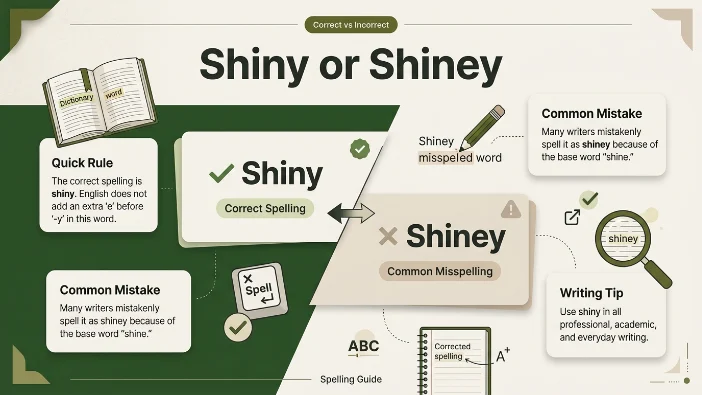
Shiny is the correct spelling in standard English. Shiney is a common misspelling that shows up in casual writing, product names, and social media, but it has no place in formal or professional English. If you’re describing something bright, polished, or gleaming, always write shiny.
You’re typing a product description, a caption, or a school essay, and your fingers pause right before that tricky word. Does a polished car look “shiny” or “shiney”? It’s a small moment, but it happens to thousands of writers every single day, and there’s a good reason for the hesitation.
English spelling doesn’t always follow a clean, predictable pattern. Some adjectives that end in a “y” sound keep that y (like funny or sunny), while others seem to invite an extra “e” that doesn’t belong. Shiny falls into that second trap. People see words like shine, whiney, or honey and assume the same “e” should carry over. It doesn’t, and using the wrong version in a resume, an email, or a published article can quietly chip away at your credibility as a writer.
This guide walks through exactly why shiny is correct, why shiney keeps appearing anyway, and how to make sure you never second-guess yourself again. By the end, you’ll understand the spelling rule behind it, see real examples from everyday writing, and have a simple trick to lock the correct form into memory for good.
Shiny vs Shiney: What’s the Difference?
There isn’t a difference in meaning between these two forms, because only one of them is a real word. Shiny is the standard, dictionary-recognized adjective. Shiney is a nonstandard spelling variant that never made it into accepted English usage, even though it appears frequently online.
Think of it less as “two words with different jobs” and more as “one correct word and one persistent typo.” That distinction matters because a lot of English learners assume both spellings are simply regional or stylistic choices, similar to color and colour. That’s not the case here. Shiney isn’t a British or Australian variant; it’s just an error that has spread through informal writing, brand names, and song titles until it started to feel familiar.
| Feature | Shiny | Shiney |
|---|---|---|
| Meaning | Bright, gleaming, polished | Same intended meaning, but not a recognized word |
| Part of Speech | Adjective | Not standard; treated as a misspelling |
| Dictionary Status | Listed in Oxford, Cambridge, Merriam-Webster | Not listed as standard English |
| Typical Usage | Formal and informal writing, business, academic | Informal typos, casual social posts, some brand names |
| Common Confusion | Assumed to need an “e” because of “shine” | Mistaken for a valid alternate spelling |
To recap: shiny is the adjective you want in every context, from a school paper to a marketing email. Shiney might show up in a friend’s text message or a quirky brand name, but it never earns a place in edited, professional writing. If you remember nothing else from this article, remember that one fact.
Is Shiny vs Shiney a Grammar, Vocabulary, or Spelling Issue?
This confusion sits squarely in the spelling category, not grammar or vocabulary. Both words, if shiney were real, would function identically as adjectives describing brightness or gleam. The issue isn’t how the word behaves in a sentence; it’s how the word is built.
English adjectives formed from a noun plus the suffix “-y” typically drop any silent “e” from the base word before adding the ending. Shine becomes shiny, the same way grime becomes grimy, and fame becomes famy… except that last one isn’t real, which shows the rule isn’t universal, only common. Still, shiny follows the standard pattern, and that pattern is worth trusting.
In formal English, business writing, and academic work, only shiny is acceptable. There’s no situation, not even casual conversation, where shiney is technically correct; it’s simply a spelling mistake that hasn’t been fully weeded out of internet writing yet. The practical takeaway: treat shiney the same way you’d treat “recieve” instead of “receive.” It’s an error worth catching, not a stylistic choice worth keeping.
Shiny: Meaning, Usage, and Examples
Shiny means bright, glossy, or reflecting light easily. It comes from the verb “shine” and works as a standard adjective before or after a noun.
Part of speech: Adjective Common collocations: shiny surface, shiny hair, shiny shoes, shiny new car, shiny coin
Workplace example: The presentation folder had a shiny finish that made it stand out on the conference table.
Academic example: The lab report noted that the metal sample retained a shiny surface even after exposure to moisture.
Technology example: Reviewers praised the phone’s shiny glass back, though some noted it attracted fingerprints easily.
Email example: “Just a heads up, the new packaging has a shiny coating, so please handle the samples carefully during shipping.”
Daily conversation example: “Look at that shiny motorcycle parked outside, it must be brand new.”
One learner mistake: Many learners write “shineyness” instead of “shininess” when forming the noun. Remember that the noun form also drops the silent e: shiny becomes shininess, not shineyness.
Mini recap: Shiny is the correct, dictionary-approved adjective for anything bright or glossy, and it keeps that spelling across every tense, tone, and context.
Shiney: Why It Keeps Showing Up
Shiney isn’t a recognized English word, but understanding why people write it helps explain the confusion and helps you avoid repeating it.
Part of speech: None; nonstandard spelling Where it appears: Casual texting, song and album titles, informal product names, handwritten notes, quick social media captions
Why the mistake happens: Writers often build adjectives by instinct rather than by rule. Since “shine” already contains an “e,” it feels natural to carry that letter into “shiney.” The same instinct causes similar errors with words like “whitey” versus the correct “whity,” though that comparison is rarely useful since so few “-y” adjectives actually keep the e.
Technology example: A product listing might read “shiney new features,” which signals to careful readers that the copy wasn’t proofread.
Email example: In an internal message, someone might type “the shiney packaging looks great,” unintentionally undermining the professionalism of the note.
One learner mistake: Non-native English speakers sometimes assume shiney is simply an alternate British spelling, similar to “colour” versus “color.” It is not; British and American English both use shiny.
Mini recap: Shiney survives mostly through repetition and familiarity rather than correctness. Recognizing it as an error, not a variant, is the first step to writing it out of your vocabulary for good.
When Not to Use “Shiney”
There is essentially no formal or professional context where shiney is acceptable. Here are the situations where writers most often slip up, and how to catch the mistake before it goes public.
In resumes and cover letters: A resume is judged on precision. Even one instance of shiney can suggest carelessness to a hiring manager, so always run a spelling check before sending.
In marketing copy: Product descriptions rely on trust. A shiney typo in an online store listing can make an otherwise polished brand feel unprofessional.
In academic papers: Instructors and professors expect standard spelling. Using shiney in an essay, even once, can cost points on grammar and mechanics.
In business emails: Clients and colleagues notice small errors more than we expect. A quick typo like shiney can distract from an otherwise strong message.
In social media captions for a brand account: Personal accounts can get away with playful misspellings, but brand accounts should stick to shiny to maintain credibility.
In children’s or educational writing: Textbooks, worksheets, and learning materials must model correct spelling, since young readers absorb what they see repeatedly.
In song titles or artistic branding: This is the one gray area. Some artists and brands intentionally use shiney as a stylistic choice, similar to using “boyz” instead of “boys.” It’s a deliberate creative decision, not a spelling error, but it should never be mistaken for standard English.
In legal or technical documents: Precision matters most here. Even minor spelling inconsistencies can raise questions about the document’s overall accuracy.
Common Mistakes Table
| Correct Sentence | Incorrect Sentence | Explanation |
|---|---|---|
| The countertop looked shiny after cleaning. | The countertop looked shiney after cleaning. | Shiny is the only standard spelling; shiney is a common typo. |
| Her shiny new sneakers caught everyone’s attention. | Her shiney new sneakers caught everyone’s attention. | The adjective form never keeps the “e” from “shine.” |
| The car’s shiny paint reflected the sunlight. | The car’s shiney paint reflected the sunlight. | Formal writing should avoid the nonstandard spelling entirely. |
| His shininess as a performer came from his energy, not his outfit. | His shineyness as a performer came from his energy, not his outfit. | The noun form is shininess, not shineyness. |
Quick Decision
If you’re writing anything formal, professional, academic, or intended for publication, use shiny.
If you’re referencing a stylized brand name or artistic title that intentionally uses the alternate spelling (like a specific song or product name), keep that spelling only when quoting the exact title, and use shiny everywhere else.
Shiny in Real World Situations
Office communication: A coworker sends a photo of new desk accessories with the caption, “These shiny nameplates just arrived, they’ll look great in the lobby.”
Business email: A supplier writes, “Please note the shiny finish option adds two business days to production time.”
School or university: A student’s lab report reads, “The shiny residue on the beaker suggested a chemical reaction had occurred.”
Customer support: A support agent replies, “I’m sorry to hear the shiny coating on your device scratched so quickly. Let’s look into a replacement.”
Technology: A tech reviewer writes, “The laptop’s shiny lid picks up fingerprints, but the display quality more than makes up for it.”
Artificial Intelligence: An AI-generated product description might say, “This shiny metallic finish gives the speaker a premium, modern look.”
Daily conversation: “I love how shiny the floor looks after you mopped it.”
Shiny in Modern Technology
Shiny appears constantly in tech writing, from product reviews to AI-generated marketing copy, and the spelling matters just as much in digital spaces as it does on paper.
Artificial Intelligence: AI writing tools and chatbots are trained on large volumes of edited text, so they almost always default to the correct spelling, shiny, unless a prompt specifically asks for a stylized alternative.
Virtual Assistants and Voice Assistants: When a voice assistant reads text aloud, spelling doesn’t affect pronunciation, but if that assistant is transcribing speech to text, it will output the standard spelling, shiny, since that’s what its language model recognizes as correct.
Chatbots: Customer service chatbots trained on professional writing samples will consistently generate shiny rather than shiney, reinforcing that the correct form is the industry standard.
Software and Business Tools: Grammar checkers built into word processors and email platforms will flag shiney as a spelling error, which is a useful, immediate way to confirm which version to use.
Word Origin
Shiny traces back to the Old English word “scinan,” meaning to give off light or gleam. Over centuries, that root evolved into the modern verb “shine,” and English speakers later added the “-y” suffix, a common pattern used to turn nouns and verbs into descriptive adjectives, similar to how “rain” becomes “rainy” or “luck” becomes “lucky.” When the “-y” suffix was added, the silent “e” from “shine” was dropped, following a spelling convention that applies to many similar words. Shiney never appears in this historical development; it’s a modern spelling drift rather than an older or alternate form.
Expert Insight
As a language instructor, I always tell students that the safest way to handle “-y” adjectives is to picture the base word without its silent e first. Shine minus the e, plus y, gives you shiny. This trick works for a surprising number of similar words, and it removes the guesswork that leads to errors like shiney. Once a student practices this pattern a few times, the correct spelling starts to feel automatic rather than something they have to consciously double check.
Error Prevention Checklist
- Always use shiny when describing something bright, polished, or reflective, in any writing context.
- Always use shininess for the noun form, never shineyness.
- Never confuse shiney with a regional or British spelling variant; it isn’t one.
- Quick memory tip: drop the “e” from “shine” before adding “y,” the same way “grime” becomes “grimy.”
Related Grammar Confusions Worth Learning
- Whiny vs Whiney: Follows the exact same pattern as shiny, since whiny drops the silent e from “whine.”
- Grey vs Gray: A genuine regional spelling difference, unlike shiny and shiney, which is worth understanding for comparison.
- Its vs It’s: A classic possessive versus contraction mix-up that trips up even experienced writers.
- Affect vs Effect: One of the most searched grammar confusions in English, useful for anyone polishing professional writing.
- Advice vs Advise: A noun and verb pair that sound similar but serve very different grammatical roles.
- Complement vs Compliment: Two words with nearly identical spelling but completely different meanings.
- Lose vs Loose: A frequent typo that changes the entire meaning of a sentence.
- Definitely vs Definately: Another common misspelling pattern, similar in spirit to shiny versus shiney.
- Judgment vs Judgement: A spelling variation based on American versus British English conventions.
- Rein vs Reign vs Rain: A homophone trio that consistently confuses even native speakers.
FAQs
Is shiney ever correct in British English?
No. The correct spelling is shiny in both British and American English. Shiney is not an accepted British variant and is simply a common spelling mistake.
Why does shine end with e, but shiny does not?
When the adjective-forming suffix -y is added, English often drops a silent e from the base word. That’s why shine becomes shiny. The same pattern appears in words like grime → grimy and haze → hazy.
Can shiney ever be used officially?
Only as a deliberate stylistic choice, such as in a brand name, song title, or creative project. In standard English, including academic, professional, and formal writing, shiney is always considered incorrect.
What is the noun form of shiny?
The noun is shininess, which refers to the quality or appearance of being shiny. Like shiny, it follows the same spelling rule and does not keep the silent e from shine.
Will spell checkers detect shiney?
In most cases, yes. Modern spell checkers and grammar tools usually identify shiney as a misspelling and recommend shiny instead. However, some messaging apps and informal platforms may not flag the error.
Is there a difference between shiny and glossy?
They are similar but not identical. Shiny is a general term for anything that reflects light, while glossy usually describes a smooth, polished surface with a noticeable sheen, such as coated paper, paint, or photographs.
Conclusion
The takeaway here is simple: shiny is correct, and shiney is a spelling mistake that has spread through informal writing rather than earned any real linguistic legitimacy. Whether you’re polishing a resume, writing a product description, or just want your emails to read cleanly, sticking with shiny keeps your writing accurate and professional.
A good rule to carry forward: drop the silent e from the base word before adding “y.” That one trick handles shiny, along with a whole family of similar English adjectives, and it will keep you from second-guessing this spelling ever again.
4 thoughts on “Shiny or Shiney | Avoid This Simple Spelling Error in English In 2026”